Garden planning tool
Plant spacing calculator: how many plants fit?
The short answer
Plant spacing is measured from the center of one mature plant to the center of the next. Enter your bed size and the mature spacing on the plant tag to get a first-pass plant count and simple layout.
Use the calculatorHow many plants fit?
Use one rectangular area and one plant variety at a time.
2 straight rows with 8 plants each. Plant centers are 18 in apart; the outer centers are at least 9 in from each edge.
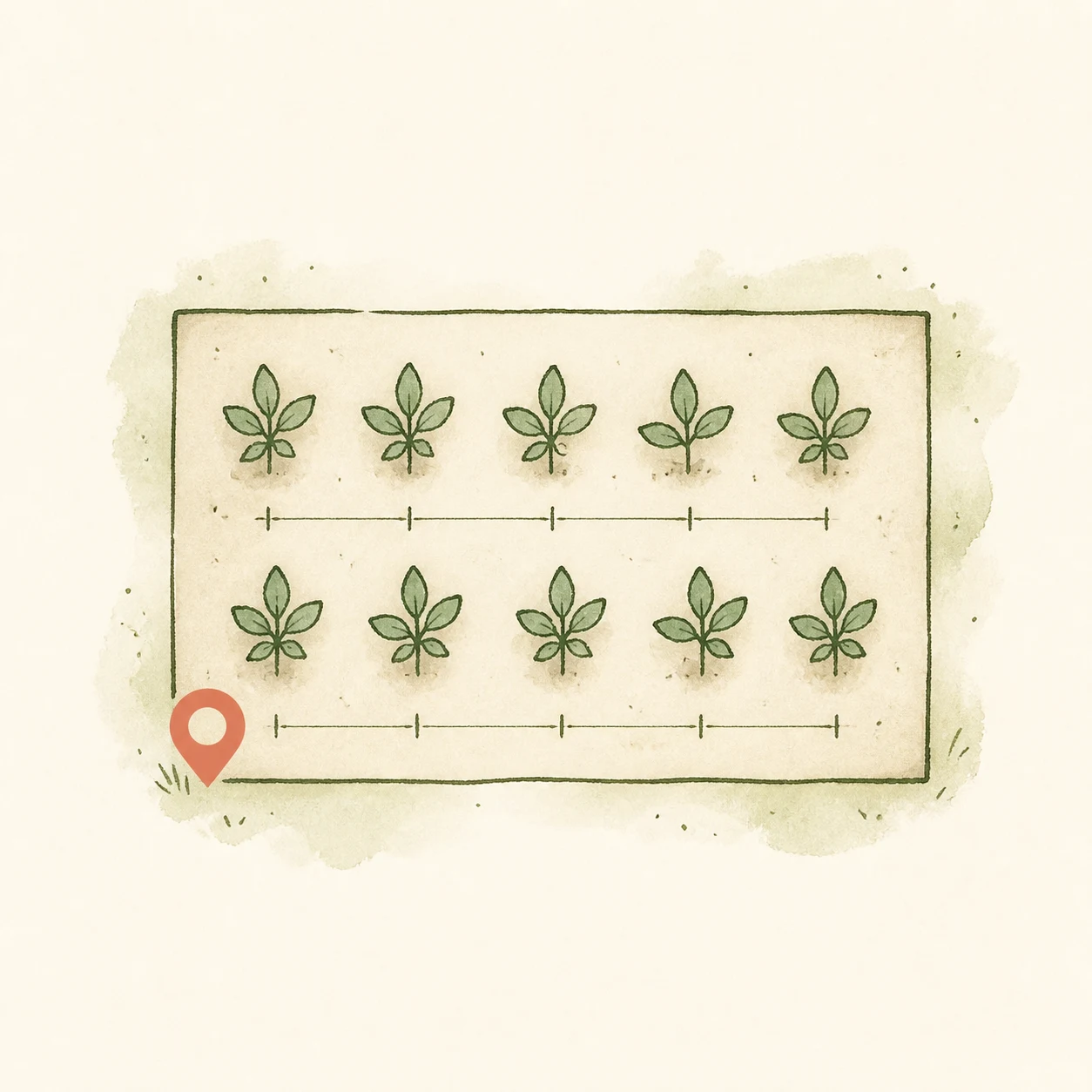
Layout preview
Center each pot on a marker.
Planting note
Estimate only. Check the plant tag and nearby obstacles before digging.
16 plants, 2 straight rows with 8 plants each. plant centers are 18 in apart; the outer centers are at least 9 in from each edge., with a 9 inch edge allowance.
For mixed beds, calculate each plant group separately.
Add this calculator to your site
Free for garden blogs and nursery sites. Keep the Gardenful credit link so readers can find the source.
<iframe
  src="https://gardenful.app/embed/plant-spacing-calculator"
  title="Plant Spacing Calculator by Gardenful"
  width="100%"
  height="1100"
  loading="lazy"
  style="border:1px solid #E7DFD0;border-radius:16px;max-width:900px;"
></iframe>
<p>Plant spacing calculator by <a href="https://gardenful.app/garden-design-guides/plant-spacing-calculator">Gardenful</a></p>Sources: University of Florida IFAS Extension
Plant spacing formula: calculate the centers, not just the area
Square footage is a useful sense check. Plant centers inside the measured bed produce the better buying estimate.
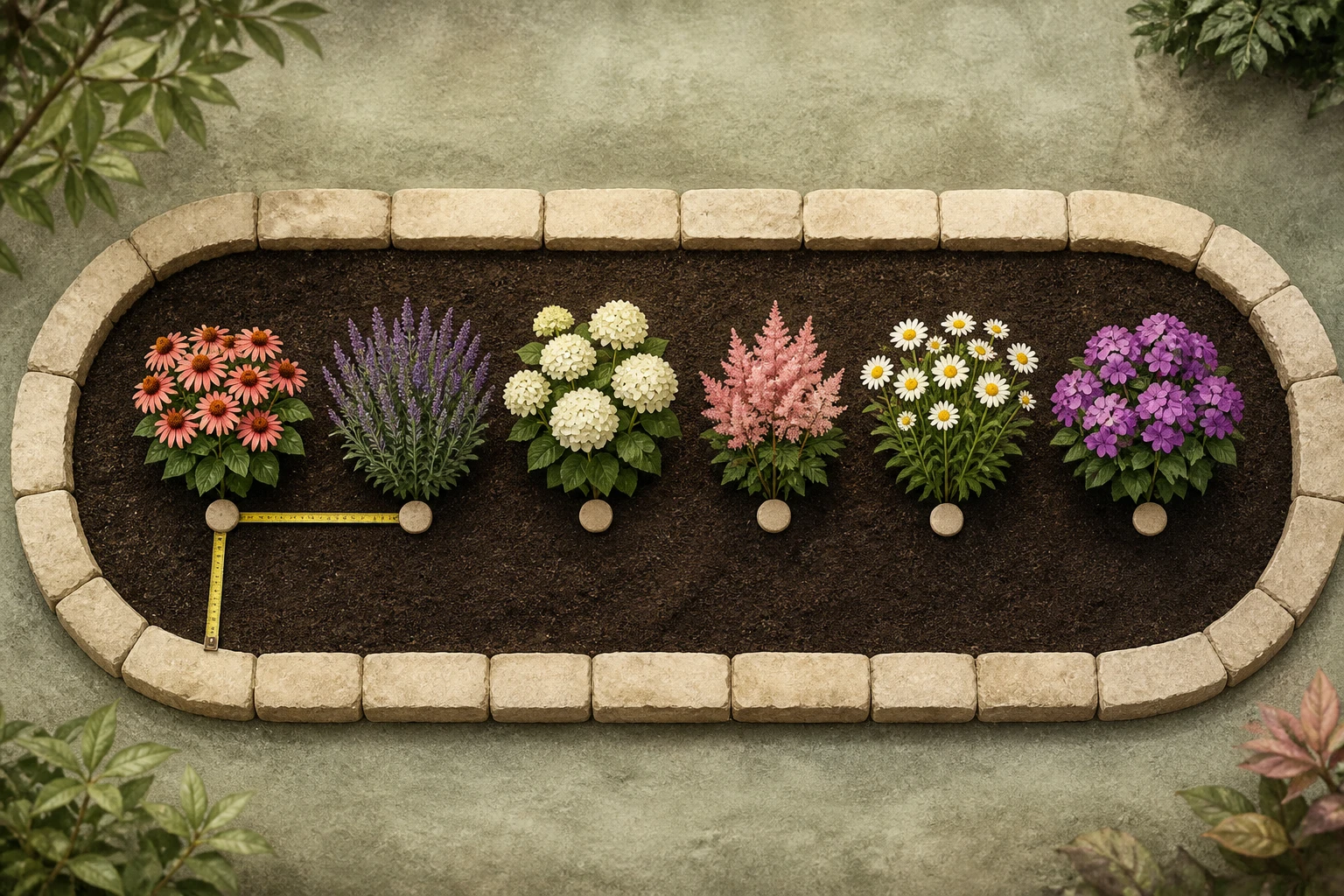
For one straight row, convert the run to inches, subtract the at both ends, divide the usable length by the mature on-center spacing, round down, then add one for the first center: plants in row = floor((run inches minus 2 times edge gap) divided by spacing) plus 1.1,2
For a rectangular bed, repeat the row calculation across the usable width. Offset rows sit about 0.866 times the selected spacing apart, and every other row starts half a spacing later. The row direction, curves, paths, utilities, existing plants, and mature shapes can all change the final count.1
For example, a 10-foot run is 120 inches. With a 12-inch edge gap at both ends and 18-inch spacing, the usable run is 96 inches: floor(96 ÷ 18) + 1 gives six plant centers. Sketch those six centers before buying; a curve, downspout, or existing shrub may still remove one.
A square-foot shortcut can overstate the count when the bed has a wide edge gap or awkward shape. Use it as a rough density check, then plot the actual centers and remove any point that conflicts with the real bed.
Use mature spacing, not the pot diameter
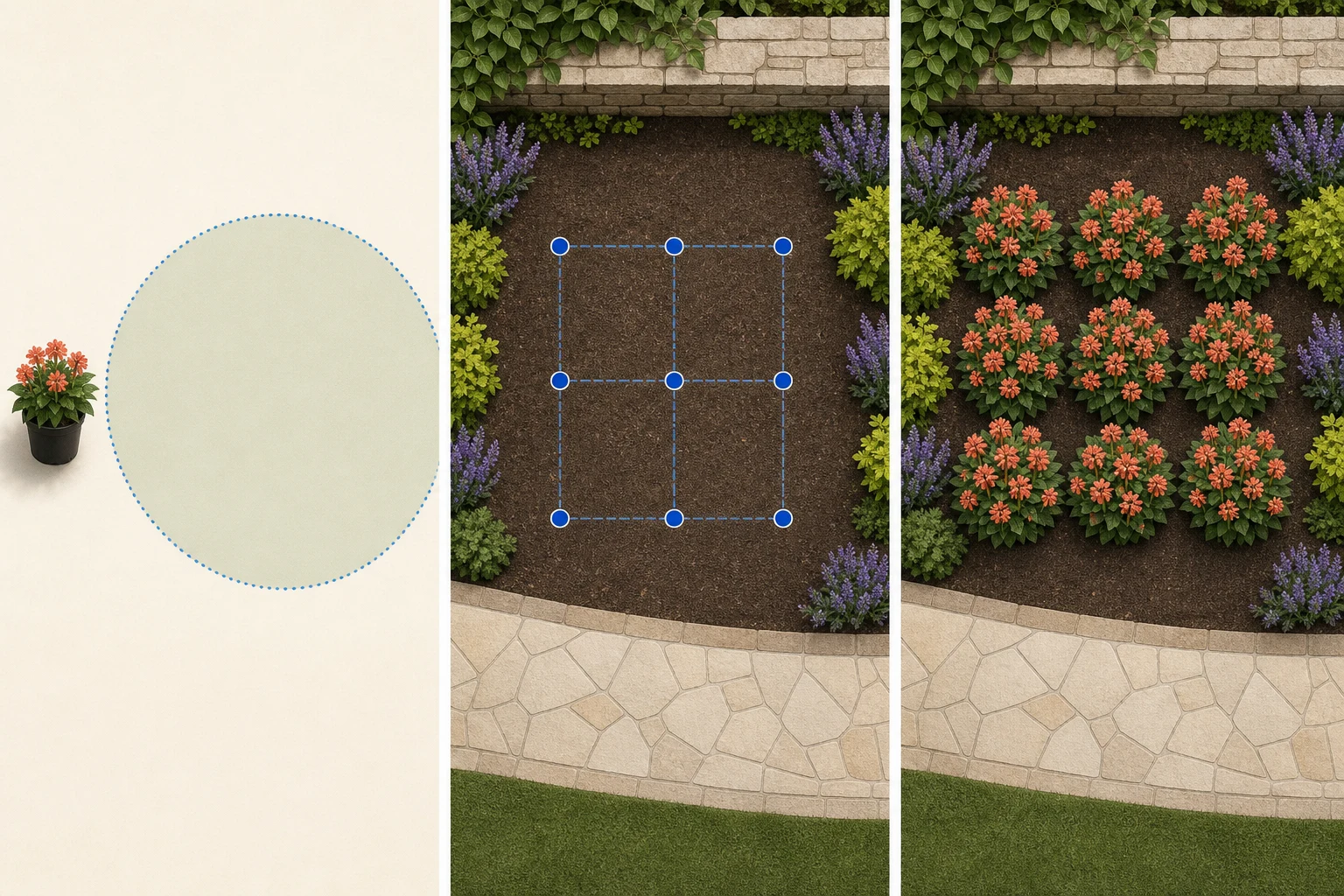
- 1. Ignore pot width
- 2. Place the centers
- 3. Leave room to mature
On-center spacing measures from the middle of one plant to the middle of the next. A plant sold in a small container may need several feet once mature, so use the exact species or variety's mature spacing rather than the pot width.1,2
The calculator removes the edge gap, places the first center, and adds centers at the selected spacing across each row. Then check the preview against the real bed: curves, paths, existing plants, and mature shape can still reduce or occasionally change the count.
Choose square or offset rows
The pattern changes the row gap and position of each plant center. It does not change the mature spacing requirement.
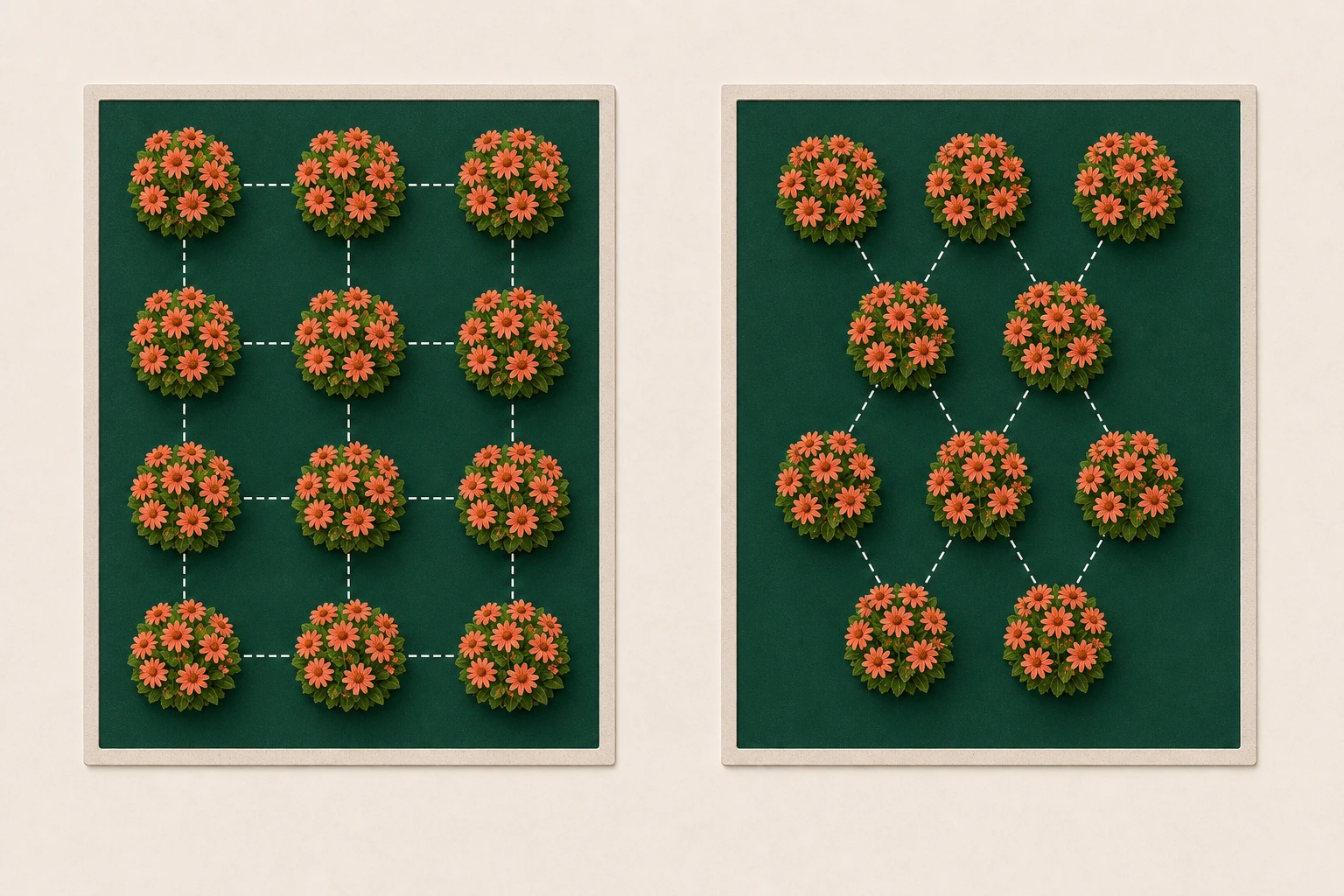
Square grid
- Works well for
- Straight rows, narrow beds, and layouts that need to align with paving or a building.
- Planning note
- The plants line up in both directions. Narrow beds can sometimes fit more straight rows because no row is shifted sideways.
Offset rows
- Works well for
- Broad masses and ground coverage where each row can sit between the plants in the previous row.
- Planning note
- Neighboring rows sit closer and every other row shifts by half the plant spacing. Bed shape and row direction still affect the final count.
A worked 12-by-4-foot example
Here the dimensions are useful because they drive the calculation. This is one measured perennial zone, not a claim that every good bed should be this size.
12 feet long, 4 feet wide, 18-inch spacing, 9-inch edge gap
After the edge gap is removed, the usable rectangle is about 10.5 feet by 2.5 feet, or 26.25 square feet.
See the plan notes
Remove the edge gap
A 9-inch gap on both sides leaves 10.5 feet along the bed and 2.5 feet across it for plant centers.
Place the centers row by row
At 18-inch spacing, eight centers fit along the 12-foot length. Two straight rows fit across the 4-foot width, producing 16 centers.
Draw the centers, then verify the plant
Check all 16 center points against paths, curves, utilities, or existing plants, and recalculate if the nursery substitute has a different mature spread.
The center layout creates a buying draft. Checking it against the real bed turns that draft into a plan.
Check the quantity before buying
A count becomes a shopping quantity only after the input, drawing, and exact plant agree.
- 1
Input
Exact plant
Mature spread for the named species or variety
- 2
Layout
Measured drawing
Usable bed area with obstacles removed
- 3
Order
Purchase quantity
A count that fits, recalculated for substitutions
Result
A quantity tied to the measured drawing
Recalculate when the exact plant or usable area changes.
What to verify before ordering
Confirm the input: Use mature spacing for the exact species or variety and calculate each shrub, flower, or edging zone separately.
Confirm the drawing: Remove paths, stones, utilities, root zones, and existing plants, then place every center on the measured sketch.
Confirm the purchase quantity: Recalculate any substitute with a different mature width, and phase one coherent area first when the site remains uncertain.
A precise calculator cannot rescue an imprecise bed measurement or the wrong mature spacing.
Frequently asked questions
How do I calculate how many plants fit in a flower bed?
Measure one rectangular plant mass, subtract the edge gap, then place centers at the mature on-center spacing across each row. Check those centers against curves and fixed obstacles before buying.
What does on-center plant spacing mean?
It is the distance from the center of one plant to the center of the next. It is not the gap between the edges of two nursery pots.
Are offset rows better than square rows?
Offset rows can create more even coverage in a broad mass. Square rows are easier to align with narrow beds and hardscape. Mature spacing and real bed constraints still control the final layout.
Should I round the plant count up or down?
Use the calculator's complete row count as a starting point, then remove any center that conflicts with a curve, path, utility, existing plant, or mature plant shape before buying.
Can I calculate plants per square foot?
An area-based formula can provide a rough density, but bed edges, row direction, curves, obstacles, and offset rows change the final count. Plotting plant centers inside the measured bed produces a more useful buying estimate.
 Gardenful
Turn the number into a plantable layout.
Use the calculator for a first quantity, then bring the measured bed, plant roles, and substitution rules into a complete Gardenful planting plan.
Gardenful for iPhone
Download the app free and start with a photo of your yard.

Sources
The calculator lays out geometric plant centers in a rectangle. The sources support mature-spacing and measured-plan principles, not a guaranteed final quantity.
- [1]Landscape Design: Drawing a Planting Plan
University of Florida IFAS Extensionhttps://ask.ifas.ufl.edu/publication/EP456
- [2]Landscape Design: Ten Important Things to Consider
University of Florida IFAS Extensionhttps://ask.ifas.ufl.edu/publication/ep375
- [3]Landscape Design: Aesthetic Characteristics of Plants
University of Florida IFAS Extensionhttps://ask.ifas.ufl.edu/publication/EP433