Gardenful field guide
What should I plant in my front yard?
The short answer
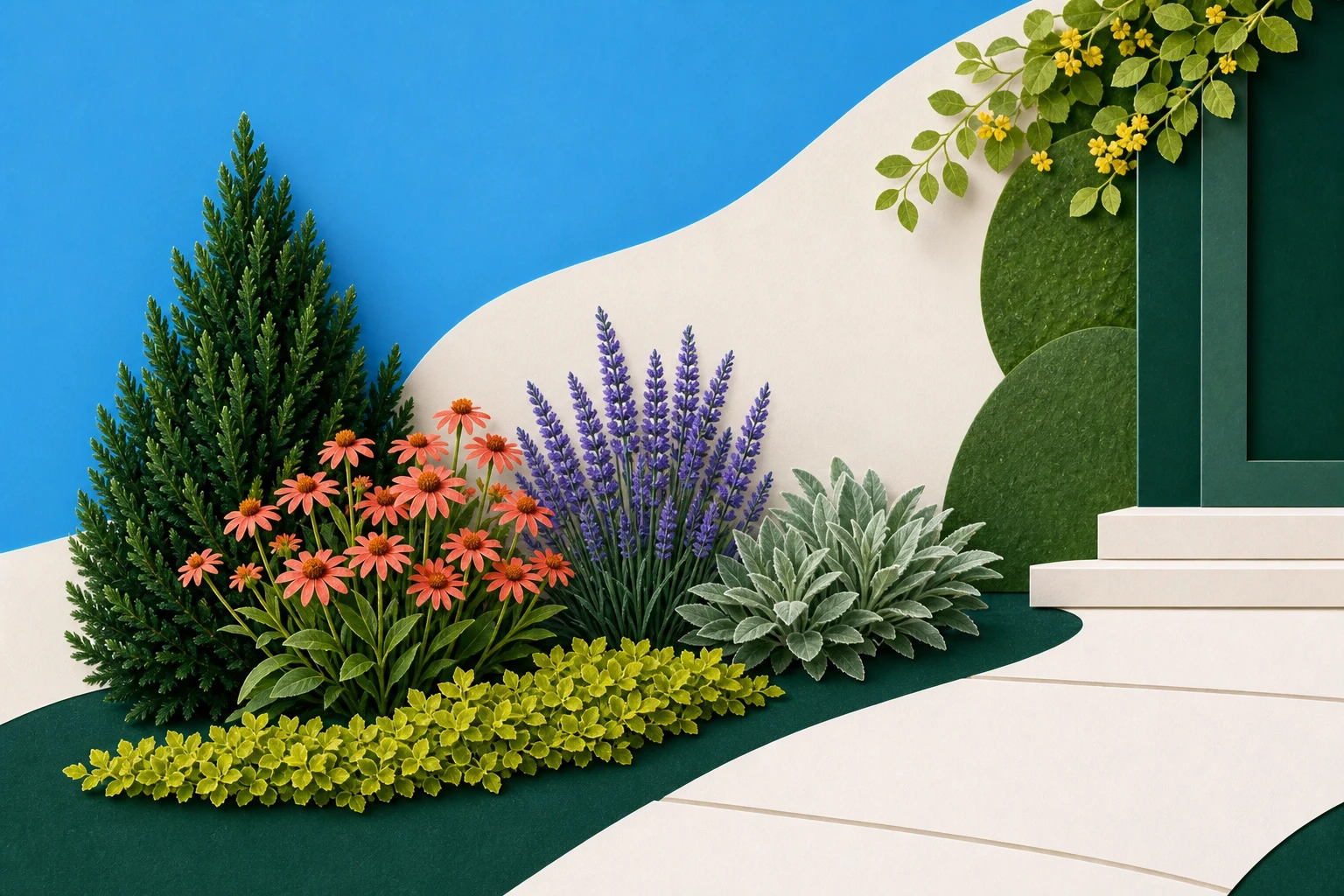
A front-yard planting looks coherent when a few plants do distinct jobs instead of every species competing for attention. Choose four roles: year-round structure, a repeated flowering plant, contrasting foliage, and a low edge. Then find local plants that fit the bed's sun, water, mature space, and upkeep.
Assess the bed before choosing plants
If your front bed is empty, patchy, or full of unrelated plants, do not begin with a longer shopping list. First record what the bed needs and what the site can support.
Stand at the curb and note which parts of the bed are still visible. Tiny flowers that look wonderful at arm's length often disappear from the street. A repeated patch of one flower, or one shrub with a clear outline, is easier to see.
Next, look at the bed when nothing is blooming. Flower color is temporary, but plant form, foliage, and the shape of a group last much longer. A front yard can use relatively few plant types and still look complete when those longer-lasting features work together.1a
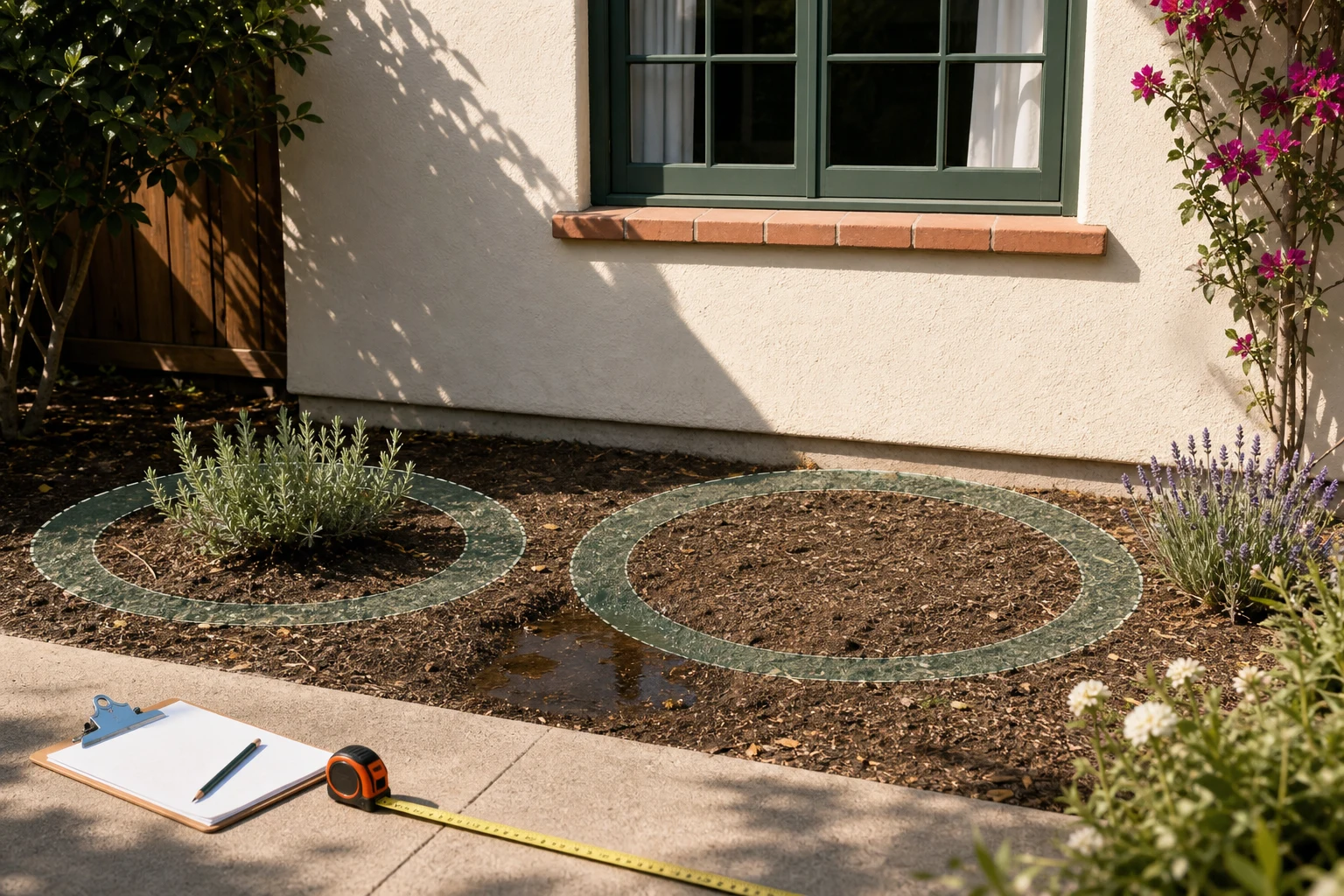
Before you save a single plant name, measure the bed and write down four facts: hours of direct sun, where water lingers or drains quickly, the height below windows, and the widest the bed can hold. Use those facts to remove plants that do not fit.2
Use four roles to build the plant list
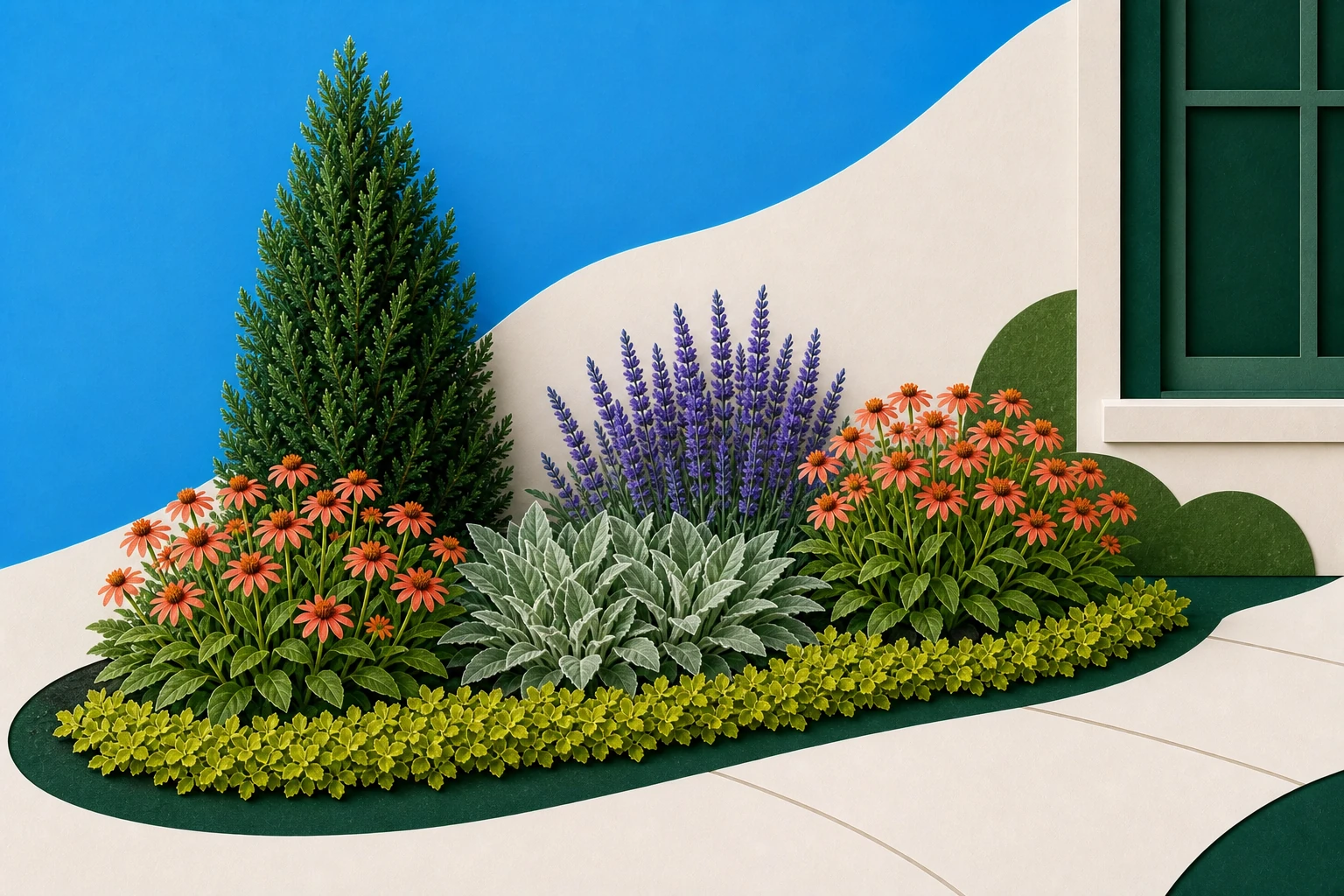
The roles are a design framework, not four mandatory species. A spreading evergreen might cover structure and edge, while one long-season flowering plant could provide both flower and foliage contrast.
Year-round structure
Choose one compact shrub or strong long-lived plant form that still looks purposeful outside peak bloom. Place it near a corner or entrance, but not directly below a window.
For example: Regional examples to investigate include inkberry holly in parts of the East, a compact manzanita in suitable Western climates, or coontie in South Florida. They are starting points for local research, not interchangeable national choices.
Repeated flower color
Pick one flowering plant that fits the site and repeat it in an uneven group, such as three plus two. The repeated plant makes the two groups look related.
For example: Depending on location and site, that might be aromatic aster, coneflower, California fuchsia, autumn sage, or beach sunflower. Check winter cold tolerance, water, and invasive guidance first.
Contrasting foliage
Add foliage that differs in leaf size, color, or outline. Silver, blue-green, burgundy, or broad leaves can keep the planting readable when the flowers are between seasons.
For example: Heuchera, lamb's ear, silver-leaved sages, ferns, and broadleaf evergreens can fill this role in different climates and exposures.
A low path edge
Use a low plant that can reach its mature width without swallowing the walk. A repeated edge hides bare gaps and makes the route to the door feel cared for.
For example: Creeping phlox, wild ginger, low sedum, frogfruit, or a compact heuchera may be worth researching where each is locally suitable.
One plant can cover two roles. For example, a compact evergreen may provide structure and cover soil at the edge, which lets you use fewer plant types.
Match plants to climate and sun
A national plant list is only useful if it helps you ask better local questions. Treat these as examples to verify with a regional extension office or knowledgeable nursery.
Cold-winter yard with full sun
Plants to investigate: Compact ninebark or inkberry for structure, coneflower or aromatic aster for a repeated flower, and creeping phlox at the edge.
What to verify: Snow load, winter salt, deer pressure, soil drainage, and whether the chosen variety truly stays below the windows.
Summer-dry Western bed
Plants to investigate: A locally suited manzanita or ceanothus, repeated salvia or California fuchsia, yarrow, and low native groundcover.
What to verify: Local fire guidance, soil drainage, summer irrigation, frost exposure, and the mature spread of woody natives.
Warm, humid front yard
Plants to investigate: Dwarf yaupon or coontie for structure, firebush or beach sunflower for color, and a locally appropriate broadleaf groundcover.
What to verify: Cold sensitivity, salt exposure, drainage, storm conditions, and current local invasive status.
Bright shade or morning sun
Plants to investigate: A shade-tolerant shrub, repeated woodland flowers, and foliage-led plants such as ferns or heuchera.
What to verify: Tree-root competition, dry shade, deer, and how much direct afternoon light reaches the bed in summer.
Search the exact plant and variety with your state or regional extension source. Common names alone can hide important differences in size and behavior.
Sources: University of California Agriculture and Natural Resources, University of Minnesota Extension, University of Florida IFAS Extension
Plan a 12-foot bed
This example applies the four roles to a measured bed. It is not a universal shopping list, and the counts must change when the exact plants have different mature spreads.
Sunny entry bed
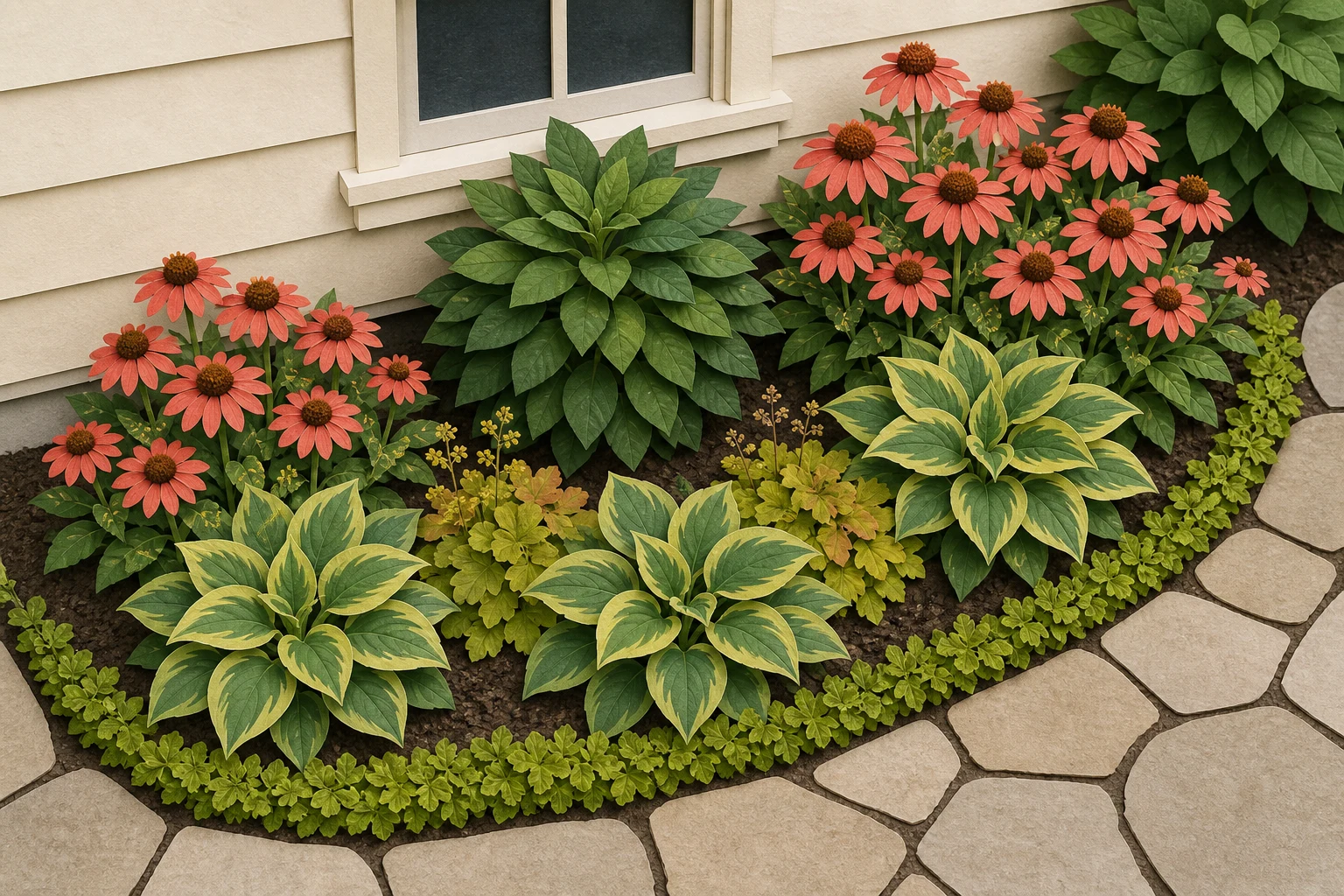
The bed is about 12 feet long. It sits below a window, borders the front walk, and has no existing shrub worth keeping. Its depth varies along the curve, so every count still depends on the mature spread of the chosen plant.
See the plan notes
One compact anchor
Place a naturally compact, roughly 3-foot structure plant off-center. Keep its mature canopy clear of the window, wall, and path.
Five matching flowering plants
Make one group of three and one group of two. Plants with an 18 to 24-inch mature spread can create visible patches without becoming a single crowded row.
Three foliage contrasts
Set these between the flowering groups. Repeat the same foliage plant so the bed does not become a collection of unrelated accents.
Seven low edge plants
Run them in a loose ribbon beside the path. Use the exact plant's mature spread to decide whether seven is sensible or whether five will close the edge just as well.
Sketch each plant at mature width. If the circles swallow the path, overlap the window zone, or leave no place to step into the bed, revise the count before you buy.
Take the plan to the nursery
The goal is not to defend a perfect online list. It is to keep the design intact when local availability changes.
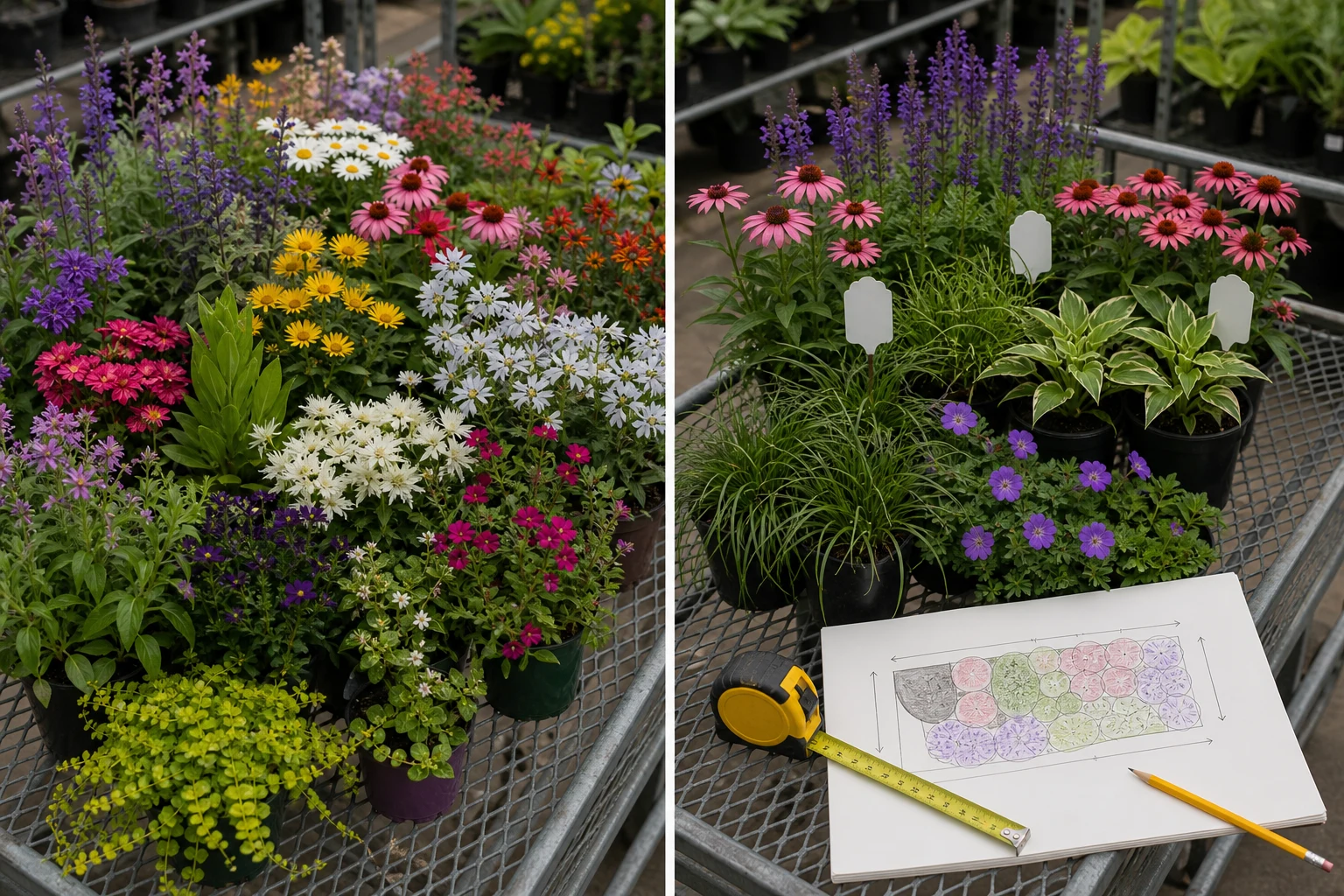
- Color-first cart
- Plan-first substitutions
- 1
Bring the site facts
Take the bed dimensions, several photos, and your notes on sun, drainage, and irrigation.
- 2
Read mature size before flower color
The container shows today's size, not the space the plant will eventually occupy.
- 3
Substitute by role and fit
Keep the same role, mature size, form, light, and water needs when the exact plant is unavailable.
- 4
Buy less when the fit is uncertain
Ask about local concerns and reduce the quantity if spacing or site fit is still unclear.
Do not substitute by flower color alone. A plant with the wrong mature size can turn a good palette into a permanent pruning job.
Frequently asked questions
How many different plants should I use in a small front yard?
Three to five plant types are often enough for a small bed if they cover the needed roles. Add another type only when it solves a real problem, such as shade beneath a shrub or an exposed gap along the path.
Should front yard plants match the house?
They do not need to be historically exact. Their size and arrangement should respect the architecture. Repeated shapes and a restrained palette can suit a formal facade, while looser drifts can soften a cottage or casual home.
Can I choose plants online without visiting a nursery?
You can build a strong shortlist online, but local availability and site fit still need checking. Bring your role list and measurements to a regional nursery or extension resource, then substitute by function and mature size rather than whatever happens to be flowering.
Is there an app that tells me what to plant in my front yard from a photo?
Gardenful works this way: photograph the front yard, mark the bed you want to change, and it suggests climate-aware plants for that spot with roles and quantities. Use the four-role palette in this guide to check the suggestions against your own sun, soil, and region before you buy.
 Gardenful
See how a short plant palette could fit your front yard.
Photograph the space, select the bed, and preview a planting layout before you turn the plant roles into a local nursery list.
Gardenful for iPhone
Download the app free and start with a photo of your yard.

Sources(5)and 1 note
Notes
- [a]If the bed only looks complete while flowers are open, add more structure or foliage that lasts beyond the bloom season.
Sources
- [1]Landscape Design with Plants: Creating Outdoor Rooms
University of Florida IFAS Extensionhttps://ask.ifas.ufl.edu/publication/EP449
- [2]The Florida Yards & Neighborhoods Handbook: Right Plant, Right Place
University of Florida IFAS Extensionhttps://ask.ifas.ufl.edu/publication/EP416
- [3]Shrubs and Perennials
University of California Agriculture and Natural Resourceshttps://ucanr.edu/site/landscape-lush/shrubs-and-perennials
- [4]Native Plants
University of Minnesota Extensionhttps://extension.umn.edu/find-plants/native-plants
- [5]Low-Maintenance Landscape Plants for South Florida
University of Florida IFAS Extensionhttps://ask.ifas.ufl.edu/publication/EP107