Gardenful style guide
How to design a cottage garden
The short answer
A cottage garden feels abundant because loose planting sits inside a clear, durable structure. Give the garden a simple permanent skeleton, keep one clear path, repeat a few anchor plants, and layer flowers by height and season. Allow selected plants to lean or self-seed without losing the route. Cottage style is planned informality, not a crowded collection of every flower you like.
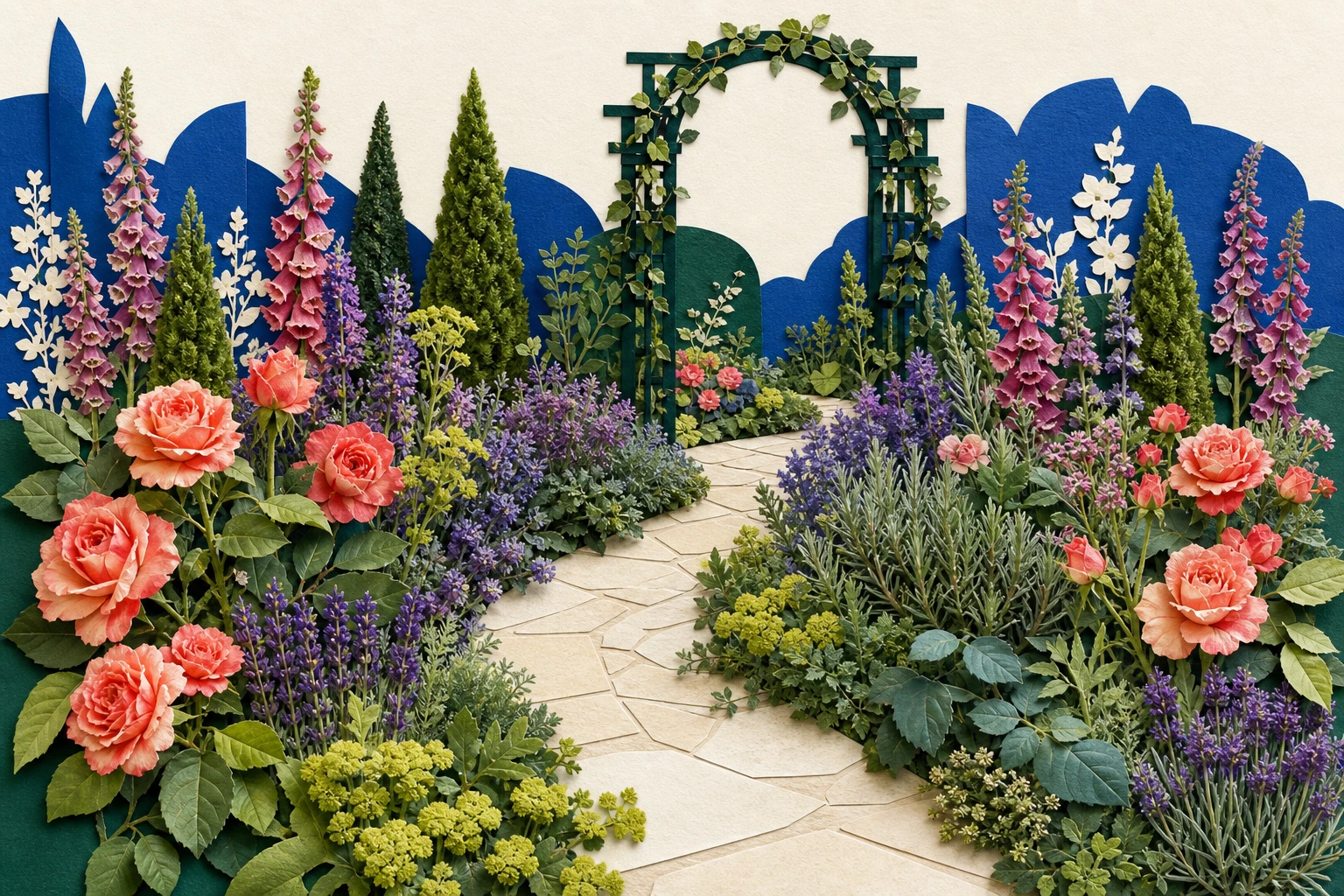
Draw the path before choosing the flowers
The path, edge, and a few permanent plants keep an informal border from turning into a maintenance trap.

Make the main route wide enough to use at summer peak. Decide where plants may soften the edge and where they must stay back for access. Then repeat a shrub or support where it reinforces the route outside bloom.
The RHS describes cottage planting as informal and flower-rich, yet its Wisley garden holds billowing plants inside a formal underlying plan. That tension between fixed structure and loose planting is the style's most useful lesson.2
Build four readable planting layers
Choose locally suitable plants for the role rather than copying a national cottage-garden list.

Permanent structure
Use a compact evergreen, small tree, or durable shrub that keeps the border legible outside peak flower.

Tall punctuation
Repeat a few upright flower spires or airy stems through the middle and back. Verify toxicity if pets or children have access.

Long flowering middle
Choose two or three plants that overlap in bloom and repeat them in uneven groups rather than singles.

Soft path edge
Use herbs, low flowers, or foliage that can lean slightly without hiding the walking surface or creating a trip hazard.
Roses, foxgloves, lavender, catmint, hardy geraniums, salvias, asters, and herbs are familiar style cues, but their climate, toxicity, disease, and invasive fit vary by region.
A cottage border beside a main path
This example uses repetition and season instead of a long plant list.
One climber, repeated anchors, and two flowering drifts
A sunny bed borders a main path. The back edge has a simple trellis and the front edge must stay passable.
See the plan notes
Place one climber on the support
Choose a locally appropriate climber and keep wall, fence, or trellis maintenance accessible.
Repeat structural anchors
Space one compact shrub or durable perennial at mature width in several positions so the border still reads outside bloom.
Make two flowering drifts
Size two uneven groups from each plant's mature spread. The visible masses matter more than an invented plant count.
Thread one vertical accent through the bed
Repeat the same upright form instead of adding several unrelated spikes.
Leave small editing gaps. A cottage garden needs room for self-seeders, division, and the plants you learn deserve a larger role.
Check the border outside its best week
A summer photograph can hide nine months of bare soil, staking, and cleanup.
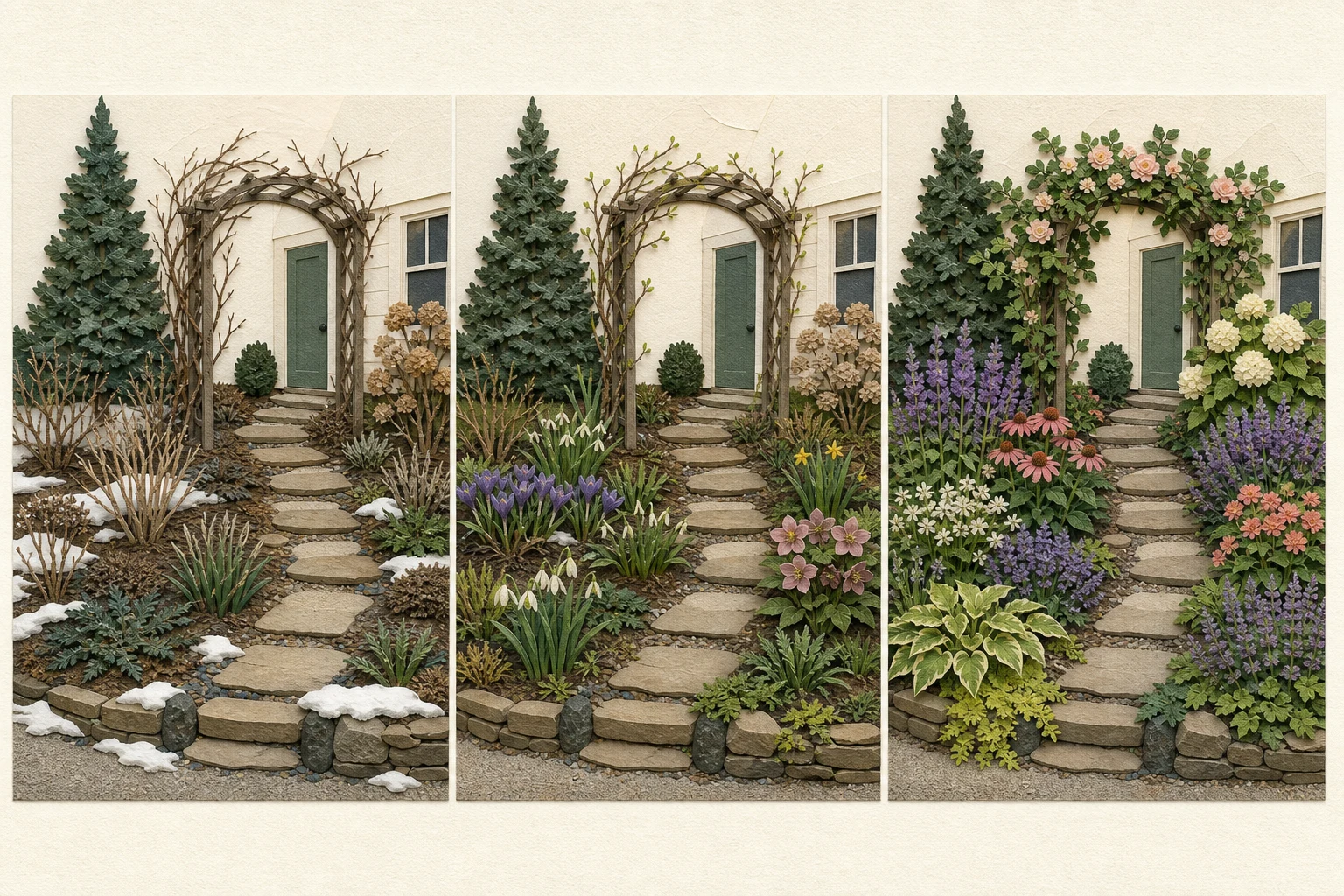
- 1. Winter structure
- 2. Early spring
- 3. Summer peak
Off-season structure: Mark what will hold the border together in winter or the dry season.
Overlapping bloom windows: Let groups hand off to one another instead of expecting every plant to flower continuously.
A path that survives weather: Keep the route visible at mature spread and after rain bends stems.
A realistic care rhythm: Plan only the supports, division, deadheading, and self-seed editing you will maintain.
Verified local fit: Check regional suitability, invasive status, disease pressure, toxicity, and water needs before buying.
The style should look generous at peak and still make sense when only foliage and structure remain.
Frequently asked questions
What makes a garden a cottage garden?
A cottage garden combines an informal, flower-rich planting with a clear underlying route and repeated structure. The plants may lean and self-seed, but the path and main masses remain readable.
Can a cottage garden be low maintenance?
It can be lower maintenance when the palette is small and site-suited, but the style often involves editing self-seeders, supporting stems, dividing perennials, and managing path edges. Choose the level of looseness you will maintain.
Is an English cottage garden different from a cottage garden?
English cottage gardens are the historic source of the style, often combining useful and ornamental plants in informal abundance. A modern cottage garden can adapt that lesson to another climate or architecture while keeping the essential balance of clear structure, repeated plants, and generous seasonal overlap.
What plants belong in a cottage garden?
Roses, lavender, catmint, hardy geraniums, salvias, asters, herbs, and upright flower spires are familiar cues. Treat them as roles and verify climate, light, soil, toxicity, disease, and invasive status locally.
Can I make a cottage garden in a small front yard?
Yes. Keep one clear route, use a smaller repeated palette, and reserve the loosest planting for one or two beds rather than filling every edge.
 Gardenful
Give the flowers a structure to grow into.
Start with your yard photo, protect the path, and test a cottage planting direction before choosing the regional plants.
Gardenful for iPhone
Download the app free and start with a photo of your yard.

Sources(3)
- [1]Cottage Garden Plants
Royal Horticultural Societyhttps://www.rhs.org.uk/garden-design/design-with-plants/cottage-garden-plants
- [2]Wisley's Cottage Garden
Royal Horticultural Societyhttps://www.rhs.org.uk/gardens/wisley/garden-highlights/the-cottage-garden
- [3]Landscape Design: Arranging Plants
University of Florida IFAS Extensionhttps://ask.ifas.ufl.edu/publication/EP449