Gardenful style guide
How to design a Japanese-inspired garden
The short answer
A Japanese-inspired garden is composed through movement, partial views, asymmetry, and restraint rather than themed objects. Bend the path so the whole garden is not visible at once, frame one view, balance planted groups unevenly, and leave quiet space around a few carefully placed plants and stones.
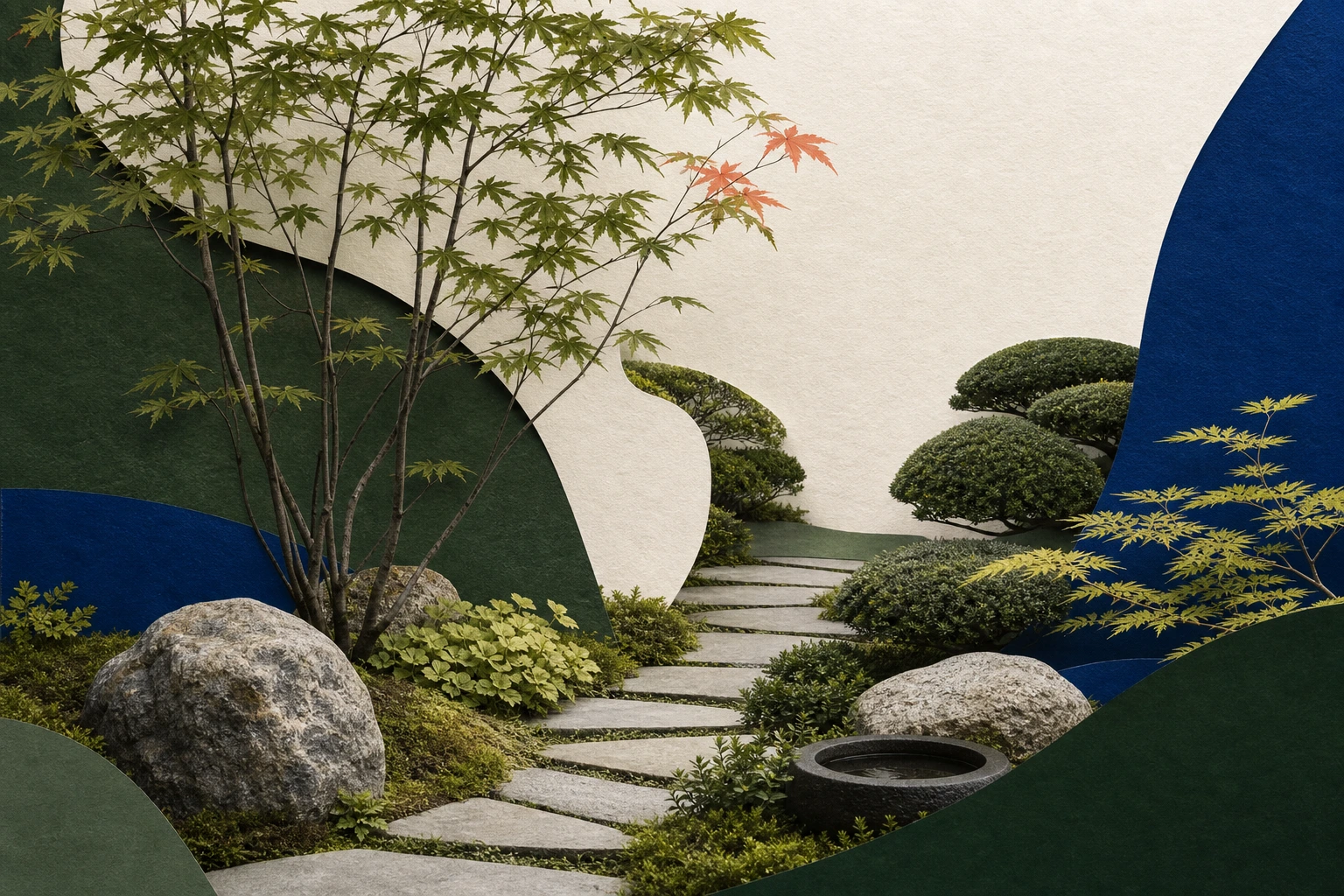
Design what appears around the bend
A Japanese garden is experienced in sequence. Even a small yard can use a partial view to create depth.
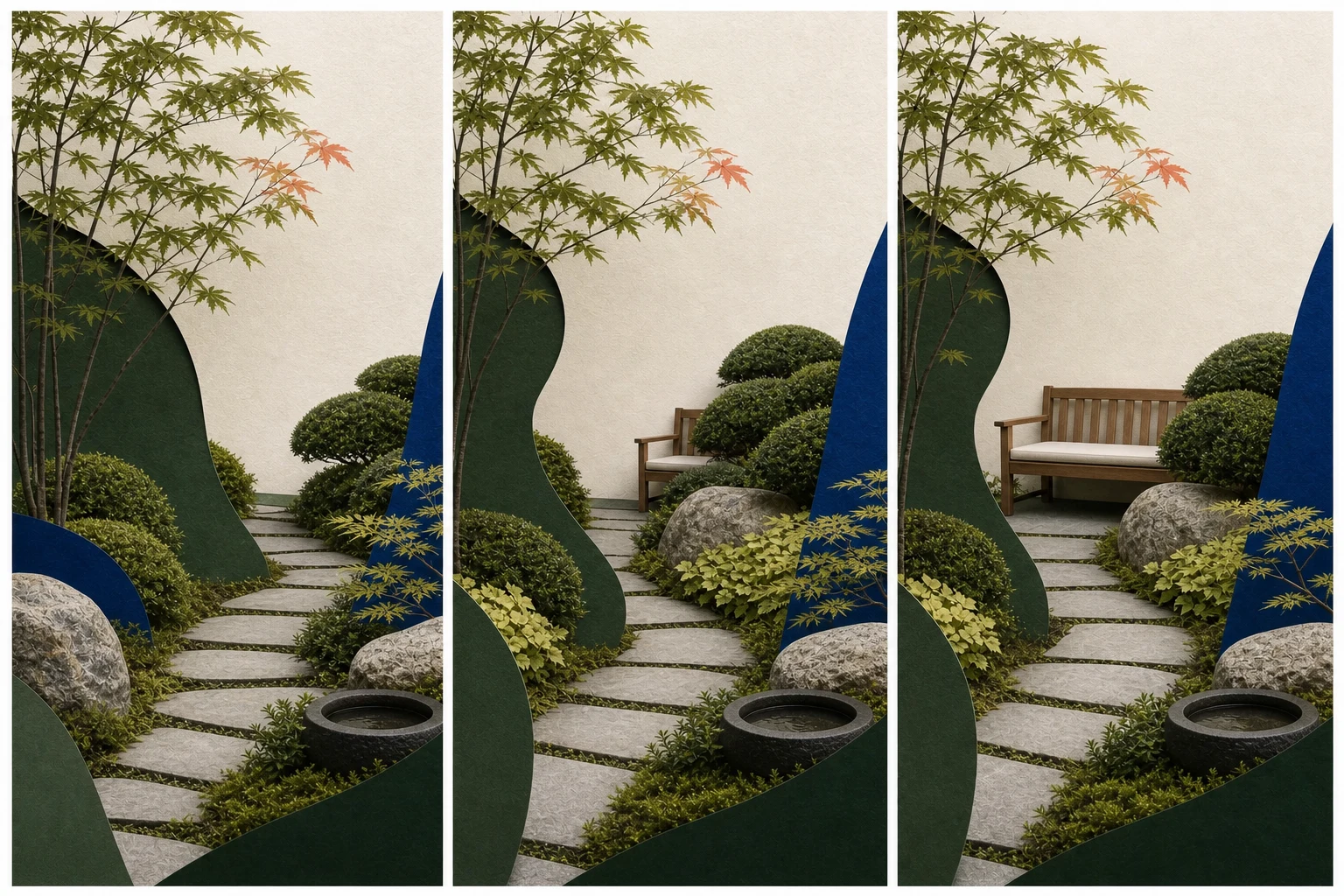
- 1. Destination hidden
- 2. Partly revealed
- 3. Fully framed
Stand at the entrance, choose the first clear element, and decide what should remain hidden. Then move to the next stopping point and shape that view before choosing individual plants or ornaments.
Portland Japanese Garden describes miegakure, or hide and reveal, as a design in which the whole landscape is not visible from one fixed place. Paths loop and bend so changing viewpoints become part of the experience.1
Use four principles before choosing an ornament
These are design translations for a home garden, not a claim to reproduce a historic Japanese garden.
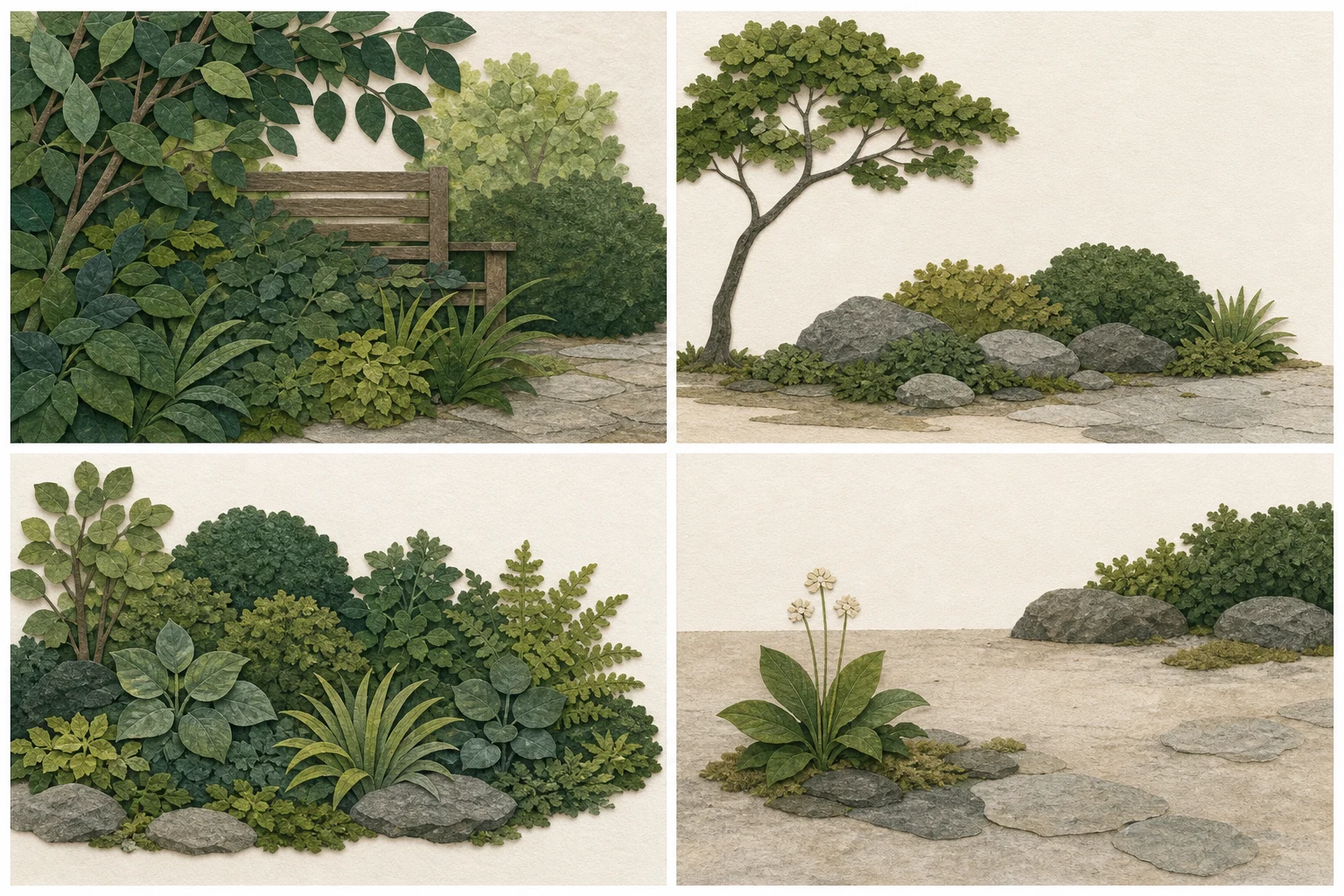
Partial views
Overlap plants or turn the route so the garden arrives in a sequence rather than one panorama.
Asymmetrical balance
Balance one large tree or stone group with a lower, wider mass instead of mirroring both sides.
Edited plant palette
Use a few foliage shapes and repeat them. Seasonal color should feel concentrated, not evenly sprinkled.
Useful empty space
Leave gravel, moss-like groundcover, water, or simple open ground around a focal element so it has visual weight.
A Japanese maple, moss, azalea, or pine may be unsuitable for your climate or site. Preserve the role with a locally adapted plant of similar form.
A narrow side-yard corner with two views
This example creates a layered view without copying a temple or tea garden.
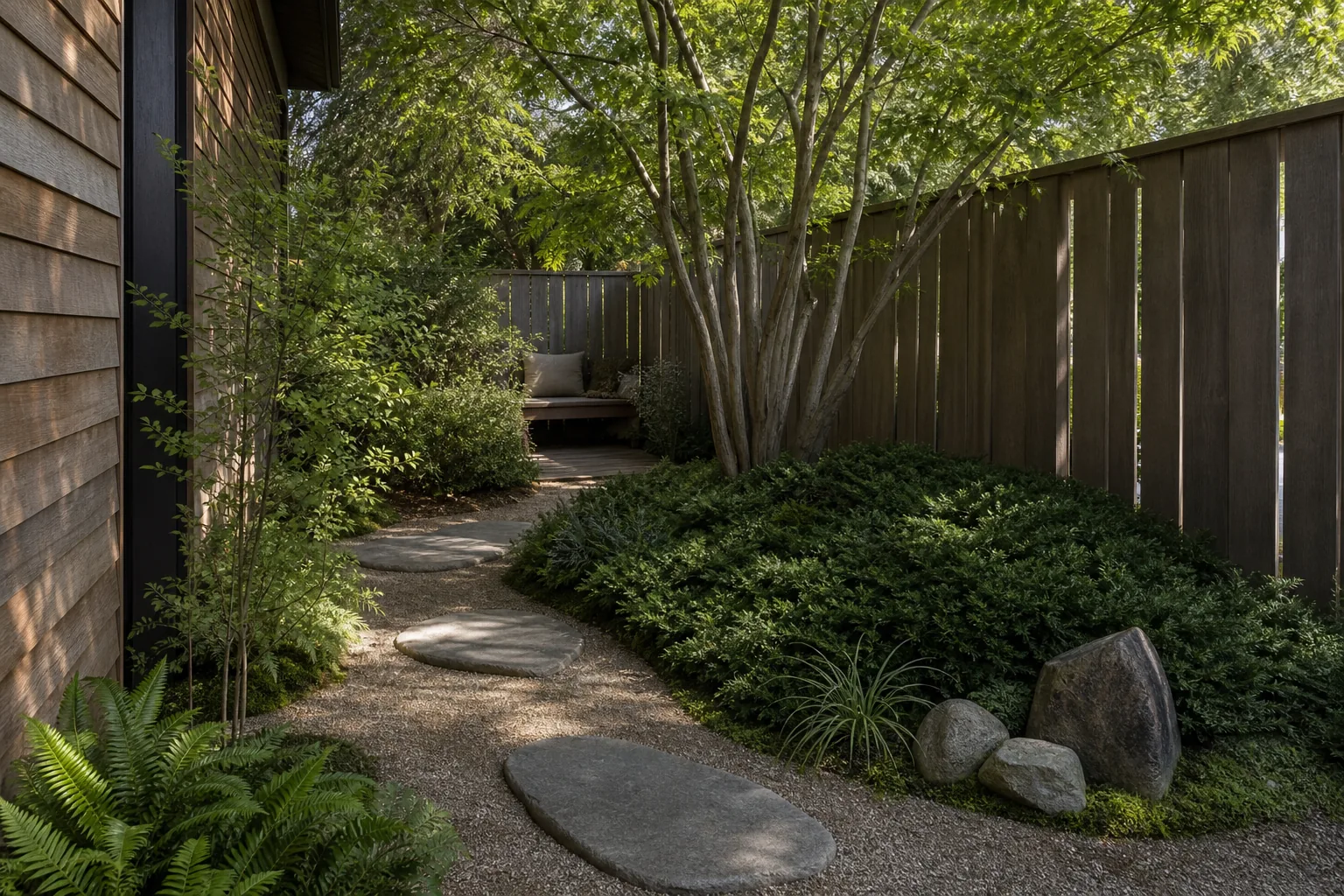
Two views and five material decisions
A narrow side yard connects the front walk to a quiet bench. The existing fence is visible from both ends.
See the plan notes
Turn the stepping route once
Offset the path around a planting mass so the bench does not appear from the entrance.
Place one multi-stem tree
Use it to filter the fence and frame the second view, with mature roots and canopy verified for the space.
Balance with a low evergreen mass
Keep it broad and below eye level so it anchors the tree without forming a matching pair.
Repeat one ground plane
Use one locally appropriate groundcover or permeable mineral surface, plus two or three stones placed as one group.
Remove one object from the first draft. The remaining elements should make the route and framed view clearer.
Keep the design respectful, maintainable, and local
Use cultural sources for the principles and regional sources for the plants and construction.
Understand a feature's context: Learn its meaning before using it as decoration.
Avoid a stack of symbols: Pagodas, torii gates, red bridges, lanterns, and statues are not shorthand for a culture.
Use local plants by role: Match form, texture, and seasonal effect instead of insisting on Japanese species.
Plan the real upkeep: Check moss, water, gravel, stone, and pruning against the climate and your care level.
Bring in qualified help: Use local expertise for ponds, electrical work, structures, grading, and drainage.
A restrained garden is not maintenance-free. Pruning, path edges, leaf cleanup, and surface care are part of the result.
Frequently asked questions
What are the main ideas in a Japanese-inspired garden?
Movement, partial views, asymmetrical balance, a restrained palette, and purposeful open space are useful starting principles. The garden should change as you move through it.
Do I need Japanese plants?
No. Choose locally adapted plants that fill the needed forms: a layered small tree, low evergreen mass, groundcover, and restrained seasonal accent.
Is a Zen garden the same as a Japanese garden?
No. Japanese gardens include many traditions and settings; dry gardens associated with Zen temples are one specific context, not a synonym for the whole subject. For a home garden, learn from movement, composition, restraint, and cultural sources rather than treating gravel and rocks as a generic theme.
How can I avoid making the garden look themed?
Start with the path and views, use fewer materials, and avoid collecting decorative symbols. Learn from Japanese cultural institutions before adding a feature with specific meaning.
Can this style work in a small yard?
Yes. A single turn in the path, one partially concealed destination, and an asymmetrical tree-shrub composition can create the sequence without needing a large garden.
 Gardenful
Design the next view, not a collection of symbols.
Start with the path through your real yard, then test a layered planting direction that reveals the space gradually.
Gardenful for iPhone
Download the app free and start with a photo of your yard.

Sources(3)
- [1]
- [2]
- [3]Landscape Design: Ten Important Things to Consider
University of Florida IFAS Extensionhttps://ask.ifas.ufl.edu/publication/EP375