Gardenful style guide
How to design a modern garden
The short answer
A modern garden feels calm because its geometry, materials, and plant forms are deliberately limited. Choose one organizing geometry, repeat a small number of plant forms, and leave deliberate open space. Modern does not require a bare concrete yard. One structural tree, a repeated evergreen mass, and a broad ribbon of softer planting can make clean lines feel calm instead of sterile.
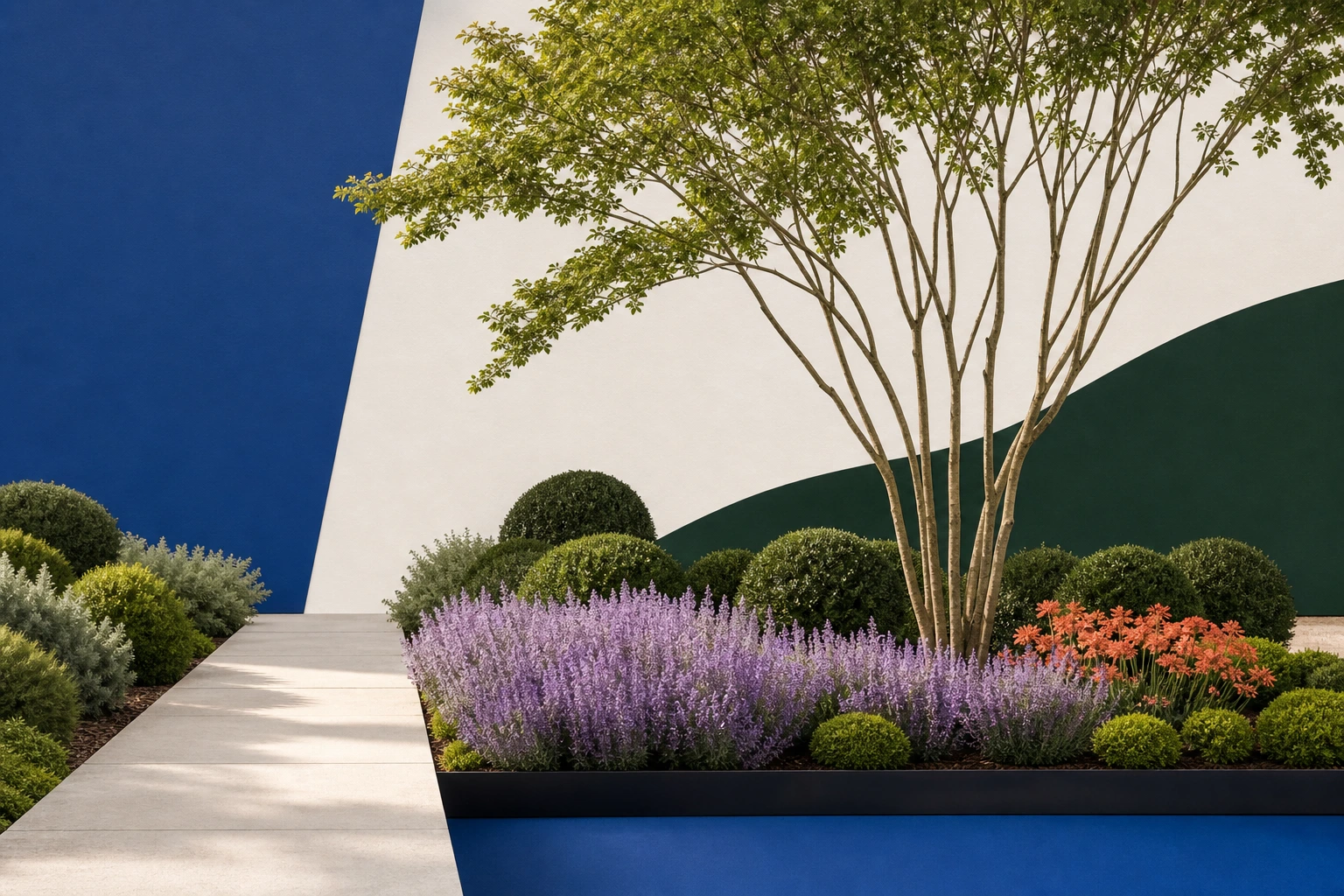
Let one geometry organize the whole space
Start with the house, doors, and routes. The cleanest line is usually already present in the architecture.
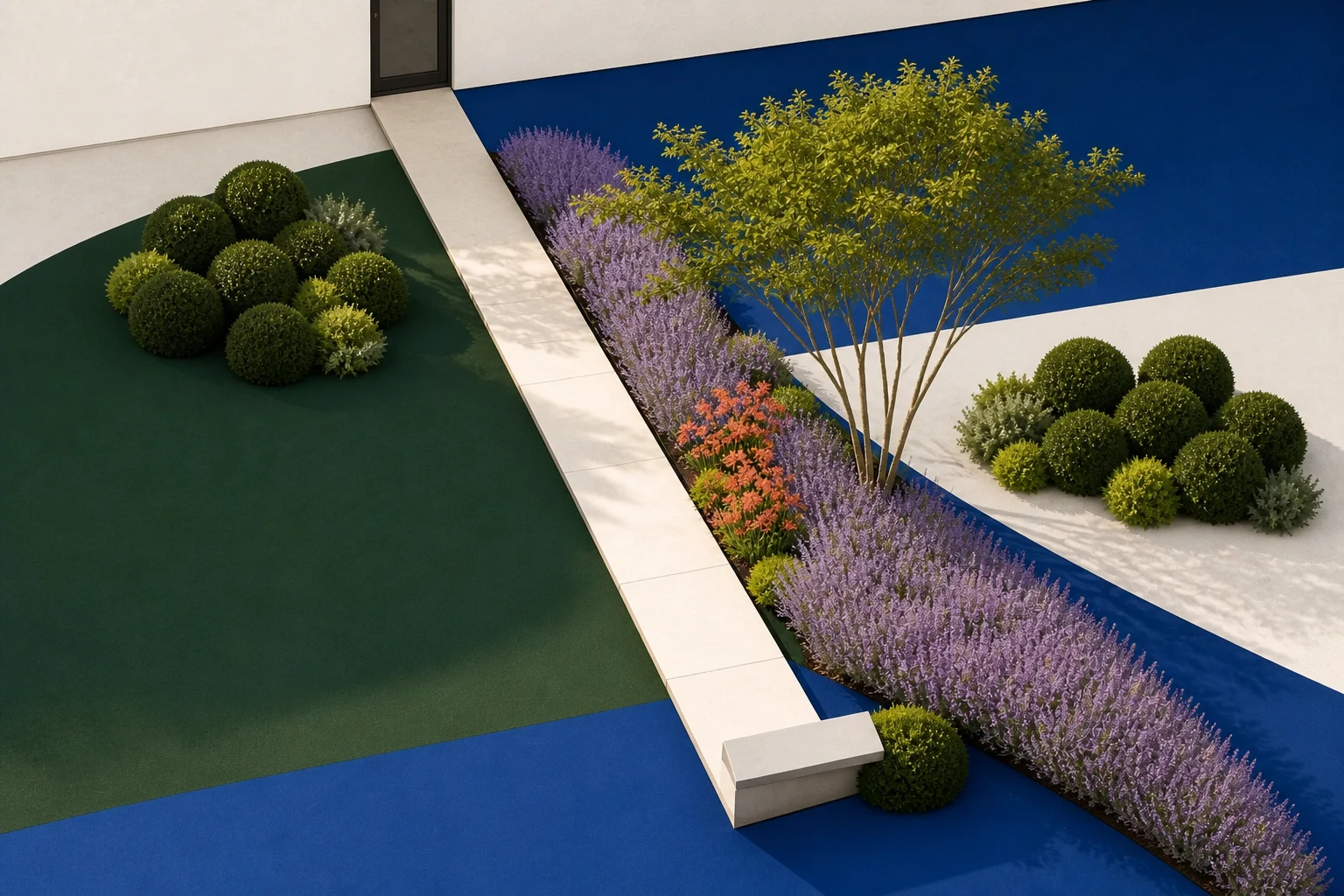
Extend an edge from a door, window, patio, or path, then use it to align the main route and strongest bed edge. A second geometry may contrast with it, but every feature does not need its own angle.
The RHS describes modern gardens through clean lines, uncluttered space, and strong structure softened by lush planting. A multi-stem tree and broad perennial mass can provide living texture without weakening the geometry.1
Choose which kind of modern you mean
Modern is not one fixed plant cast. Choose how much geometry, warmth, and living texture the space needs before selecting plants.
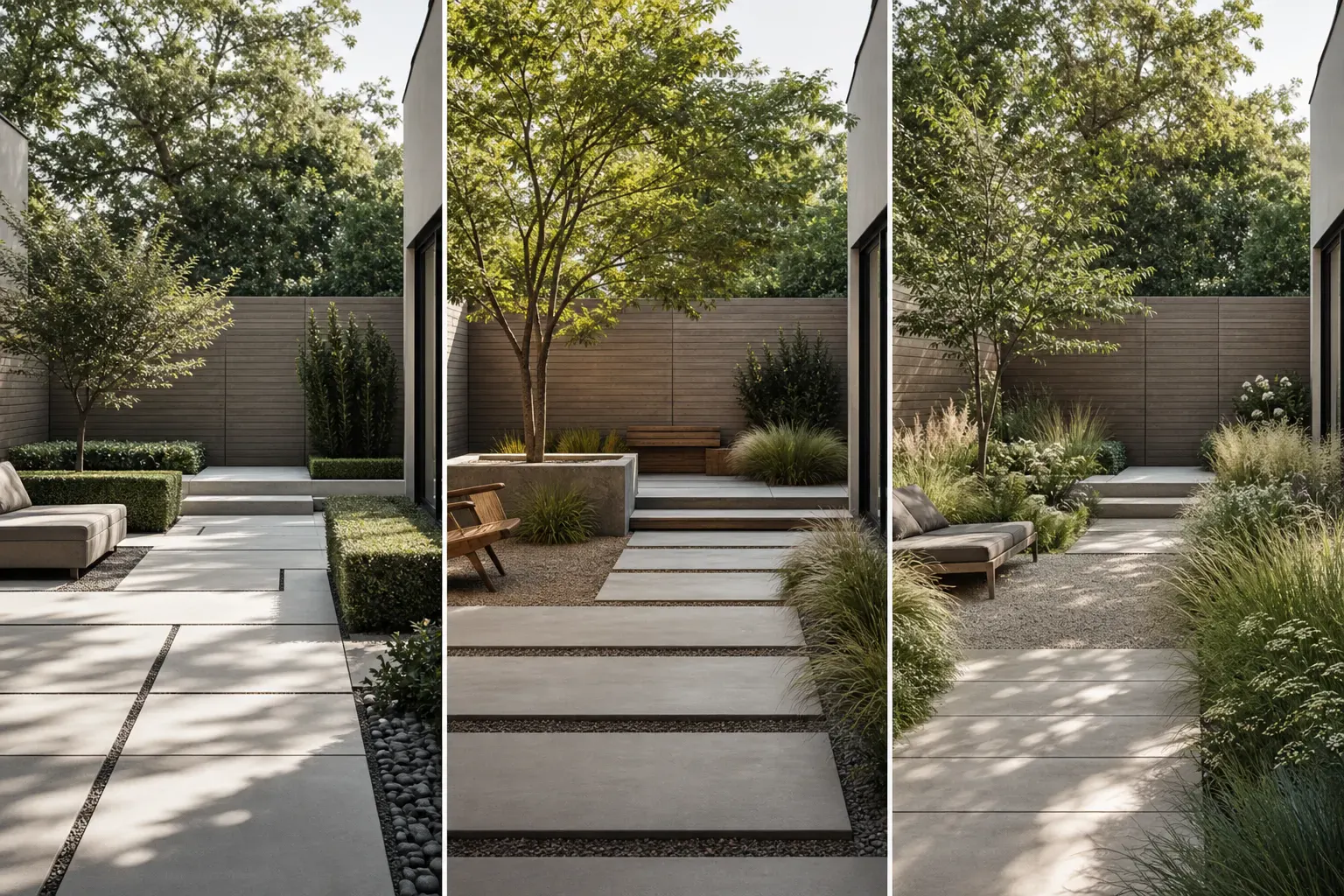
Architectural minimal
- What organizes it
- Crisp planes, strong negative space, and a very limited repeated palette.
- Watch for
- Too much exposed paving or isolated planting can feel hot, sterile, and unforgiving.
- Plant emphasis
- One canopy or anchor, compact structure, and a quiet ground plane.
Warm mid-century
- What organizes it
- House-grid alignment, indoor-outdoor views, one airy specimen, and repeated low masses with warmer materials.
- Watch for
- A universal agave-and-gravel formula ignores the architecture's relationship to the local climate.
- Plant emphasis
- One specimen, low structural blocks, and a repeated regional ground layer.
Naturalistic contemporary
- What organizes it
- Clean geometry softened by broad, disciplined drifts of grasses and perennials.
- Watch for
- Many scattered species or a weak edge can erase the modern structure.
- Plant emphasis
- Fewer forms, larger repeated masses, and visible open space.
Sources: Royal Horticultural Society, University of Florida IFAS Extension
Use four plant roles with disciplined repetition
The plants should vary in texture while repeating enough form to read as one system.
One sculptural anchor
Choose a multi-stem tree, architectural shrub, or strong perennial form that fits the mature space.
One repeated evergreen mass
Use the same compact structure plant in several positions to connect the plan through winter or the dry season.
One soft planting ribbon
Repeat a fine-textured perennial or grass-like role in one broad mass instead of sprinkling it through every bed.
One seasonal accent
Use one flower color in a concentrated group. Let foliage and form do most of the year-round work.
Plant names change by climate. Preserve the roles and proportions when a local nursery substitutes the palette.
A compact modern backyard with an off-center door
This example uses one axis and three plant forms without turning the yard into a grid of small boxes.
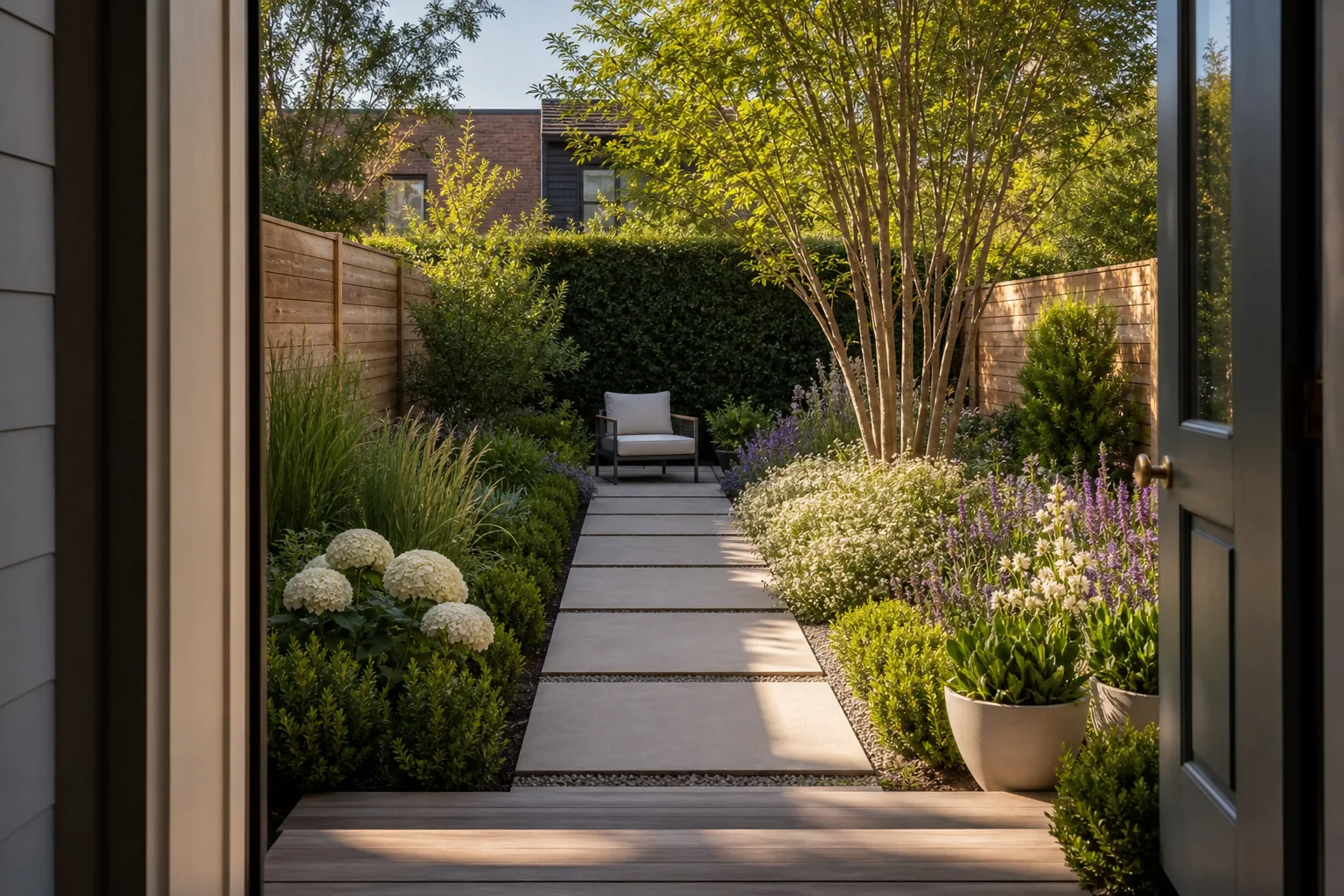
One path, one tree, two repeated masses
A rear door sits off-center. The yard needs a route to one chair, planting, and a clear view from indoors.
- Extend the door axis
- Run a generous, unobstructed path toward the seat or destination and align the main bed edge with it.
- Offset one multi-stem tree
- Place it beside, not at the end of, the axis so its canopy frames the view without blocking the route.
- Repeat one structural plant form
- Use one group of three and one group of two at mature spacing to connect opposite sides.
- Fill one broad perennial ribbon
- Keep the flowering or textural mass continuous enough to read as one shape from the house.
If the plan needs many labels to explain its order, simplify the geometry or reduce the number of plant forms.
Keep modern from becoming cold or high maintenance
Restraint should remove noise, not habitat, shade, comfort, or practical use.
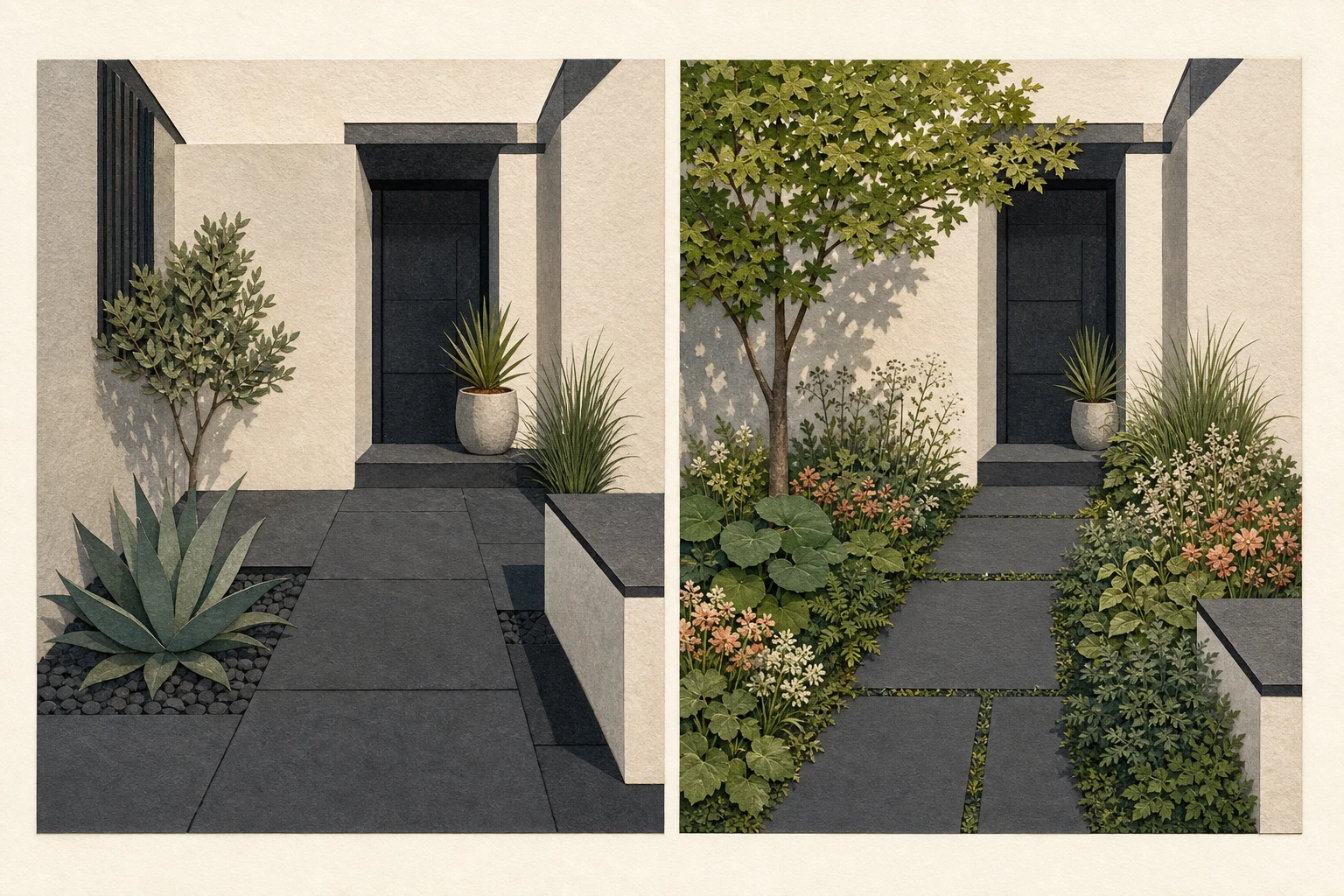
- Hard geometry only
- Geometry + living softness
Living shade and broad planting: Use canopy and plant masses to soften hard surfaces and summer heat.
Materials chosen for performance: Judge paving and gravel by drainage, access, climate, and maintenance as well as appearance.
Plants that fit the geometry: Avoid oversized plants that need constant shearing to hold the intended outline.
Repeated form without monoculture: Vary species when resilience or local ecology calls for it.
An off-season composition: Check that the design still reads in winter or the dry season without relying on one short bloom.
Clean lines are easiest to maintain when the plants naturally fit the intended outline.
Frequently asked questions
What makes a garden look modern?
A clear organizing geometry, restrained materials, repeated plant forms, and deliberate open space create the modern character. The planting can still be lush when it is massed rather than scattered.
Do modern gardens need concrete and gravel?
No. Modern design is about order and proportion, not a required material list. Paths, planted areas, and living canopy can carry the geometry with less hard surface.
Are modern, contemporary, and minimalist gardens the same?
They overlap but are not identical. Modern garden design usually emphasizes strong geometry and repetition; contemporary describes current approaches and can be more naturalistic; minimalist pushes the palette and number of elements further down. Choose the direction that fits the house, climate, and amount of living texture you want.
What plants work in a modern garden?
Choose by role: one sculptural anchor, one repeated structure plant, one broad soft-texture mass, and one seasonal accent. Select the exact species for local climate, site, mature space, and care.
Can a modern garden support pollinators?
Yes. Use regionally appropriate flowering plants in broad repeated masses and include bloom across seasons. Modern composition and habitat value are compatible.
 Gardenful
Find the clean line already in your yard.
Use the house and path as the geometry, then test a repeated modern plant palette on the real photo.
Gardenful for iPhone
Download the app free and start with a photo of your yard.

Sources(3)
- [1]Modern and Minimal Garden Design
Royal Horticultural Societyhttps://www.rhs.org.uk/garden-inspiration/design/modern-and-minimal
- [2]Finding Inspiration for a Design Theme
University of Florida IFAS Extensionhttps://ask.ifas.ufl.edu/publication/EP430
- [3]Landscape Design: Arranging Plants
University of Florida IFAS Extensionhttps://ask.ifas.ufl.edu/publication/EP449