Gardenful style guide
How to design a Mediterranean-style garden
The short answer
Mediterranean-style gardens are defined as much by shade, pale surfaces, and restrained texture as by individual plants. Build the look from one shade-giving small tree, a few dark vertical accents, silver-green and aromatic-looking shrubs, a pale permeable route, and restrained terracotta. Then substitute plants for your own winter cold, summer humidity, soil drainage, water rules, and fire guidance. A Mediterranean look does not make every Mediterranean plant locally suitable.
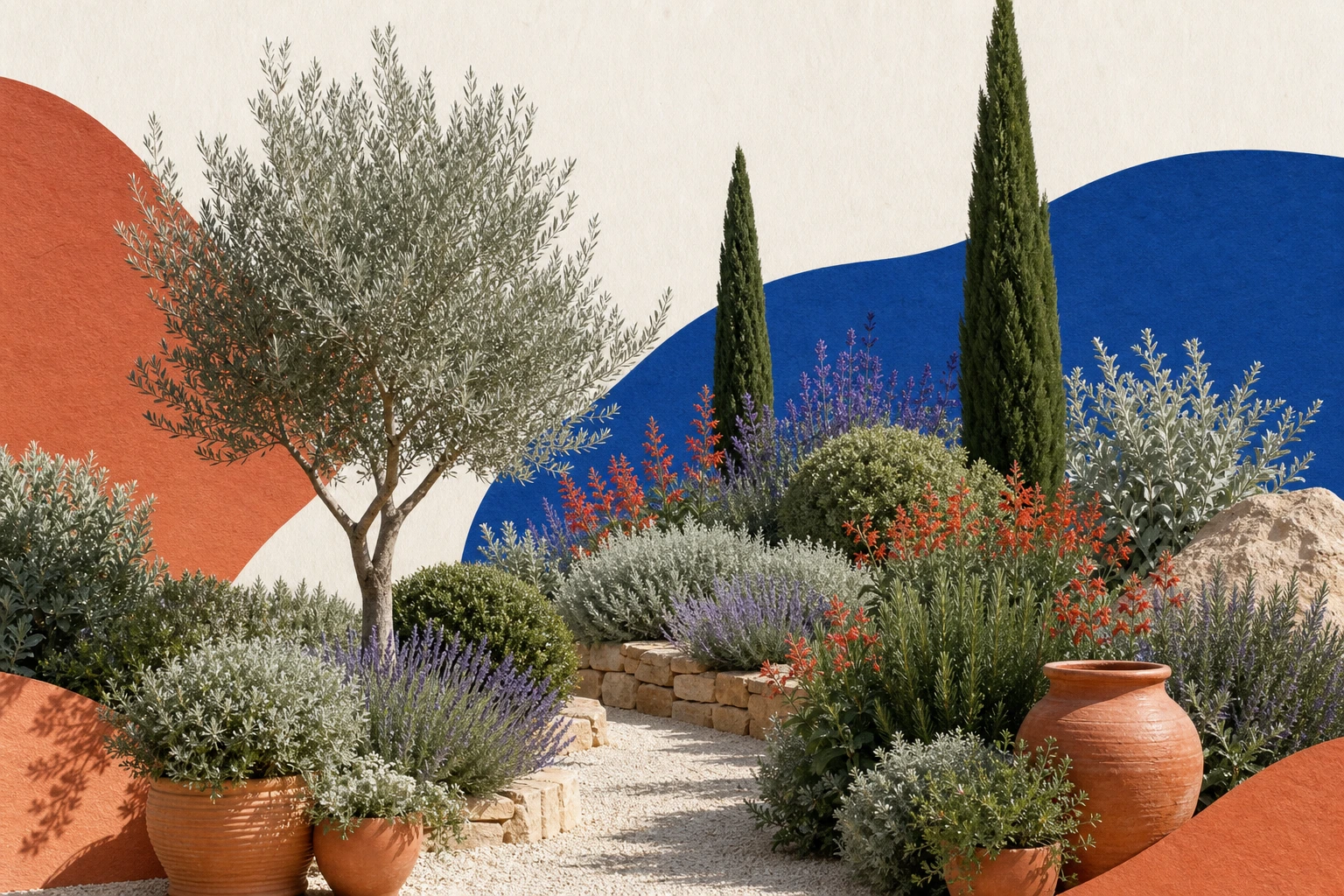
Start with shade and structure, not lavender
A single plant does not create the style. The useful pattern is a cool place to pause inside a sunlit, textured garden.
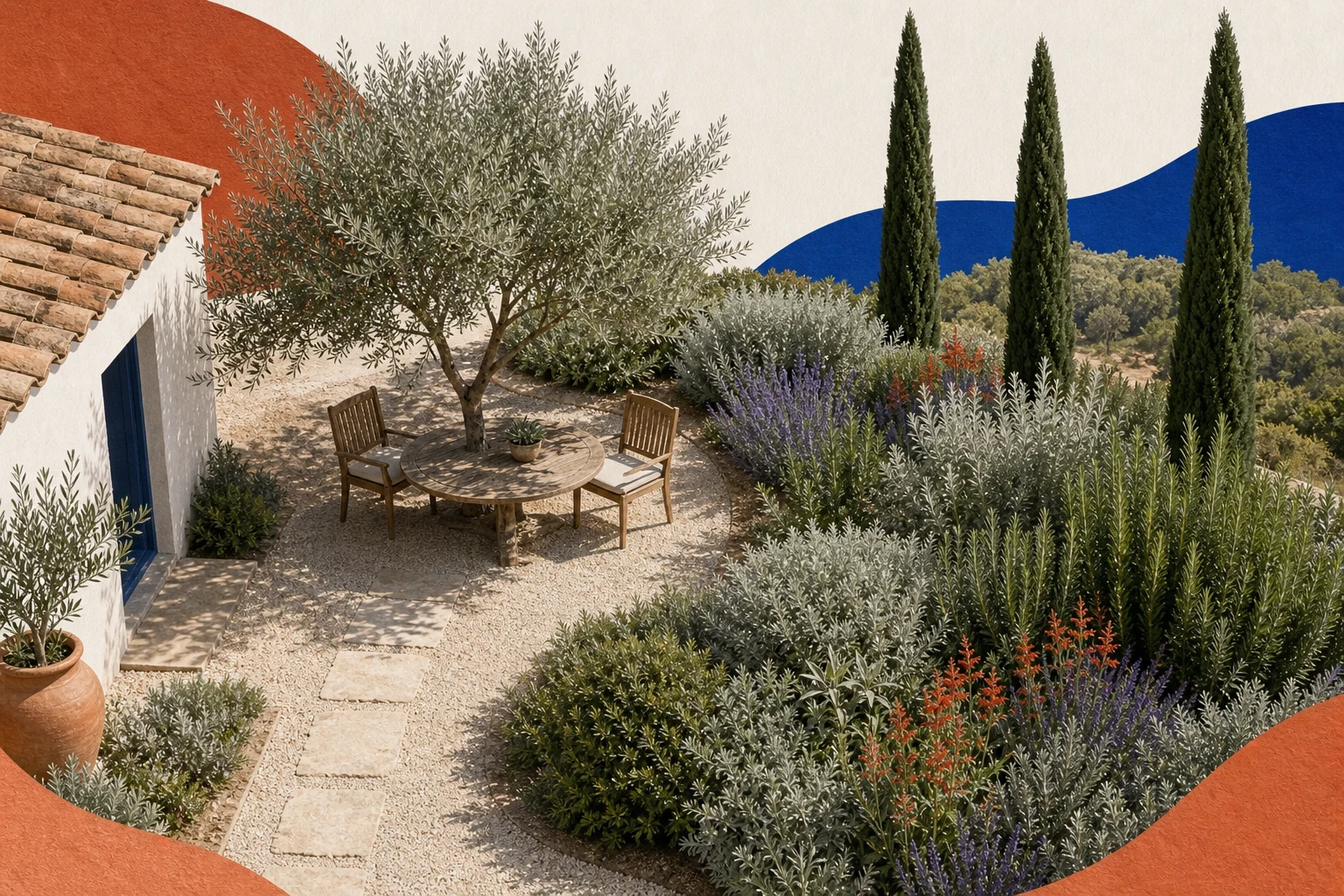
Choose locally adapted plants for these roles rather than insisting on familiar Mediterranean species. The shade tree, upright forms, and broad foliage masses matter more than copying a list.
RHS examples pair gravel, natural stone, terracotta, sculptural drought-aware plants, and shade. Its drought guidance also stresses establishment water and warns that many Mediterranean plants suffer in cold, damp soil or sudden heavy rain.3,4
Choose a Mediterranean direction before choosing plants
These interpretations share warm materials and useful shade, but their geometry, exposure, and plant forms are deliberately different.
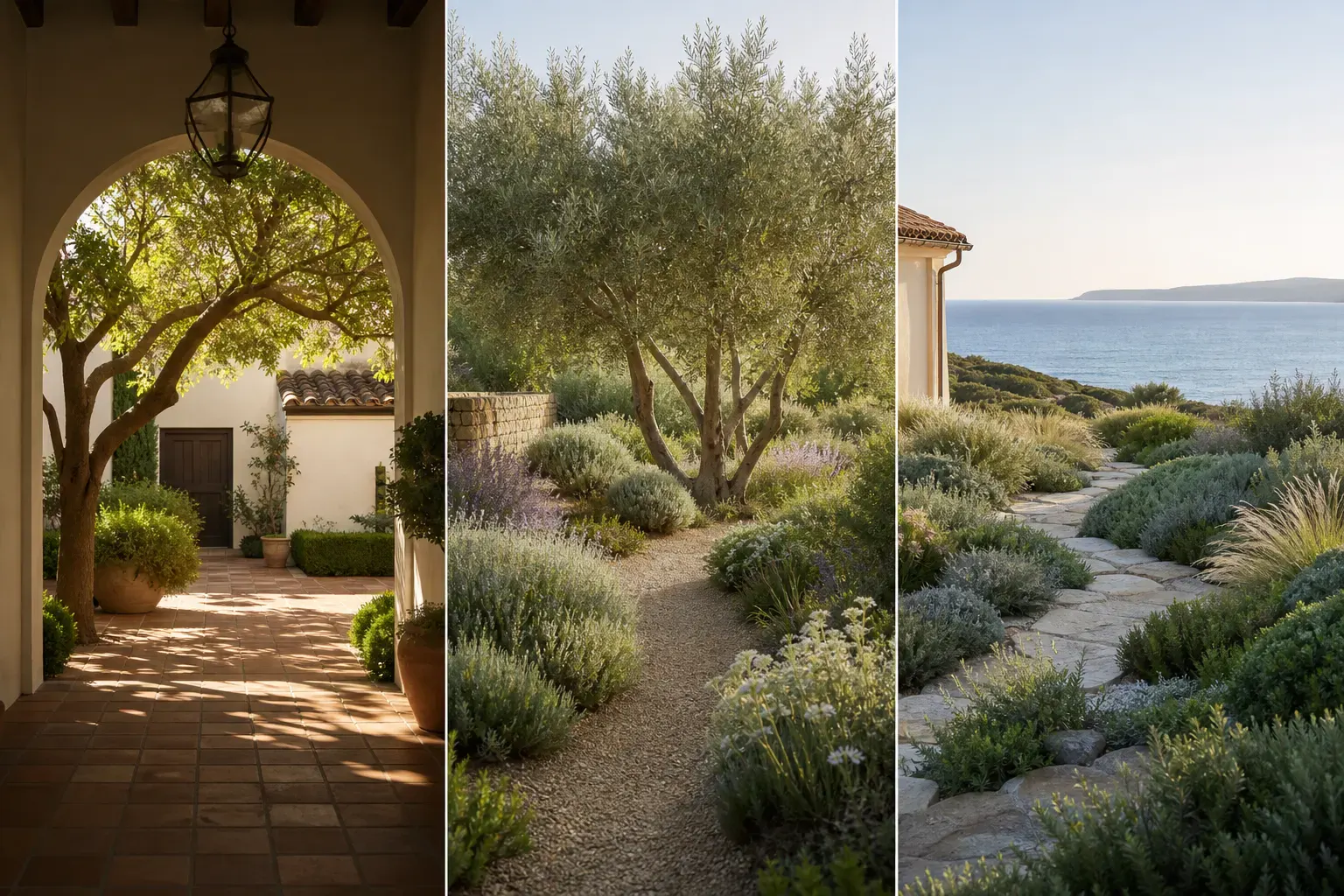
Spanish courtyard
- What carries it
- A shaded threshold, aligned route, warm paving, containers, and restrained repeated structure.
- Watch for
- Formal geometry still needs drainage, comfortable shade, and plants that tolerate the local climate.
- Useful forms
- Broad canopy, low structure, and one warm accent.
Dry naturalistic
- What carries it
- An airy small tree, broad silver-green or aromatic-looking masses, gravel joints, and a looser route.
- Watch for
- Do not copy dry-summer species into cold wet or humid soil because the scene looks familiar.
- Useful forms
- Airy canopy, mounded foliage, and restrained seasonal color.
Sheltered coastal
- What carries it
- Lower wind-shaped shrubs and grasses, pale stone, open views, and a smaller number of vertical accents.
- Watch for
- Salt and wind exposure can change within the lot; sheltered planting cannot be assumed to fit the windward edge.
- Useful forms
- Low filter, flexible texture, and clear open space.
Sources: Royal Horticultural Society, Royal Horticultural Society
Keep the roles and change the plants
The style can travel farther than the exact Mediterranean species.
Summer-dry climate
Design direction: Investigate locally appropriate olive-like canopy forms, salvias, rosemary-like shrubs, lavender-like masses, and gravel or mineral mulch.
Verify: Fire guidance, summer irrigation, invasive status, frost pockets, and mature spread.
Cold-winter climate
Design direction: Use hardy silver foliage, upright conifers, aromatic perennials, pale stone, and containers that can move or drain well.
Verify: Winter hardiness, road salt, freeze-thaw, wet roots, and container protection.
Humid or rain-heavy climate
Design direction: Keep the vertical rhythm and warm materials, but choose plants that tolerate humidity and local disease pressure.
Verify: Drainage, fungal disease, storm exposure, and whether gravel increases heat around plants.
Sources: Royal Horticultural Society, University of Florida IFAS Extension
A sunny courtyard with one shaded seat
This example creates shade and vertical rhythm without turning the whole space into gravel.
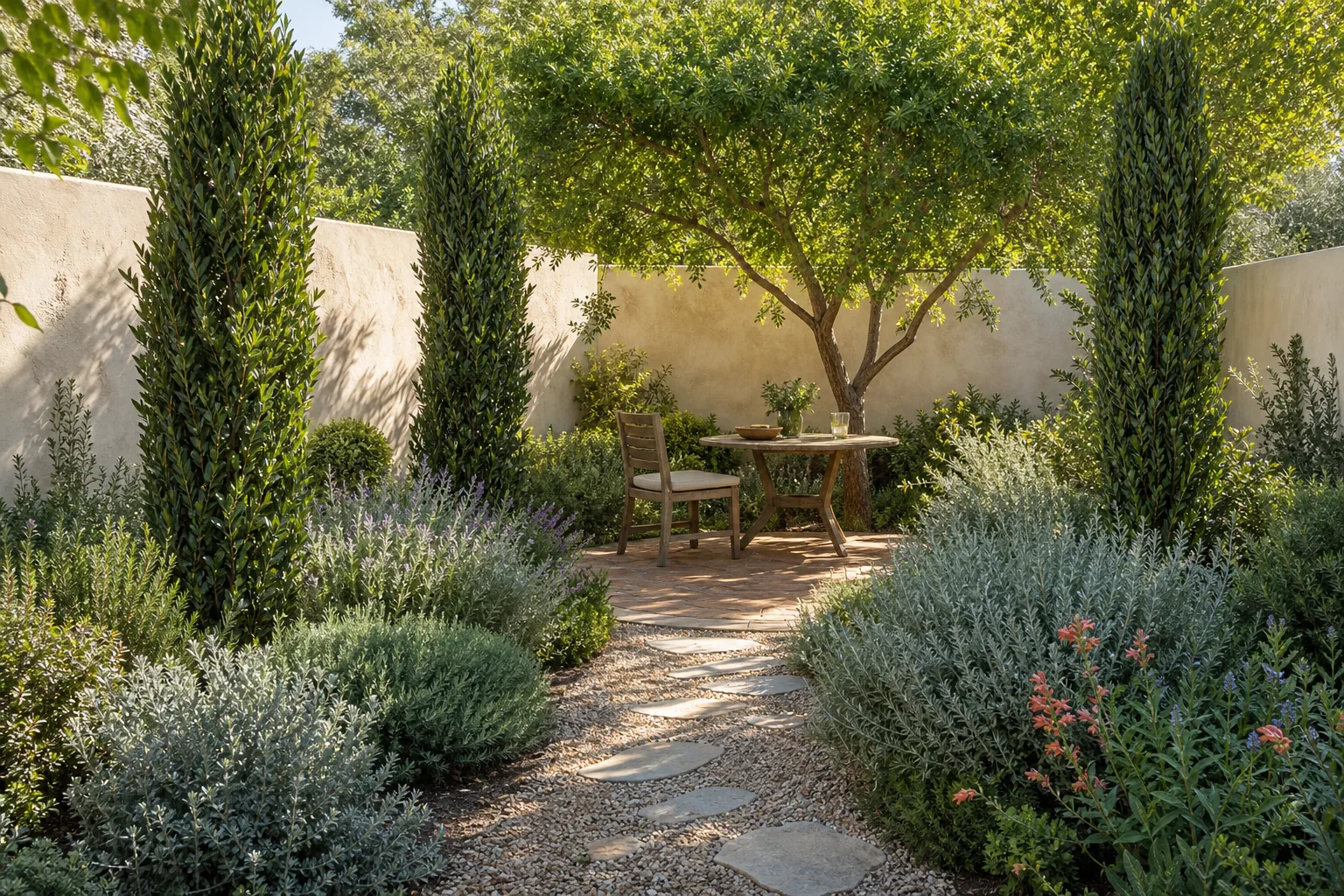
One tree, three uprights, two broad masses
The space is sunny, enclosed, and used for a small table. The planting beds frame the seat while leaving a clear route.
- Place one small canopy tree
- Set it to shade the seat at the useful time of day and verify root space, mature canopy, litter, and local fit.
- Repeat three vertical accents
- Use narrow dark plants to frame the view without forming a solid wall.
- Mass silver and deep-green foliage
- Use two broad repeated groups and one coral or violet flower accent.
- Keep surfaces permeable where practical
- Choose a locally appropriate path assembly and leave enough planted soil to cool and absorb water.
The courtyard should offer shade and a clear route first. The recognizable palette comes second.
Check local water, drainage, and fire constraints
A dry-climate visual style can create real risk when copied without site guidance.
Establishment water: Water new plants while their roots develop, even when they are described as drought tolerant.
Winter wet and climate fit: Verify that dry-climate plants can tolerate local moisture, humidity, and cold.
Local fire guidance: Follow the fire authority's rules for plant placement, mulch, spacing, and defensible space.
Heat around the roots: Check whether gravel or rock mulch will overheat the root zone in that exposure.
Runoff direction: Keep paths permeable where practical and do not redirect water toward buildings or neighbors.
Mediterranean-style is a design direction, not a promise of zero water or universal plant survival.
Frequently asked questions
What makes a garden Mediterranean style?
A shade-giving tree, dark vertical accents, silver-green and aromatic textures, pale stone or gravel, and restrained terracotta create the visual language. Exact plants vary by climate.
Is a Mediterranean garden drought tolerant?
It can use lower-water plants where they fit, but new plants still need establishment water. Local winter moisture, humidity, soil drainage, fire guidance, and climate determine whether a Mediterranean species is appropriate.
Can I create the style in a cold climate?
Yes, by substituting hardy plants with similar roles: a small canopy, narrow evergreens, silver foliage, aromatic perennials, and warm containers or stone. Verify every plant for local winter and drainage conditions.
Does Mediterranean style require gravel everywhere?
No. One pale permeable route, mineral accent, or terracotta group can establish the material direction while planted soil and canopy provide cooling and water absorption.
 Gardenful
Build the Mediterranean rhythm with local plants.
Test the shade tree, vertical accents, silver foliage, and warm materials on your yard photo before selecting regional equivalents.
Gardenful for iPhone
Download the app free and start with a photo of your yard.

Sources(6)
- [1]Garden Themes
Royal Horticultural Societyhttps://www.rhs.org.uk/garden-design/garden-themes?platform=hootsuite
- [2]
- [3]Drought-Resistant Gardening
Royal Horticultural Societyhttps://www.rhs.org.uk/garden-design/drought-resistant-gardening/
- [4]
- [5]Right Plant, Right Place
University of Florida IFAS Extensionhttps://ask.ifas.ufl.edu/publication/EP416
- [6]Landscaping Tips
U.S. EPA WaterSensehttps://www.epa.gov/watersense/landscaping-tips