Gardenful field guide
Low-maintenance front yard plants that still look intentional
The short answer
Low-maintenance planting starts by removing a recurring chore, not by searching for a universal easy-care plant list. Choose the chore you want to reduce first. Then use plants that fit the space at maturity, share water needs, and repeat in a simple .
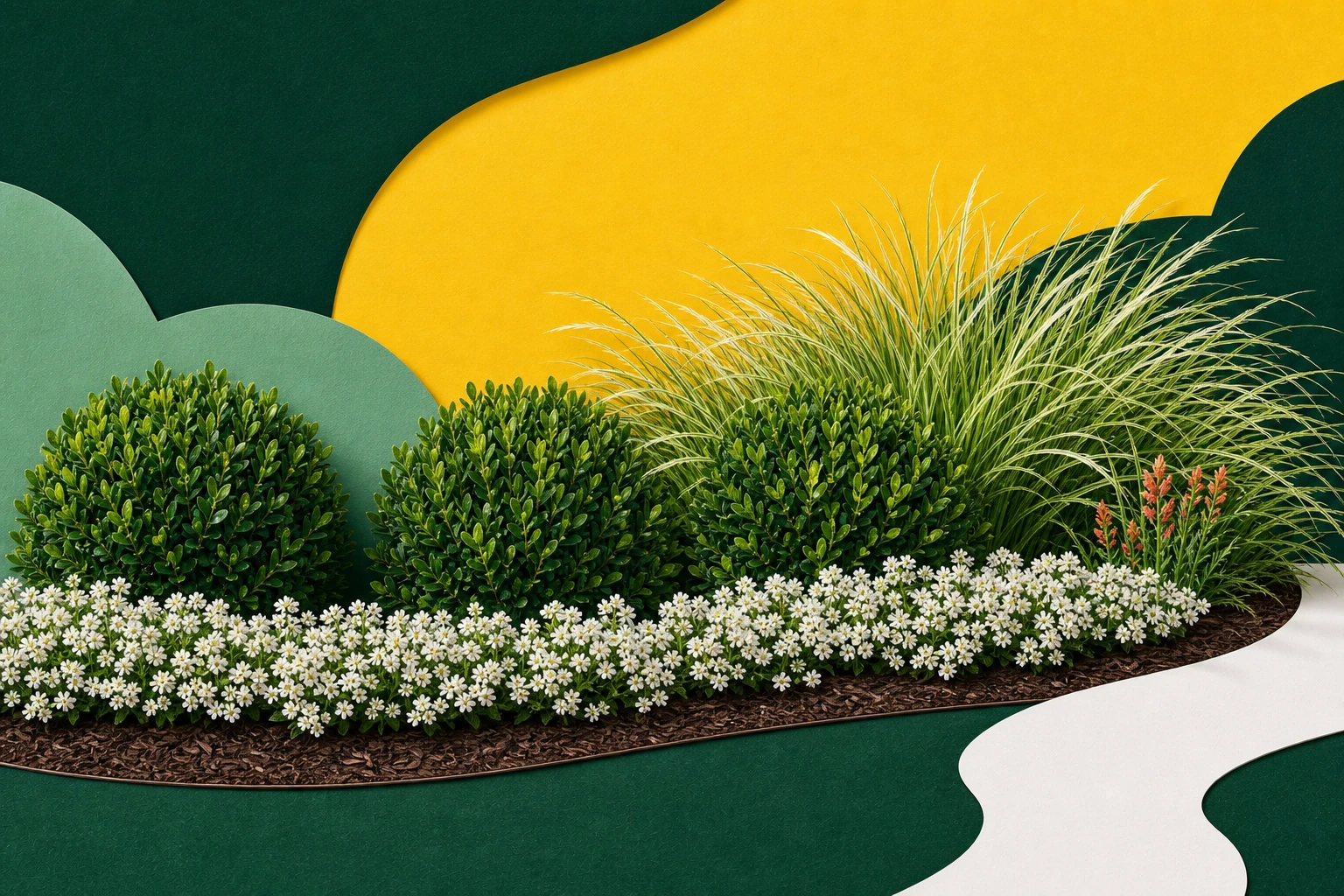
Reduce maintenance by fixing plant and layout problems
A shrub sold as tough or easy to care for can still create constant work if it blocks a window or needs a different watering schedule from the plants beside it.
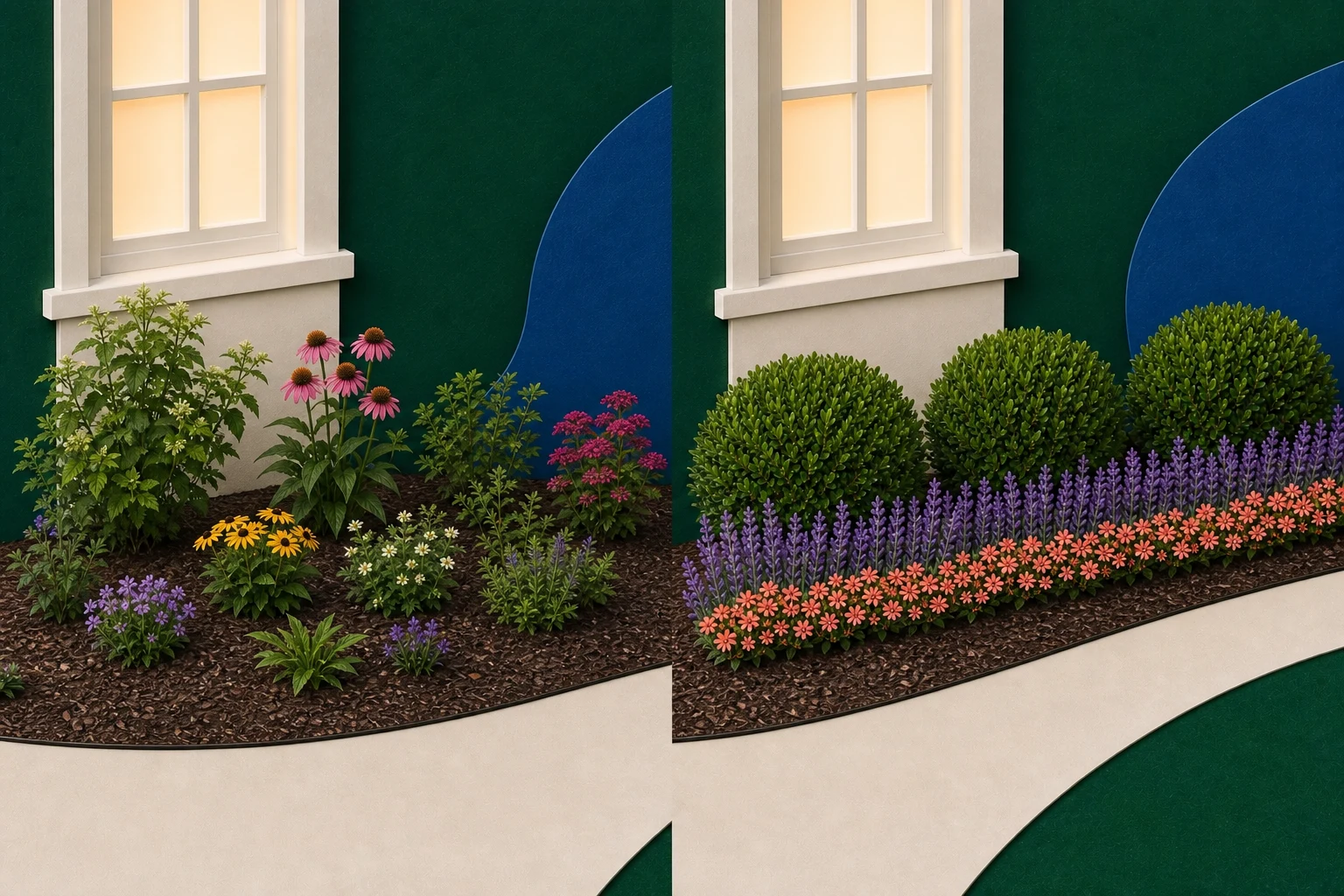
- Many one-off plants
- A few repeated groups
Many maintenance problems repeat because the original mismatch remains. A shrub grows across the walk, so you cut it back. The cut stimulates new growth, so you cut it again. A thirsty plant wilts in a dry bed, so you water the whole zone more often. Bare gaps invite weeds, so you keep pulling them while waiting for scattered plants to fill in.1,3
Reduce the work by fixing the mismatch. Choose a shrub whose natural mature size fits below the window. Put plants with similar water needs on the same irrigation pattern. Repeat enough low plants to cover the soil when mature. The nursery list may be shorter, but the finished bed will be easier to care for and understand.2,3
There is no honest no-maintenance garden. New plants need , weeds arrive, irrigation needs checking, and even long-lived plants change. A useful goal is fewer recurring interventions, with most of the work happening in a predictable season instead of every weekend.4
Choose the chore to reduce
Low maintenance means something different to a person who hates pruning than it does to someone who travels for weeks at a time. Use your least favorite task as the first filter.
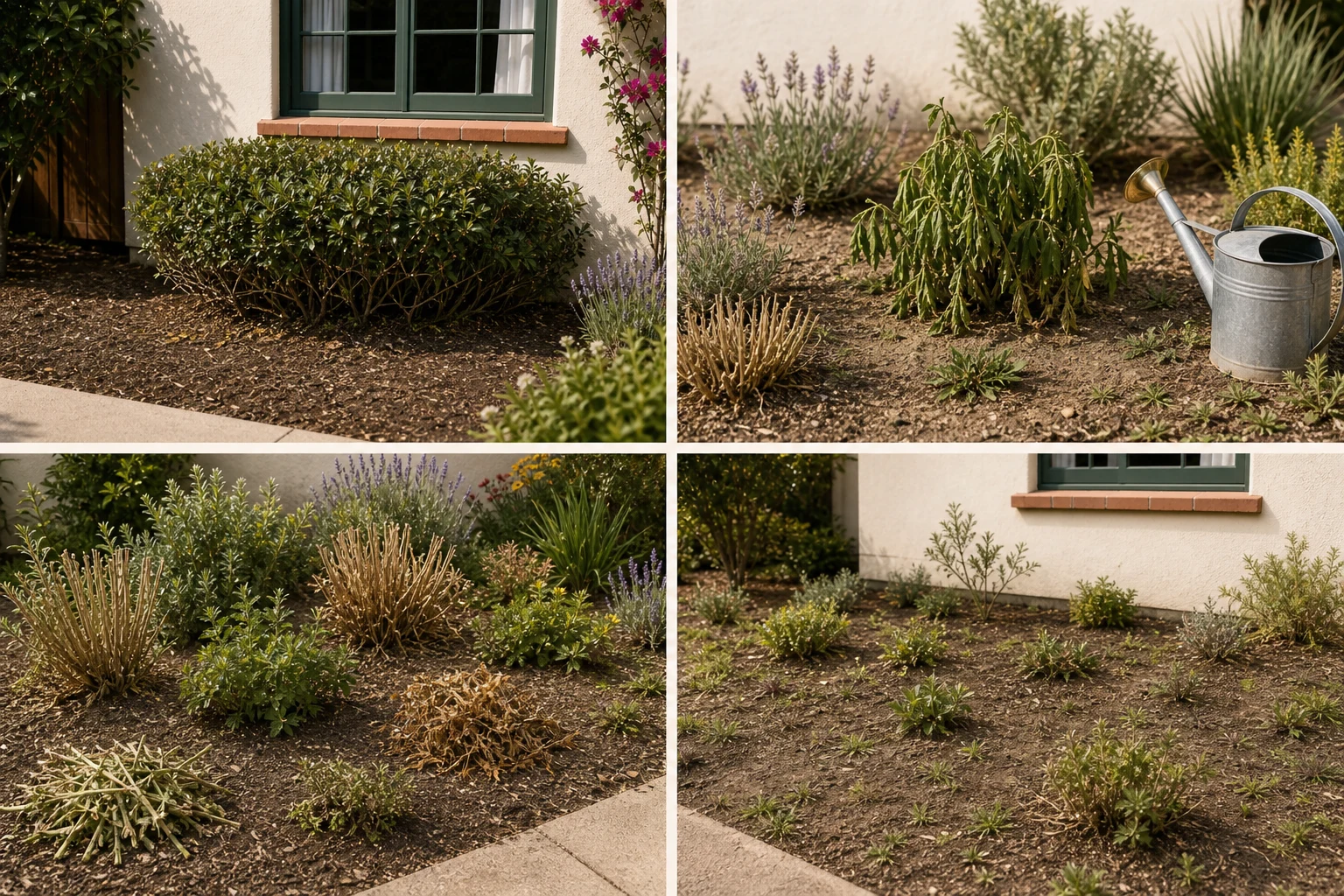
Too much pruning
Look for plants whose natural form and mature height fit the exact spot. Leave space between the mature canopy, the house, the path, and the neighboring plant.
Constant watering
Group plants by water need and keep a thirsty exception out of an otherwise dry bed. One drip line cannot serve two opposite watering schedules well.
Seasonal cleanup
Use enough evergreen or long-season foliage for the bed to look complete outside the bloom season. Keep plants that need cutting back in one or two repeated groups.
Weeding and replacement
Close the mature plant canopy without crowding it. Repeated groundcovers, mulch during establishment, and plants suited to the soil reduce open niches and failed experiments.
Do not choose a plant that removes one chore but creates several others. Check mature size, water, cleanup, and replacement risk together.
Find plants for your region
These regional examples show the level of specificity to bring to a nursery. They are plants to investigate for a suitable site, not blanket recommendations for every home in the region.
Mid-Atlantic sun or light shade
A palette to investigate: A compact inkberry or aronia, a repeated group of coneflower or aromatic aster, and green-and-gold or creeping phlox where the exposure fits.
Local question: Check deer pressure, drainage, winter salt, variety size, and whether the ground layer is vigorous enough for the site without becoming troublesome.
Upper Midwest with cold winters
A palette to investigate: A compact ninebark or bush honeysuckle, repeated prairie flowers, and a hardy ground layer selected through local extension guidance.
Local question: Check snow load, hardiness, winter interest, road salt, and whether the site is dry, average, or seasonally wet.
Summer-dry California climate
A palette to investigate: A site-sized manzanita or ceanothus, repeated salvias or yarrow, and a low plant chosen for the same irrigation zone.
Local question: Confirm summer water needs, drainage, frost, local fire guidance, and mature size. Many woody natives resent conditions that suit a conventional irrigated border.
South Florida heat and humidity
A palette to investigate: Coontie or a site-sized cocoplum, repeated beach sunflower or firebush, and a regional groundcover suited to the light and salt exposure.
Local question: Use the current local list to check invasive status, cold sensitivity, salt, soil, hurricane exposure, and establishment watering.
A strong nursery question sounds like this: I need a shrub that stays near 3 feet, takes morning sun, shares moderate water, and does not need shearing. What fits locally?
Sources: University of Florida IFAS Extension, University of California Agriculture and Natural Resources, University of Minnesota Extension
Use repetition to simplify care
This layout is for a long foundation bed with morning sun. It favors natural shapes, broad groups, and enough access to inspect the house and irrigation.
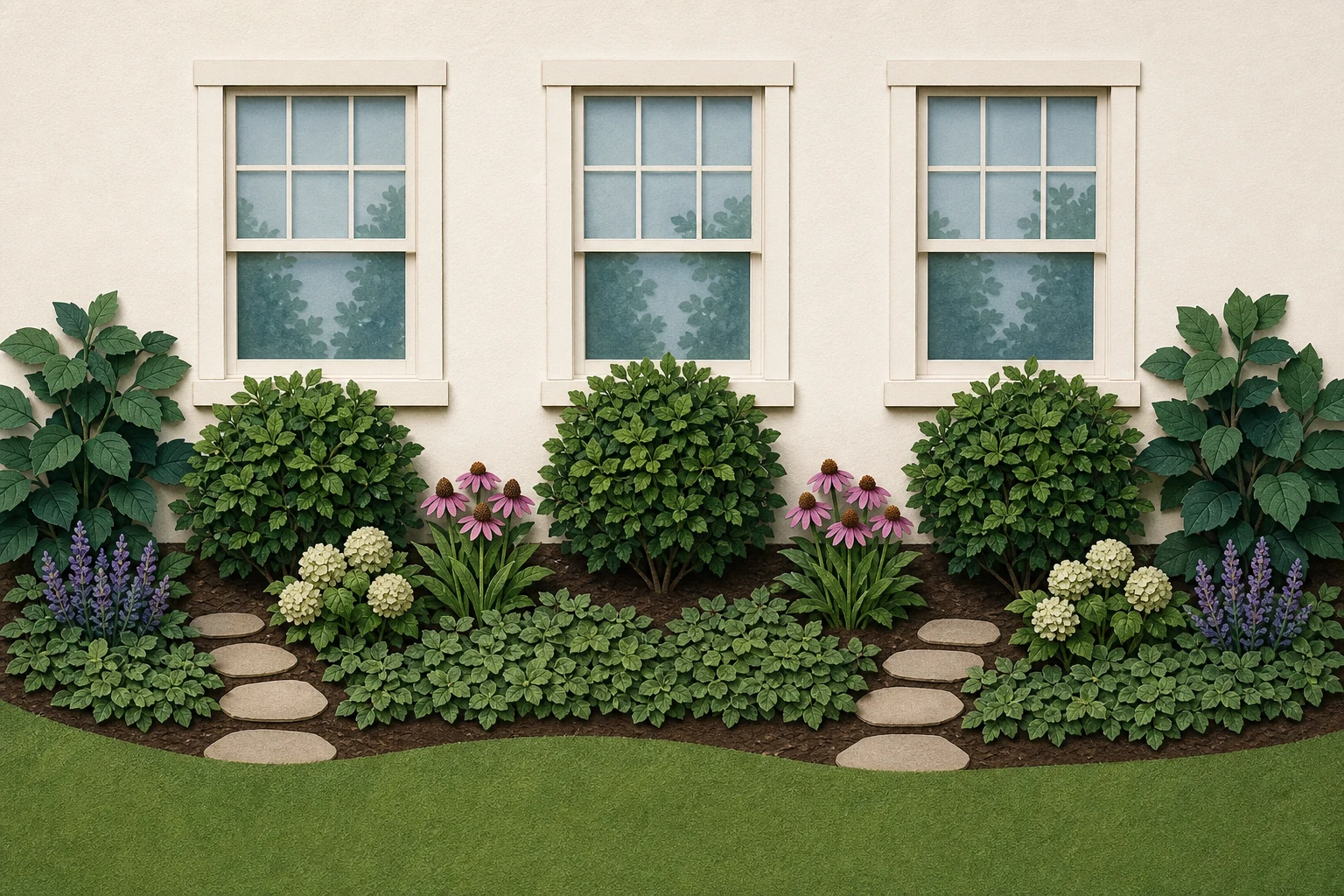
Foundation bed with one main cleanup season
The bed sits below three windows. The homeowner is willing to do one winter cleanup and irrigation checks, but does not want monthly shearing or frequent flower cleanup.
See the plan notes
Three naturally compact shrubs
Repeat one structure plant beneath the wall sections, not directly under the window centers. Size it so pruning is for health or shape, not survival of the layout.
Two groups of the same flowering plant
Use five plants in one group and three in the other. Pick a locally suitable plant that can be cut back on the same winter or early-spring visit.
One continuous ground layer
Choose a groundcover or another low plant for the actual light and water. Space for mature coverage, then mulch the gaps while it establishes.
Two access pockets
Leave stepping room near the hose connection and between plant masses. Access is part of a low-maintenance plan, even though it is not a plant.
Write the annual care next to each group. If the page fills with different watering, pruning, and cleanup dates, simplify the palette before installation.
Plan the first year of care
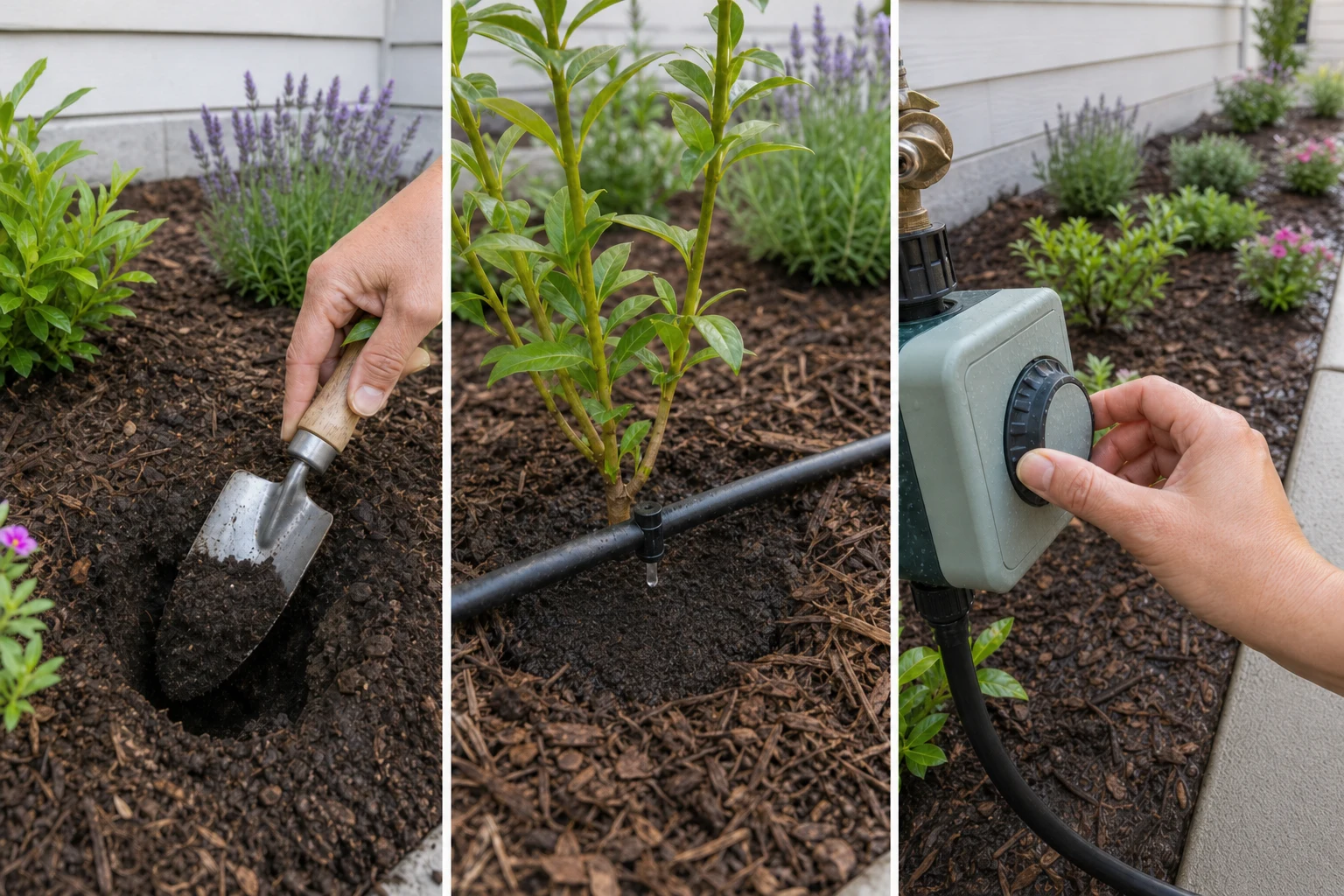
Even an easy-care plant needs establishment care while new roots grow into the surrounding soil.
1
Check the soil before watering
Feel below the surface, then adjust for rain, heat, and soil conditions.
2
Water the whole root area
Apply water slowly, confirm that drip outlets reach every new plant, and keep mulch away from trunks and stems.
3
Adjust through the season
Respond to rain and heat, remove weeds while plants fill in, and compare photos before filling every apparent gap.
Low maintenance begins with good establishment. A failed plant is more work than a healthy plant that needed a sensible first-season routine.
Frequently asked questions
What is the easiest front yard plant to maintain?
There is no universal easiest plant. The best candidate is adapted to your climate and soil, fits the available space at maturity, shares water needs with its neighbors, and does not require a task you want to avoid.
Are native plants always low maintenance?
A locally native plant can be well adapted, but native does not automatically mean suitable for every yard. Light, soil moisture, mature size, behavior, and establishment still matter. Use a regional native-plant source, not a national label.
How many plant types make a yard easier to care for?
There is no magic count, but a small repeated palette usually creates fewer care schedules than many unrelated singles. For a modest front bed, begin with three or four types and add another only for a distinct job.
 Gardenful
Choose a planting layout that also reduces recurring work.
Start with your yard photo, preview a layout with fewer repeated plant types, and bring the plant roles to a local source for final verification.
Gardenful for iPhone
Download the app free and start with a photo of your yard.

Sources(6)
- [1]Pruning Shrubs and Hedges in the Home Garden
University of Maryland Extensionhttps://extension.umd.edu/resource/pruning-shrubs-and-hedges-home-garden
- [2]The Florida Yards & Neighborhoods Handbook: Right Plant, Right Place
University of Florida IFAS Extensionhttps://ask.ifas.ufl.edu/publication/EP416
- [3]Watering Tips
US EPA WaterSensehttps://www.epa.gov/watersense/watering-tips
- [4]Low-Maintenance Landscape Plants for South Florida
University of Florida IFAS Extensionhttps://ask.ifas.ufl.edu/publication/EP107
- [5]Shrubs and Perennials
University of California Agriculture and Natural Resourceshttps://ucanr.edu/site/landscape-lush/shrubs-and-perennials
- [6]Native Plants
University of Minnesota Extensionhttps://extension.umn.edu/find-plants/native-plants