Compact yard planning
Small front yard landscaping ideas that keep the entrance clear
The short answer
A small front yard needs fewer competing ideas, not smaller versions of everything. Protect the route to the door, keep one area visually open, and repeat two or three plant forms at a scale that fits the house and the available ground.
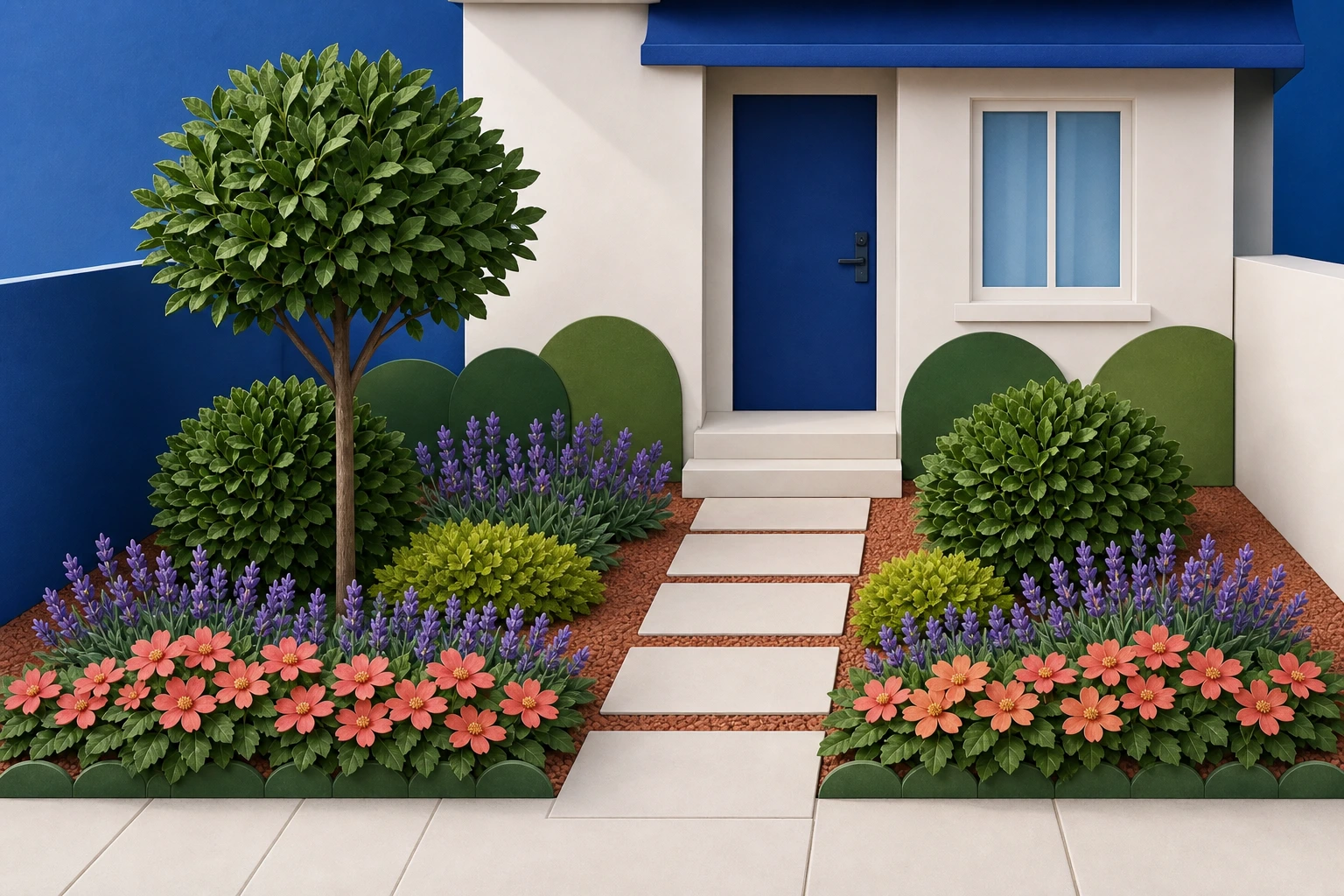
Protect the few moves that organize the whole yard
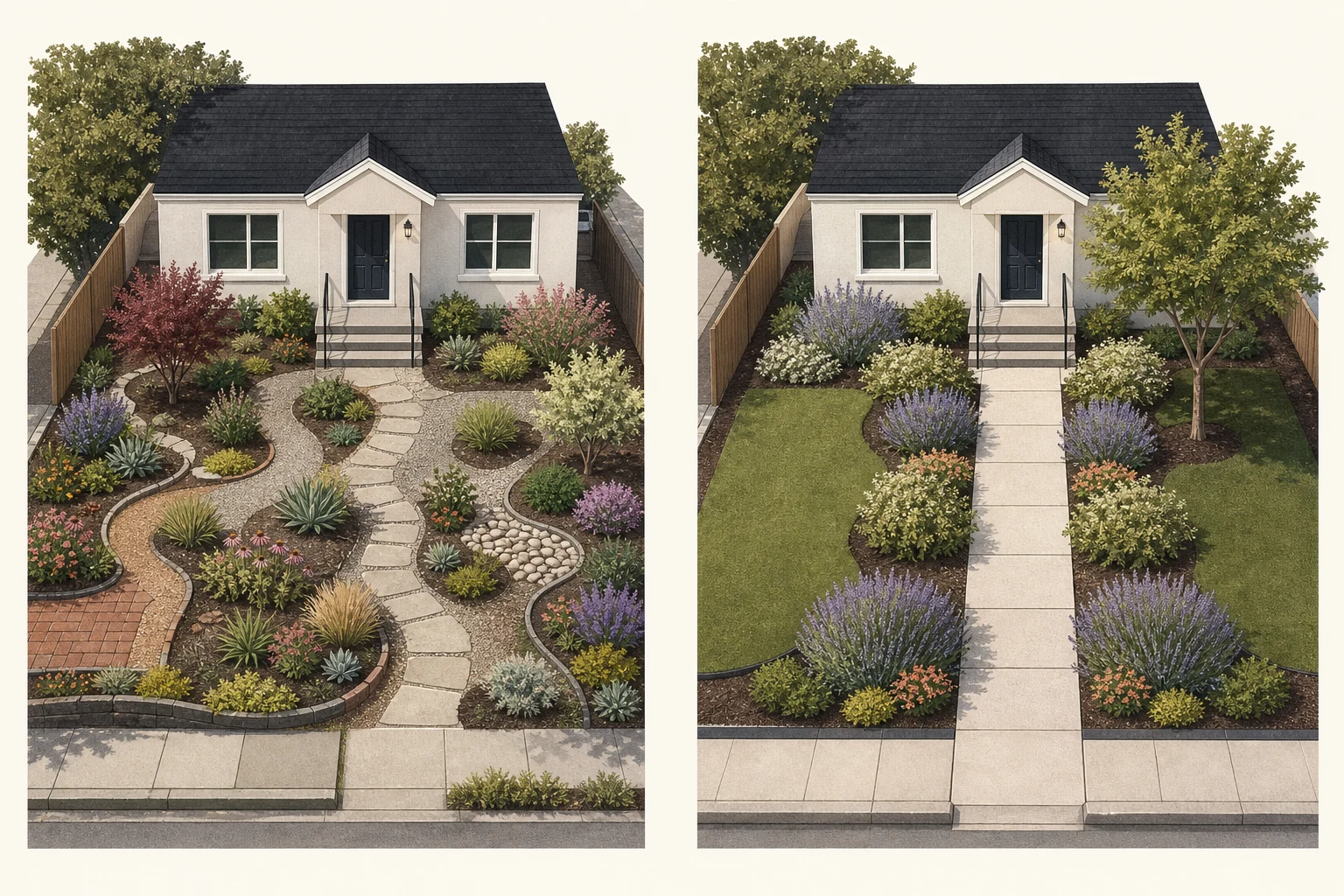
- Competing moves
- Clear hierarchy
In a compact yard, every object occupies a large share of the view. A winding path, several specimen shrubs, many border materials, and a tiny tree can each make sense alone while the combination feels busy.
Choose what stays open first: the walk to the door, room to open a car door, a useful patch for a child or dog, or simply enough calm foreground to see the planted edges. Then judge every plant by its mature proportion to that space, not its nursery pot.2,3
Choose one of three compact-yard layouts
Pick the layout that matches how people move through the yard. Do not combine all three unless the space is large enough to keep each route obvious.
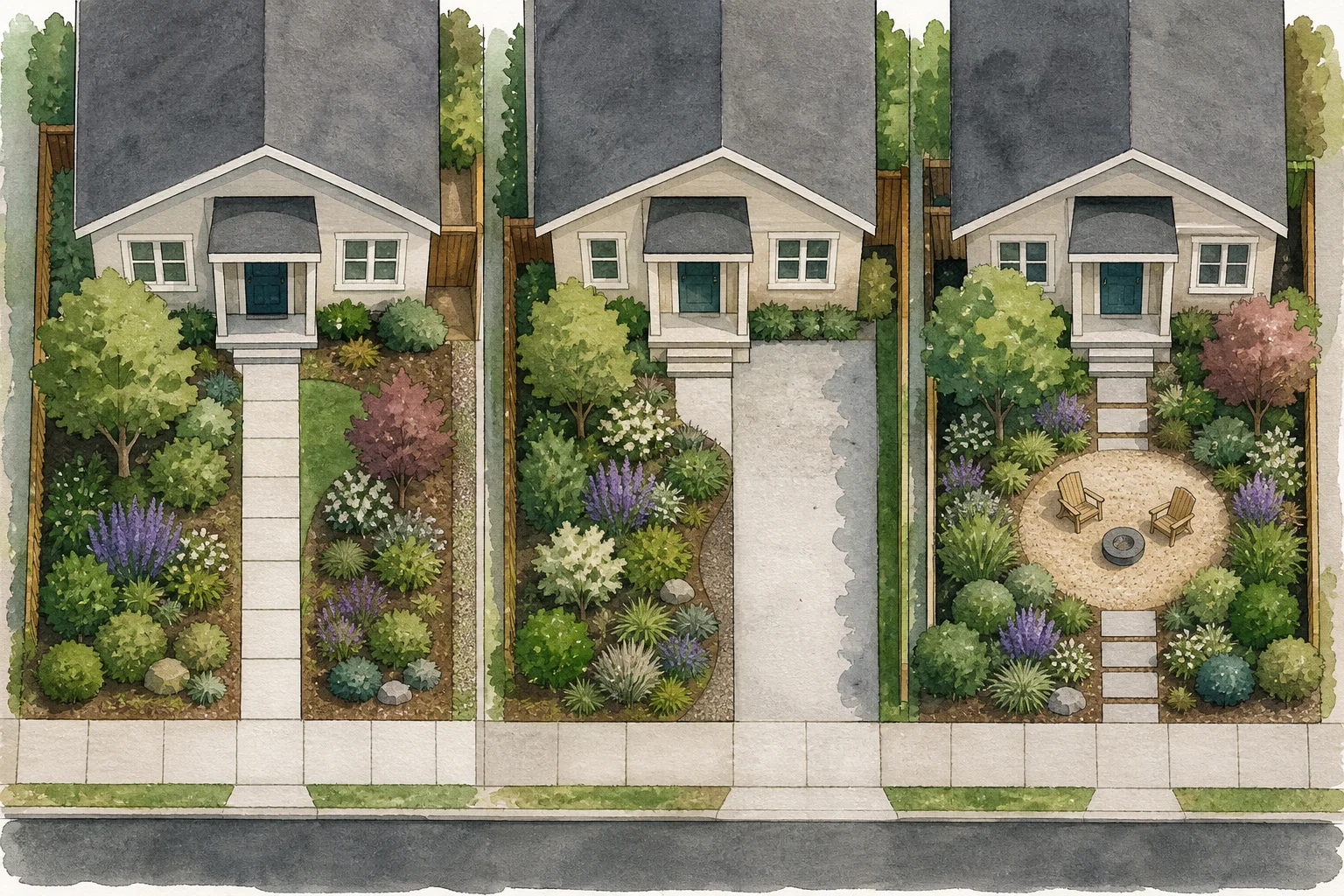
Direct entry garden
- Works best when
- The sidewalk and front door already align. Keep the center route straight and build two unequal planted sides.
- Watch for
- Perfectly mirrored beds can make a narrow facade feel rigid. Repeat plants without copying every position.
One-sided planted edge
- Works best when
- The driveway or access route uses most of the width. Concentrate plants on one side and keep the other edge low.
- Watch for
- A tall continuous hedge can turn the entry into a corridor. Break the mass near the door and windows.
Small open court
- Works best when
- The yard needs a bench, container, or tiny usable landing. Let one simple surface become the center and plant its perimeter.
- Watch for
- Too many paving materials make the area look smaller. Choose one main surface and one clear edge condition.
A compact plan becomes easier when the route, open space, and planted mass can each be described in one sentence.
Build a small palette that still has depth
Use plant roles to create layers without collecting one of everything.
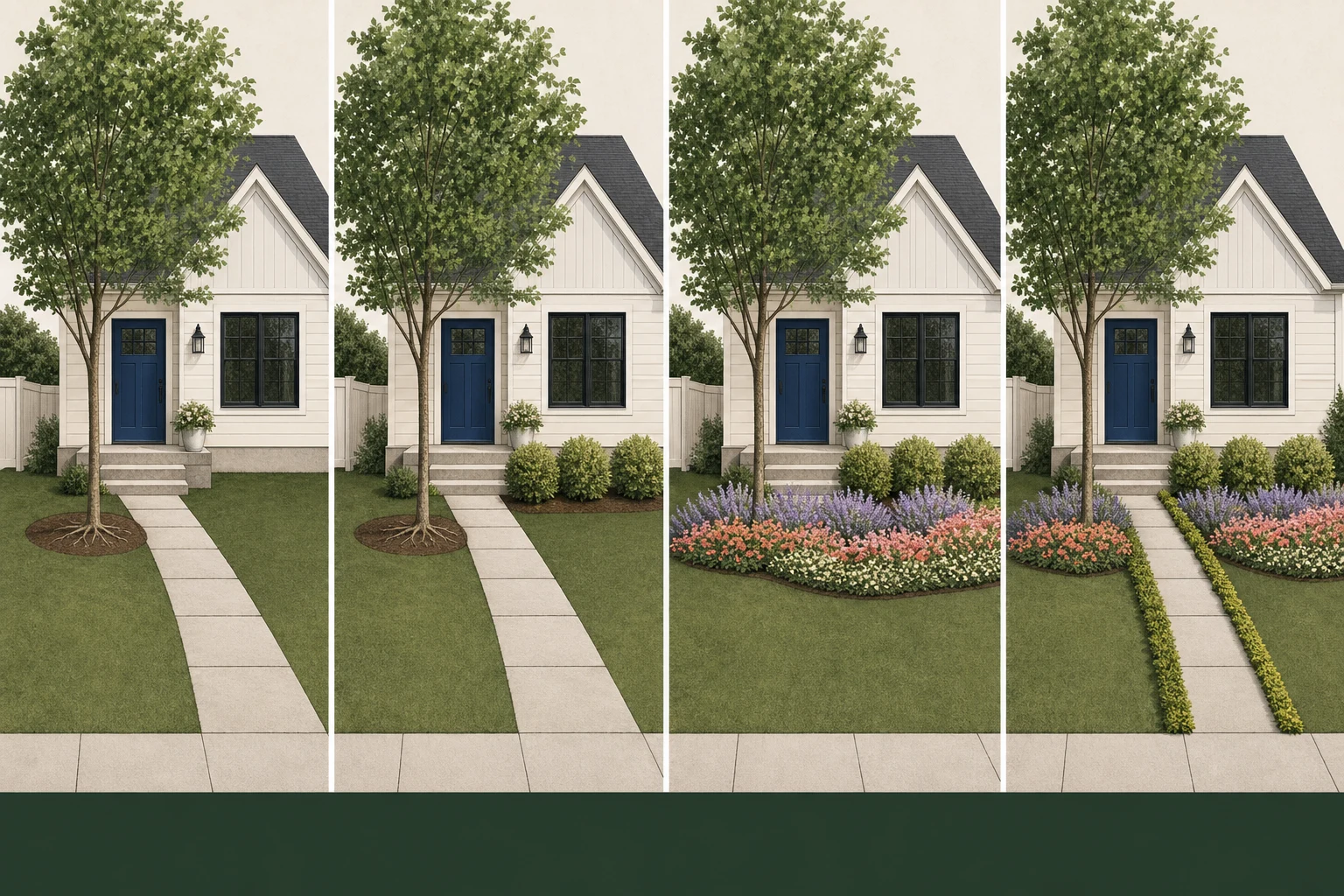
One vertical anchor
Use a compact tree or upright shrub to frame the entrance after checking canopy, roots, utilities, roof, and mature width.
One repeated structure plant
Repeat two or three compact shrubs to connect house and yard without turning them into a hedge.
One broad flowering ribbon
A connected group reads more clearly than small spots of color spread around the yard.
One low edge where it matters
Use it along the main path or visible bed front, then stop before every surface is outlined.
A worked plan for a compact front yard
This compact example keeps the route and one open foreground before assigning plant quantities.
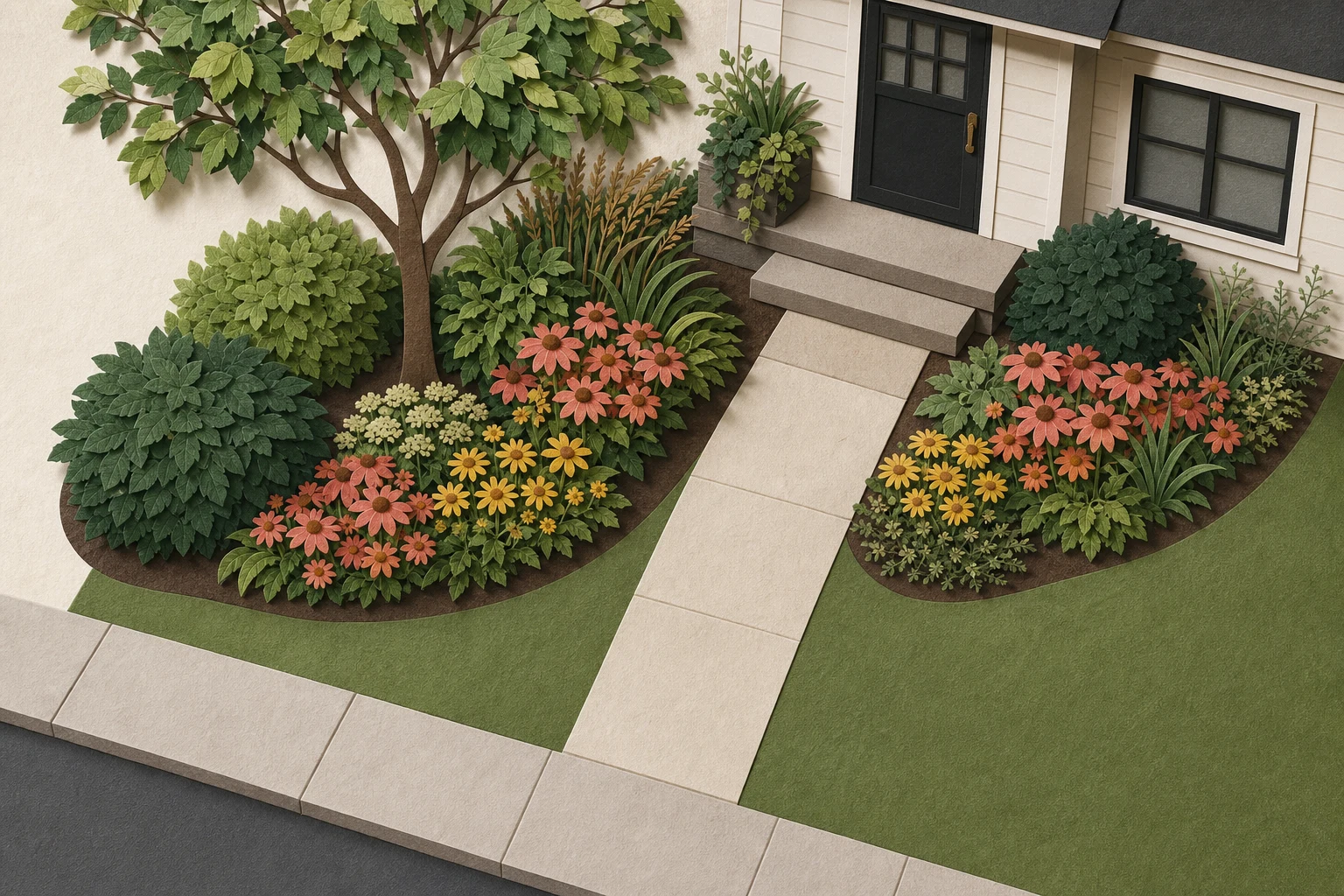
A centered door, a direct path, and more planting space on the left
A four-foot path runs from sidewalk to door. The remaining space is split into a larger left bed and a smaller right bed.
See the plan notes
Keep the four-foot path direct
Do not narrow the arrival route with mature foliage. Place spreading plants far enough back to preserve the usable width.
Place one small tree in the larger bed
Move it away from the exact center. Confirm mature canopy and root fit before choosing a species.
Repeat one compact shrub type
Use two on the larger side and one on the smaller side so the palette repeats without creating mirror symmetry.
Use matching flowering masses on both sides
Let one mass be visibly larger than the other. The mature spread and actual bed shape determine how many plants each mass needs.
If the plan needs more than one tree, three shrub types, several path turns, and multiple edging materials, remove one idea before buying anything.
Check the plan in three real moments
A small yard is read in motion. Review the approach, the arrival, and the everyday view before finalizing it.
- Approaching from curb or driveway
- The front door stays obvious, and car doors, bins, and the walk remain usable at mature size.
- Arriving at the front step
- The path keeps its full usable width and foliage stays clear of steps, lighting, and handrails.
- Living with the yard
- Views from the windows stay useful, and property edges, utilities, roots, and local rules remain respected.
The best compact-yard idea is the one that still works from every daily route, not the one that looks fullest in a single image.
Frequently asked questions
How do I make a small front yard look bigger?
Keep the main route simple, preserve one open shape, repeat a limited plant palette, and avoid dividing the yard with many small objects and materials. Mature scale matters more than using only tiny plants.
Can a small front yard have a tree?
It can when the exact tree's mature canopy, roots, height, utilities, building clearance, and local conditions fit the site. A tree that is small at purchase is not necessarily a small mature tree.
Should both sides of the path match?
They can share the same plants without matching every position. Unequal masses often fit real driveways, windows, and property edges better than strict symmetry.
What photo works best for planning a small front yard?
Use a wide photo from the curb that includes the whole facade, door, path, driveway edge, property boundaries, and existing plants. Add measurements separately.
 Gardenful
Plan the whole small yard in one frame.
Photograph the entrance, path, and available ground together. Gardenful can help you test a planting direction without losing the routes that make the yard work.
Gardenful for iPhone
Download the app free and start with a photo of your yard.

Sources
These design principles are broadly useful. Exact plant selection, setbacks, utilities, and property rules require local checks.
- [1]Landscape Design: Ten Important Things to Consider
University of Florida IFAS Extensionhttps://ask.ifas.ufl.edu/publication/ep375
- [2]Landscape Design: Aesthetic Characteristics of Plants
University of Florida IFAS Extensionhttps://ask.ifas.ufl.edu/publication/EP433
- [3]