Privacy planting
Best plants for privacy: choose by role, width, and season
The short answer
The best privacy plant is the one whose mature shape interrupts your actual sightline without swallowing the available bed. Use narrow forms or climbers in tight strips, overlapping shrubs for eye-level cover, and a small tree only when the view is higher. Then verify the exact variety's mature width, seasonal density, roots, hardiness, and local suitability.
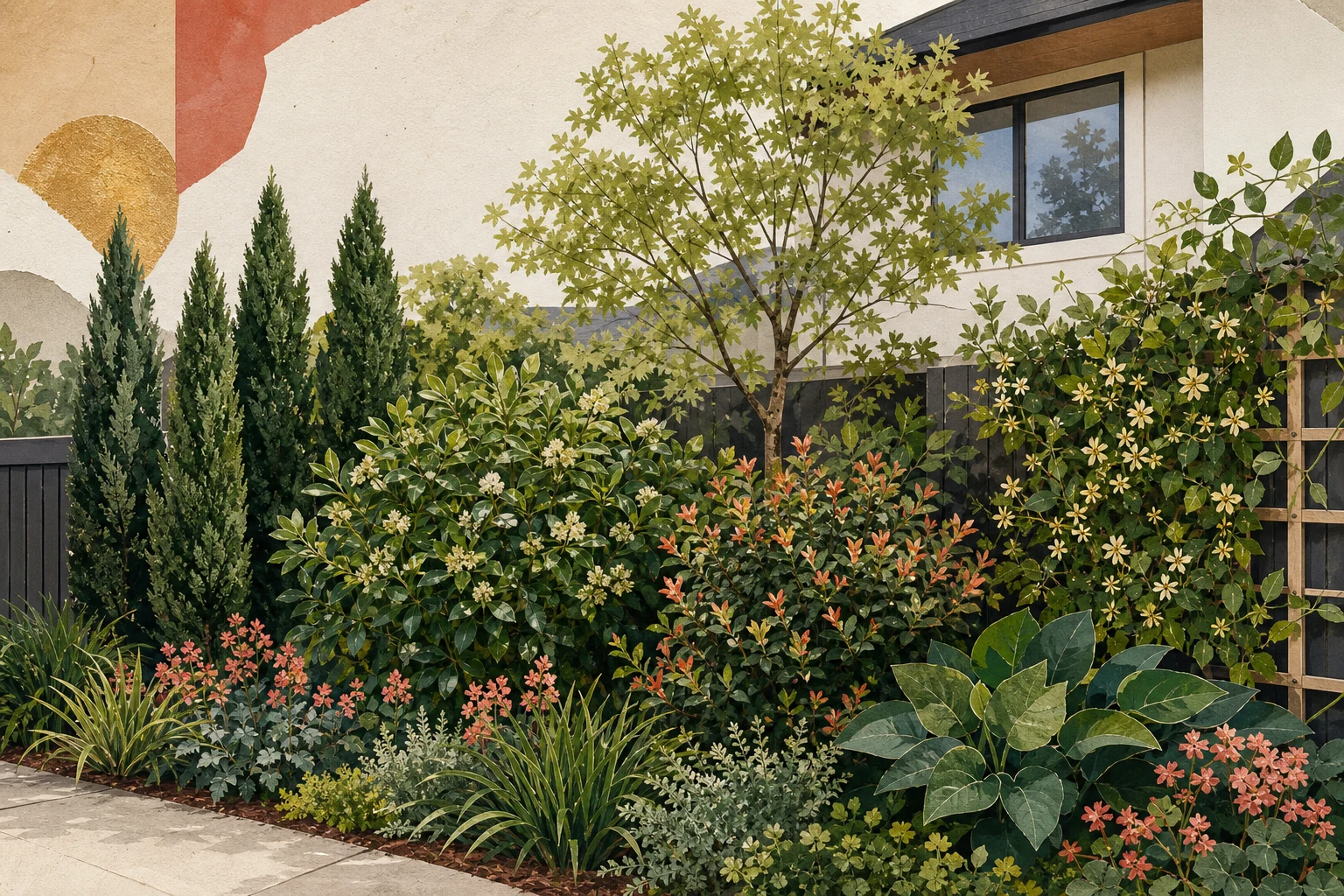
Match five privacy plant roles to five different gaps
Plant categories are more useful than a universal species list because each one solves a different combination of width, height, and season.
Start with the gap and the viewing position. Plant names come later, after the role and mature envelope are known.
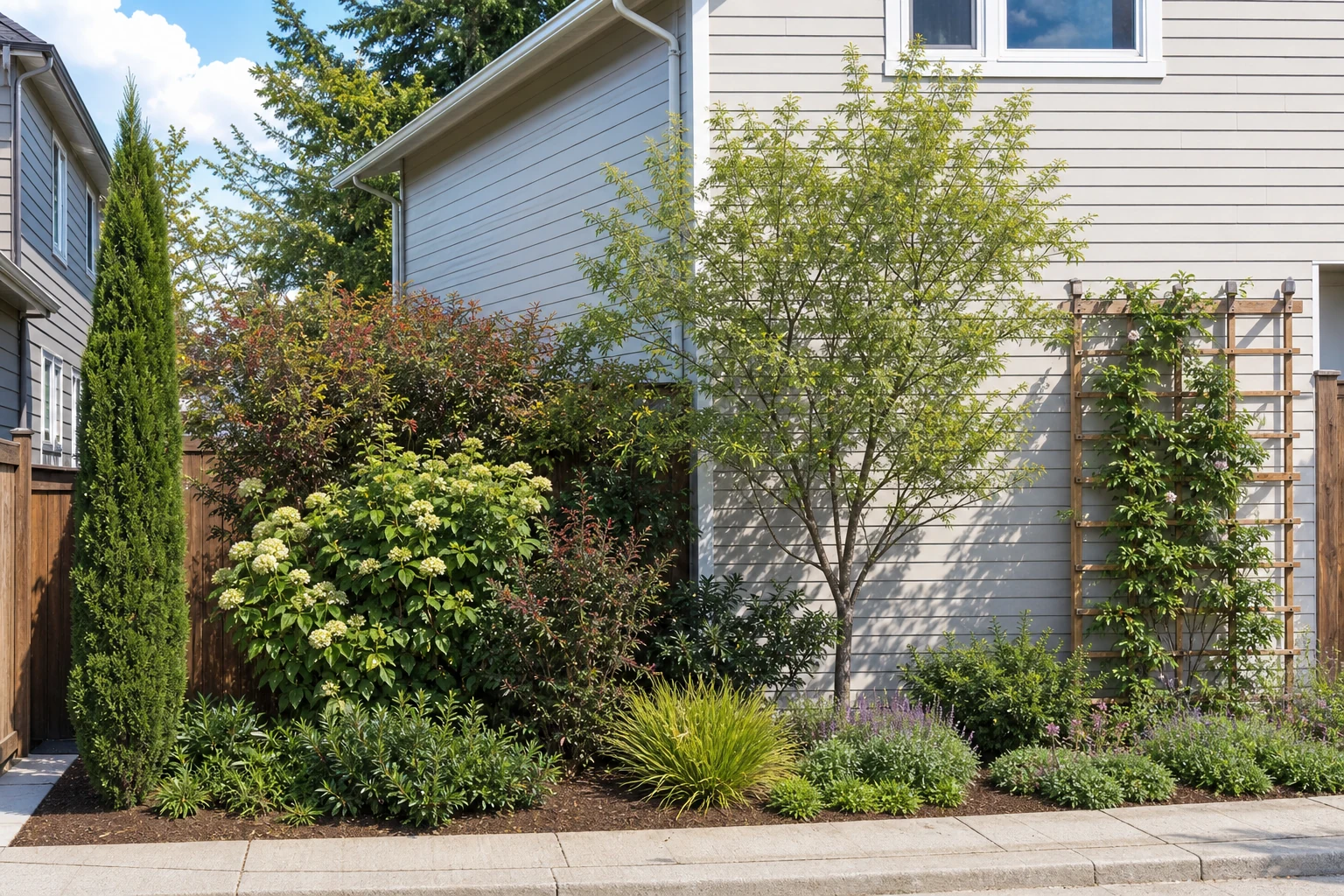
- 1
Narrow upright evergreen
Best for a tight side strip that needs year-round cover, provided the exact variety truly stays within the available width.
- 2
Broad screening shrub
Best for eye-level cover where the bed can hold its mature spread without constant shearing.
- 3
Airy small tree
Best for interrupting an upper window or long diagonal view without making the whole boundary equally tall.
- 4
Climber on a structure
Best where planting depth is scarce and a durable, permitted support can carry the screen.
- 5
Lower gap closer
Best for softening exposed stems and connecting the screen to the rest of the planting, not for replacing the main privacy layer.
Sources: Clemson Cooperative Extension, University of Florida IFAS Extension
Measure the view before comparing privacy shrubs or trees
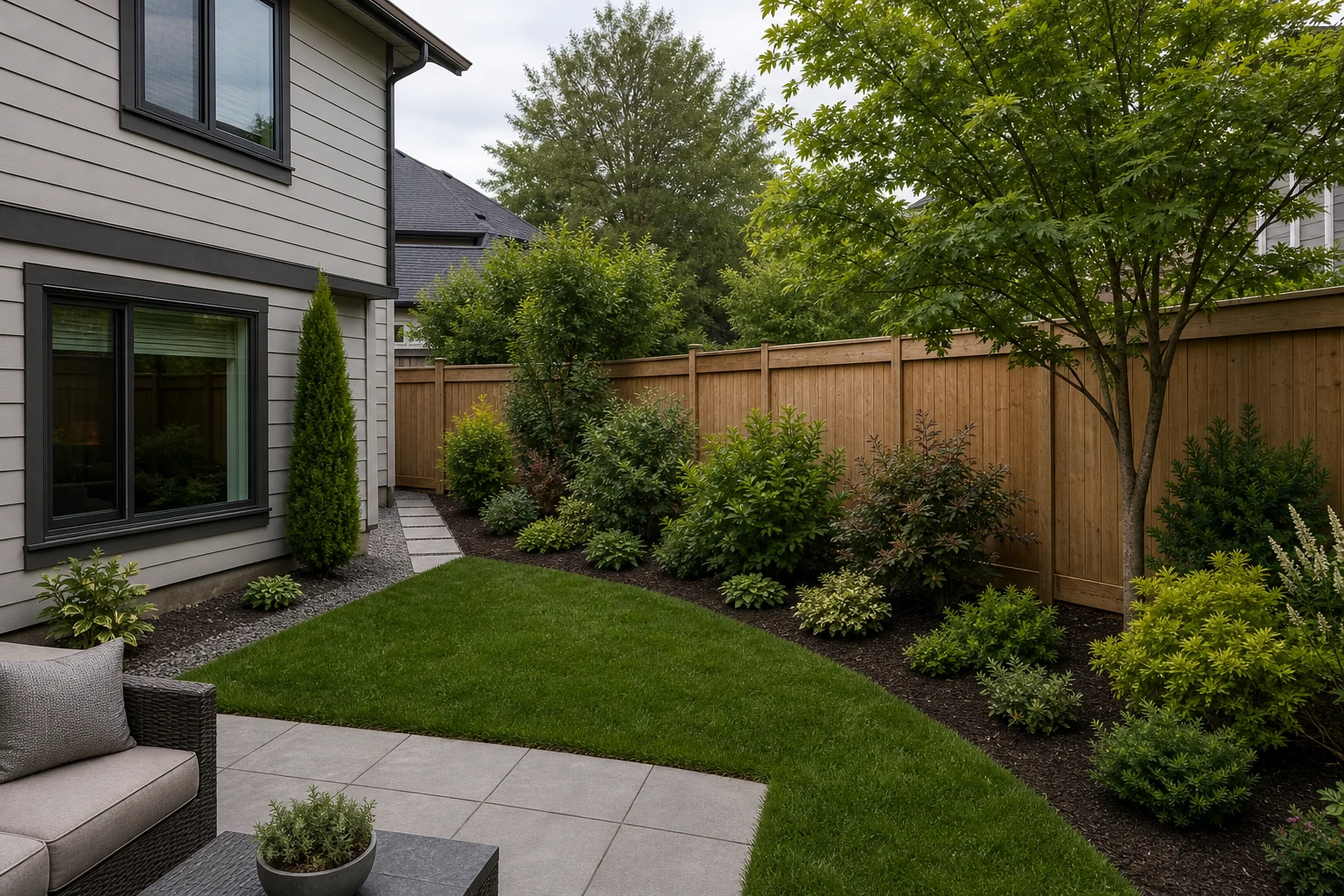
Height alone is a poor buying filter. A plant can be tall enough and still miss the view, or wide enough to make a path unusable.
- 1
Stand where privacy matters
Use the patio seat, kitchen window, desk, or daily route—not the property line—as the starting point.
- 2
Identify the smallest interruption
Mark the part of the neighboring window, route, or activity area that actually needs to disappear.
- 3
Measure usable bed depth
Subtract paths, gate swings, utilities, fence access, eaves, and the space needed to maintain both sides.
- 4
Draw the mature envelope
Compare the exact variety's mature height and width with the remaining space before calculating quantity.
Choose a privacy-screen structure before choosing species
Answer three short questions to match the view and available planting depth to one honest screen structure. The result teaches a starting system; it does not invent measurements for your yard.
Choose a screen structure
1 of 3
Confirm the sightline in place, then verify exact plants with local extension guidance or a knowledgeable nursery. Check utilities, access, neighbor impacts, and local rules before digging or adding a structure.
Sources: Clemson Cooperative Extension, Common Ground Alliance
Verify six facts for the exact privacy plant variety
Common names often cover plants with very different widths and habits. For scale, one Maryland reference lists 'Blue Arrow' juniper at about 2–3 feet wide, 'Emerald' arborvitae at about 3–4 feet, and inkberry holly at about 5–8 feet. These are regional examples, but the contrast shows why the exact variety—not just the plant type—decides whether a screen will fit.
Mature height and width in conditions like yours
Evergreen, semi-evergreen, or deciduous behavior in your climate
Sun, soil, drainage, and establishment-water needs
Root space, utility clearance, and distance from paving or structures
Disease, pest, deer, salt, wind, or heat issues relevant to the site
Regional native status, invasiveness, and local planting restrictions
Frequently asked questions
What are the best plants for privacy?
There is no single best privacy plant. Use a narrow evergreen or climber on a trellis for a tight strip, a broad shrub for eye-level cover, and a small tree for an upper window. Then verify the exact plant's mature width, seasonal density, and fit for your climate and site.
Are privacy trees better than privacy shrubs?
Not automatically. A tree is useful for a higher or longer sightline, while shrubs usually provide denser eye-level cover. A layered mix often solves both views with less unnecessary height.
How far apart should privacy plants be?
Follow the exact variety's recommended spacing and compare it with its mature spread, accounting for whether you are planting a single or staggered screen. Do not calculate from nursery-pot width, and leave access to fences, utilities, and maintenance routes.
Should a privacy screen be one evergreen hedge?
A uniform hedge can work in a formal setting with enough width and maintenance, but a mixed screen can provide better layering, seasonal interest, and resilience if one plant develops a problem.
 Gardenful
Preview the privacy roles before buying a hedge
Start from a yard photo and a clear sightline, then verify mature dimensions and exact varieties locally.
Gardenful for iPhone
Download the app free and start with a photo of your yard.

Sources(4)
- [1]Mixed Screens
Clemson Cooperative Extensionhttps://hgic.clemson.edu/factsheet/mixed-screens/
- [2]Plants for Mixed Privacy Screens
University of Maryland Extensionhttps://www.extension.umd.edu/resource/plants-mixed-privacy-screens
- [3]Landscape Design with Plants: Creating Outdoor Rooms
University of Florida IFAS Extensionhttps://ask.ifas.ufl.edu/publication/EP449
- [4]811 Before You Dig
Common Ground Alliancehttps://call811.com/