Gardenful style guide
How to design a meadow garden
The short answer
A meadow garden is a managed plant community that takes several seasons to establish. Choose a sunny site, remove competing vegetation thoroughly, use a regional seed mix or small plants, and keep one mown path or crisp edge. Plan for first-year mowing and weed control; many perennial meadow plants remain small while they establish.
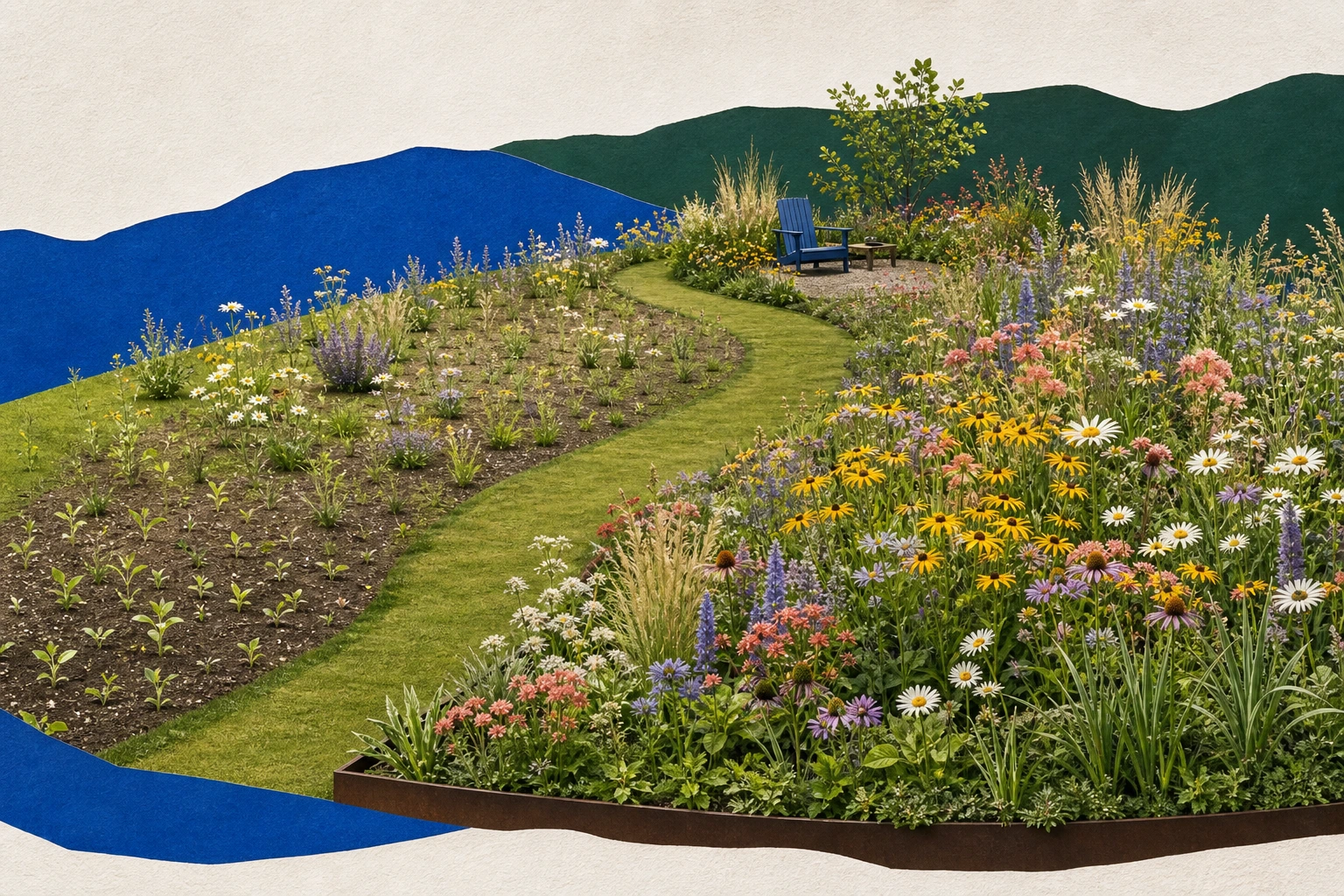
The meadow begins before the flowers
Existing lawn and perennial weeds are strong competitors. Scattering seed into them rarely creates a durable meadow.
Identify the current vegetation and perennial weeds before disturbing the site. Choose a preparation method that fits the season, local guidance, and your tolerance for herbicide, solarization, cultivation, or sod removal. Test before adding fertilizer, which can favor grass and weeds.
University of New Hampshire Extension describes seed establishment as a three-year process and gives the first year to preparation. Young perennial wildflowers stay small and cannot compete with established lawn grass and aggressive weeds.1
Choose the establishment method you can manage
Seed is economical at scale, while plugs make species placement and early identification easier.
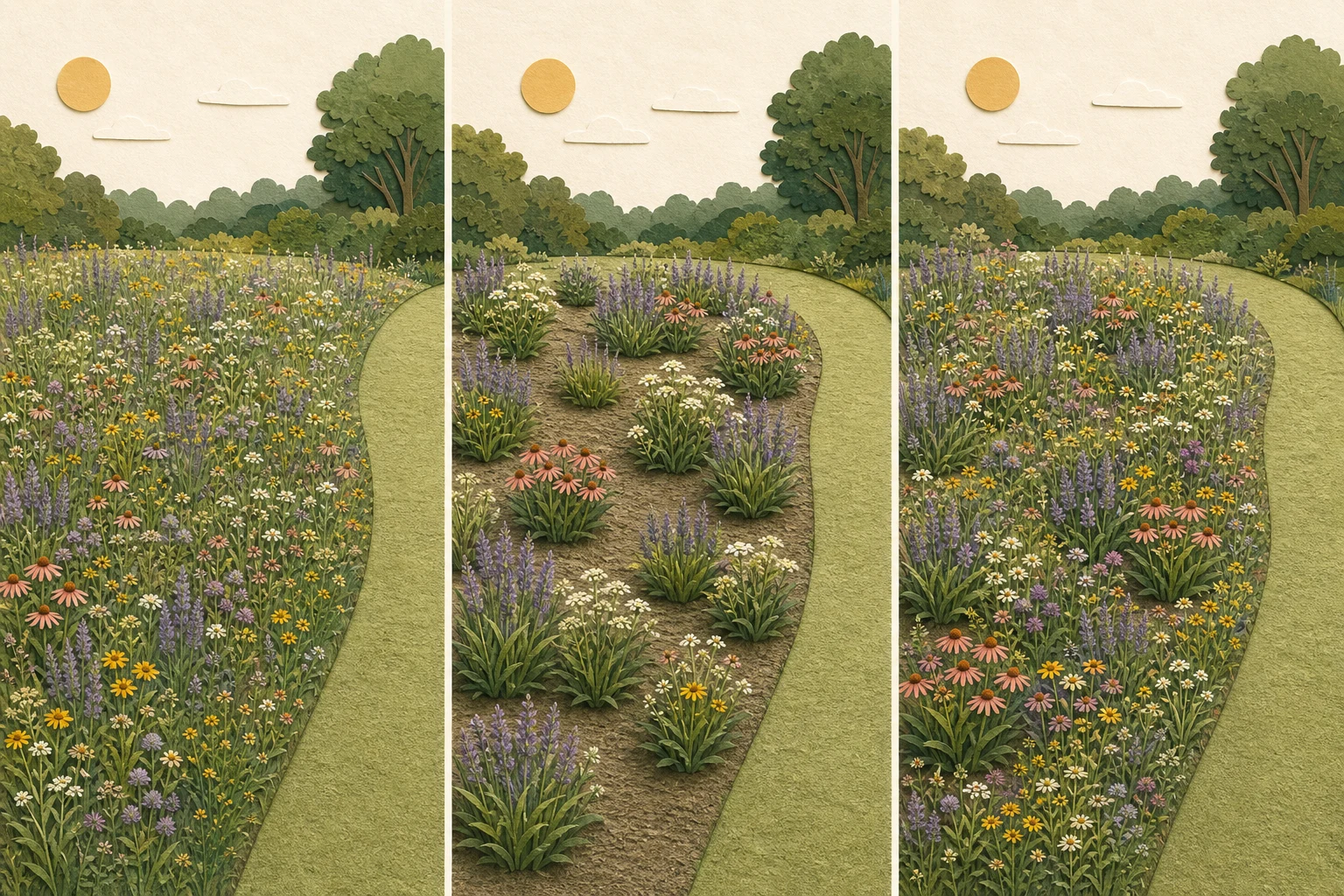
Regional seed mix
- Strength
- Larger sunny areas where thorough preparation and multi-year weed management are realistic.
- Watch for
- Seed source, regional composition, germination needs, first-year identification, and slow establishment.
Plugs
- Strength
- Smaller home beds where you want a legible pattern, selected species, and easier weed recognition.
- Watch for
- Higher material cost, establishment water, and more planting labor.
Seed plus plugs
- Strength
- A visible home garden where repeated plug groups can carry the design while seeded plants fill the matrix.
- Watch for
- Requires a coordinated palette so the plugs do not compete with or disappear inside the seed mix.
Sources: University of New Hampshire Extension, University of Connecticut Home Garden Education Office
A former lawn becoming a meadow over three years
This example reserves one clear path and treats establishment as a sequence of different jobs.
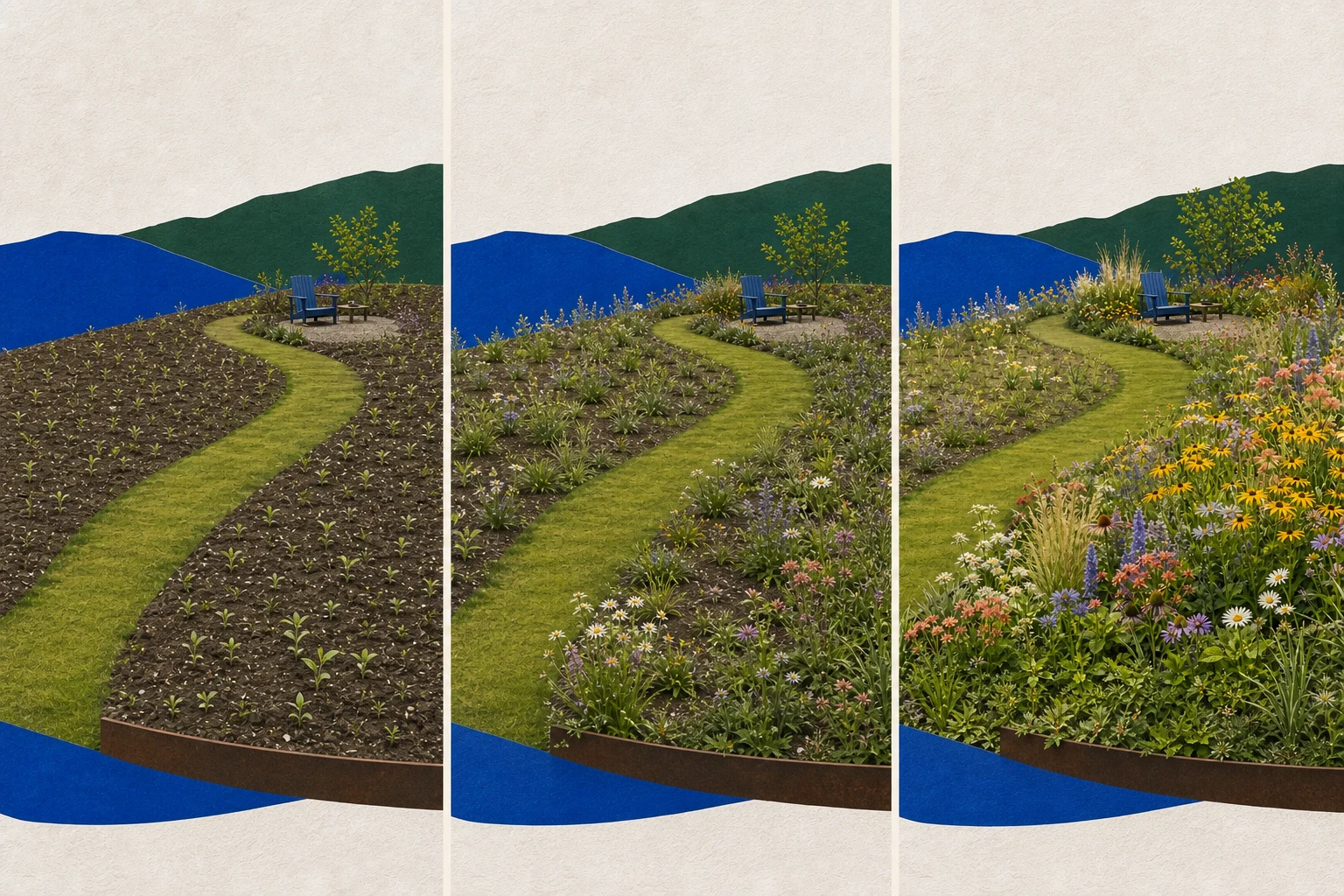
- 1. First season
- 2. Second season
- 3. Established meadow
Prepare, establish, then edit
A sunny former lawn has a rectangular boundary, one desired curved route, and moderate perennial weed pressure.
Preparation season
Map weeds, choose the regional meadow type and supplier, control existing vegetation, test soil, and keep the future path out of the planting area.
First growing season
Follow the seed supplier and regional extension timing. Monitor weeds and mow at the recommended height and frequency before they shade young meadow plants.
Second season
Identify gaps and aggressive weeds, add plugs where the design needs visible repetition, and keep the path and edge clear.
Third season and beyond
Use the locally recommended annual cut or mow, remove woody invaders, edit problem species, and review whether the mix still fits the site.
A meadow is lower-frequency maintenance after establishment, not no maintenance. The work shifts from weekly mowing to seasonal cutting and plant-community editing.
Make the meadow look intentional from the street
Visible cues of care help a home meadow read as a designed landscape while the plant community changes.
One usable path: Keep a mown or paved route wide enough to use and maintain.
A crisp foreground edge: Use a low planted band or short-mown frame near sidewalks and drives.
A repeated entrance pattern: Group a few plug-grown flowers near the entrance so the planting reads clearly.
Open sightlines: Keep driveways, corners, hydrants, utilities, and addresses visible.
Local rules: Check weed, fire, HOA, municipal, and roadside-height requirements before planting.
The managed edge is not a betrayal of the meadow. It tells neighbors and future you where the planting begins and ends.
Frequently asked questions
Can I scatter wildflower seed over my lawn?
Usually not with durable results. Established turf and perennial weeds outcompete young meadow seedlings. Thorough site preparation is a central part of extension guidance.
How long does a meadow take to establish?
Plan for about three years from seed, with preparation before sowing and active weed management during establishment. Some annuals may flower earlier, but they do not prove the perennial meadow is established.
Is a meadow garden low maintenance?
It changes the maintenance rather than removing it. After establishment, expect seasonal cutting or mowing, weed and woody-seedling control, path and edge care, and periodic editing.
Should I use a national wildflower mix?
Prefer a reputable regional mix or locally appropriate species plan matched to the site's soil, moisture, light, and goals. Check every mix for unwanted or invasive species in your area.
 Gardenful
Plan the meadow you will manage for three years.
Use the yard photo to reserve a path, crisp edge, and mature planting zones before choosing a regional seed or plug plan.
Gardenful for iPhone
Download the app free and start with a photo of your yard.

Sources(3)
- [1]Establishing a Wildflower Meadow from Seed
University of New Hampshire Extensionhttps://extension.unh.edu/resource/planting-pollinators-establishing-wildflower-meadow-seed-fact-sheet
- [2]Establishing Meadows from Seed
University of Delaware Cooperative Extensionhttps://www.udel.edu/academics/colleges/canr/cooperative-extension/fact-sheets/establishing-meadows/
- [3]Wildflower Meadows
University of Connecticut Home Garden Education Officehttps://homegarden.cahnr.uconn.edu/factsheets/wildflower-meadows/