Gardenful field guide
Landscaping ideas for a red brick house
The short answer
Red brick is already the largest and strongest color in the front-yard composition. Treat it as the starting point, repeat one quiet bridge color from the trim or door, and add plenty of green structure. Choose one flower family that either cools the brick with blue-violet and white or warms it with coral and cream. Keep mature plants below windows and leave the entrance easy to read.
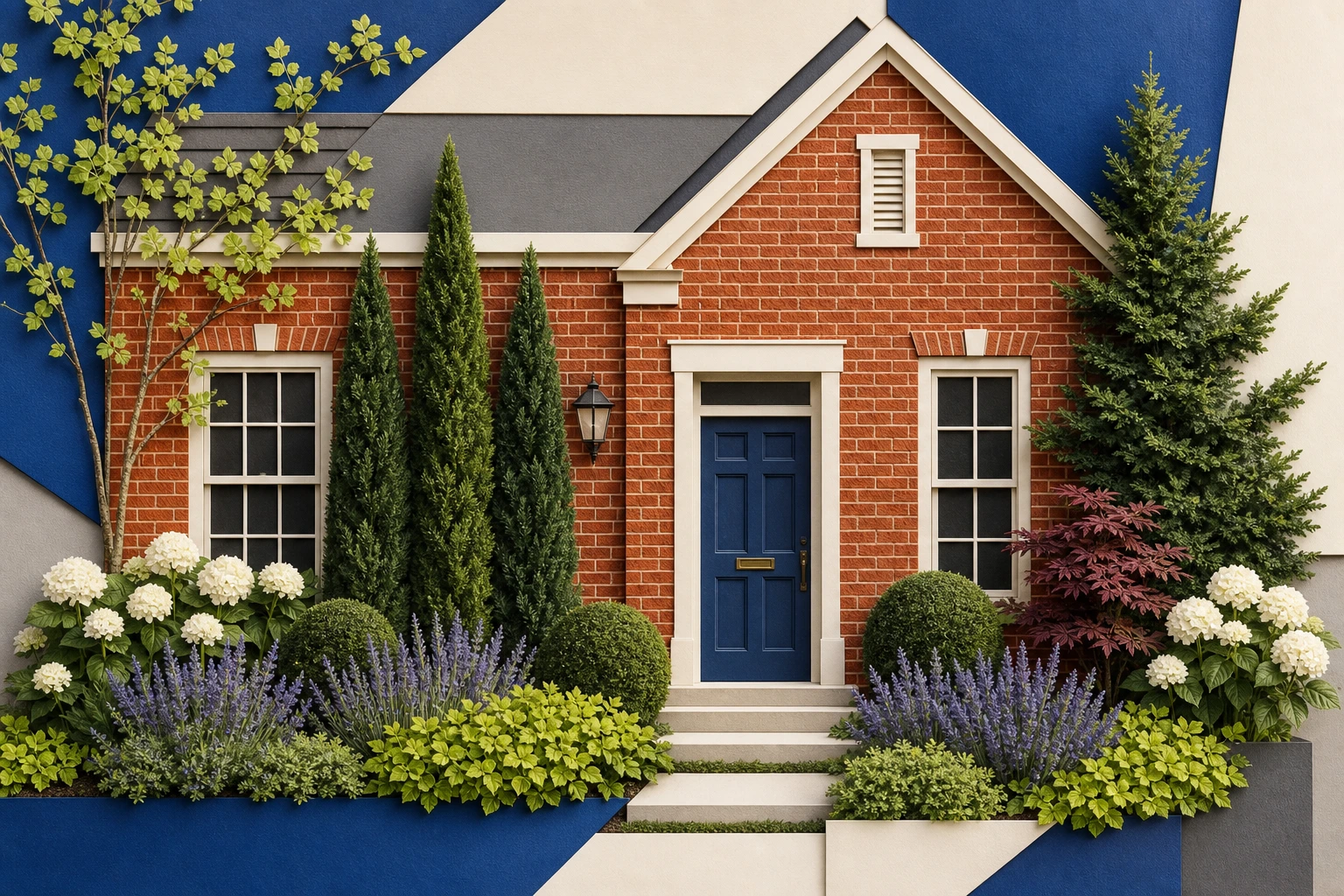
Sample the brick before choosing flower colors
Red brick may lean orange, brown, rose, or blue-red. The undertone changes which colors feel calm beside it.
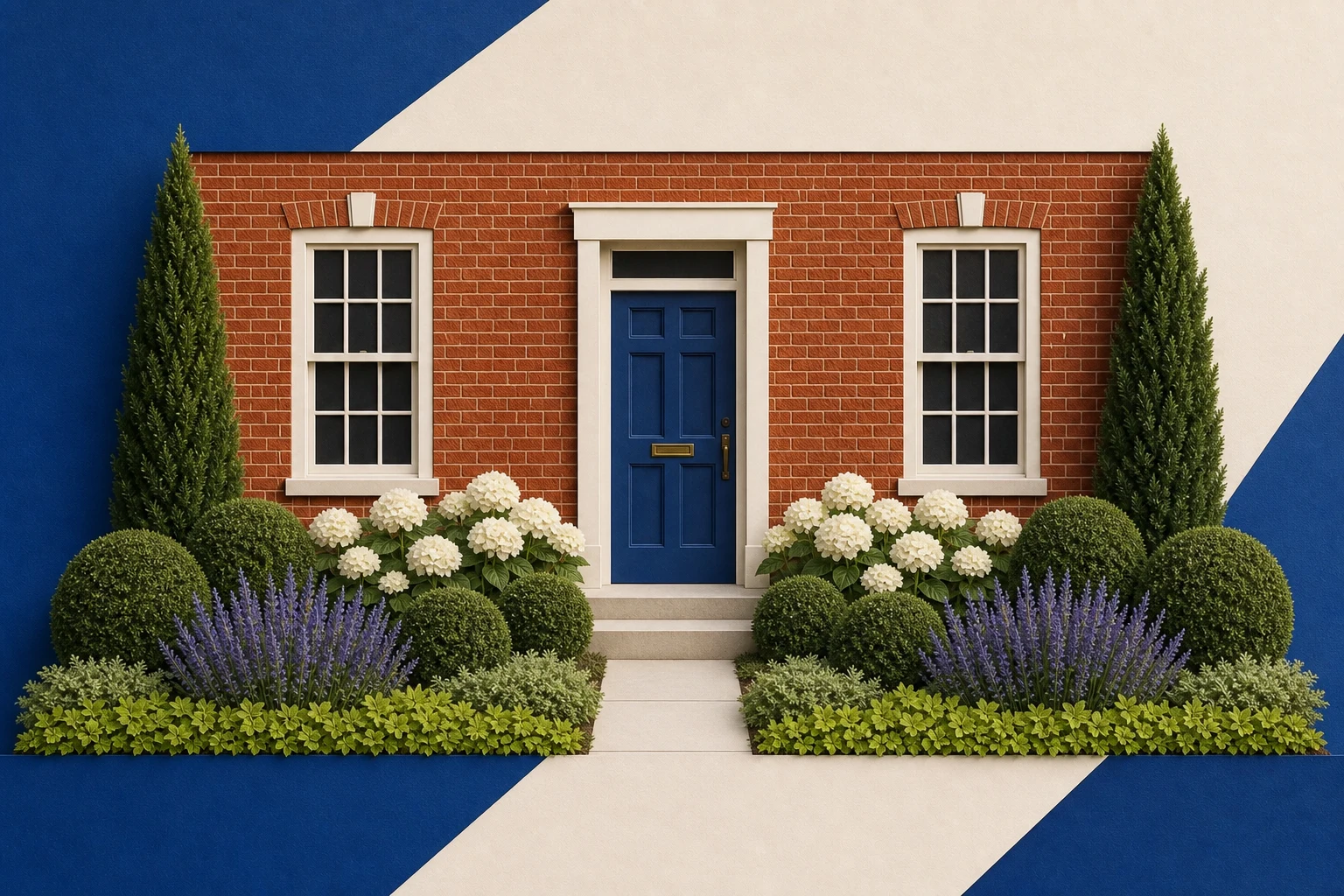
Photograph the facade in open shade and late-day sun. Pull out the dominant red and darkest shadow, then note the trim, roof, and door. Check the palette from the curb, where fine dark foliage may disappear but a broad light mass remains visible.
Flower color is powerful but temporary. UF/IFAS recommends considering form, texture, foliage, bark, and fruit so the composition still works outside bloom. Against brick, repeated foliage does more long-term work than a fourth flower color.1,2
Choose one of three dependable color directions
Keep green as the base, then repeat one light color and one accent family.
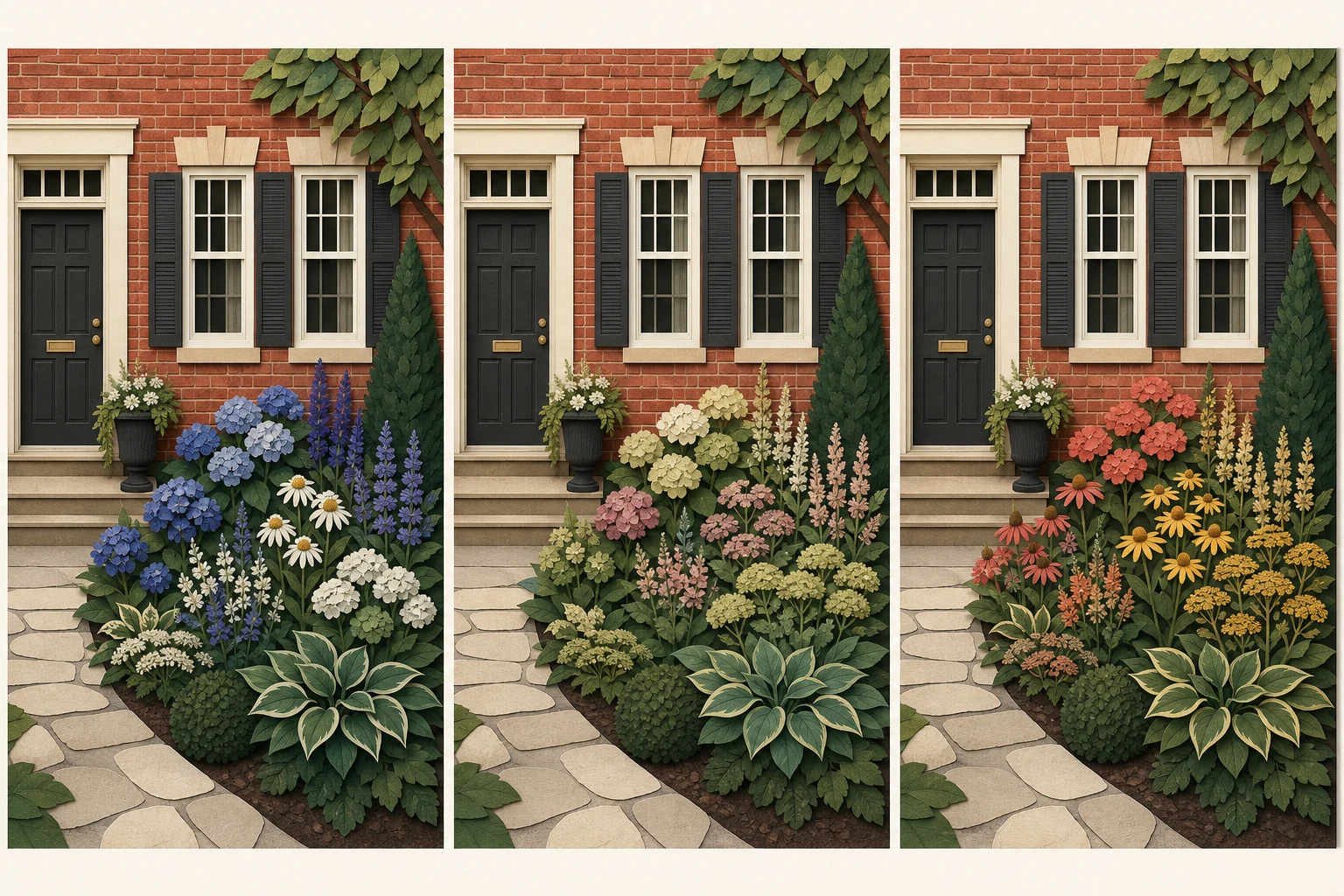
Cool and crisp
- Plant color idea
- Deep green structure with white and blue-violet flowers. This gives orange-red brick the clearest separation.
- Watch for
- Very cool blue can feel disconnected if the roof, trim, and door are all warm brown.
Warm and quiet
- Plant color idea
- Cream, soft yellow, apricot, and restrained coral repeat the warmth without trying to match every brick.
- Watch for
- Use different leaf shapes and enough green so the facade and flowers do not merge.
Foliage-led
- Plant color idea
- Chartreuse, silver-green, deep green, and one small burgundy accent work when you want less seasonal color.
- Watch for
- Burgundy needs a lighter neighbor or it can vanish against darker brick.
Sources: University of Florida IFAS Extension, University of Florida IFAS Extension
A front bed below two windows
This example uses a cool palette to calm orange-red brick without hiding the facade.
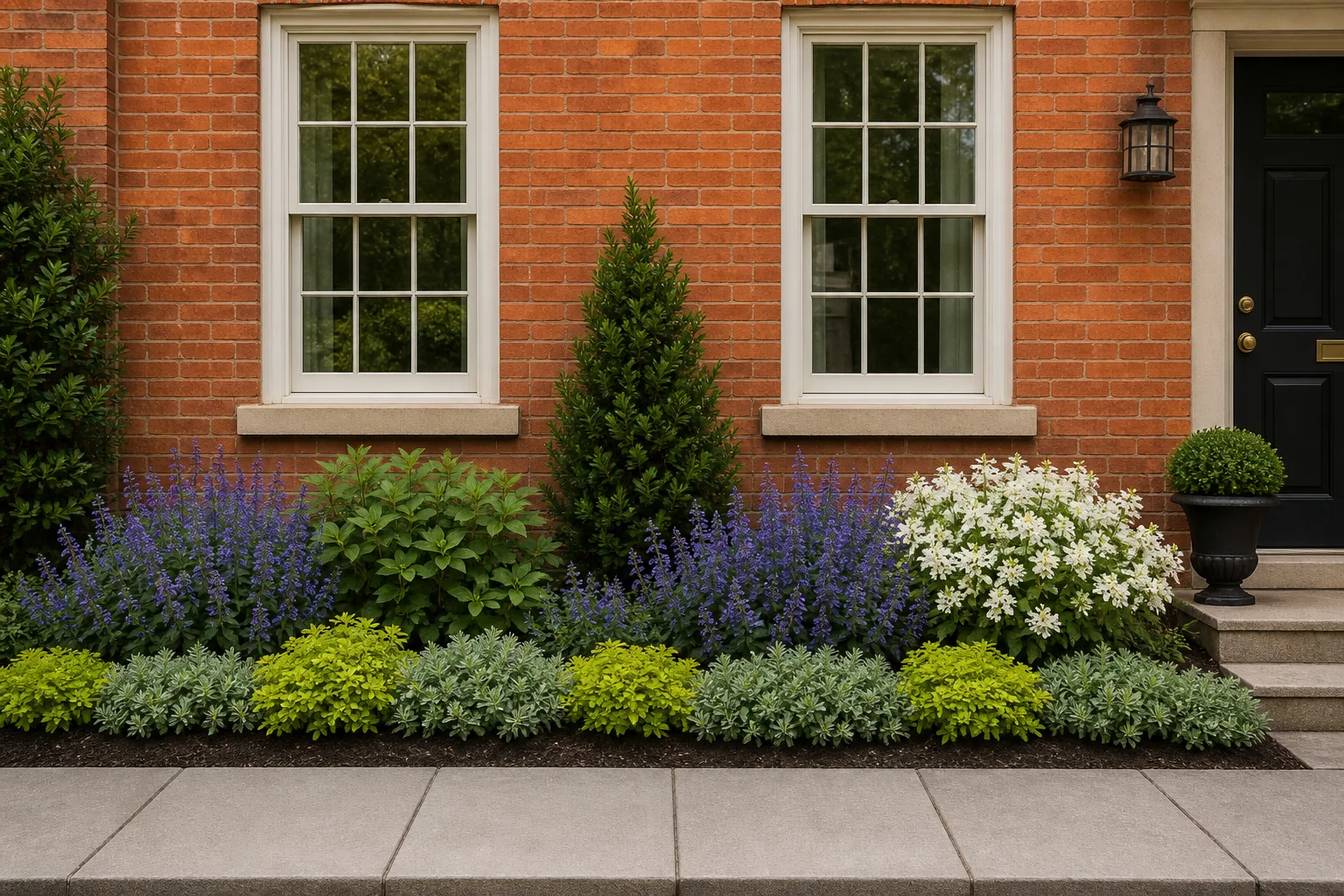
Green structure, white light, blue-violet rhythm
Two windows sit above the bed, with sills 42 inches above soil level. That clearance, not the bed's total width, sets the front planting height.
See the plan notes
Frame, do not plug, the windows
Place two compact structural plants between or outside the windows, based on mature width. Keep the sill area lower.
Repeat one blue-violet plant
Use two uneven groups, such as three and five, to create rhythm across the facade.
Add one white flowering mass
Put the lightest group near the entrance or the darkest brick section where it can clarify the route.
Finish with a low foliage edge
Repeat a chartreuse or silver-green edge so the bed remains visible when flowers are closed.
Check every candidate at mature height. The palette cannot rescue a shrub that blocks the window or swallows the walk.
Keep the planting from fighting the architecture
The house sets real limits that matter more than a color board.
Keep wall access clear: Leave windows, vents, meters, downspouts, and service areas visible and reachable.
Protect the entrance hierarchy: The front door and primary walk should remain obvious from the street.
Draw shrubs at mature size: Do not rely on permanent shearing to fit an oversized plant below a window.
Repeat house color sparingly: Use small doses in pots, edging, or flowers instead of copying every brick tone.
Verify the actual site: Check light, drainage, foundation clearances, utilities, and local plant fit.
A good front bed makes the house easier to read, not harder to maintain.
Frequently asked questions
What flower colors look good with red brick?
White and blue-violet create clear separation, while cream, apricot, and restrained coral make a warmer scheme. Test the palette against the actual brick undertone, trim, roof, and door rather than treating all red brick alike.
Do burgundy plants work with red brick?
They can, but dark burgundy often disappears against dark red or brown brick. Use it as a small accent beside lighter green, silver, chartreuse, or white so the outline stays visible.
Should foundation shrubs cover the bottom of the house?
No. Plants can soften the transition between house and ground without forming a continuous wall. Keep windows, vents, meters, downspouts, and access clear.
Can Gardenful match plants to my brick house?
Gardenful can use your yard photo to create a planting direction that responds to the facade. Final plant fit still depends on local light, soil, climate, mature size, and availability.
 Gardenful
Try the palette against the brick, not a mood board.
Use a photo of the real facade to compare planting structure and color before the nursery trip.
Gardenful for iPhone
Download the app free and start with a photo of your yard.

Sources(3)
- [1]Color in the Landscape
University of Florida IFAS Extensionhttps://ask.ifas.ufl.edu/publication/EP425
- [2]Landscape Design: Arranging Plants
University of Florida IFAS Extensionhttps://ask.ifas.ufl.edu/publication/EP449
- [3]Landscape Design: Ten Important Things to Consider
University of Florida IFAS Extensionhttps://ask.ifas.ufl.edu/publication/EP375