Gardenful field guide
Sloped front yard landscaping ideas
The short answer
A sloped yard is first a water-and-soil problem, then a planting design. Watch where water enters, speeds up, and leaves the slope. Keep soil covered, place repeated plant masses across the contour, and use roots plus temporary erosion protection while plants establish. Treat walls, major grading, drainage systems, and unstable soil as professional work rather than a planting project.
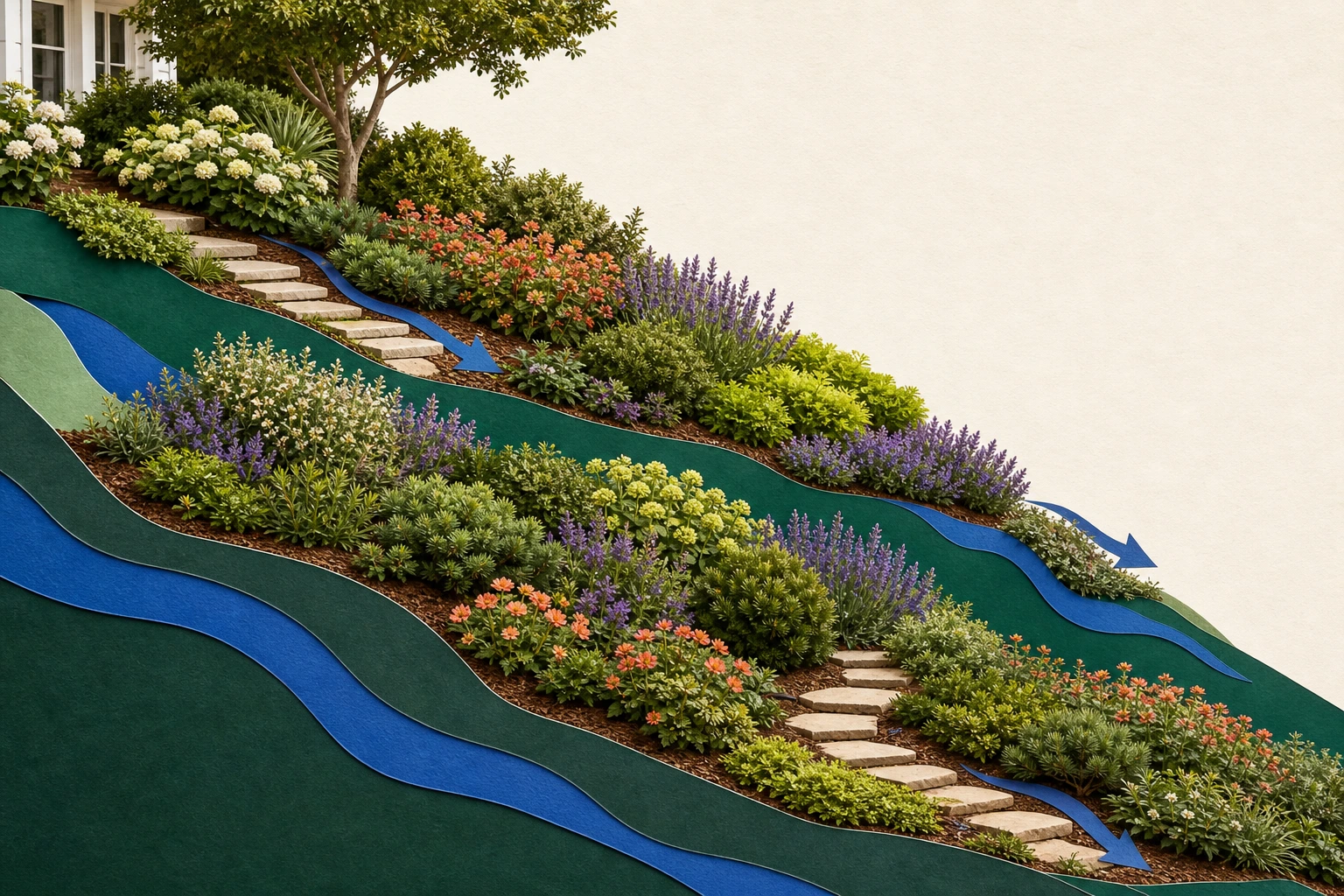
Watch one hard rain before drawing the plan
A slope is a water path. The planting plan should respond to how water actually moves across it.
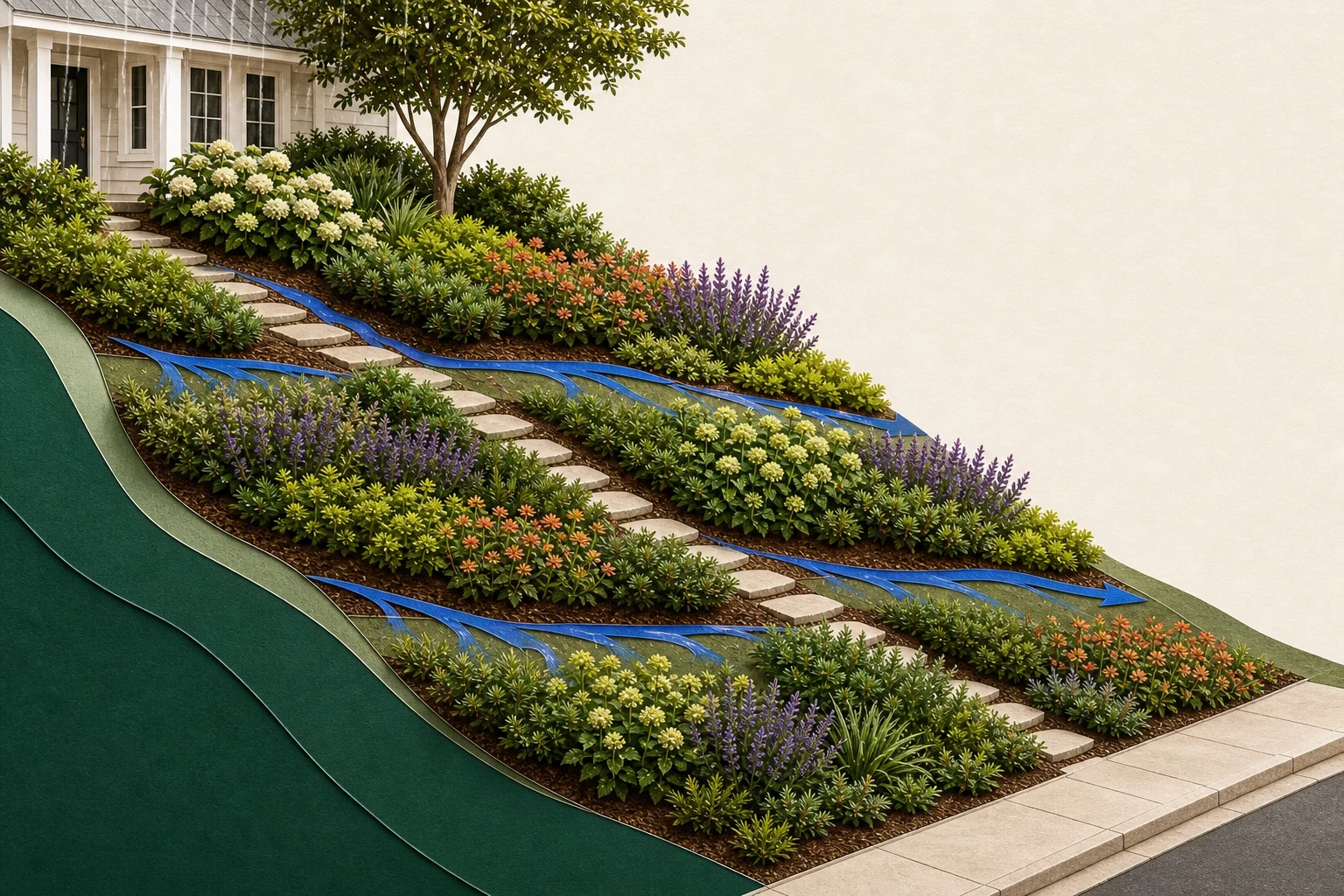
From a safe location, photograph the slope during or just after rain. Mark downspouts, compacted tracks, bare streaks, displaced mulch, and water crossing a path. Those clues separate ordinary surface flow from a concentrated source that needs drainage or grading advice.
Exposed soil remains vulnerable while groundcovers establish. University of Maryland Extension recommends temporary mulch or biodegradable cover during that gap. Roots provide the long-term cover, but protection begins as soon as the old vegetation is disturbed.1
Use broad bands instead of scattered dots
Planting masses that cross the contour are easier to read and leave less connected bare soil downhill.
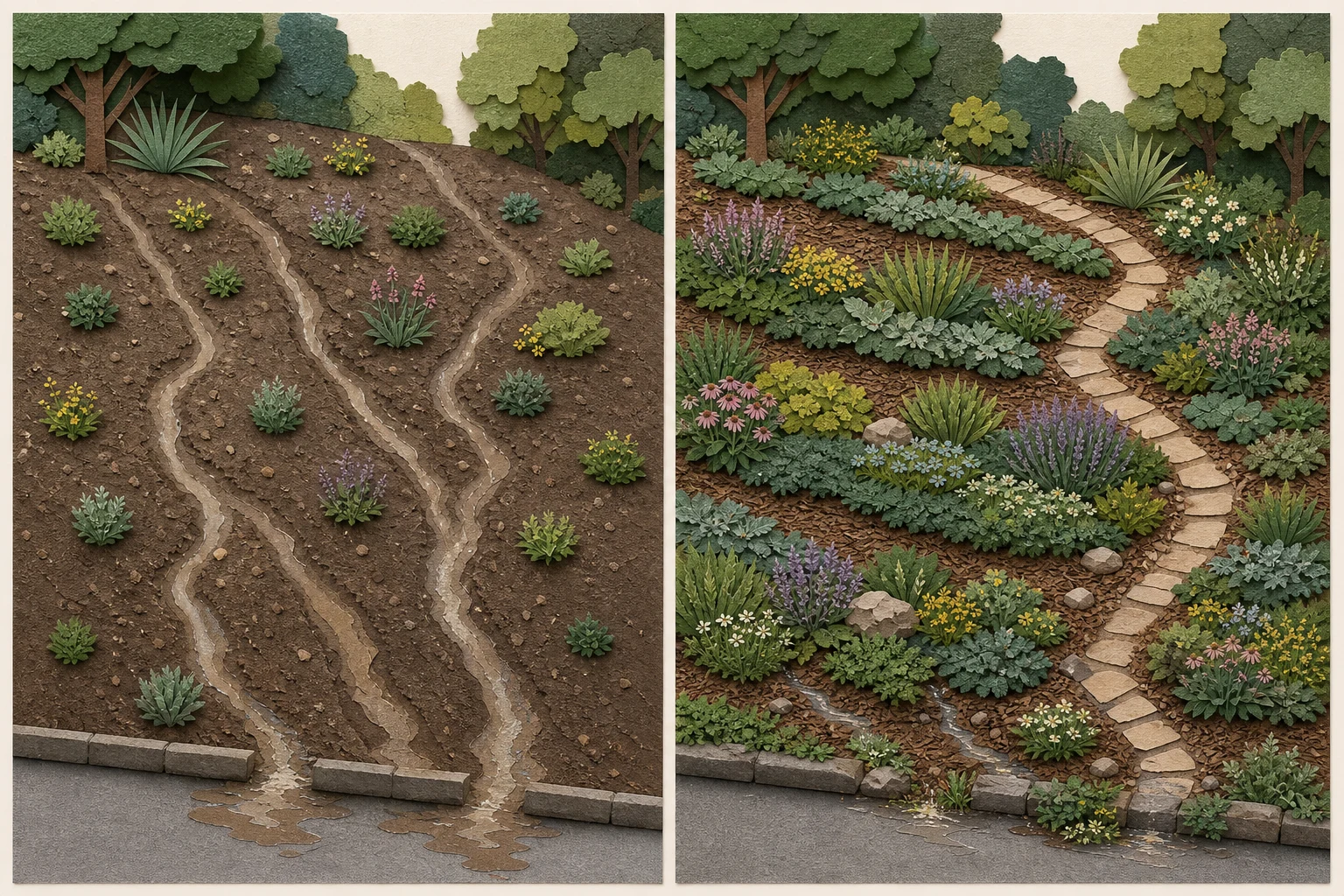
- Scattered plants
- Cross-slope bands
Anchor with repeated shrubs
Use locally suited shrubs in offset groups where the soil depth and access allow. Draw each at mature spread so maintenance remains possible.
Connect with spreading perennials
Repeat clumping or spreading plants between anchors. Check vigor and invasive status so erosion control does not become a containment problem.
Cover the soil surface
Use mulch or a suitable temporary erosion-control material during establishment. Avoid loose material that simply washes to the sidewalk.
Give people a cross-slope route
A gentle diagonal or switchback route is often easier than steps straight up the fall line. Structural path design and code questions belong with a qualified local professional.
Planting can stabilize ordinary landscape soil, but it is not a repair for a failing slope, retaining wall, landslide risk, or drainage system.
A moderate front slope with a diagonal route
This example organizes a planted slope without proposing structural grading.
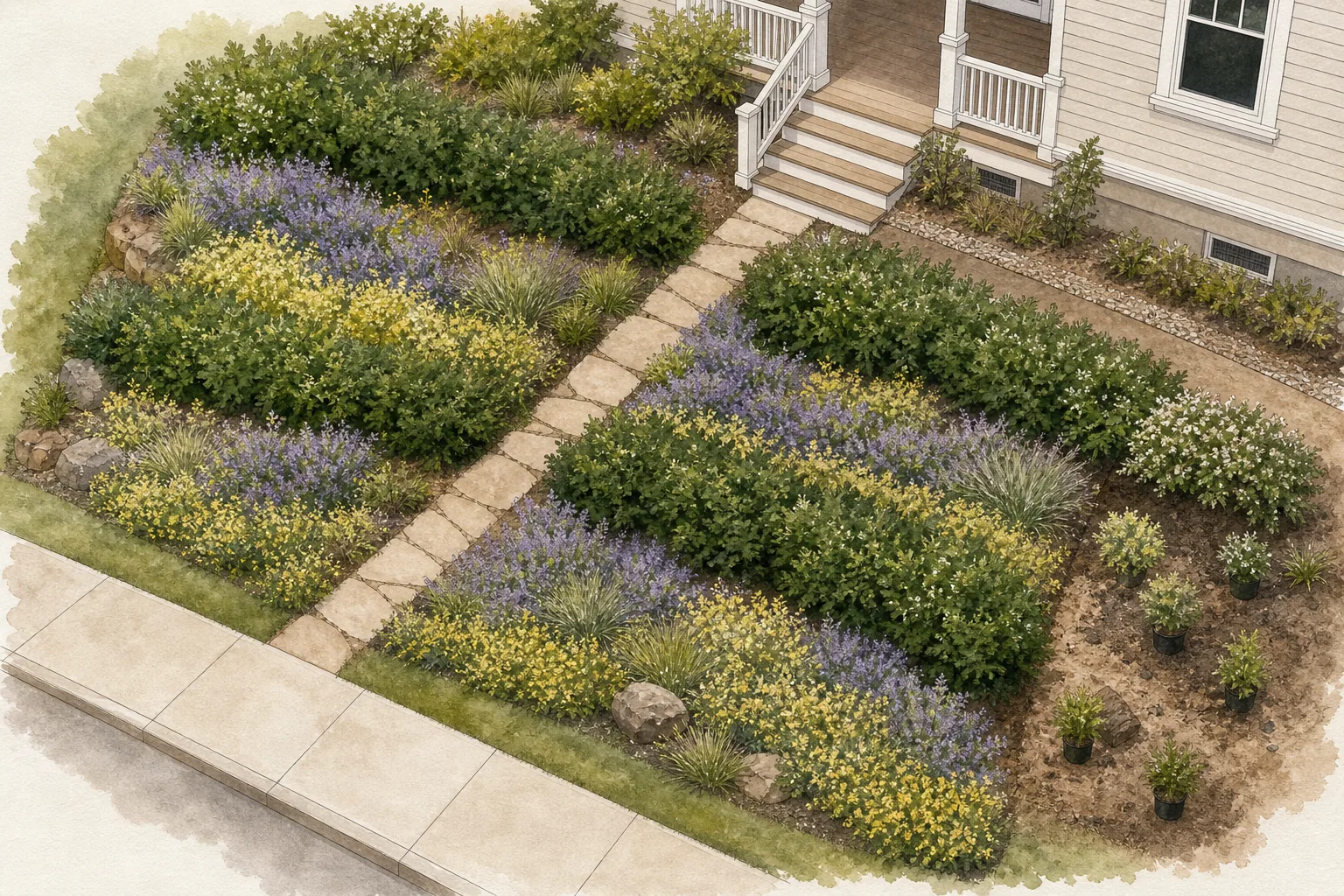
Three bands and one diagonal route
The sunny slope runs from sidewalk to porch and shows shallow surface erosion after rain.
See the plan notes
Keep an access and observation strip at the top
Do not bury the house, vents, or drainage outlets. Preserve access and keep runoff sources visible.
Repeat three shrub groups
Place them in staggered bands across the slope, not in one downhill line that can channel water.
Fill with two lower plant masses
Use one broad flowering perennial and one lower ground-covering role suited to the region and soil.
Stage the installation
Work in sections so the entire slope is never bare. Protect disturbed soil before the next expected rain.
The visual pattern and erosion strategy can share the same geometry: broad overlapping bands across the slope.
Stop and get local help when the slope is structural
Some warning signs are beyond the scope of a planting guide or garden-design app.
The ground or structures are moving: Cracks, bulges, slumping soil, leaning walls, and exposed foundations need local assessment.
Water is damaging property: Get help when water enters a house, crosses a boundary, or concentrates from a public drain.
The slope is unsafe to access: Do not plant, water, or maintain a slope you cannot reach safely.
The work changes the structure: Retaining walls, major regrading, drainage pipes, and permit-dependent work need qualified guidance.
Utilities or excavation limits are unknown: Pause near services, easements, sidewalks, and structures until they are located.
Gardenful can help with planting direction. It does not replace grading, drainage, engineering, or permit advice.
Frequently asked questions
What is the best landscaping for a sloped front yard?
A good planting approach keeps soil covered, repeats plants in broad bands across the slope, and responds to runoff. The exact plants depend on region, sun, soil, moisture, access, and the slope's stability.
Will groundcover stop erosion immediately?
No. Young plants need time to establish. Protect exposed soil with an appropriate temporary cover or mulch and avoid disturbing the whole slope at once.
Do I need a retaining wall?
That is a structural and site-specific decision. Cracking, slumping, steep grades, drainage problems, and proposed walls or regrading should be assessed by qualified local professionals and permitting authorities.
Can Gardenful design a sloped yard?
Gardenful can help visualize a planting direction on the photo. It does not provide grading, drainage, retaining-wall, engineering, or permit guidance.
 Gardenful
Turn the slope into broad planted bands.
Start with a photo after rain, mark the planting area, and compare a direction that keeps the water path and maintenance access visible.
Gardenful for iPhone
Download the app free and start with a photo of your yard.

Sources(3)
- [1]Groundcovers
University of Maryland Extensionhttps://extension.umd.edu/resource/groundcovers
- [2]
- [3]Landscaping Tips
U.S. EPA WaterSensehttps://www.epa.gov/watersense/landscaping-tips