Gardenful field guide
How to design a desert landscape
The short answer
A comfortable desert landscape manages heat and water before it displays sculptural plants. Cool a window, route, or sitting area with an appropriately scaled tree or built shade, direct suitable runoff toward planted areas, and group plants with similar water needs. Leave open ground around strong forms, but avoid an unshaded gravel field. The final plant list must fit the region.
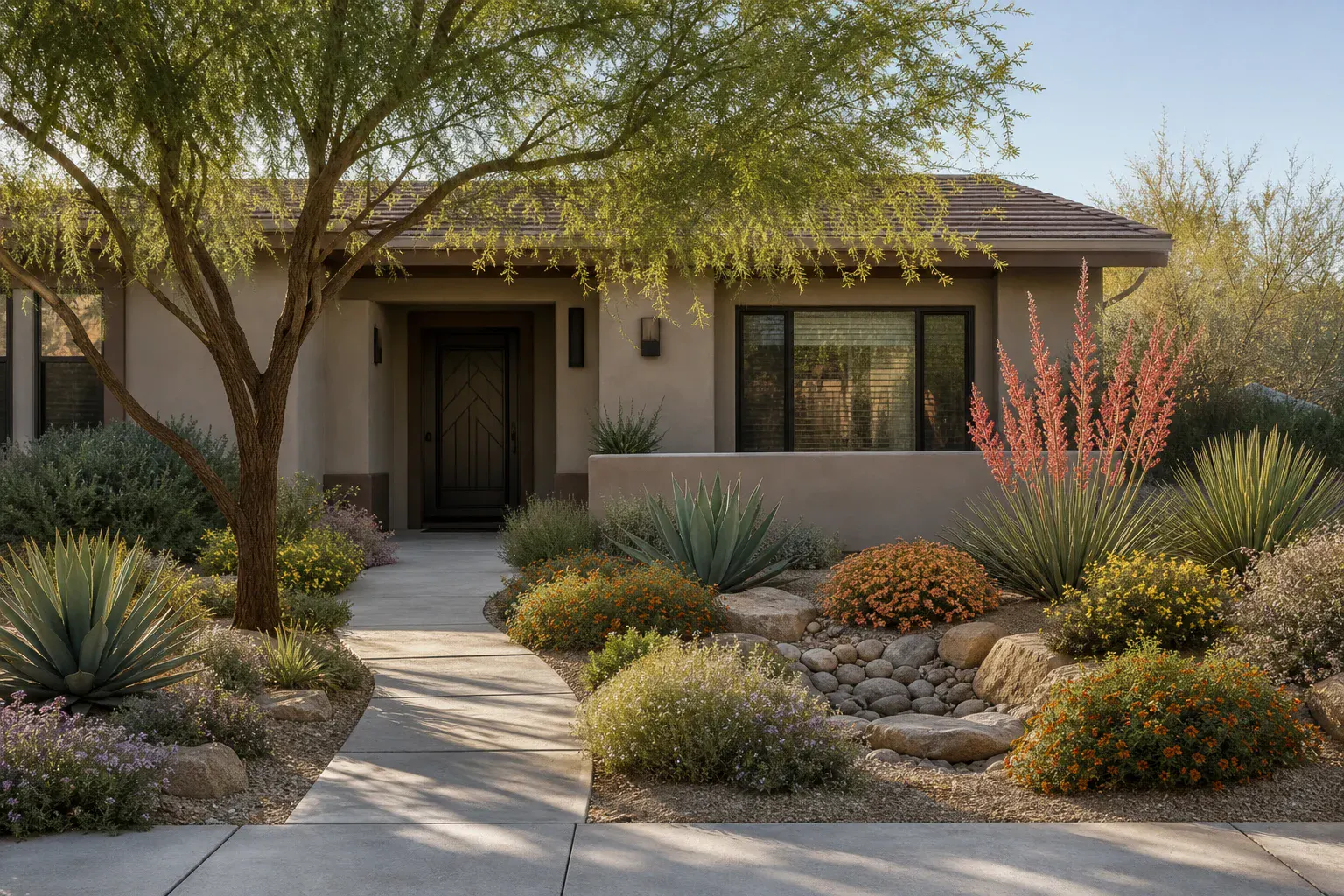
Make the yard comfortable before making it decorative
A strong desert plan works with heat, scarce water, and dramatic seasonal rain rather than styling the surface after the fact.
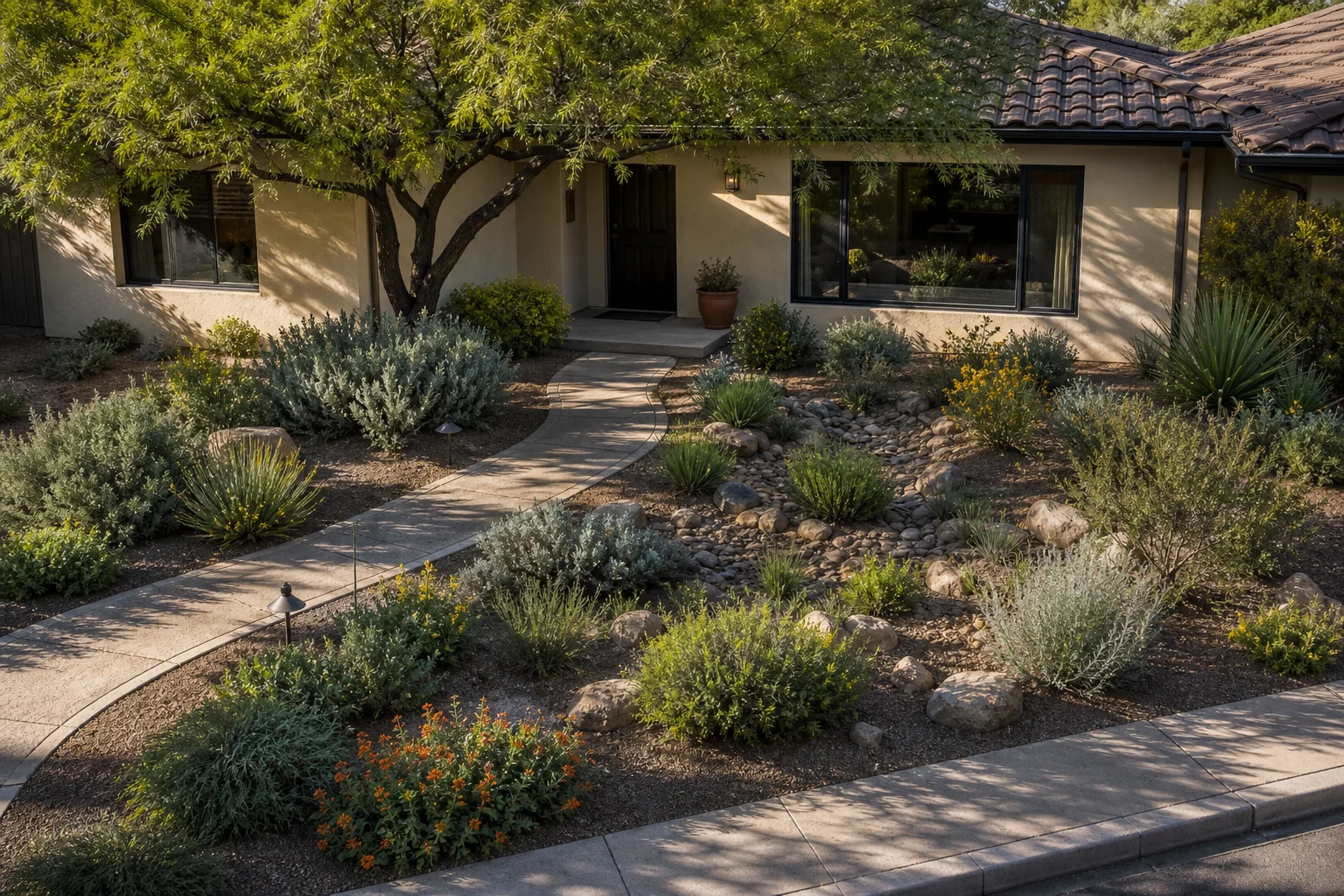
- 1
Put shade where people and glass need it
Use a regionally appropriate tree or built shade to cool the entry, west-facing glass, or a sitting area without blocking the route or damaging the house.
- 2
Read the runoff path
Observe where roof and paving water already move. Where appropriate, shallow planted basins can slow and spread water without trapping it against the foundation.
- 3
Group plants by water need
Keep plants with similar irrigation needs together. Put the most regular watering near the house or active area, then transition to lower-water regional planting.
- 4
Use gravel selectively
Gravel can support circulation and drainage, but broad unshaded expanses absorb and radiate heat. Combine mineral surfaces with canopy, planted masses, and unpaved infiltration areas.
Choose a desert direction that matches the region
The visual language can travel, but the plant palette, winter limits, and water pattern cannot be copied unchanged.
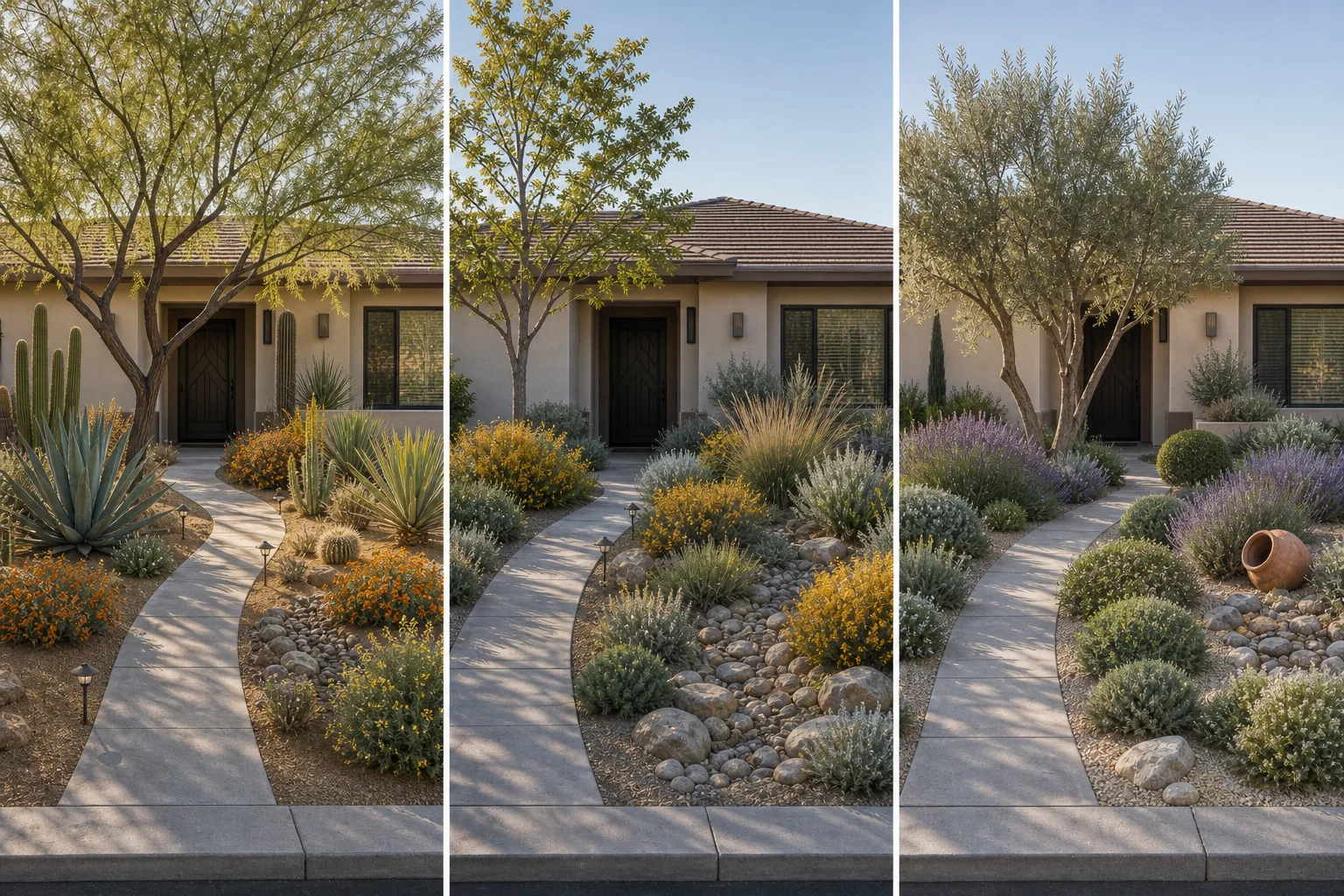
Sonoran low desert
- Composition
- Airy shade canopy, broad open spacing, rounded flowering mounds, and sculptural accents.
- Climate boundary
- Extreme heat and mild winters; many high-desert plants struggle here while frost-sensitive plants fail at elevation.
- Useful plant forms
- Canopy + open shrub + flowering mound + guarded sculptural accent.
Cold or high desert
- Composition
- Wind-aware structure, hardy bunchgrasses, lower shrubs, and a smaller number of cold-tolerant accents.
- Climate boundary
- Cold minimums and wind can matter as much as summer drought. The USDA zone only describes winter minimum temperature.
- Useful plant forms
- Hardy small tree + grass block + perennial repeat + low ground plane.
Dry-summer Mediterranean
- Composition
- Silvery shrubs, small drought-adapted trees, restrained flower ribbons, and a few clipped structural forms.
- Climate boundary
- A winter-rain dry-summer site is not Sonoran ecology. Drainage, fire context, and local plant communities change the palette.
- Useful plant forms
- Small tree + repeated regional shrub + seasonal ribbon + open ground.
Sources: University of Arizona Cooperative Extension, USDA Plant Hardiness Zone Map, University of Florida IFAS Extension
Build a desert palette by role
A short role list produces more cohesion than collecting one of every dramatic plant.
The role stays; the exact plant can change
- Cooling canopy
- An airy tree or built shade placed for people and glass.
- Structural repeat
- A shrub, grass, or upright form repeated through the view.
- Seasonal middle
- Broad flowering masses rather than scattered dots.
- Ground and basin
- Mulch, low plants, and infiltration contours that support the water plan.
- Sculptural accent
- One or two strong forms kept away from circulation.
Regional planting directions
Low-desert example: A palo-verde-like canopy, creosote-like open structure, brittlebush- and desert-marigold-like flower masses, and guarded agave- or red-yucca-like accents can create a Sonoran direction.
Higher-desert example: A desert-willow-like small tree, sotol- or hardy-yucca-like structure, penstemon- and blackfoot-daisy-like seasonal repeats, and a dry regional grass ground plane can handle a colder visual translation.
Dry-summer example: A desert-willow-like anchor, manzanita-like evergreen structure, deergrass-like repetition, and California-fuchsia- or buckwheat-like seasonal masses can create a regional desert-modern composition.
Role language in this illustration does not identify exact species. Verify a named plant with a regional source and local invasive guidance before buying.
Keep heat, spines, and runoff away from the route
Desert plants often have defensive forms or large mature outlines. Their placement is a safety decision.
Clear the walk: Keep spined, serrated, brittle, or bee-heavy plants outside the mature reach of paths, play areas, utilities, and doors.
Protect the foundation: Do not direct basins or roof runoff against the house. Confirm grades, overflow, and local stormwater guidance.
Account for reflected heat: Wall, gravel, and pavement temperatures can exceed general sun conditions. Check whether the exact plant tolerates that exposure.
Leave mature open space: Draw every canopy, shrub, and rosette at maturity so the garden stays open without forcing constant pruning.
Verify the regional palette
Desert is a broad visual category, not a complete site description.
Winter minimum and elevation: Use the USDA zone for cold screening, then check elevation and local frost patterns.
Heat, sun, and soil: Confirm reflected heat, drainage, soil chemistry, and summer versus winter rainfall.
Water and establishment: Even low-water plants need an establishment plan. Match irrigation frequency and root-zone depth to the exact plant.
Local risks: Check invasiveness, fire guidance, wildlife, toxicity, spines, and nursery availability with regional sources.
Frequently asked questions
Is desert landscaping just gravel and cactus?
No. A livable desert landscape usually needs shade, safe circulation, water-harvesting logic, repeated plant masses, and regionally adapted structure. Gravel is one surface, not the whole design.
How do I make desert landscaping less hot?
Prioritize an appropriately placed canopy or built shade, reduce broad unshaded rock surfaces, and direct suitable runoff toward planted areas. Confirm that drainage and grading remain safe for the house.
Can I use the same desert plants in every dry climate?
No. Low desert, high desert, and dry-summer climates differ in winter cold, elevation, humidity, rainfall timing, soil, and fire context. Translate the plant roles with regional sources.
How many sculptural plants should I use?
Use enough to create a repeated rhythm, but keep the strongest forms limited and safely outside circulation. A few accents usually read more clearly than a collection of unrelated rosettes and cacti.
 Gardenful
See a cooler, more planted desert direction.
Use a clear yard photo to test shade, open spacing, and regional plant roles before choosing exact plants.
Gardenful for iPhone
Download the app free and start with a photo of your yard.

Sources(4)
- [1]Xeriscaping: Retrofit Your Yard
Colorado State University Extensionhttps://extension.colostate.edu/resource/xeriscaping-retrofit-your-yard/
- [2]Recommended Plants for Sierra Vista
University of Arizona Cooperative Extensionhttps://extension.arizona.edu/publication/recommended-plants-sierra-vista
- [3]How to Use the Maps
USDA Plant Hardiness Zone Maphttps://planthardiness.ars.usda.gov/pages/how-to-use-the-maps
- [4]Right Plant, Right Place
University of Florida IFAS Extensionhttps://ask.ifas.ufl.edu/publication/EP416