Gardenful field guide
How to design a practical farmhouse garden
The short answer
A farmhouse garden feels useful and welcoming because of its practical layout and relaxed order—not because it is filled with vintage objects. Keep the porch and everyday routes clear, place herbs, berries, or cutting flowers where they are easy to reach, and use a few repeated shrubs or grasses to organize looser seasonal planting.
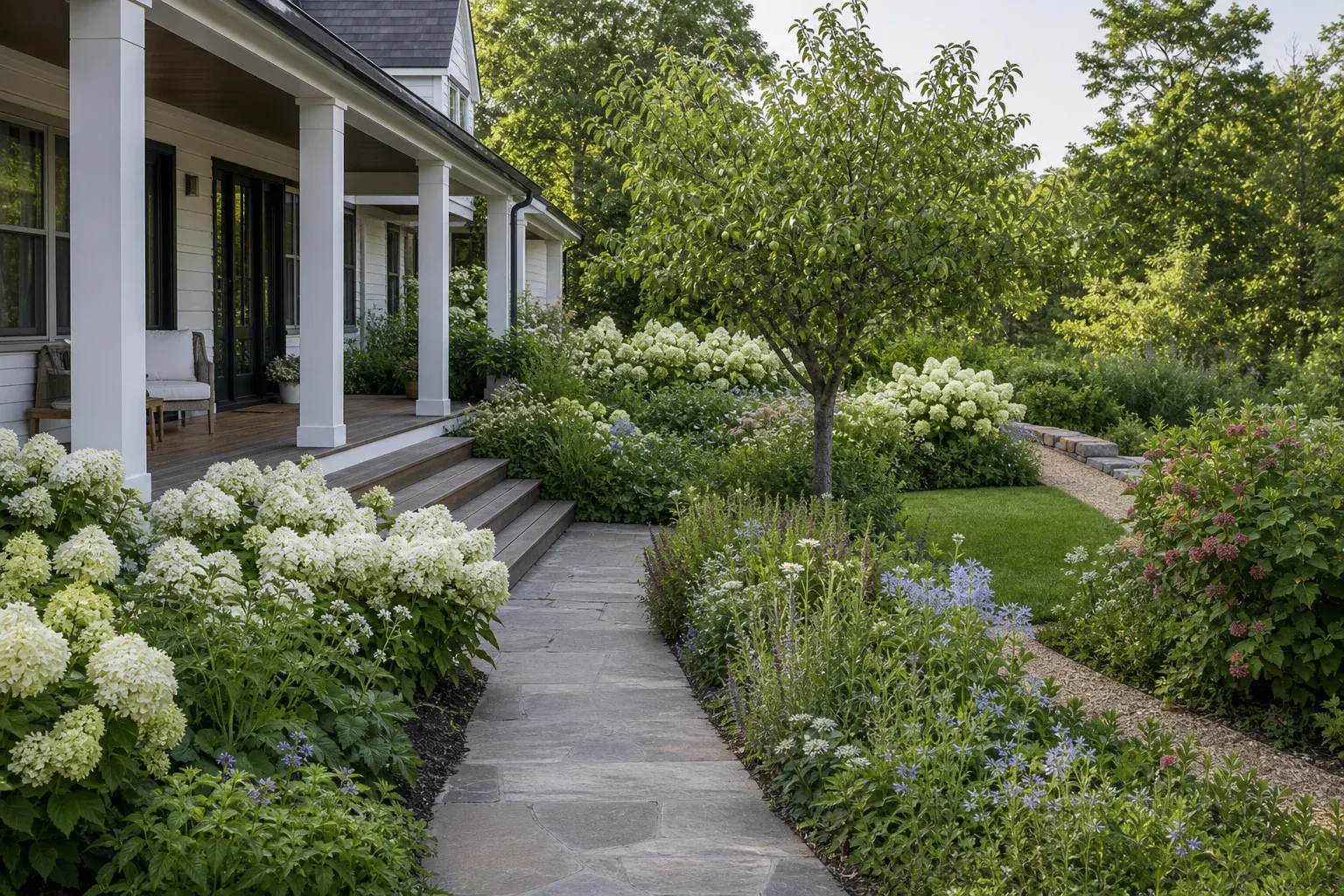
Organize the garden around everyday use
Start with what the yard needs to support. The style should make those jobs easier to understand, not hide them.
Place the most frequently used plants and routes closest to the door that serves them.
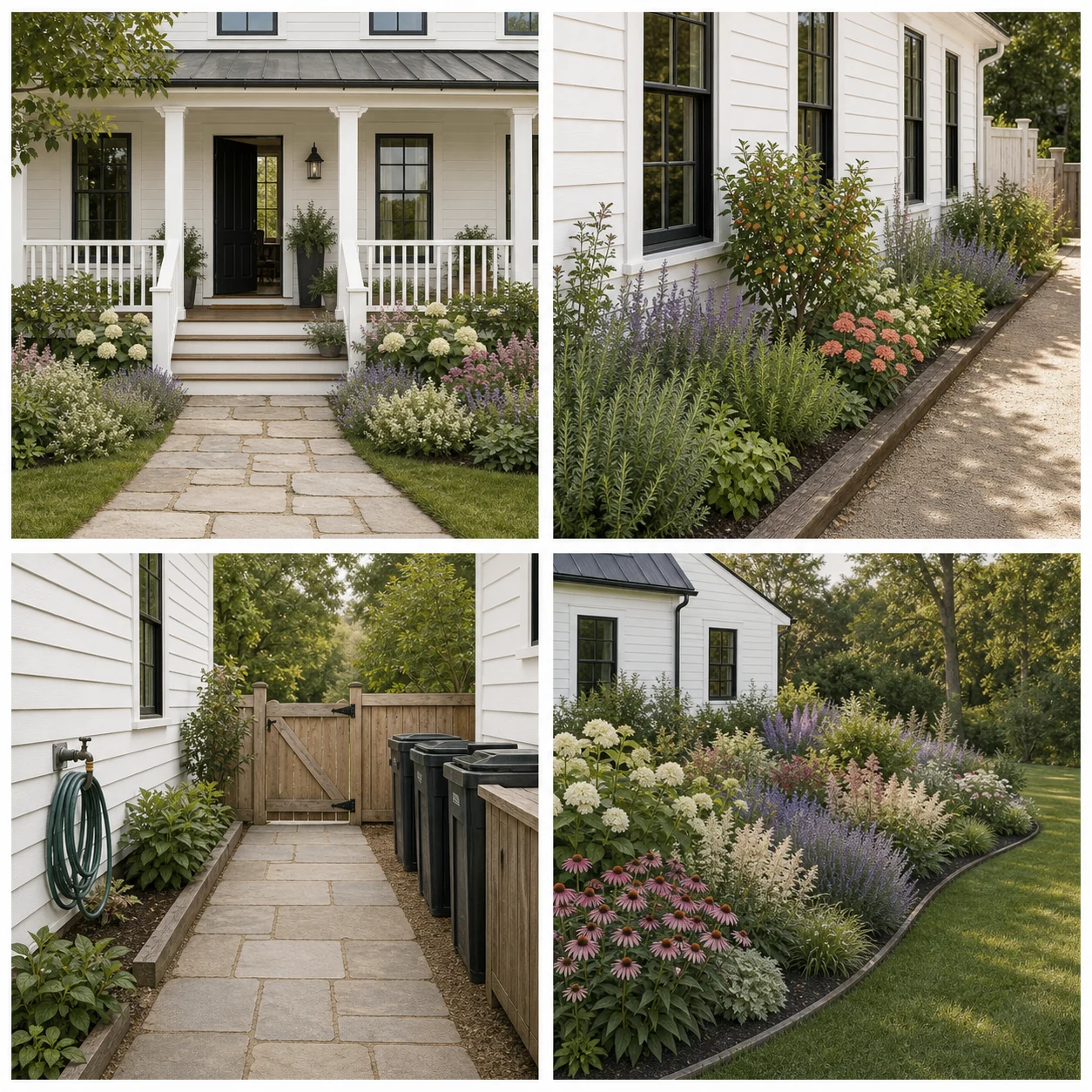
Welcome zone
Keep the door visible, the path generous, and the porch foundation low enough to preserve windows and railings.
Useful strip
Put herbs, cutting flowers, or a small fruiting shrub near a sunny route where harvest and watering are convenient.
Work route
Keep access to bins, hose connections, gates, and side yards direct. Use durable paving or mulch where traffic is frequent.
Relaxed border
Use the deeper or more distant bed for larger seasonal masses, habitat planting, and looser repetition.
Choose a farmhouse direction that belongs to the house
Farmhouse is broad. Pick the relationship between useful planting and ornament before selecting colors or objects.
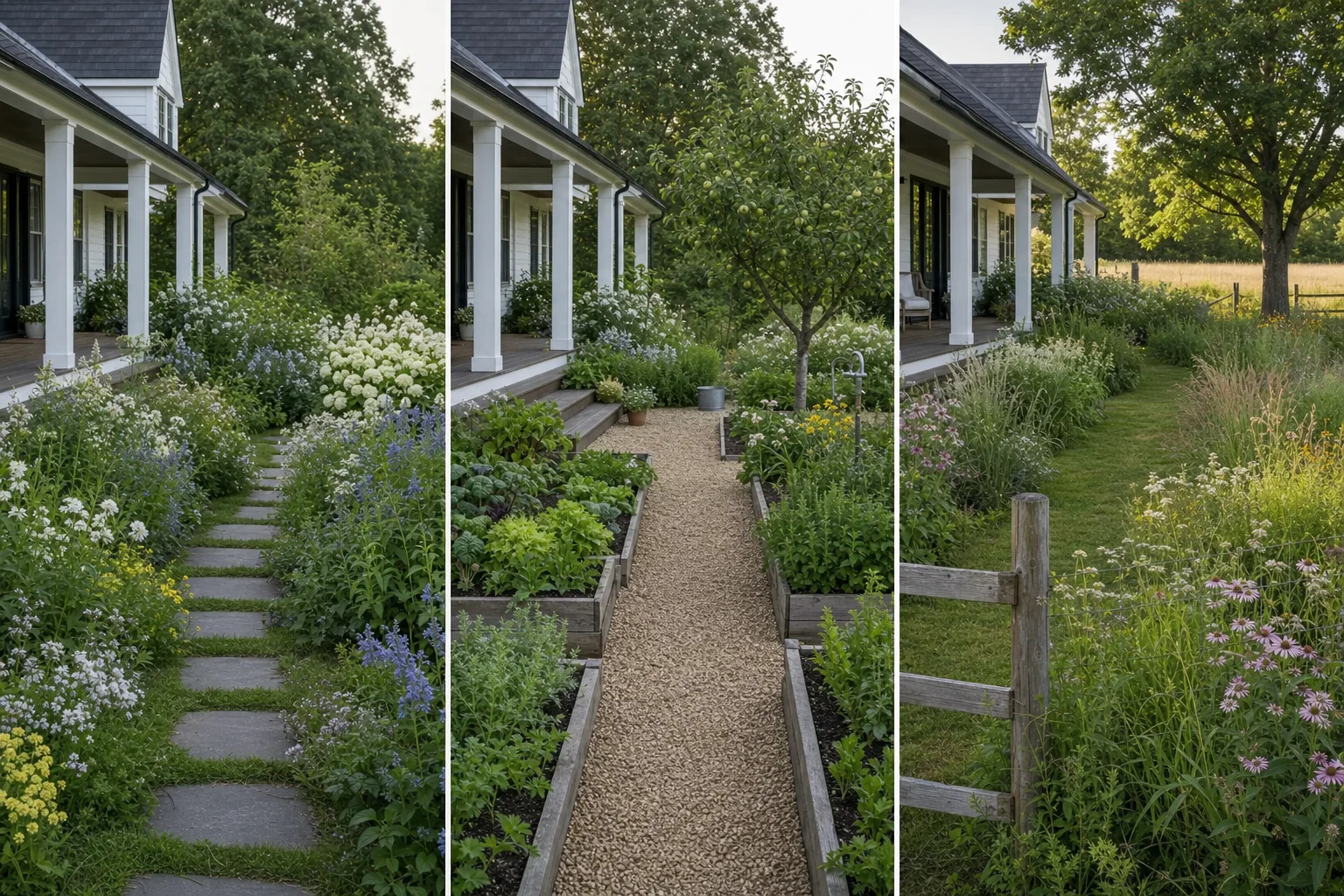
Porch-led
- Organizing idea
- A strong front porch with familiar materials, visible steps, low foundation planting, and one small tree offset from the view.
- Watch for
- Large shrubs and decorative objects can quickly bury the architecture and narrow the approach.
- Best first move
- Photograph the house from the street and protect the porch outline.
Productive entry
- Organizing idea
- Herbs, berries, cutting flowers, and seasonal food plants organized beside a clear path.
- Watch for
- Food and cutting plants may need more water, pruning, harvest, or pest care than the ornamental border.
- Best first move
- Map harvest and hose access before expanding the bed.
Regional farmstead
- Organizing idea
- A simpler palette of locally adapted canopy, hedge, grass, and flowering masses connected to habitat or wind protection.
- Watch for
- A naturalistic regional palette still needs edges and repetition near the house to feel intentional.
- Best first move
- Choose one repeated backbone before adding seasonal diversity.
Build a useful five-role palette
Not every farmhouse garden needs every role. Choose only the jobs that fit the site and the amount of care you want.
The role stays; the exact plant can change
- Small tree
- Shade, fruit, or a seasonal anchor placed away from porch sightlines.
- Repeated shrub
- A dependable backbone that carries the view outside bloom.
- Useful crop
- Herb, berry, cutting flower, or compact food plant near the work route.
- Seasonal mass
- One or two flowers repeated in broad groups rather than scattered.
- Ground and edge
- Sedge, low groundcover, mulch, or a clear border that contains the planting.
Regional planting directions
Cold-climate direction: A hardy serviceberry-like anchor, aronia- or berry-like shrub, little-bluestem-like repeat, coneflower- and aster-like seasonal mass, plus a contained herb or cutting strip can create a useful northern palette.
Mid-Atlantic direction: A serviceberry-like small tree, locally suitable blueberry only in compatible acidic soil, Virginia-sweetspire-like structure, controlled mountain-mint-like mass, and seasonal cutting flowers can connect usefulness and habitat.
Southeast direction: A locally recommended fig- or rabbiteye-blueberry-like useful plant, yaupon- or oakleaf-hydrangea-like structure, coreopsis-like seasonal mass, and regionally appropriate herbs can translate the roles.
Fruit plants can require pollination partners, pruning, disease management, and soil conditions that ornamental plants do not. Verify locally before treating a useful plant as an easy default.
Make the porch garden welcoming and workable
This example keeps daily circulation clear and lets the useful planting feel integrated rather than tacked on.
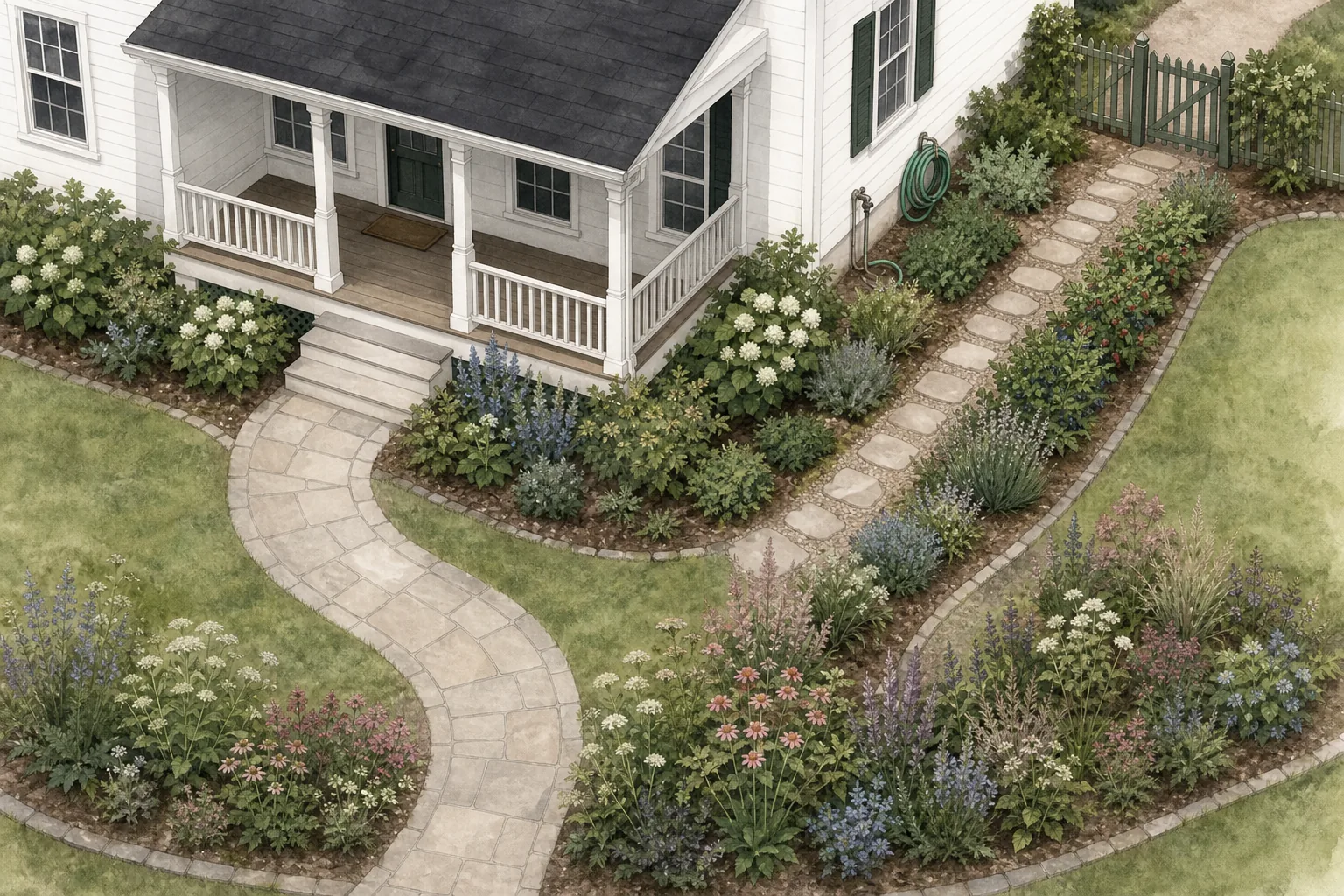
A porch, front walk, and sunny side route
The porch is the main architectural feature. A sunny route beside the house reaches the hose and backyard gate.
- 1. Keep the porch outline
- Place the tallest anchor outside the main window and railing views.
- 2. Repeat the foundation mass
- Use two or three groups of one structural shrub or grass rather than a specimen row.
- 3. Put useful plants on the side route
- Keep herbs, berries, or cutting flowers within reach of the hose and kitchen-side circulation.
- 4. Loosen the outer edge
- Use larger seasonal groups farther from the house, held by a clear path or bed edge.
The porch remains the welcome; the useful strip supports daily life; the looser border adds character without blocking either one.
Verify the useful plants as carefully as the ornamental ones
A familiar plant can still be the wrong size, climate fit, or maintenance commitment for the site.
Harvest and maintenance: Confirm pruning, pollination, disease pressure, cleanup, and realistic harvest access.
Sun, soil, and water: Useful crops often have different needs from established foundation shrubs. Do not force them into one irrigation zone.
Mature clearance: Keep trees and shrubs clear of porch roofs, windows, paths, utilities, and foundations.
Regional suitability: Check exact plants for cold, heat, humidity, invasiveness, toxicity, and local wildlife pressure.
Frequently asked questions
What is the difference between a cottage garden and a farmhouse garden?
Cottage design is usually led by immersive flower masses and an informal route. Farmhouse design earns its distinction through useful zones, porch and work-route relationships, and productive or cutting plants held within relaxed structure.
Does a farmhouse garden need vegetables?
No. Usefulness can come from herbs, berries, cutting flowers, shade, habitat, or simply clear everyday routes. Add edible plants only where their site and maintenance needs fit.
How do I keep farmhouse landscaping from looking cluttered?
Protect the main route, repeat a small number of structural plants, limit decorative objects, and group seasonal plants into visible masses. Let the porch and useful zones do more of the storytelling.
Can native plants work in farmhouse landscaping?
Yes. Regionally suitable native trees, shrubs, grasses, and flowers can support the same practical roles. Use repetition and a clear edge near the house so the composition stays legible.
 Gardenful
See a useful, relaxed direction on your own yard.
Start with the porch and daily routes, then test a regional planting structure before choosing exact plants.
Gardenful for iPhone
Download the app free and start with a photo of your yard.

Sources(4)
- [1]Landscape Design with Plants
University of Florida IFAS Extensionhttps://ask.ifas.ufl.edu/publication/EP449
- [2]Basic Principles of Landscape Design
University of Florida IFAS Extensionhttps://ask.ifas.ufl.edu/publication/EP375
- [3]
- [4]Right Plant, Right Place
University of Florida IFAS Extensionhttps://ask.ifas.ufl.edu/publication/EP416