Gardenful field guide
How to design a moon garden
The short answer
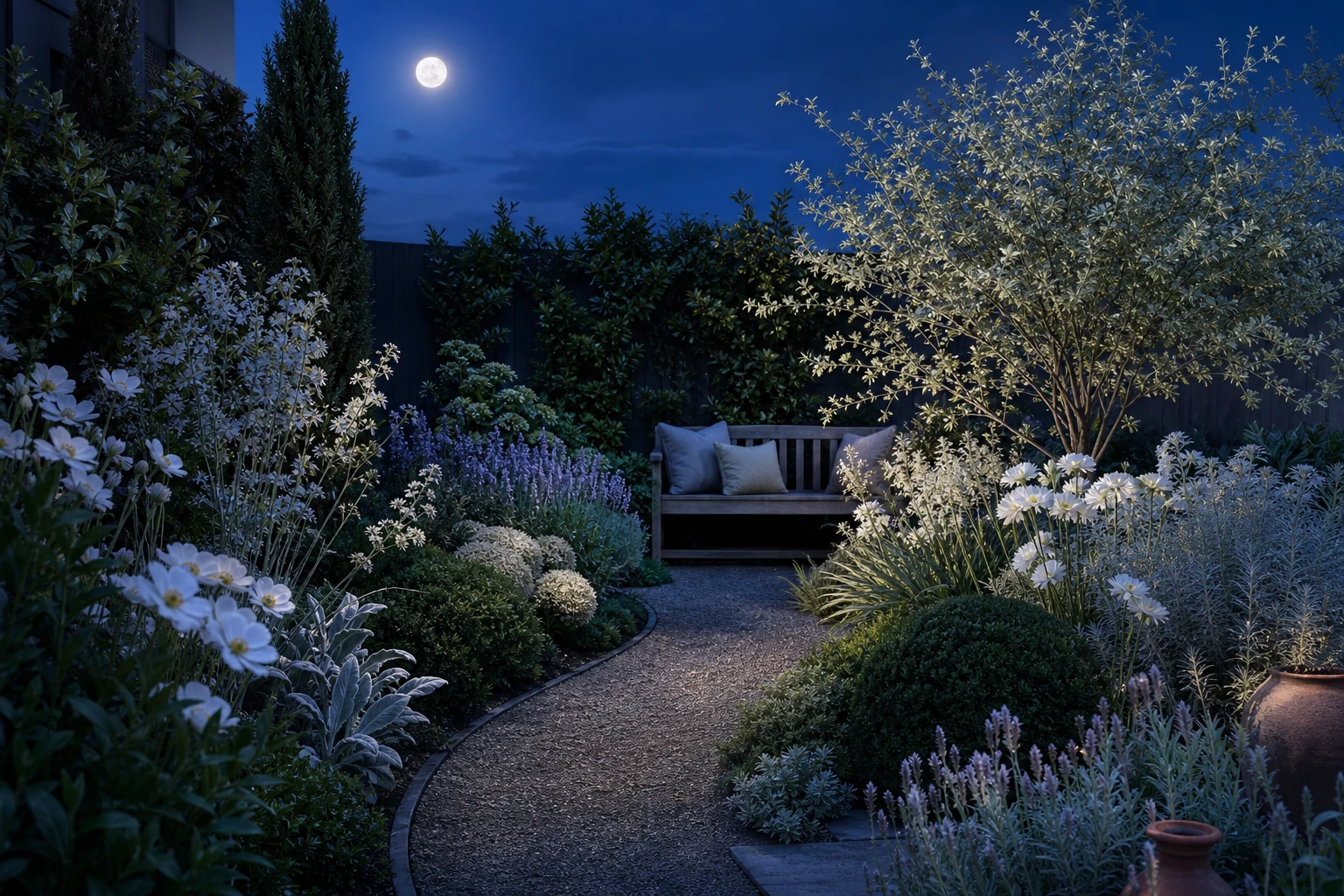
A moon garden is composed for the view and light you actually have after sunset. Start with a patio seat, a window, or the walk to the door. Repeat white flowers and silver leaves where they will catch available light, with darker foliage behind them for contrast. Keep the path clear, and place fragrant plants close enough to enjoy from the seat.
Start where you will actually see the garden
A moon garden begins with the view you enjoy after dark. White flowers are only one part of it.
- 1
Choose one evening viewpoint
Use the patio seat, window, or route already part of the household's night.
- 2
Keep the path easy to follow
Use a continuous edge and uncluttered walking surface before adding pale flowers.
- 3
Put the palest group near the seat
Repeat one broad pale group near the destination instead of scattering white dots.
- 4
Add dark structure behind it
Deep foliage gives pale flowers and silver leaves enough contrast to read.
Build interest beyond white flowers
Foliage, form, scent, and movement carry the garden between blooms.
| Role | Contribution | Watch for | Local check |
|---|---|---|---|
| Pale flower mass | ContributionReflects available light and marks the destination. | Watch forSmall flowers need repetition to read at a distance. | Local checkBloom season, pollinators, and mature spread. |
| Silver foliage | ContributionKeeps the bed visible between blooms. | Watch forMany silver plants prefer sun and sharp drainage. | Local checkLight, moisture, winter survival, and local fit. |
| Fragrant plant | ContributionAdds an evening cue near a seat or window. | Watch forStrong scent can overwhelm a small space. | Local checkTiming, allergies, toxicity, and mature size. |
| Dark structure | ContributionFrames lighter plants and carries the daytime view. | Watch forA dense wall can block airflow or outgrow the space. | Local checkClearance, roots, and year-round form. |
Penn State's Pennsylvania examples include mock orange, summersweet, oakleaf hydrangea, northern sea oats, and cosmos. Size matters: Penn State lists summersweet at 4 to 9 feet tall and wide and oakleaf hydrangea at 10 feet tall and wide, too large for many small patio beds. Use the examples for inspiration, then choose plants that fit your climate and space.
Sources: Penn State Extension
Create one luminous patio edge
In a small bed, give contrast, fragrance, and pale foliage their own places.
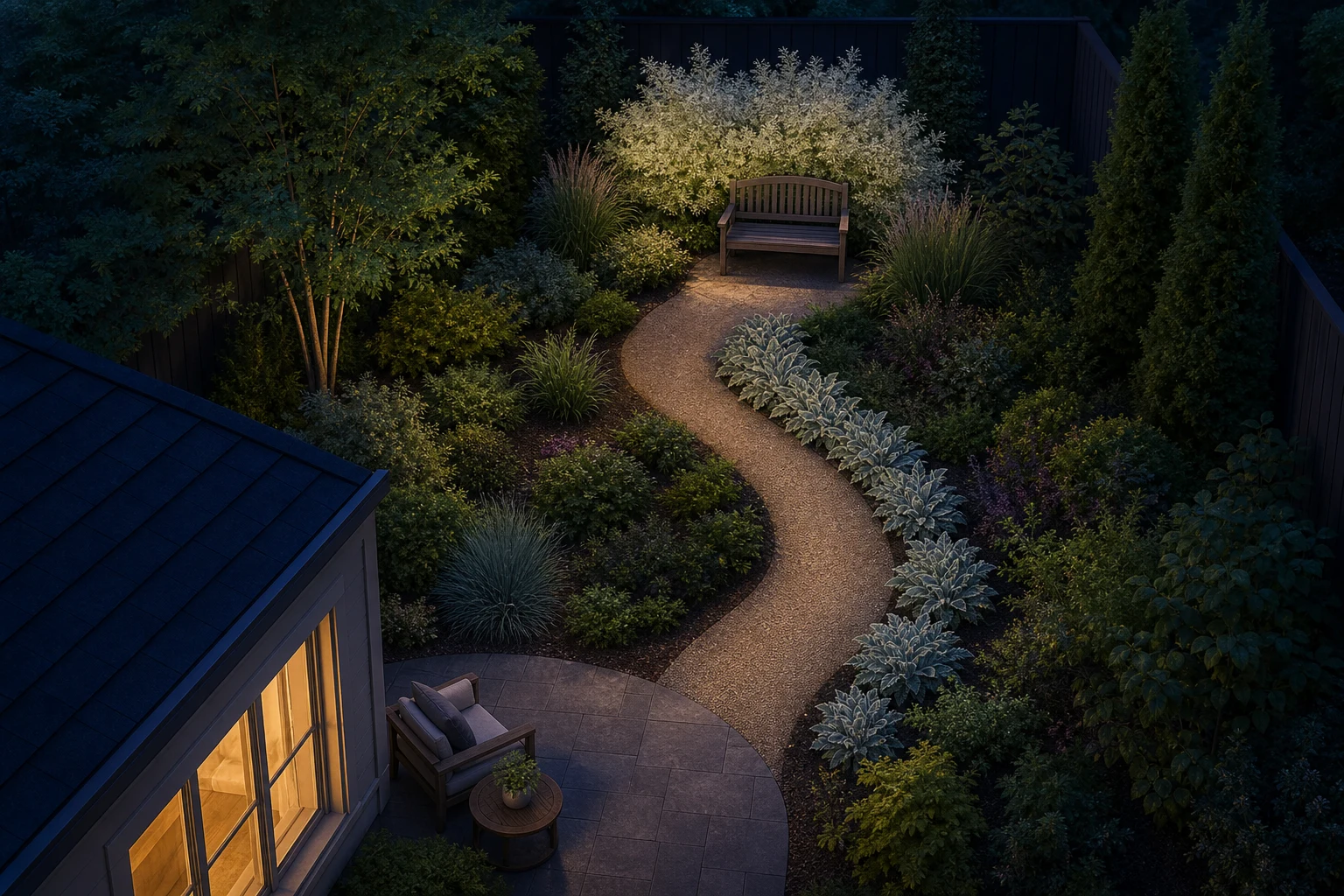
A curving path ending at a bench
The bed is visible from the house. Existing dark shrubs form the rear layer.
- 1
Keep the dark backdrop
Prune only for health, path clearance, and the intended shape.
- 2
Repeat one pale flowering group
Place the broadest mass near the bench.
- 3
Run silver foliage along part of the path
Use one repeated plant instead of outlining every edge.
- 4
Put one fragrant plant near the seat
Keep circulation and household comfort in mind.
The view works after dark and still has structure in daylight.
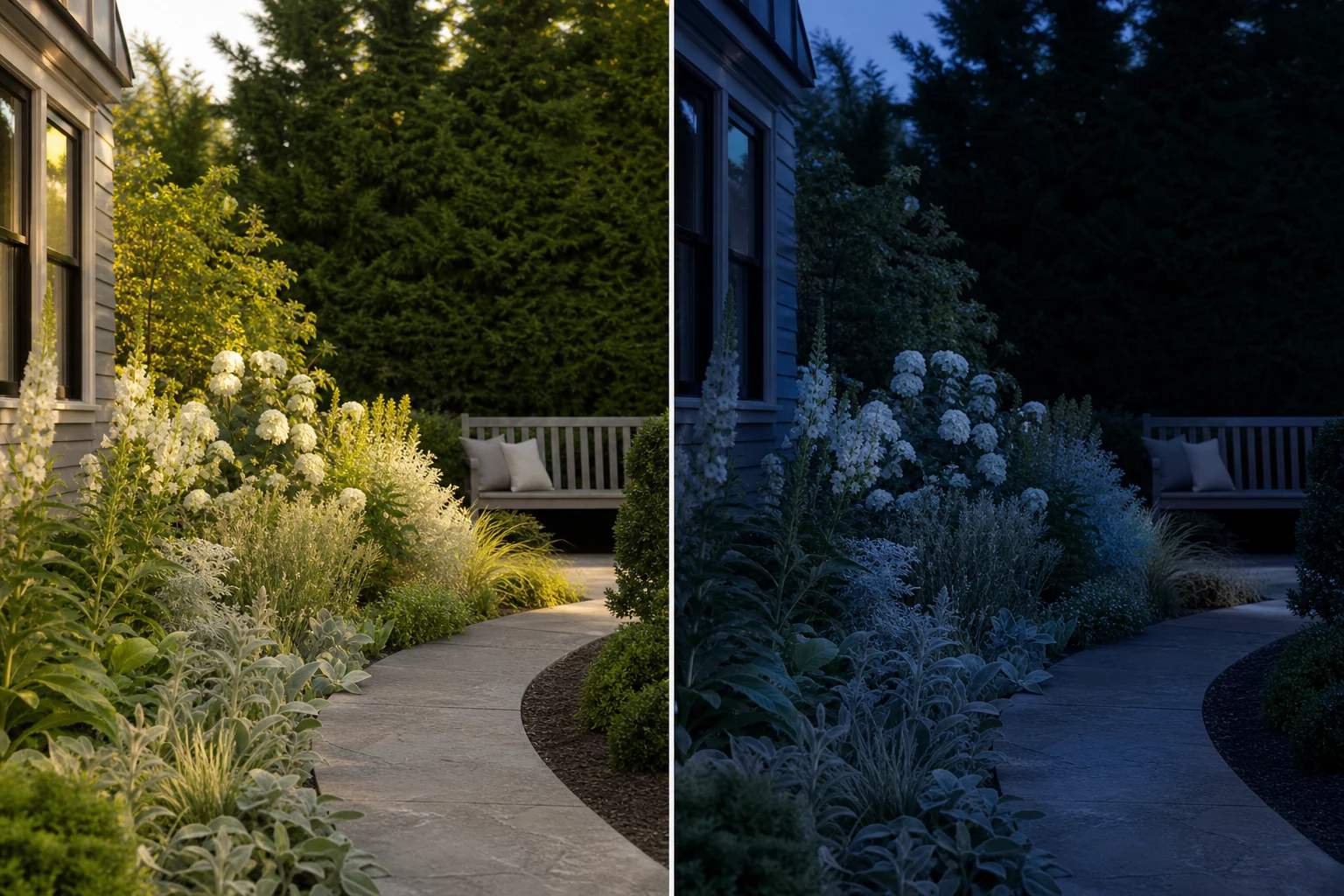
Review the garden in darkness and daylight
A beautiful evening garden still needs a clear path and plants that suit the site.
- Late afternoon
- Blue hour
Walk after sunset: Confirm edges, steps, gates, and trip hazards without depending on flowers for safety.
Check the daytime view: Make sure the bed still has a clear shape when the pale flowers are less noticeable.
Choose plants that fit: Check climate, sun, soil, water, toxicity, invasiveness, mature size, and pollinator value.
Use lighting sparingly: If lighting is needed for safety, follow the fixture instructions and local outdoor-lighting rules.
Frequently asked questions
What is a moon garden?
A garden designed for after dark with pale flowers, light foliage, fragrance, movement, dark contrast, and a clear evening viewpoint.
Does it need only white flowers?
No. Silver foliage, dark structure, pale lavender or yellow, scent, and plant form carry the garden between blooms.
Can it work in a small space?
Yes. Choose one viewpoint, one pale mass, a short run of silver foliage, and a clear route.
 Gardenful
Design the evening view before choosing flowers.
Use Gardenful to compare a moon-garden layout, then walk the real path after dark and check the plants for your yard.
Gardenful for iPhone
Download the app free and start with a photo of your yard.

Sources(2)
- [1]
- [2]Right Plant, Right Place
University of Florida IFAS Extensionhttps://ask.ifas.ufl.edu/publication/EP416