Gardenful field guide
Patio landscaping ideas that preserve a comfortable outdoor room
The short answer
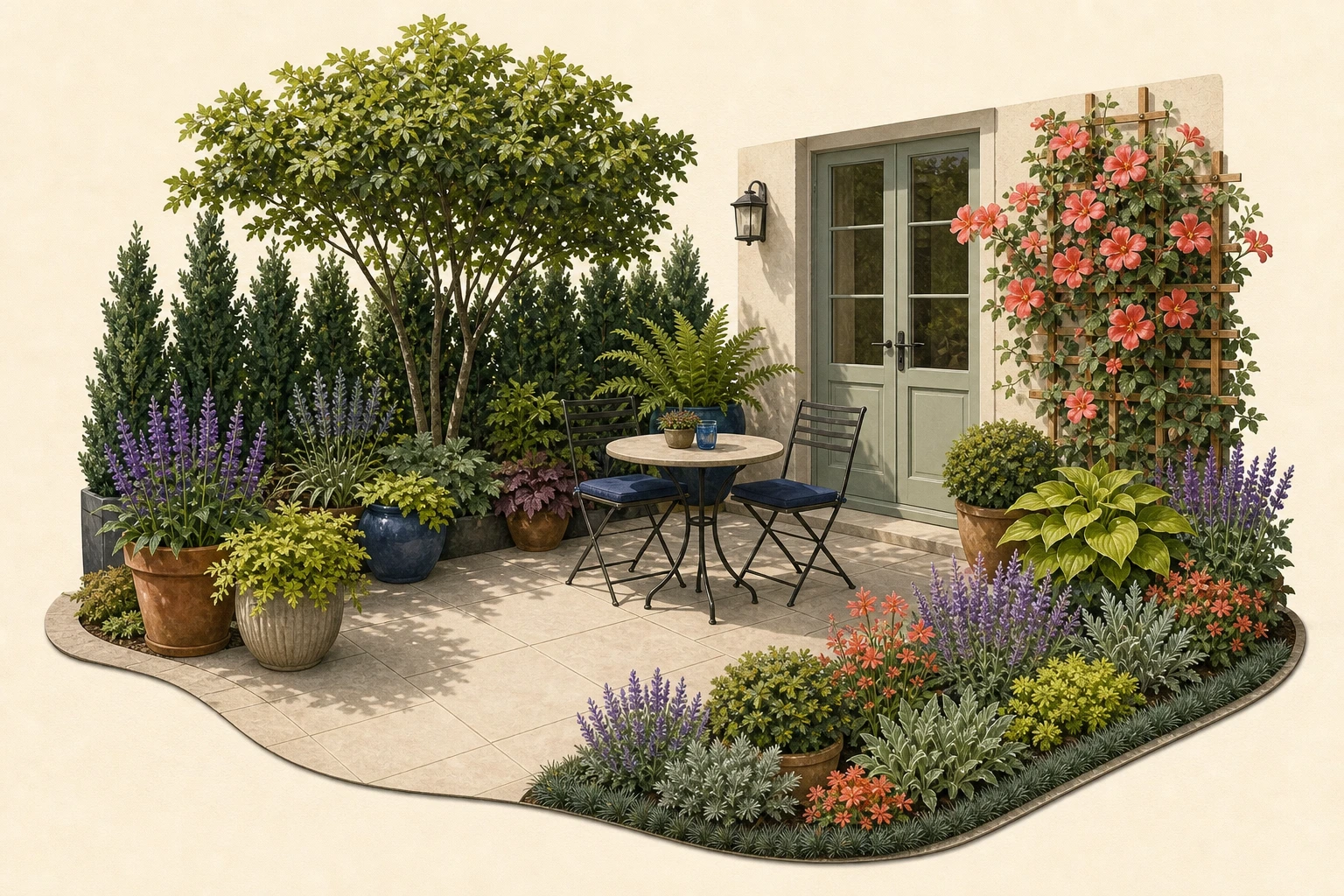
Patio planting succeeds when it improves the place to sit without taking over the space needed to use it. Keep doors, chairs, the daily walking route, heat sources, and one useful view clear. Then give each planted edge one job, such as shade, seated privacy, or softening hard paving. Choose beds, containers, or climbers for the available root room and drainage, and repeat a small palette around the seat.
Keep the patio usable before adding plants
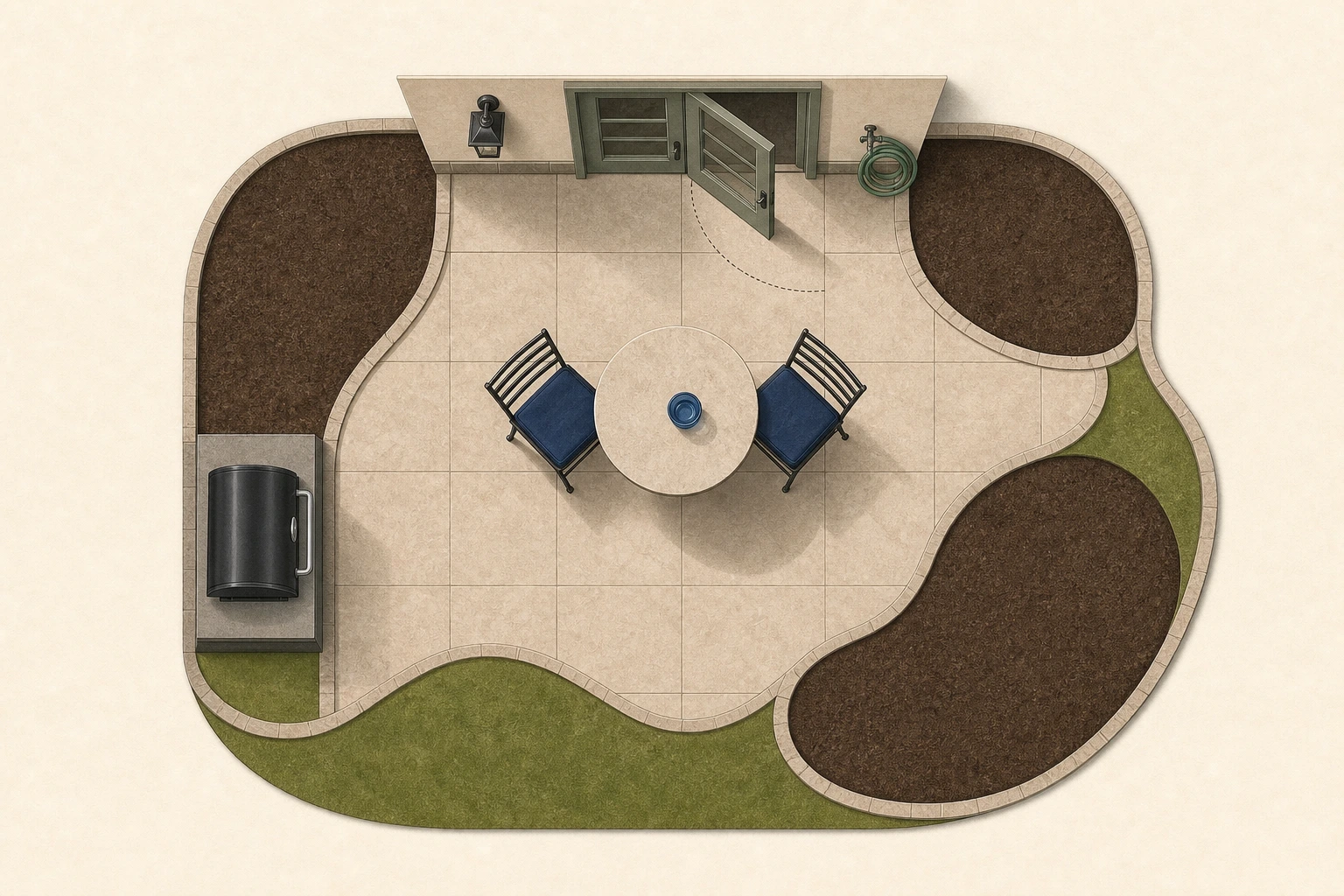
Draw what happens on the hard surface on an ordinary day. The empty space around furniture is part of the design, not a gap to fill.
- 1
Move through the real setup
Open the door, pull every chair out, carry a tray through the space, and mark the route you actually use.
- 2
Record the patio climate
Note direct sun, reflected heat, afternoon shade, wind, roof overhangs, and where rain does not reach.
- 3
Keep heat and access separate
Protect access to the hose, drain, utilities, and grill or other heat-producing equipment. Follow local and manufacturer safety guidance.
- 4
Leave one view open
Decide which view should stay long and which seated sightline needs softening or privacy.
Give each planted edge one job
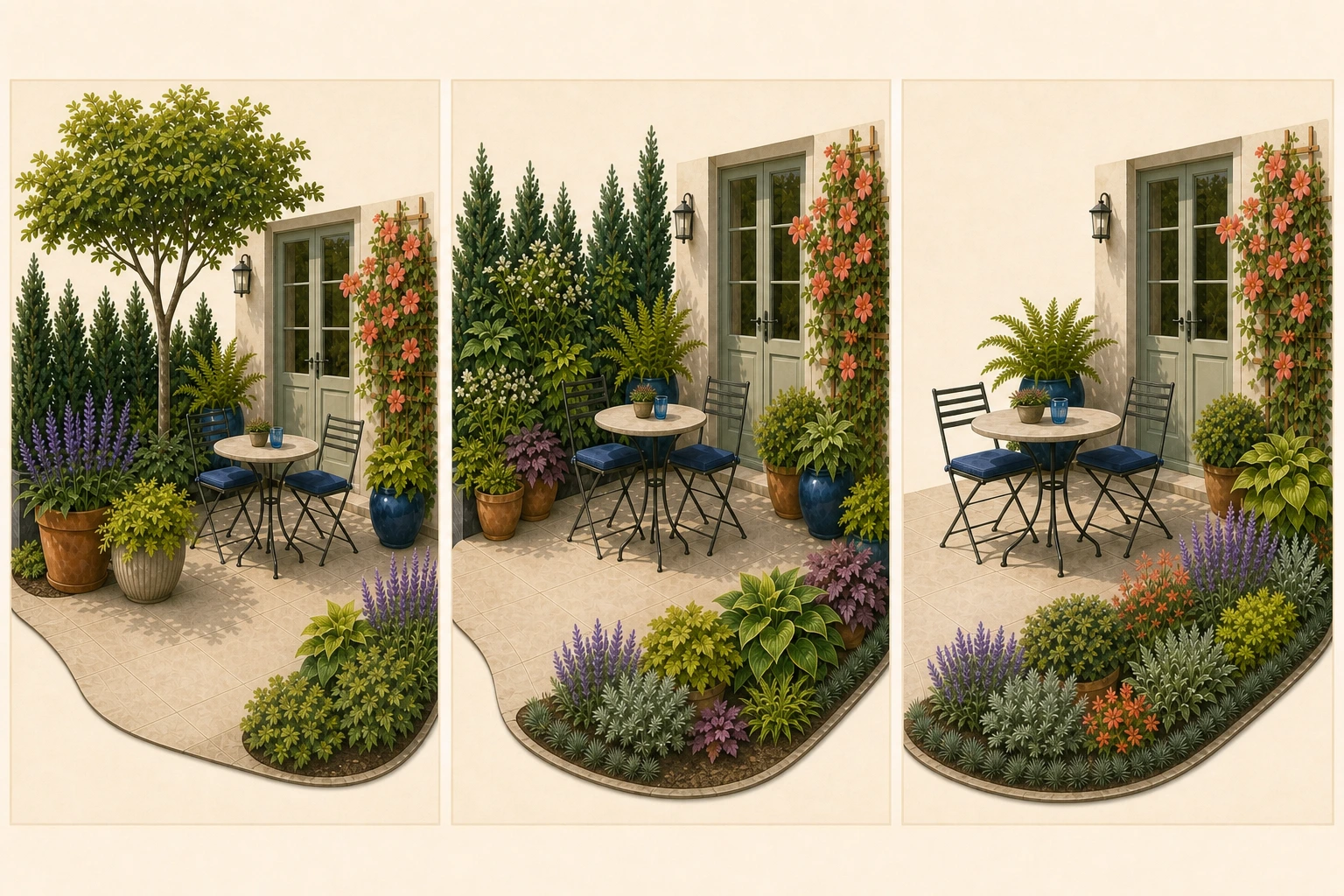
A small patio gets busy when every edge tries to provide color, privacy, shade, and storage at once. Choose the job that matters most from the seat.
Use one main job per edge, repeat a small palette across those edges, and let at least one side remain visually open.
Add useful shade
Check roots, litter, overhead clearance, and mature spread.
Place a locally suitable small tree or tall shrub where its mature canopy can help without blocking the door or route.
Screen the seated sightline
Protect light, airflow, access, and the neighbor-facing boundary.
Build privacy where a person sits, using a mixed layer rather than closing every boundary.
Soften a hard edge
Keep stems, thorns, fruit, and irrigation off the route.
Repeat low plants along one paving edge so the patio feels planted without narrowing the walking surface.
If the patio already has a good borrowed view, leave that edge quiet instead of surrounding the seat with plants.
Choose where the roots can live
The planting method changes water, root room, permanence, and upkeep. Choose it from the site constraint, not from a photograph of a pot.
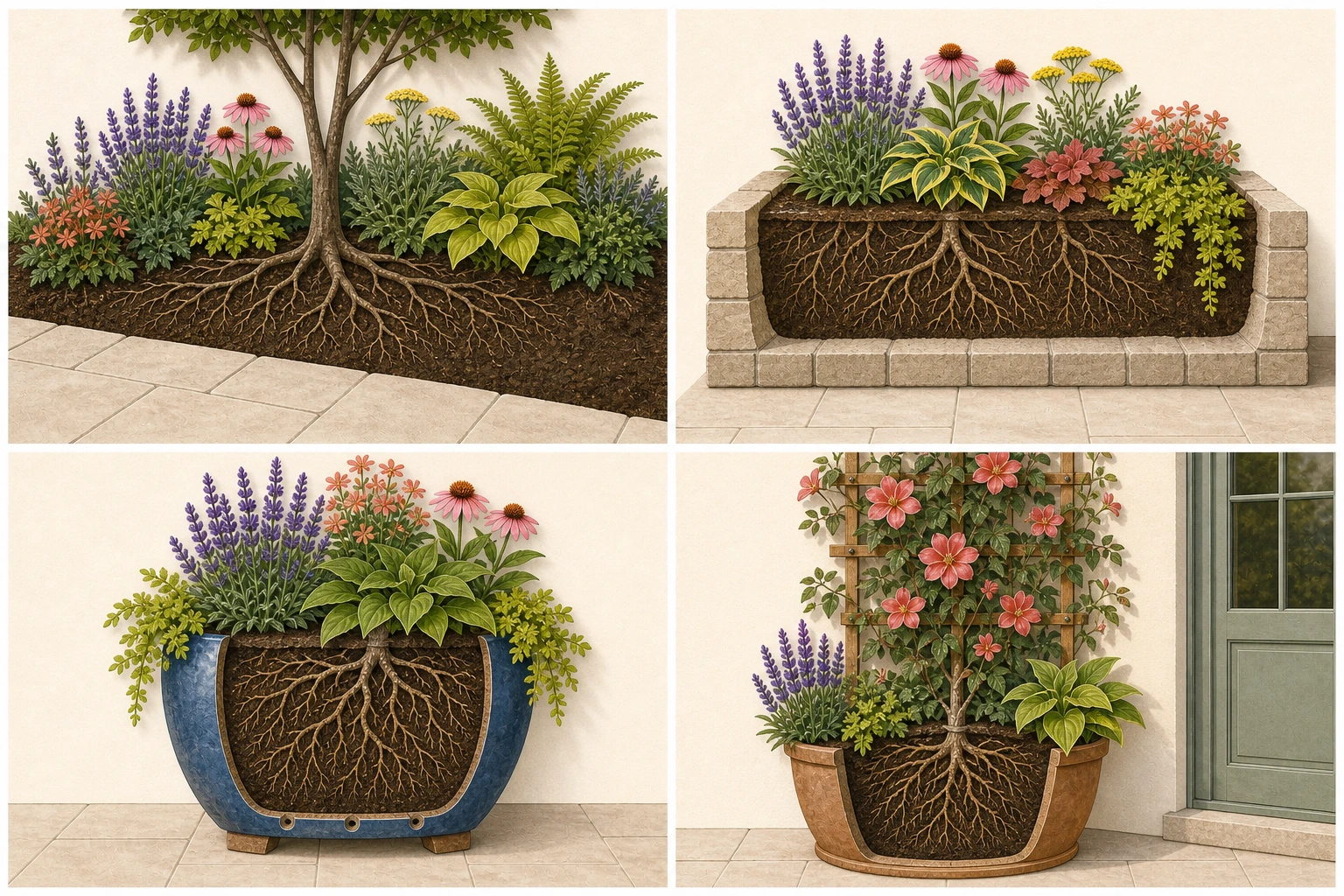
In-ground border
- Use when
- Soil is accessible beside the paving.
- Plan for
- The most root room and a permanent layout.
- Check first
- Soil, drainage, utilities, and mature spread.
Raised or contained bed
- Use when
- The edge needs definition or soil separation.
- Plan for
- Bounded root volume and a fixed structure.
- Check first
- Drainage, construction, access, and load.
Movable containers
- Use when
- The surface must stay flexible or portable.
- Plan for
- Faster drying and more frequent monitoring.
- Check first
- Drain holes, stability, weight, and winter exposure.
Climber on support
- Use when
- Vertical coverage matters more than floor space.
- Plan for
- A support, pruning, and enough root volume.
- Check first
- Attachment, mature weight, vigor, and access.
Container plants experience less soil insulation and often dry faster than the same plants in the ground. Larger containers generally hold water longer, but they also become heavy.
Sources: University of Maryland Extension, University of Maryland Extension, Colorado State University Extension
Build one coherent palette around the seat
Add the plants in passes. Each pass should make the space clearer, not simply fuller.
A two-seat patio with one exposed side
The door, table, chairs, and main route already work. The seated edge feels exposed, and the paving looks disconnected from the rest of the garden.
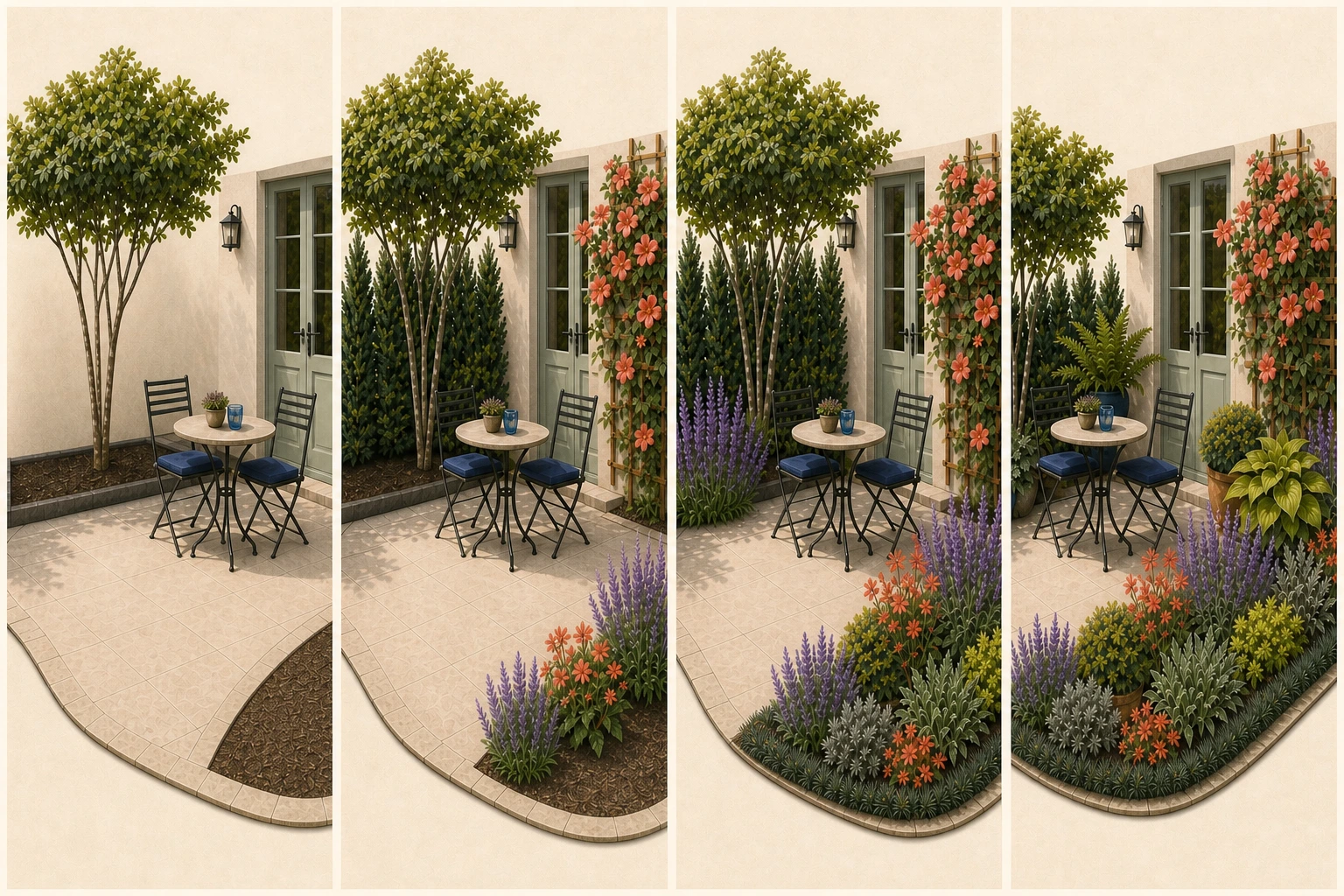
1
Place one structural anchor
Use one small tree, compact shrub, or substantial container where it can hold the composition beyond peak bloom.
2
Add height only where it solves the sightline
Use a mixed upright layer or climber beside the exposed seat, leaving the door and open view clear.
3
Repeat two middle-layer plants
Carry the same foliage or flower masses across more than one edge so the patio reads as one garden.
4
Finish with a low edge
Use a restrained low plant near the paving, keeping its mature spread away from feet and chair legs.
A small repeated palette makes separate containers and beds feel related. Verify every exact plant for the light, heat, water, root room, and climate at your patio.
Check the patio plan before buying
A plant can fit the color palette and still fail the space. Recheck the conditions that change comfort, care, and safety.
Light and reflected heat: Observe the patio at different times. Walls and paving can make one pocket hotter or drier than the yard nearby.
Water and drainage: Make sure every container drains freely, water will not create a slippery route, and roof overhangs are not hiding a dry pocket.
Mature clearance: Draw mature plant width around doors, chair backs, walking surfaces, utilities, and windows before buying.
Weight and stability: Plan heavy containers in place, use stable supports, and get appropriate advice before adding significant loads to a deck or balcony.
Household safety: Verify plant toxicity, thorns, irritating sap, fruit drop, and pet access for the exact varieties you plan to use.
Local plant fit: Confirm climate, invasive status, availability, and care with a regional source or established local nursery.
A patio rendering can test the planting direction. It does not verify structural loads, fire clearance, drainage construction, utilities, permits, or local code.
Frequently asked questions
How do I make a patio feel planted without making it crowded?
Protect the door, chair space, and main route first. Give two or three edges distinct jobs, repeat a small plant palette, and leave at least one view open. Fewer larger containers usually read more clearly than many unrelated small pots.
What are the best patio landscaping ideas for a small space?
Start with one comfortable use, protect the door and chair-clearance zones, and give each remaining edge one job. A small tree or tall container can add shade, a climber can use vertical space, and two or three repeated plant forms can connect the composition without filling every corner.
Are containers easier than an in-ground patio border?
Containers are flexible and avoid poor soil, but their limited root volume can dry faster and experience larger temperature swings. They still need drainage, stable placement, appropriate potting mix, and plants that fit the light and climate.
What plants are best around a patio?
There is no universal patio list. Choose plants that fit the patio's light, reflected heat, wind, water access, root room, and local climate, then assign them clear roles such as structure, screening, repeated color, or a low edge.
How can I add privacy to a patio with plants?
Screen the actual seated sightline rather than every boundary. Use a layered shrub, small-tree, or climbing combination that preserves light, airflow, access, and mature clearance. Check the boundary and support before planting.
Can Gardenful design planting for a patio?
Yes. Start with a clear photo that keeps the patio edges, door, furniture, and the area you want to change visible. Gardenful can help you explore a planting-led visual direction and plant list. Verify the exact plants and any structural, drainage, or safety work locally.
 Gardenful
See a planting direction around your patio.
Photograph the whole usable space, keep the door and furniture in view, and compare a coherent plant palette before you buy pots or plants.
Gardenful for iPhone
Download the app free and start with a photo of your yard.

Sources(5)
- [1]Landscape Design: Ten Important Things to Consider
University of Florida IFAS Extensionhttps://ask.ifas.ufl.edu/publication/EP375
- [2]Small Space Gardening Styles
UC Master Gardeners of Amador Countyhttps://ucanr.edu/sites/default/files/2020-02/319534.pdf
- [3]
- [4]Types of Containers for Growing Vegetables
University of Maryland Extensionhttps://www.extension.umd.edu/resource/types-containers-growing-vegetables
- [5]Container Gardens
Colorado State University Extensionhttps://extension.colostate.edu/resource/container-gardens/