Gardenful field guide
How to design a four-season garden
The short answer
A four-season garden stays legible because different plants carry the composition at different times. Begin with a small structural layer that remains clear beyond bloom, add foliage masses that hold the growing season together, and schedule a few overlapping flower, fruit, bark, or seedhead moments. Use a month-by-month ledger to find genuine gaps instead of asking every plant to be interesting all year.
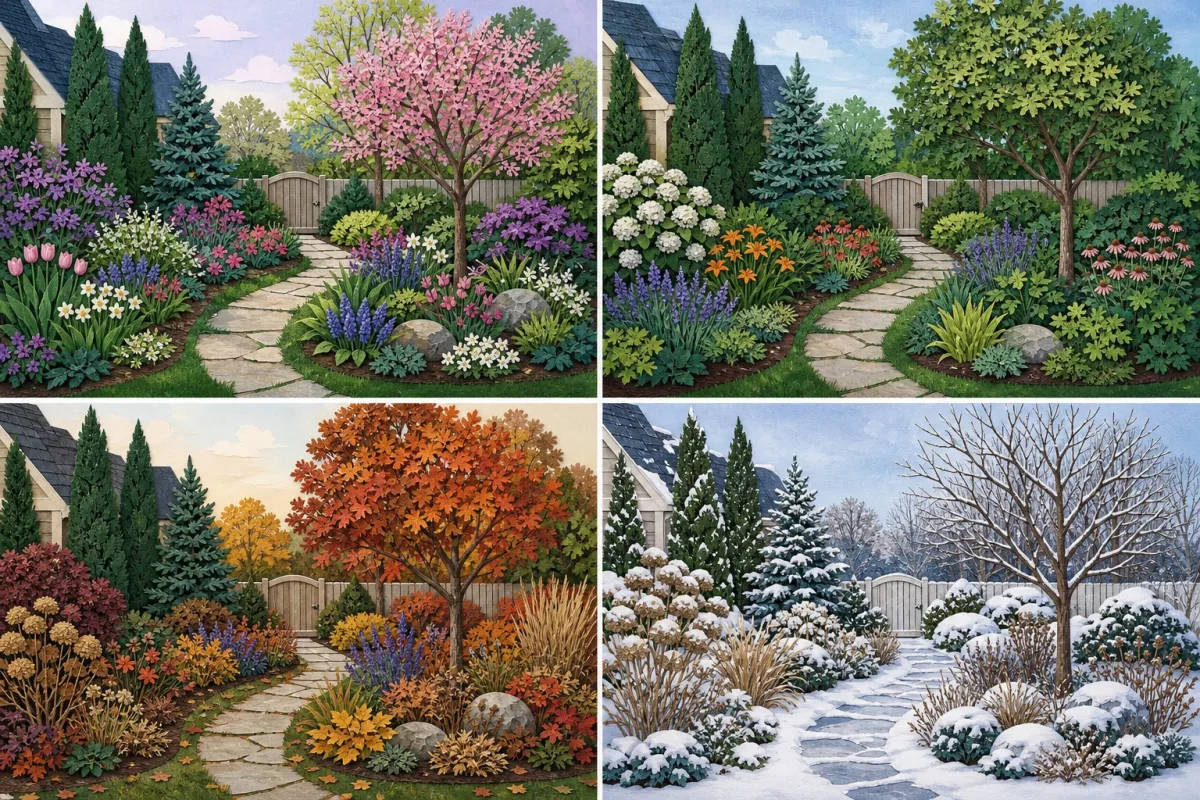
- Spring
- Summer
- Autumn
- Winter
Build the garden from four kinds of interest
Flowers are one seasonal layer, not the whole composition. A garden remains readable when structure and foliage carry the quieter weeks.
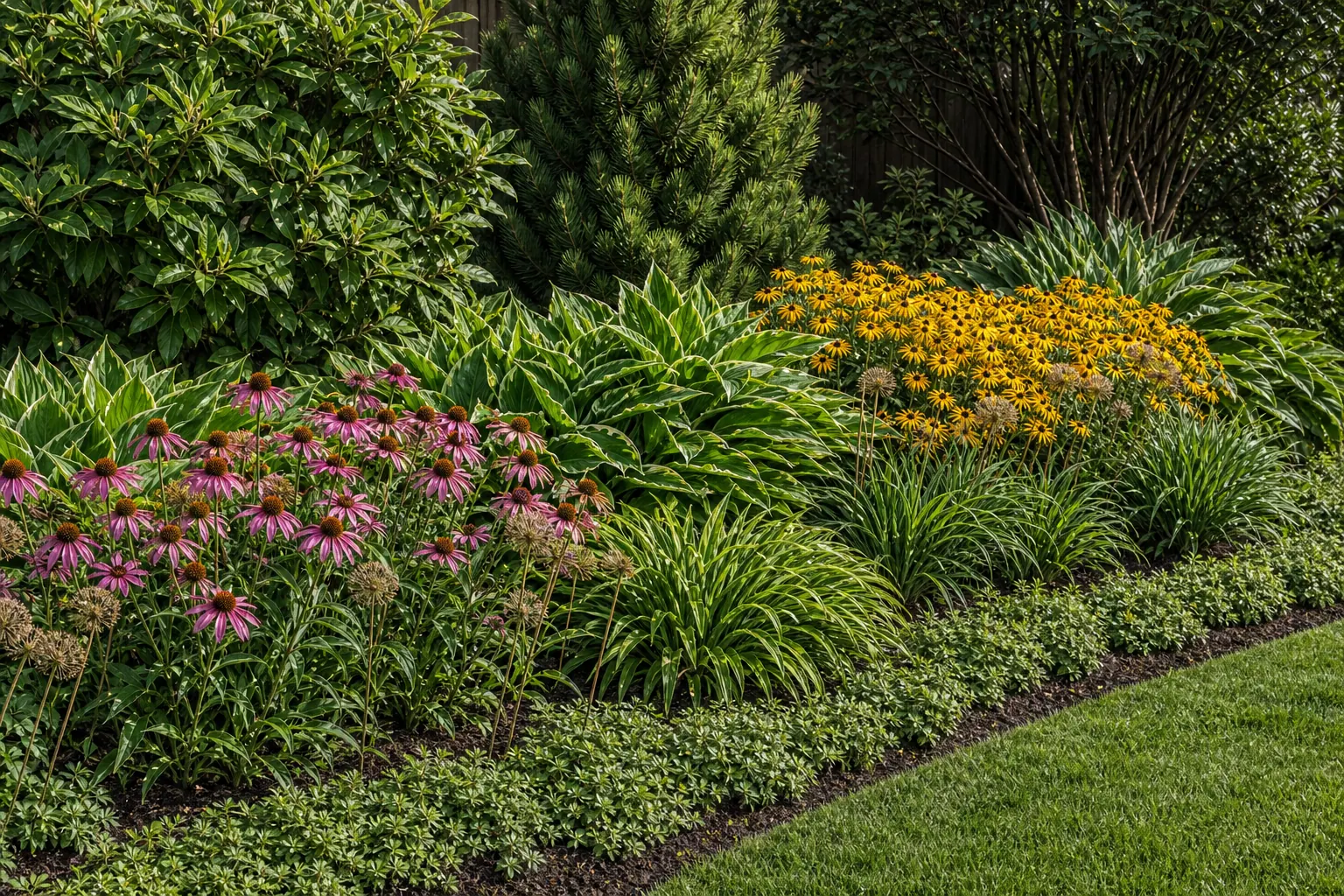
Assign each plant a main job, then look for useful overlap. One shrub may provide structure, spring flowers, autumn color, and winter stems, but it does not need to do everything.
- 1
Persistent structure
This layer keeps the major masses legible when flowers and leaves are absent.
Use a restrained framework of suitable evergreens, deciduous branching, hedges, grasses, or durable plant forms.
- 2
Growing-season foliage
Foliage connects isolated flowering moments into one garden.
Repeat contrasting leaf shapes, sizes, or colors in masses that remain useful before and after bloom.
- 3
Seasonal events
A few strong moments are easier to notice than constant scattered novelty.
Plan a limited sequence of flowers, fruit, autumn color, bark, buds, or seedheads where they can be seen.
- 4
Lowest layer
The garden looks cared for even when the upper layers are quiet.
Use compatible groundcover, mulch, or retained seedheads to keep soil and bed edges intentional between peaks.
Make a seasonal ledger before buying plants
List when each plant is useful in your actual climate. Use broad seasonal blocks when exact bloom dates are uncertain, and expect weather to shift the schedule.
A four-season ledger for one main view
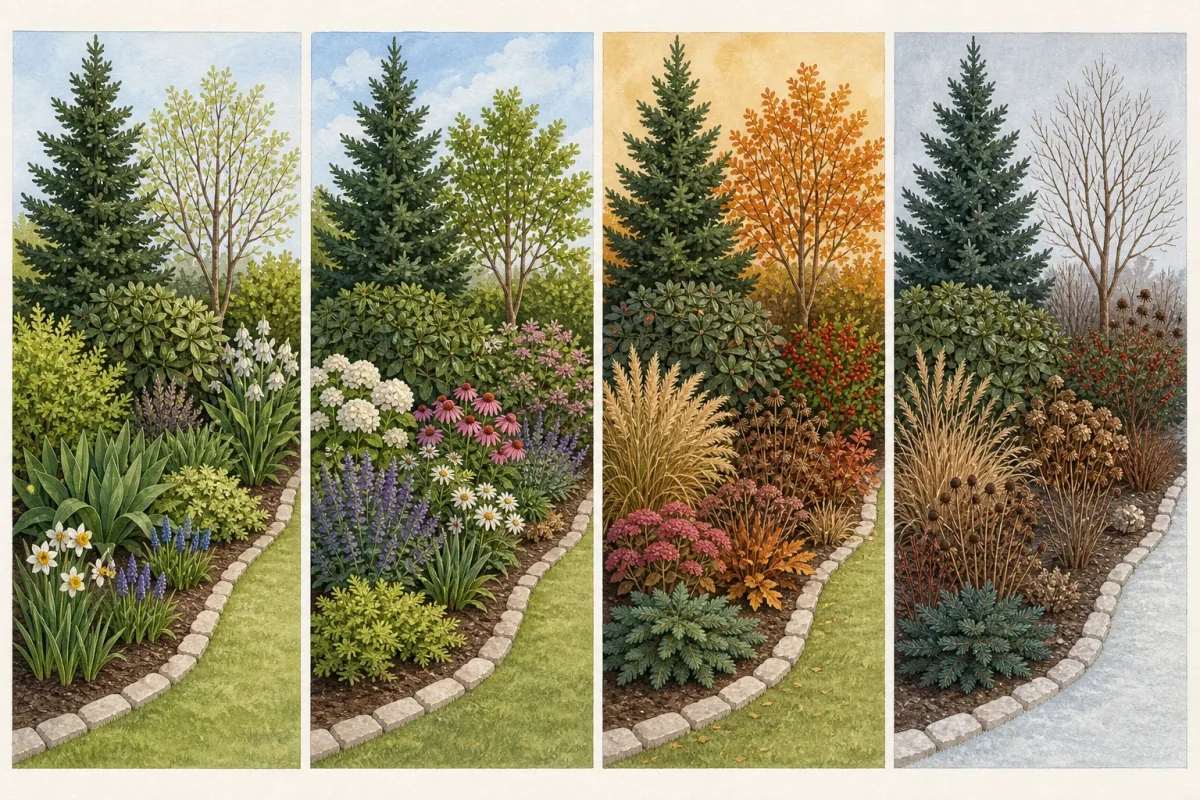
Start with the view used most often: the entry, kitchen window, patio seat, or approach. Record what carries that view in each season.
1
Spring
Buds, bulbs, fresh foliage, and early flowers can lead, while the structural plants keep the still-empty areas connected.
2
Summer
Foliage mass, repeated flowers, canopy, and a clear edge usually carry the fullest season.
3
Autumn
Leaf color, late flowers, fruit, grasses, and developing seedheads can replace summer emphasis.
4
Winter
Evergreen foliage, branching, bark, persistent fruit, seedheads, and the ground plane become more visible.
A ledger exposes weak views and weak months. It should guide a targeted addition, not become a reason to fit one different plant into every calendar slot.
Fix the weakest season with the smallest useful change
Once the ledger reveals a gap, identify what is actually missing. More flowers are not always the answer.
| What feels missing | Try this layer | Why it helps |
|---|---|---|
| What feels missingThe bed disappears in winter | Try this layerOne structural evergreen, strong branching plant, grass mass, or durable edge. | Why it helpsRestores the main shape rather than adding isolated winter novelties.Check locallyMature size, snow or wind exposure, winter burn, and local fire guidance. |
| What feels missingSpring starts too slowly | Try this layerRepeated bulbs or locally suitable early perennials woven through the established framework. | Why it helpsAdds an early event without rebuilding the whole palette.Check locallyChill needs, drainage, wildlife pressure, foliage after bloom, and local suitability. |
| What feels missingSummer looks busy but unrelated | Try this layerRepeat one foliage or flower mass and remove a few isolated accents. | Why it helpsCreates rhythm and a stronger long view.Check locallyBloom overlap, mature spread, and whether the repeated plant fits each pocket. |
| What feels missingAutumn ends abruptly | Try this layerLate flowers, foliage color, grasses, fruit, or seedheads already compatible with the site. | Why it helpsExtends interest without requiring continuous bloom.Check locallyPersistence, cleanup preference, self-sowing, and wildlife or household concerns. |
Sources: Penn State Extension, Penn State Extension
Compose for continuity, then let seasons change it
The seasonal calendar matters only if the plants still read as one composition. Repetition and proportion keep the view calm as individual plants come and go.
Repeat across seasons
Let the same foliage color, plant form, or ground layer reappear in multiple areas so the view retains a recognizable rhythm.
Concentrate seasonal color
A noticeable group in one or two places often reads better than the same number of flowers scattered through the bed.
Plan the off-season state
Decide which stems or seedheads remain and which areas will be cut back. Cleanup preference is part of the design.
Verify every season against the real site
A seasonal promise is only useful when the plant can thrive in that garden and the feature appears in the local climate.
Local bloom, leaf-out, dormancy, and winter-interest timing rather than a national calendar
Mature height and spread, including what remains after herbaceous plants die back
Sun, water, soil, wind, snow, heat, and microclimate across the year
Whether fruit, seedheads, or evergreen foliage create household, pet, wildlife, or cleanup concerns
A maintenance plan for pruning, division, cutting back, mulching, and establishment water
Regional invasive guidance and locally appropriate alternatives
Four-season interest does not mean four seasons of flowers. A strong winter silhouette or repeated foliage mass can carry more of the year than another brief bloom.
Frequently asked questions
What makes a garden look good in all four seasons?
A persistent structure, repeated foliage, a clear ground plane, and a limited sequence of seasonal events. The garden does not need to peak all year; it needs enough continuity that each season feels intentional.
Which plants provide year-round interest?
That depends on climate and site. Look for locally suitable plants with more than one useful feature, such as branching, evergreen or long-lasting foliage, bark, fruit, flowers, or seedheads, while still fitting the mature space and maintenance plan.
How many plants should bloom in each season?
There is no useful universal number. Build the structural and foliage layers first, then use a seasonal ledger to find the weak period in the main view. One strong repeated group may solve it better than several unrelated plants.
Should I leave seedheads standing in winter?
Some seedheads provide texture or wildlife value, but persistence and appearance vary by plant and climate. Keep the ones that remain structurally useful and safe, and remove diseased, collapsed, invasive, or unwanted self-sowing material as appropriate.
Can Gardenful show a garden in every season?
Gardenful can help compare a planting composition from your photo. Treat the visual as one design direction, then use local plant data and a seasonal ledger to verify how the exact palette changes through the year.
 Gardenful
See the structure behind the seasons.
Compare a coherent planting direction in your main view, then use a seasonal ledger to make the exact local palette work across the year.
Gardenful for iPhone
Download the app free and start with a photo of your yard.

Sources(3)
- [1]
- [2]
- [3]Principles of Garden Design
Penn State Extensionhttps://extension.psu.edu/principles-of-garden-design