Soft movement without an overgrown border
Ornamental grasses for a small front yard
The short answer
Ornamental grasses can give a small front yard movement, soft edges and autumn color. Choose by mature width and flowering height before buying: a low mound may send stalks well above a window. Prairie dropseed suits a soft rounded border, little bluestem adds more upright stems, and feather reed grass can make a taller accent. Repeat one main grass, leave the path clear and include something that looks good before the grasses fill out in summer.
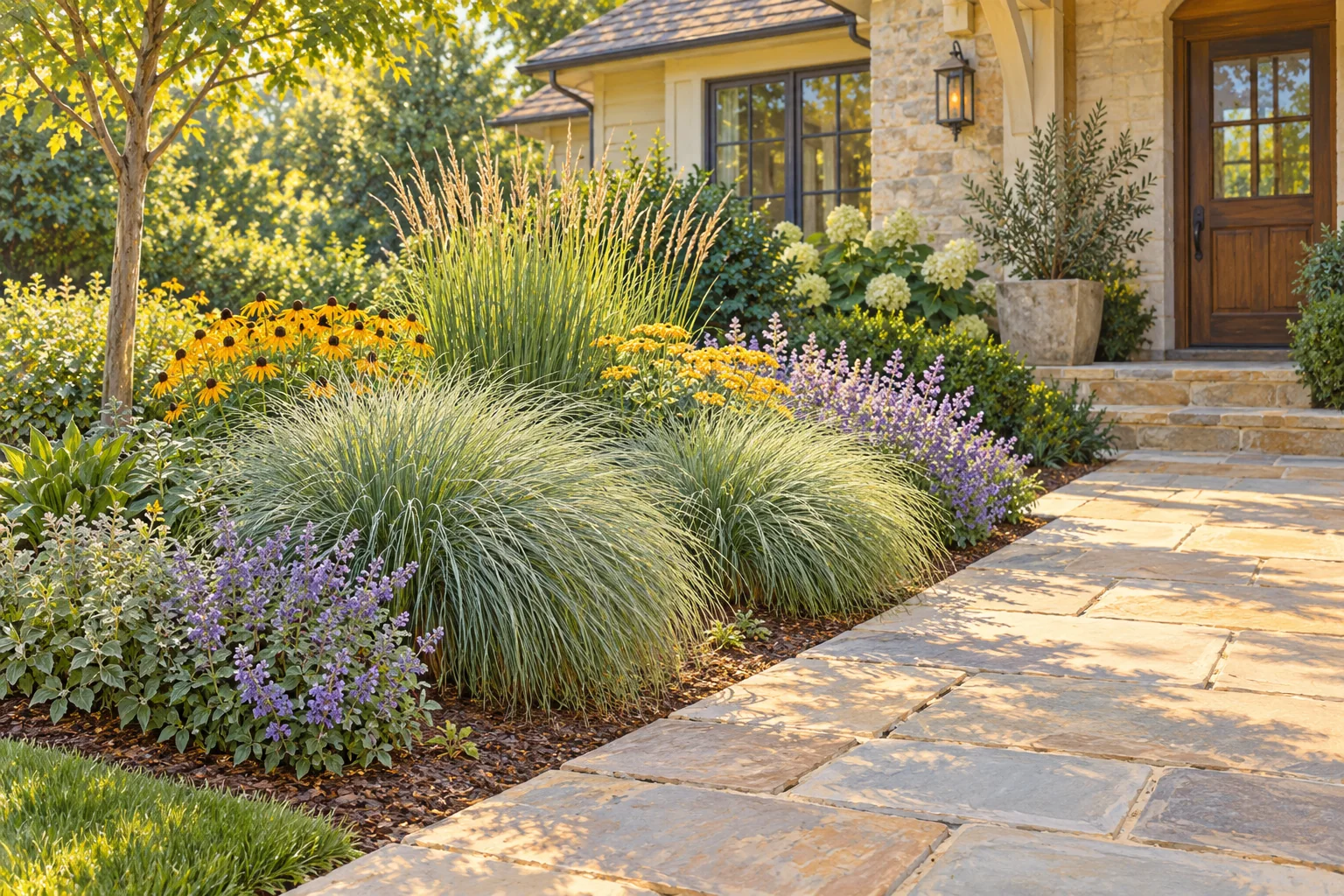
Check the flowering height as well as the leafy mound
These are starting points for sunny, well-drained beds in suitable temperate US climates. Use the exact variety's label to confirm winter hardiness and mature dimensions.
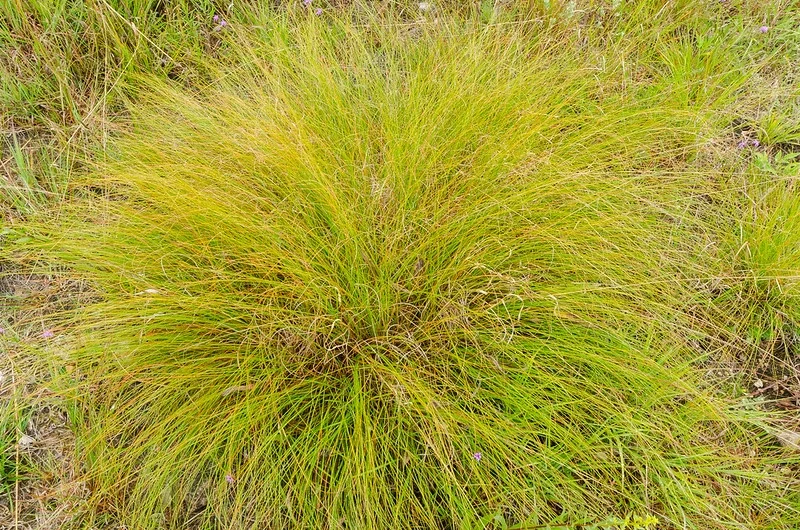
Prairie dropseed spreads outward
Its fine leaves soften an edge, but the foliage mound can spread about 3 feet, with flower stalks rising above it. Allow that width inside the bed. It establishes slowly, so resist filling every early gap with another permanent plant.
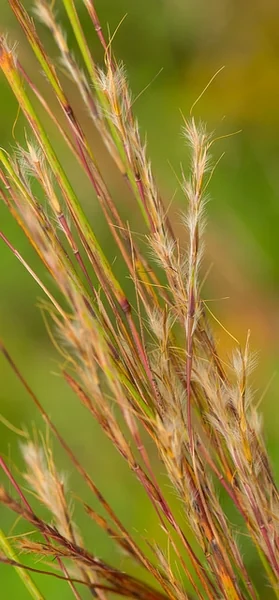
Little bluestem gives a stronger upright shape
Often 2–4 feet tall, its upright stems bring warm autumn color. Choose a variety for the available width and keep the view of the door open. Full sun and well-drained soil help it keep its shape; a shaded, heavily fed bed is a poor place to copy a prairie planting.
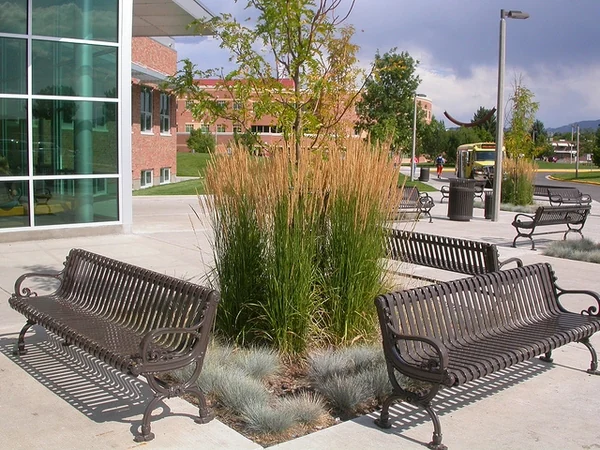
Feather reed grass makes a taller accent
'Karl Foerster' carries narrow flower stems above its leaves; the stalks can reach about 5 feet tall. Hot humid summers can be difficult. Place it where the extra height is useful, such as beside a window, rather than directly across a view you want to keep.
Give the border a spring season, too
Warm-season grasses start growing later in spring than cool-season grasses. A border designed only from its August photo may look surprisingly empty earlier in the year.
A sunny Midwestern border through the year
For a zone 5–6 bed with good drainage, combine repeated prairie dropseed with a separate low edge of moss phlox. Check local suitability and leave enough space for both plants to mature.
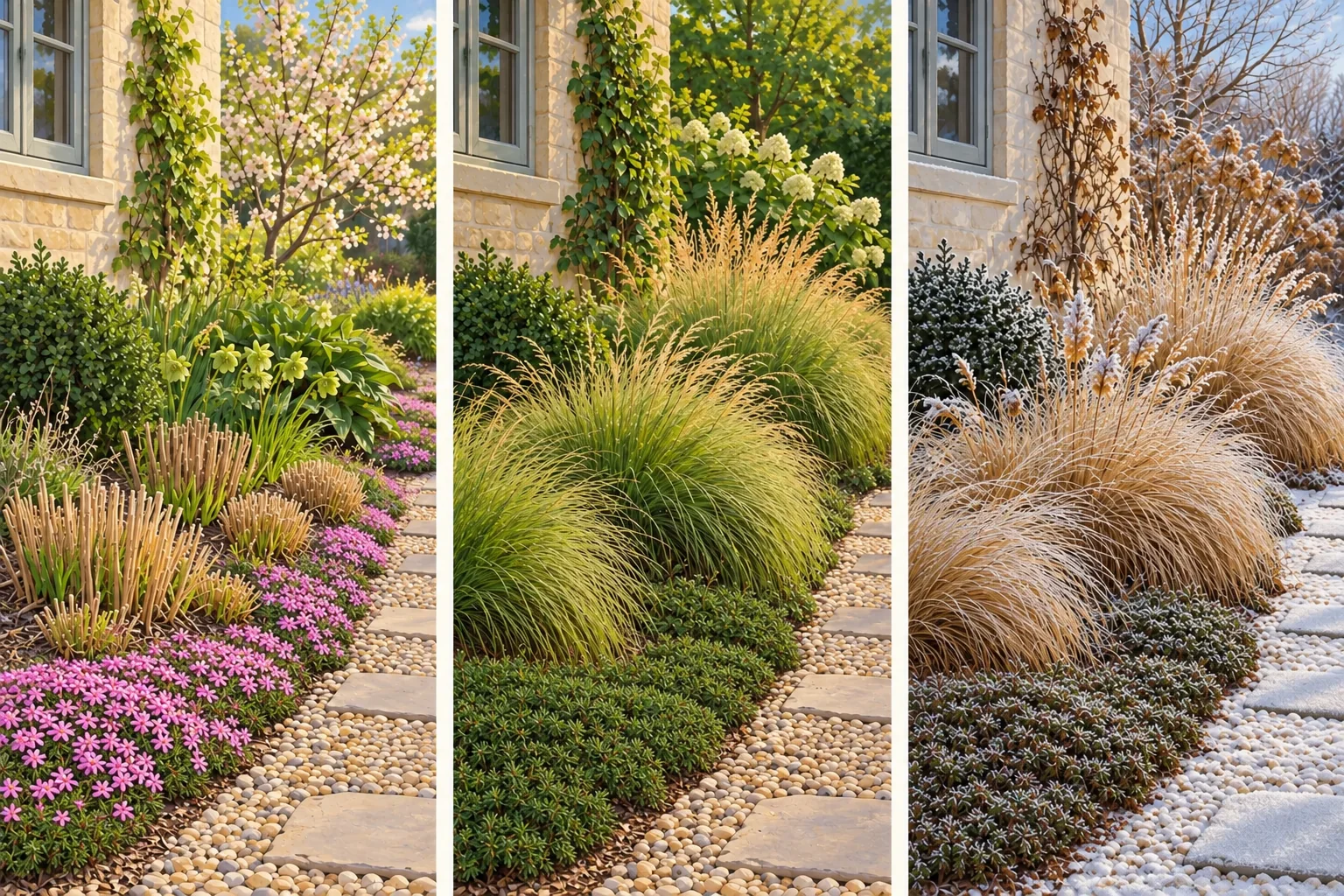
1
Spring: the lower edge flowers
Moss phlox brings a low band of color while the dropseed is still short. Keep it in its own front strip so it doesn't spread over the grass crowns.
2
Summer: the grasses fill out
The phlox becomes a green foreground beneath the grasses. This change is useful: the whole border doesn't need to flower at once.
3
Winter: stems and the bed edge remain
Leave sound stems standing where local fire guidance allows it, then cut back for spring growth. The path and defined bed edge help the planting look cared for after the flowers are gone.
Put the mature grass inside the bed, not across the path
A fountain-shaped grass spreads in every direction. The planting hole can be inside the border while half the mature plant hangs over the paving.
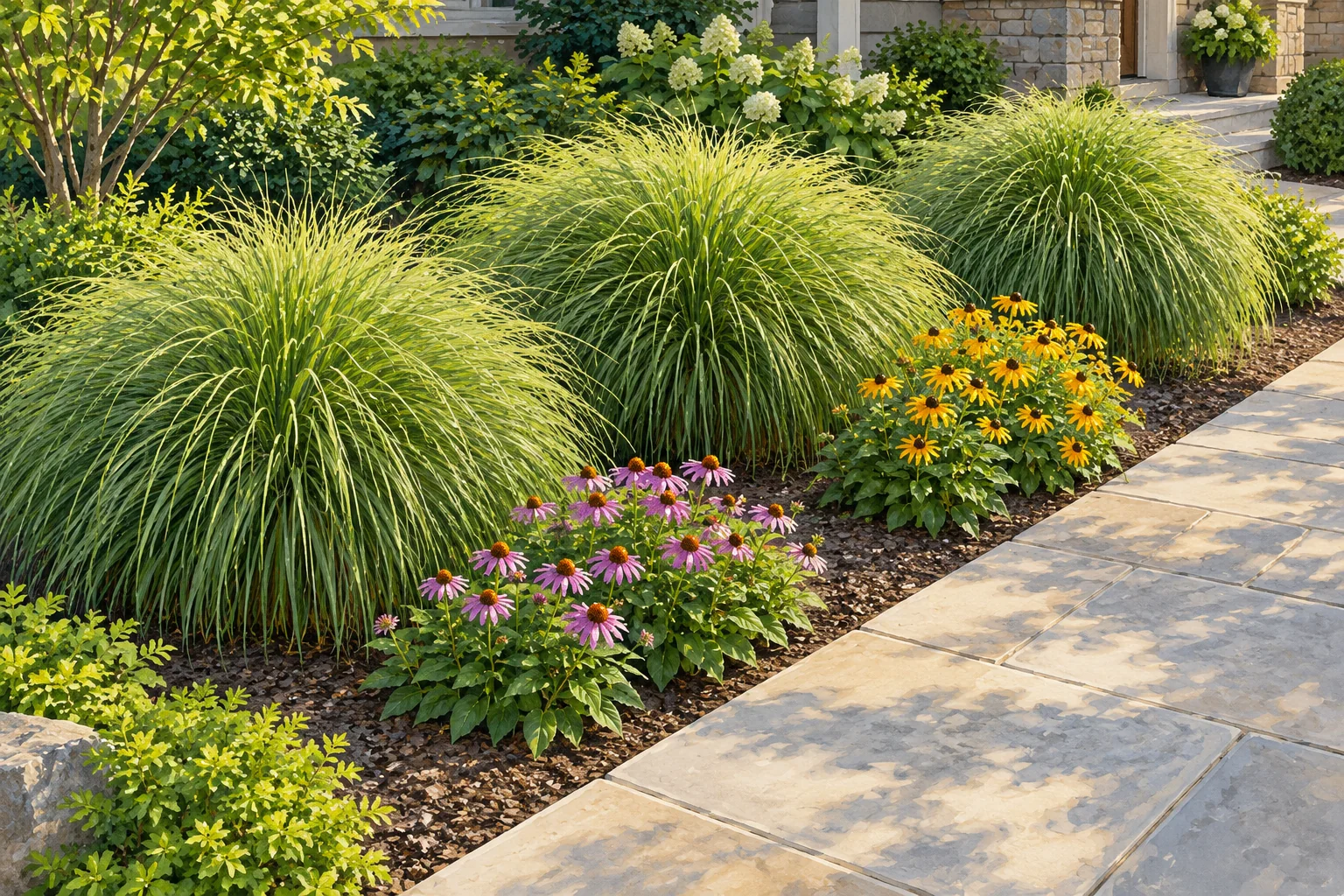
A 3-foot-wide grass beside a walk
Assume the chosen variety reaches 3 feet across. Its center needs to be at least 1.5 feet inside the bed for the expected outline to reach the edge; allow more for leaning stems or a visible gap.
- 1
Mark the mature circles
Use a hose or temporary markers to show the expected outlines. If the circles cover the paving, move the centers back or choose a narrower plant.
- 2
Try the everyday route
Walk past with shopping bags or a stroller. Keep the useful walking space clear, including at corners where foliage is easy to brush against.
- 3
Add flowers to the remaining space
A lower patch in front or between groups may fit. In a shallow bed, one repeated grass with a clean edge can be enough; an extra row is not always an improvement.
Use companions that share the grass's watering needs
Moss phlox (Phlox subulata) offers spring flowers and a low spreading edge in a sunny, well-drained bed. It can spread 2–3 feet, so keep it away from the grass crowns rather than treating it as a tiny filler.9
Threadleaf coreopsis, often sold as Coreopsis verticillata, offers a different pairing: yellow summer flowers among fine foliage. It suits sunny, well-drained conditions and can spread. Give it a defined patch beside the grass rather than scattering plants through every gap.10
For a dry border, avoid adding a thirsty companion that forces you to water the whole bed more often. In shade, start a different shortlist: a suitable sedge or Japanese forest grass may fit, but the sunny prairie combination above is not the right model.
Choose a border you can still manage after it fills out
Clump-forming grasses still need care. Plan for seasonal cutting back and occasional division when a clump outgrows its space. Warm-season and cool-season grasses wake at different times, so check the plant's growth before cutting into new leaves.1
Check your local invasive-plant list before buying an unfamiliar grass. Don't substitute a plant labeled only 'fountain grass' or 'ornamental grass' for a named variety. In wildfire-prone areas, follow local guidance on dry vegetation near buildings; attractive winter stems are not a reason to ignore that placement.
Once you know the bed's depth and sun, take a photo from the front walk. Gardenful can help you compare a softer grass-led border with a more flower-filled one. Tell it which paths and windows must stay open, then check the suggested plants against your climate and available space.
Frequently asked questions
What ornamental grass is best for a small front yard?
Prairie dropseed is useful for a rounded, fine-textured border; little bluestem adds a more upright shape. Where a tall narrow accent fits, consider 'Karl Foerster' feather reed grass. The best choice depends on mature width, flowering height, sun and your local climate.
Why do my ornamental grasses look dead in spring?
Warm-season grasses often start new growth later than nearby cool-season plants. Check the species and local timing before replacing a clump. Include an early-season companion so the whole border doesn't depend on the grass looking full in April.
Can I plant ornamental grasses below windows?
Yes, if the mature plant fits the view you want to keep. Check flower-stalk height as well as foliage height. A grass with low leaves can still send tall stems across the glass; keep taller accents beside the window instead.
 Gardenful
See how grasses could soften your front yard.
Start with your own yard photo in Gardenful. Compare planting shapes, keep the entrance open and build a shortlist that fits the space.
Gardenful for iPhone
Download the app free and start with a photo of your yard.

Sources(10)
- [1]Selecting ornamental grasses for your landscape
Iowa State University Extension and Outreachhttps://yardandgarden.extension.iastate.edu/how-to/selecting-ornamental-grasses-your-landscape
- [2]Prairie dropseed
NC State Extensionhttps://plants.ces.ncsu.edu/plants/sporobolus-heterolepis/
Photograph by Joshua Mayer, CC BY-SA 2.0; resized and converted to WebP for responsive display; adaptation retains the license.
- [3]Little bluestem
NC State Extensionhttps://plants.ces.ncsu.edu/plants/schizachyrium-scoparium/
Photograph by Joshua Mayer, CC BY-SA 2.0 DE; resized and converted to WebP for responsive display; adaptation retains the license.
- [4]
- [5]Feather reed grass photograph
NC State Extensionhttps://plants.ces.ncsu.edu/plants/calamagrostis-x-acutiflora/
Karl Foerster photograph by F. D. Richards, CC BY-SA 4.0; resized and converted to WebP for responsive display; adaptation retains the license.
- [6]CC BY-SA 2.0
Creative Commonshttps://creativecommons.org/licenses/by-sa/2.0/
- [7]
- [8]CC BY-SA 4.0
Creative Commonshttps://creativecommons.org/licenses/by-sa/4.0/
- [9]Moss phlox
NC State Extensionhttps://plants.ces.ncsu.edu/plants/phlox-subulata/
- [10]