Gardenful field guide
What plants will grow in my zone?
The short answer
Your tells you which perennials may survive an average winter low. It does not tell you which plants will thrive in your particular bed. Start with plants rated for your zone, then filter that list by summer heat, sunlight, soil moisture and drainage, mature space, and local concerns before choosing a small palette.
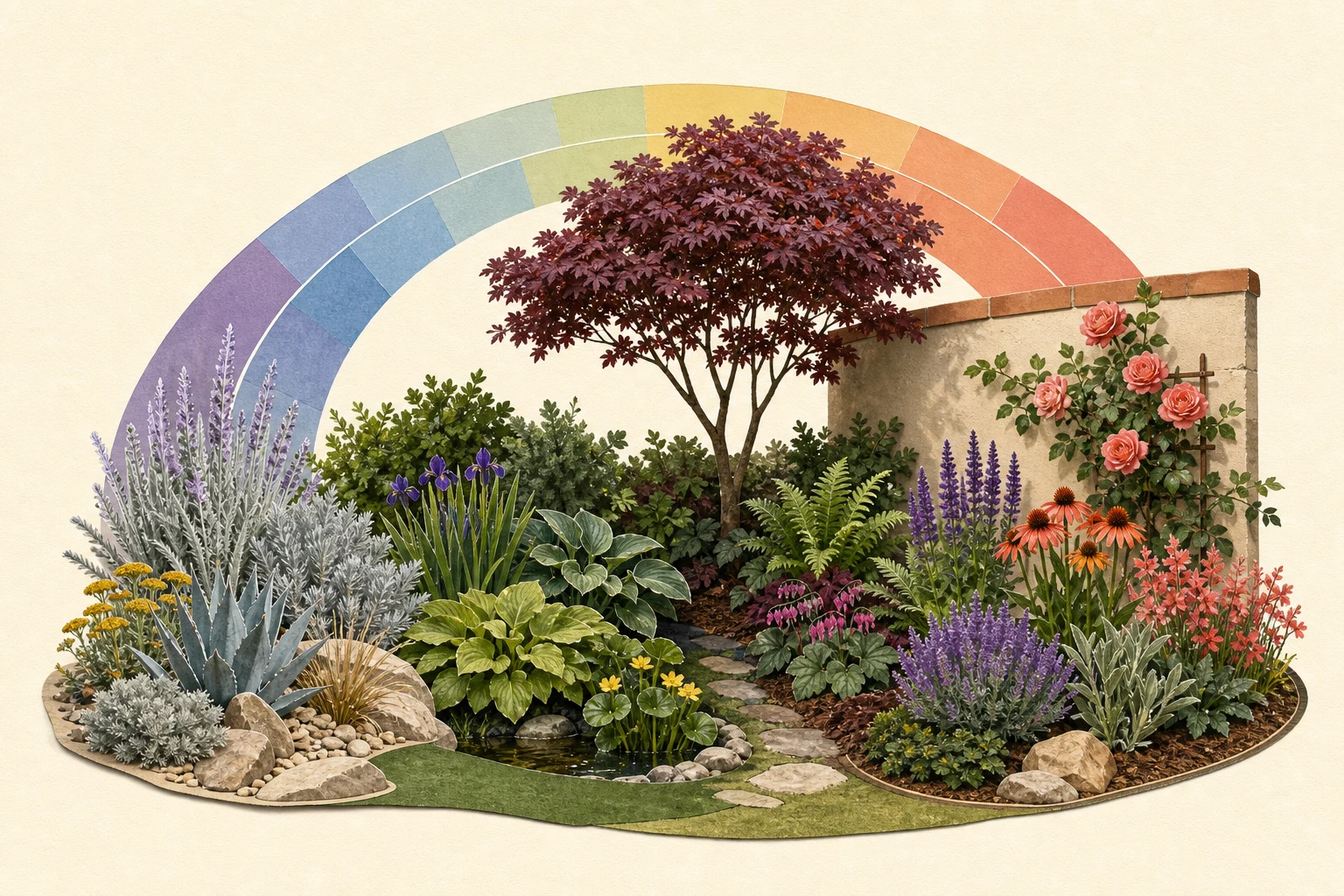
Use your zone as a winter screen, not a shopping list
The hardiness map answers one useful question: how cold an average winter gets in your area.
The USDA map groups locations by average annual extreme minimum winter temperature. It is a general guide for perennial survival, not a promise that every plant carrying your zone number will succeed.1
The USDA also names wind, soil type, soil moisture, humidity, summer heat, and plant placement among the factors that can change survival. Two gardens in the same zone can therefore need very different plant lists.1
Narrow the list with five filters
Work from conditions that can kill or disqualify a plant toward the choices that shape the design.
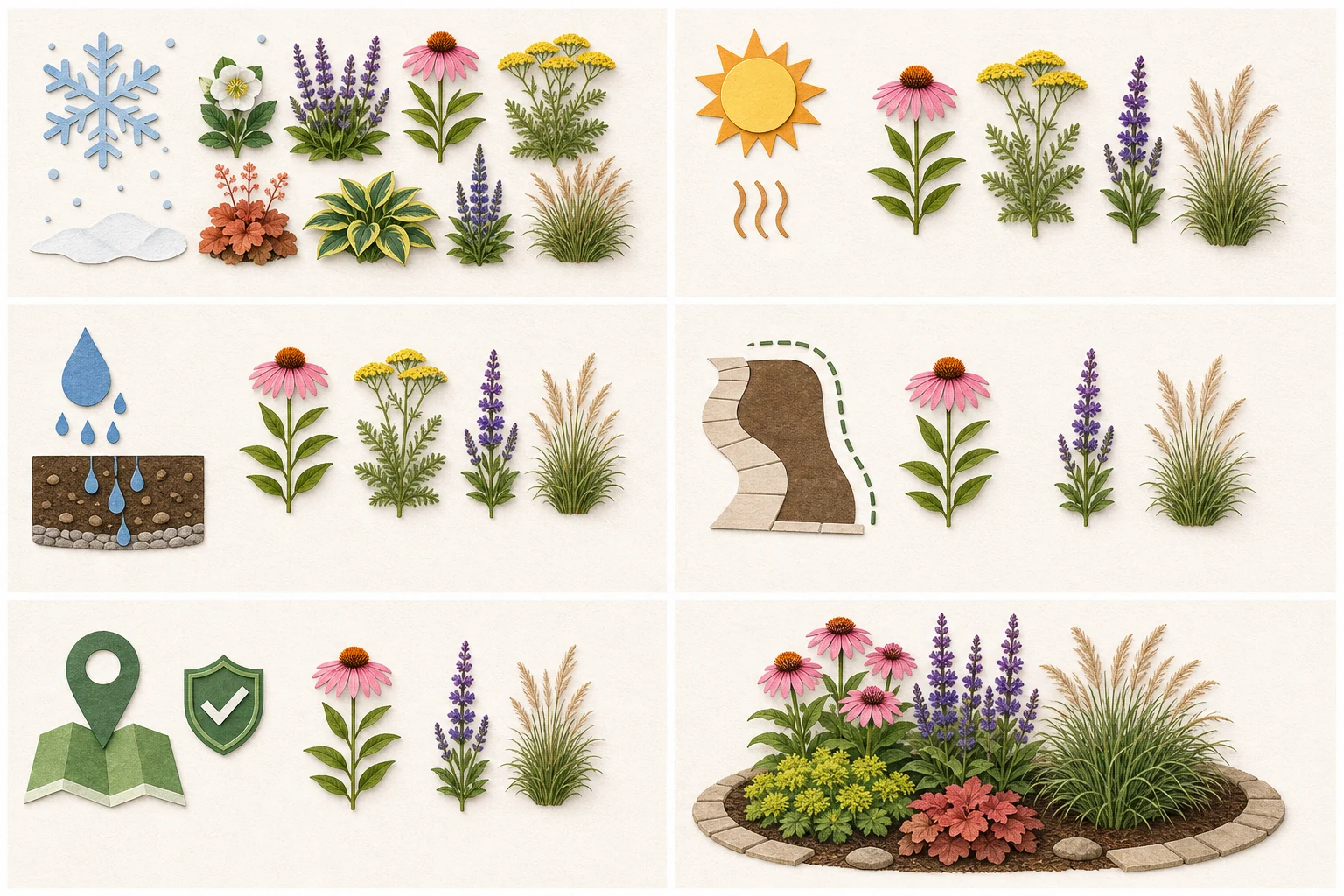
- 1. Winter cold
- 2. Sun and heat
- 3. Moisture and drainage
- 4. Mature space
- 5. Local checks
- 6. Useful shortlist
- 1
Check winter cold
Use the official USDA ZIP Code search and keep plants whose full hardiness range includes your zone.
- 2
Record sun, heat, and moisture
Record direct sun, reflected heat, winter wind, drainage, irrigation, and root competition at the bed.
- 3
Draw the mature space
Compare each plant's mature spread with paths, windows, walls, utilities, and neighboring plants.
- 4
Verify the exact plant locally
Confirm regional performance, invasive status, pest pressure, and household safety with a local source.
- 5
Build the palette last
Only then compare plant role, form, foliage, bloom sequence, and color.
Turn suitable plants into a garden, not a collection
Once the unsuitable plants are gone, give the remaining choices clear jobs. A small palette is easier to arrange, repeat, and maintain.
Select one candidate for each needed role, then repeat those plants in visible groups instead of adding a new species for every empty spot.
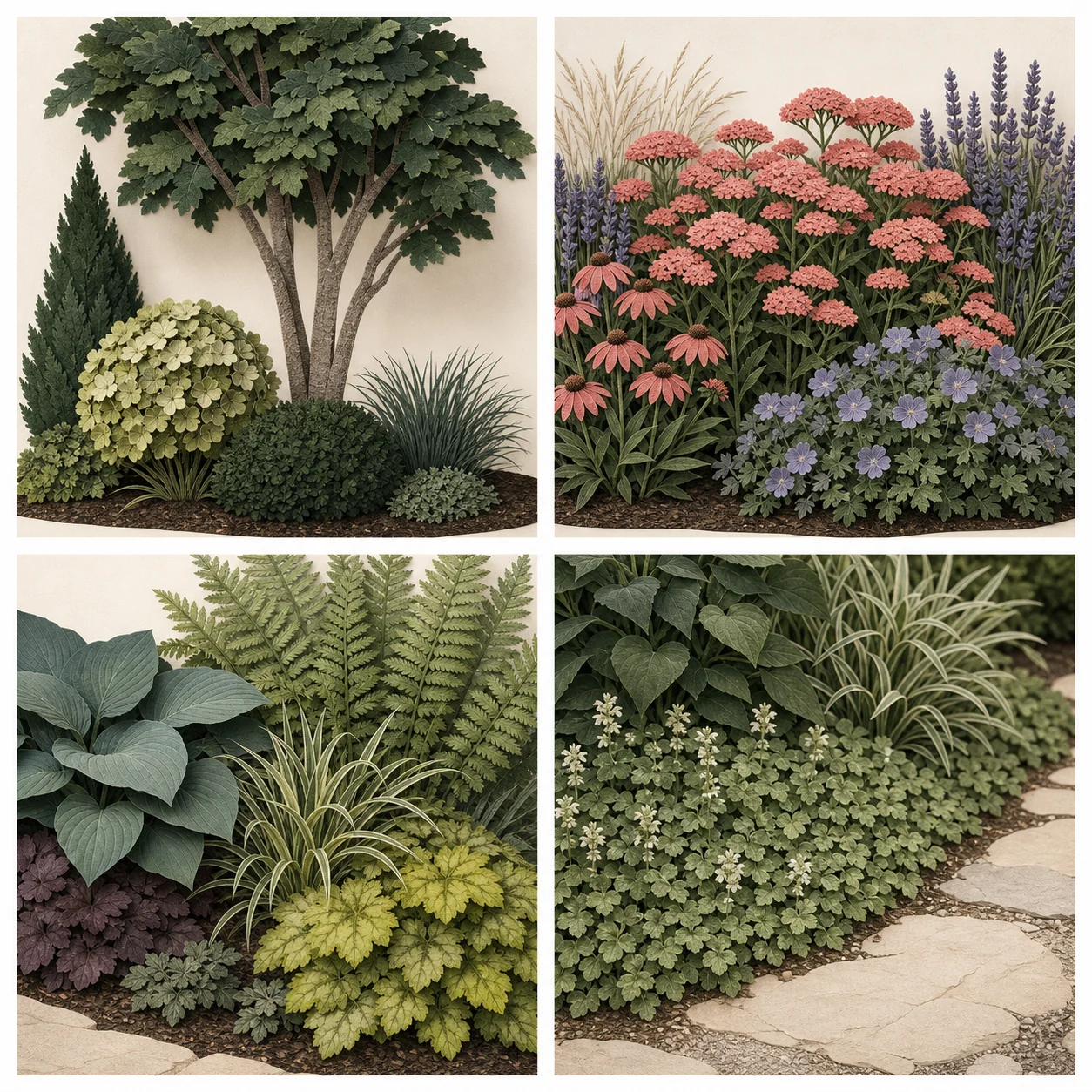
Structure
Use one or a few anchors where the eye naturally stops.
A shrub, grass, or upright perennial that holds a clear shape beyond peak bloom.
Main flowering mass
Let this carry most of the seasonal color.
A locally suitable plant repeated broadly enough to read from the normal viewing distance.
Foliage contrast
Use contrast to separate neighboring masses.
A different leaf size, texture, or tone that keeps the bed legible when flowers fade.
Edge or ground layer
Keep its mature spread clear of the walking surface.
A lower plant that covers soil, softens the bed line, or transitions toward a path.
The same role can be filled by different species in different regions. Preserve the composition when a local expert recommends a substitution.
See a plant shortlist become site-specific
A useful plant list belongs to one planting spot, not to a zone number alone.
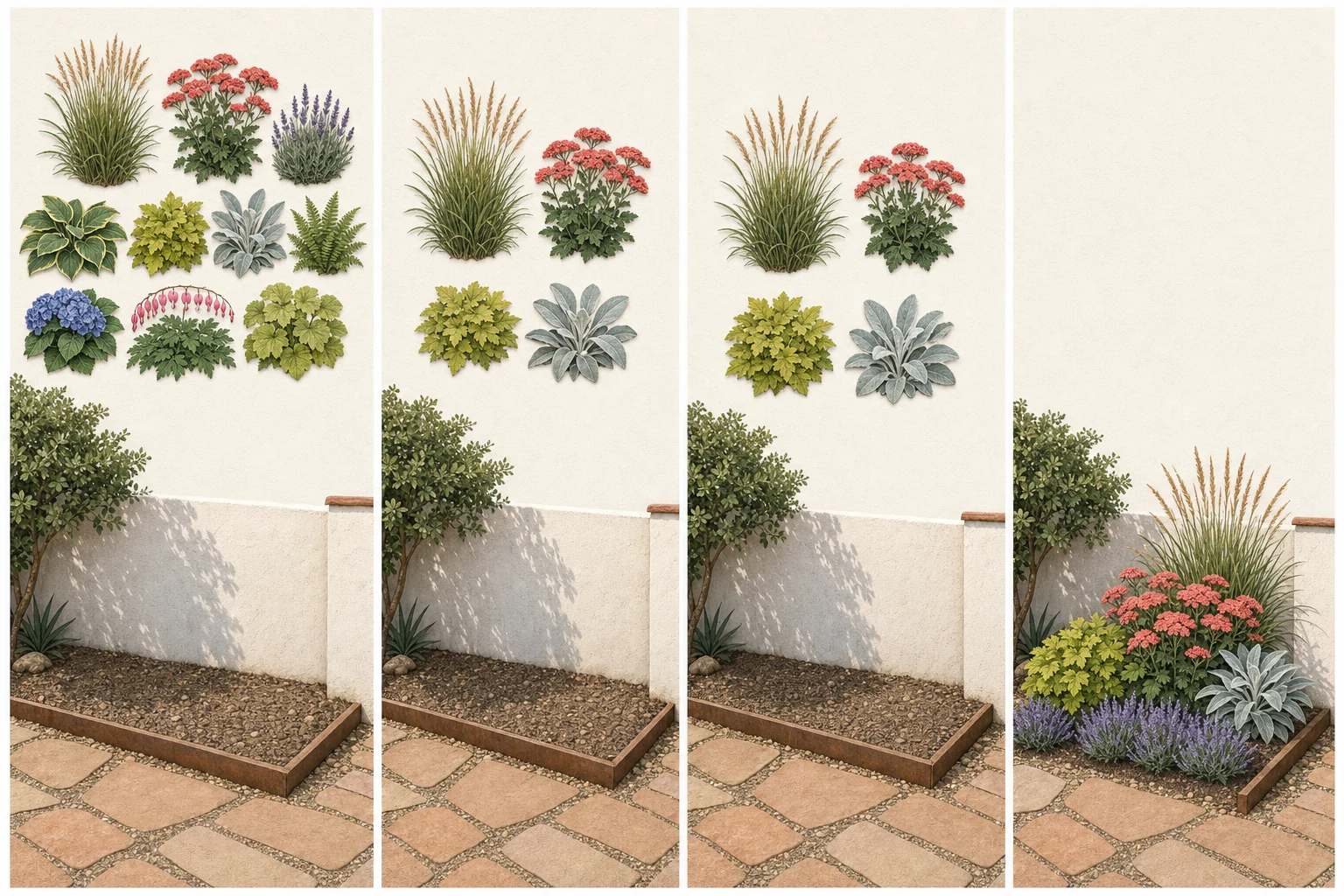
- 1. Zone
- 2. Site
- 3. Space
- 4. Roles
A hot, fast-draining bed beside a west-facing wall
The gardener starts with perennials whose hardiness ranges include the local zone. The bed gets strong afternoon sun, reflects heat from masonry, drains quickly, and borders a walkway.
See the plan notes
Start with zone-compatible candidates
The published hardiness range is only the entry requirement; it does not rank the plants for this bed.
Remove the site mismatches
Set aside plants that need cool afternoon shade or consistently moist soil, and keep candidates documented for sun, heat, and faster drainage.
Remove the space mismatches
Set aside forms that would cover the walkway or press against the wall at maturity, leaving room for access and airflow.
Assign four useful roles
Choose a structural plant, a repeatable flowering mass, a foliage contrast, and a low edge from the locally verified candidates.
The useful answer is not a longer zone list. It is a shorter list for one real bed.
Verify the shortlist before buying
Plant databases help you narrow the universe. Local evidence helps you avoid expensive mismatches.
Confirm the exact variety: Named varieties can differ in mature size, hardiness, growth habit, and flower behavior.
Check a regional source: Look for state extension guidance, trial-garden results, or advice from an established local nursery.
Check invasive status: Use the current state or regional invasive plant list. A plant sold locally is not automatically appropriate locally.
Check household safety: If children or pets use the garden, verify toxicity and thorn, sap, fruit, or seed hazards for the exact plant.
Plan establishment care: Even a well-matched plant needs appropriate planting, watering, and monitoring while roots establish.
If a plant's zone, light, moisture, or mature size is unclear, pause the purchase. Color is not evidence of fit.
Frequently asked questions
How do I find my USDA plant hardiness zone?
Enter the planting address or ZIP Code in the official USDA Plant Hardiness Zone Map. Record the full result, including the a or b half zone, then treat it as the first filter rather than a complete plant recommendation.
Are all plants labeled for my zone safe to buy?
No. The zone addresses average extreme winter cold. A plant can match your zone and still fail because of summer heat, sunlight, drainage, soil moisture, wind, mature size, pests, or other local conditions.
Should I choose a plant at the edge of its hardiness range?
Treat it as a higher-risk choice. The USDA notes that plants at the cold edge of their range can be lost during an unusually severe cold snap even after several successful years. Local performance records are especially useful for those choices.
Does Gardenful know which plants grow in my zone?
Gardenful can help you explore a visual direction and organize plants by role, but final species and varieties still need local verification for hardiness, heat, soil, water, mature size, invasive status, and household safety.
 Gardenful
Bring a verified plant palette into view.
Start with a clear yard photo and use your site notes to explore where each plant role belongs before you buy.
Gardenful for iPhone
Download the app free and start with a photo of your yard.

Sources(3)
- [1]How to Use the Maps
USDA Agricultural Research Servicehttps://planthardiness.ars.usda.gov/pages/how-to-use-the-maps
- [2]Lawns and Landscapes in Minnesota
University of Minnesota Extensionhttps://extension.umn.edu/yard-and-garden/lawns-and-landscapes-minnesota
- [3]Landscape Design: Arranging Plants in the Landscape
University of Florida IFAS Extensionhttps://ask.ifas.ufl.edu/publication/EP449