Gardenful field guide
How should I arrange plants in a flower bed?
The short answer
A flower bed looks intentional when repeated es share the work instead of every specimen standing alone. Start with one structural plant, then place two or three broad masses around it. Vary height in layers without making a rigid staircase, keep the lowest plants near visible edges, repeat one form or color to connect the bed, and space every plant for its mature width. Leave a clear route for maintenance before filling gaps.
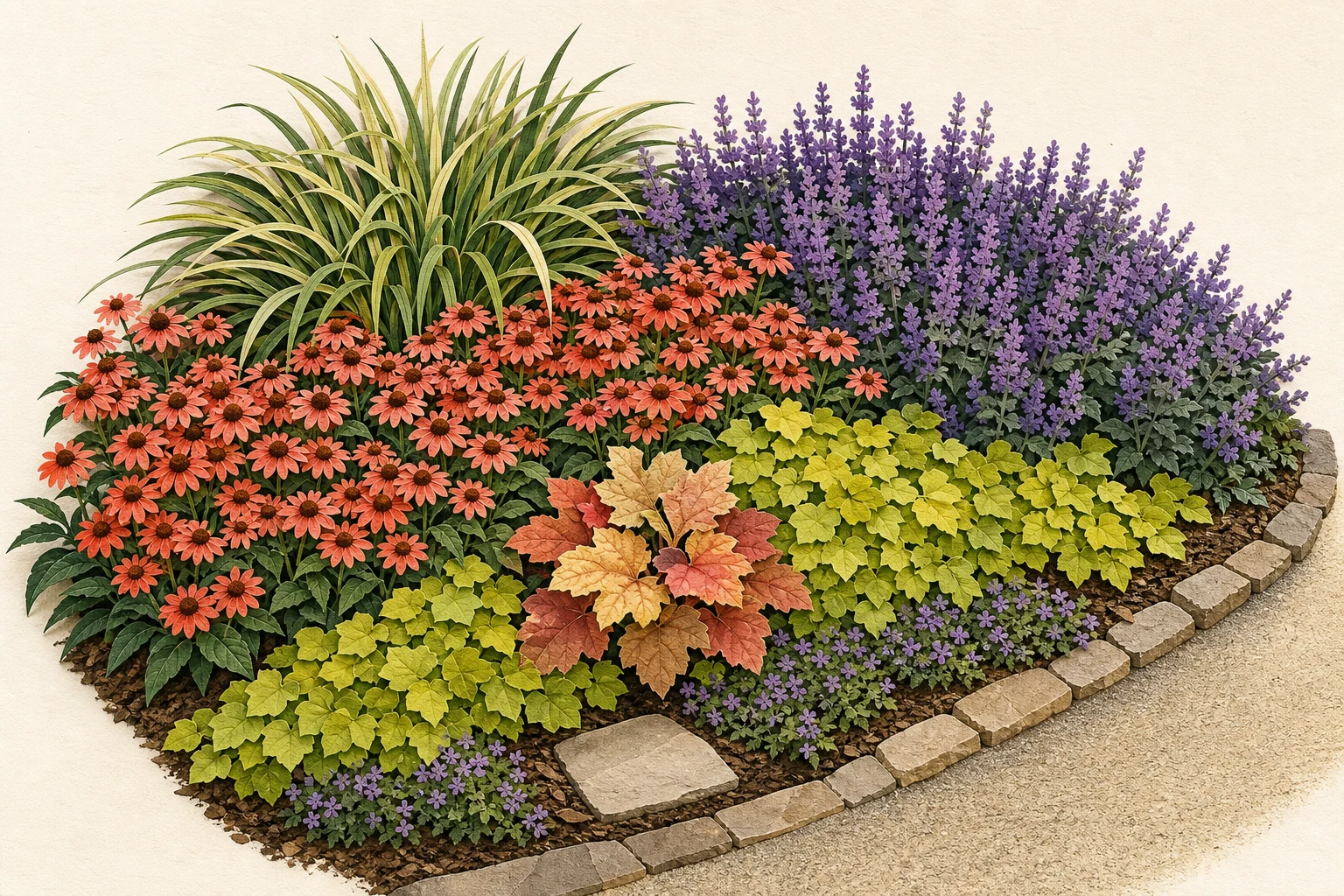
Arrange the fixed space before arranging plants
The bed edge, viewing direction, and access points decide where height and detail will be useful.
Draw the bed as a simple shape and mark the parts that cannot move: paths, walls, windows, downspouts, utilities, tree roots, and plants that will remain. Then mark where people usually see the bed. A front bed viewed from the street needs broader masses than a small border beside a seat.
Add an access route before planting. A deep bed may need stepping stones or a narrow maintenance opening so you can reach the middle without compressing soil or leaning through mature plants.
Draw plant outlines at mature spread, not the size of the nursery container. Mature spacing makes the number of plants and the long-term shape of each mass visible before purchase.2
Group plants into masses instead of scattering singles
A flower bed becomes easier to read when fewer plant types create larger, connected shapes.
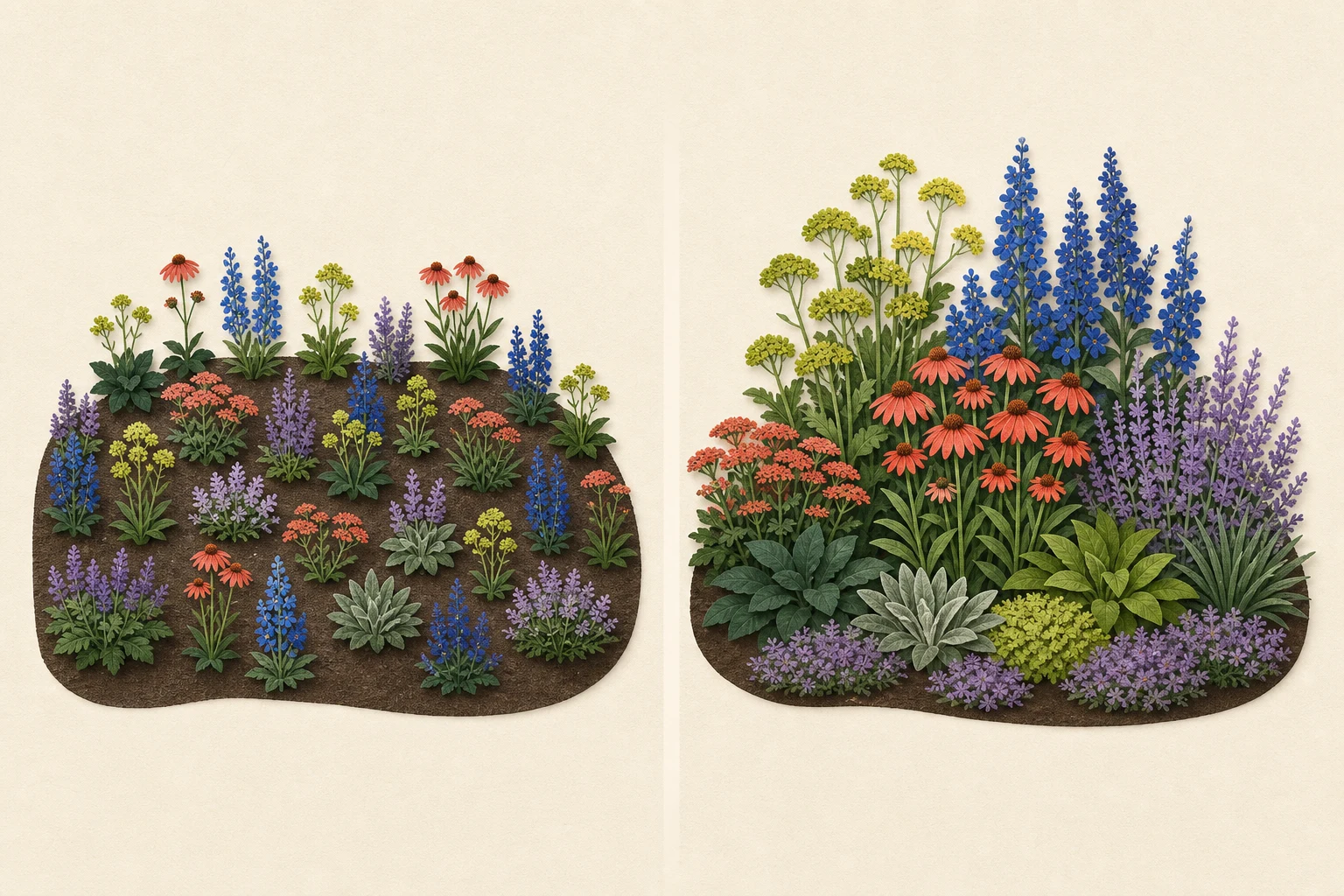
- Scattered singles
- Repeated masses
In natural plant communities, plants often appear in clusters and drifts that overlap in layers. University of Florida guidance applies that idea to designed landscapes by connecting plant masses and repeating plants or characteristics across the composition.1
A single specimen can still be useful when its form deserves attention. The problem is not one plant standing alone. The problem is giving every plant equal emphasis, which leaves the eye with no obvious place to settle.
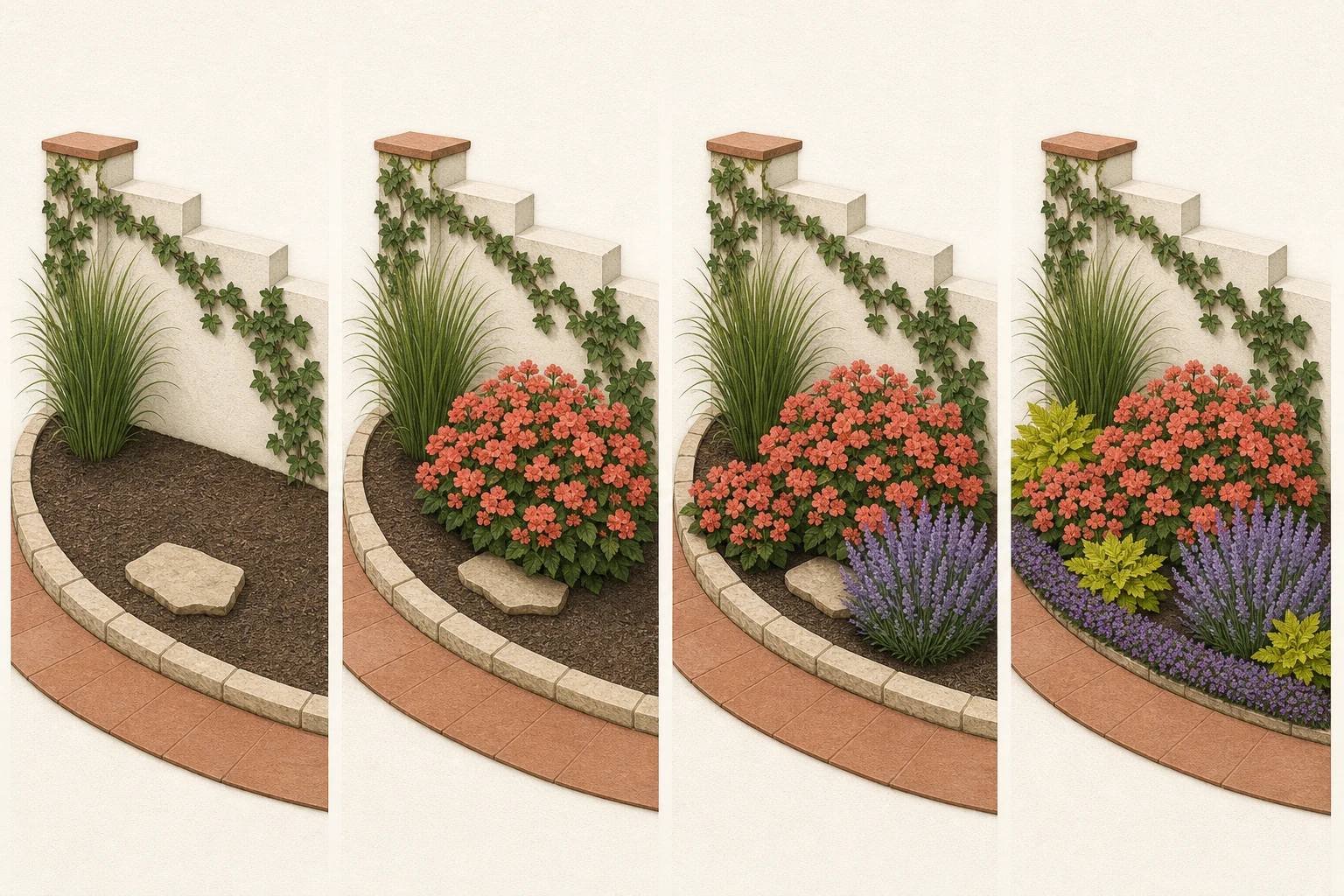
See one border take shape in four passes
The same bed stays in view as each plant role is added, so the reason for every layer remains visible.
One dominant mass, several supporting layers
The exact plants have already been verified for the site's zone, sun, moisture, and mature space. The coral flowering mass stays dominant while structure, a smaller lavender mass, foliage contrast, and a low edge support it.
1
Place the structural plant
Set one strong form off-center, clear of the wall and access route, so it anchors the bed without dividing it into equal halves.
2
Draw the main flowering mass
Let the main flower form the largest shape, with a gently uneven outline instead of a straight row.
3
Add a smaller supporting mass
Place a different flowering group beside the main mass, but keep it smaller so the bed retains a clear hierarchy.
4
Finish with foliage and a low edge
Add foliage contrast, keep the maintenance opening visible, and place plant centers from each exact variety's mature spacing.
The drawing decides where each role belongs. Mature spacing decides how many plants the drawing needs.
Check the arrangement from a gardener's point of view
A bed can look balanced on paper and still become awkward to maintain or unclear from its real viewing distance.
Step back to the main view: Confirm that the largest masses and structural forms remain visible from the path, window, patio, or street that matters most.
Test the no-bloom version: Imagine every flower removed. The remaining heights, forms, and foliage should still create a coherent bed.
Check mature outlines: Keep plants clear of paths, walls, windows, utilities, and one another according to the exact mature spread.
Walk the maintenance route: Make sure you can water, weed, divide, prune, and inspect the back of the bed without stepping through plant crowns.
Remove one unnecessary variety: If two plants serve the same visual and seasonal role, repeating the stronger choice often makes the bed calmer and easier to care for.
Do not use closer spacing to make a new bed look mature. Use mulch, temporary annuals, or patience while permanent plants reach their planned width.
Frequently asked questions
Should tall plants always go at the back of a flower bed?
Not always. Put taller plants where they will not block important views or access. A bed viewed from one side often rises generally toward the back, while an island bed usually places taller structure nearer the middle. Vary the height enough to avoid a rigid staircase.
How many different plants should be in one flower bed?
There is no universal number. Start with enough types to cover structure, a main mass, useful contrast, and an edge or ground layer. Repeat those before adding another variety. A small bed often becomes clearer when one unnecessary type is removed.
Should I plant flowers in rows or groups?
Groups and interlocking masses usually read more naturally in an ornamental bed. Straight or geometric rows can suit a formal design, a cutting garden, or a narrow edge, but the spacing still needs to reflect mature plant width.
How do I know how many plants to buy?
First draw each plant mass and select the exact species or variety. Then use its mature on-center spacing to place plant centers inside the measured mass. Recalculate any substitute whose mature width changes.
Can Gardenful arrange plants in my flower bed?
Gardenful can help you explore a visual planting direction on your yard photo and organize plants into roles and suggested quantities. Verify the exact plants, mature spacing, site conditions, and final count before buying.
 Gardenful
See the plant masses on your own flower bed.
Start with a clear photo, keep the fixed edges and access visible, and compare a few arrangements before you buy the final quantities.
Gardenful for iPhone
Download the app free and start with a photo of your yard.

Sources(3)
- [1]Landscape Design: Arranging Plants in the Landscape
University of Florida IFAS Extensionhttps://ask.ifas.ufl.edu/publication/EP449
- [2]Home Landscape Design
Mississippi State University Extensionhttps://extension.msstate.edu/publications/home-landscape-design
- [3]Lawns and Landscapes in Minnesota
University of Minnesota Extensionhttps://extension.umn.edu/yard-and-garden/lawns-and-landscapes-minnesota