Shade garden design
Shade garden ideas for dry, moist, and dappled sites
The short answer
Shade is not one condition. A dry root zone beneath a mature tree needs a different strategy from cool, moist shade or a bright woodland edge. Observe both light and soil moisture first, then build the design from repeated leaf shapes, durable mounds, fine-textured contrast, and a restrained flowering accent.
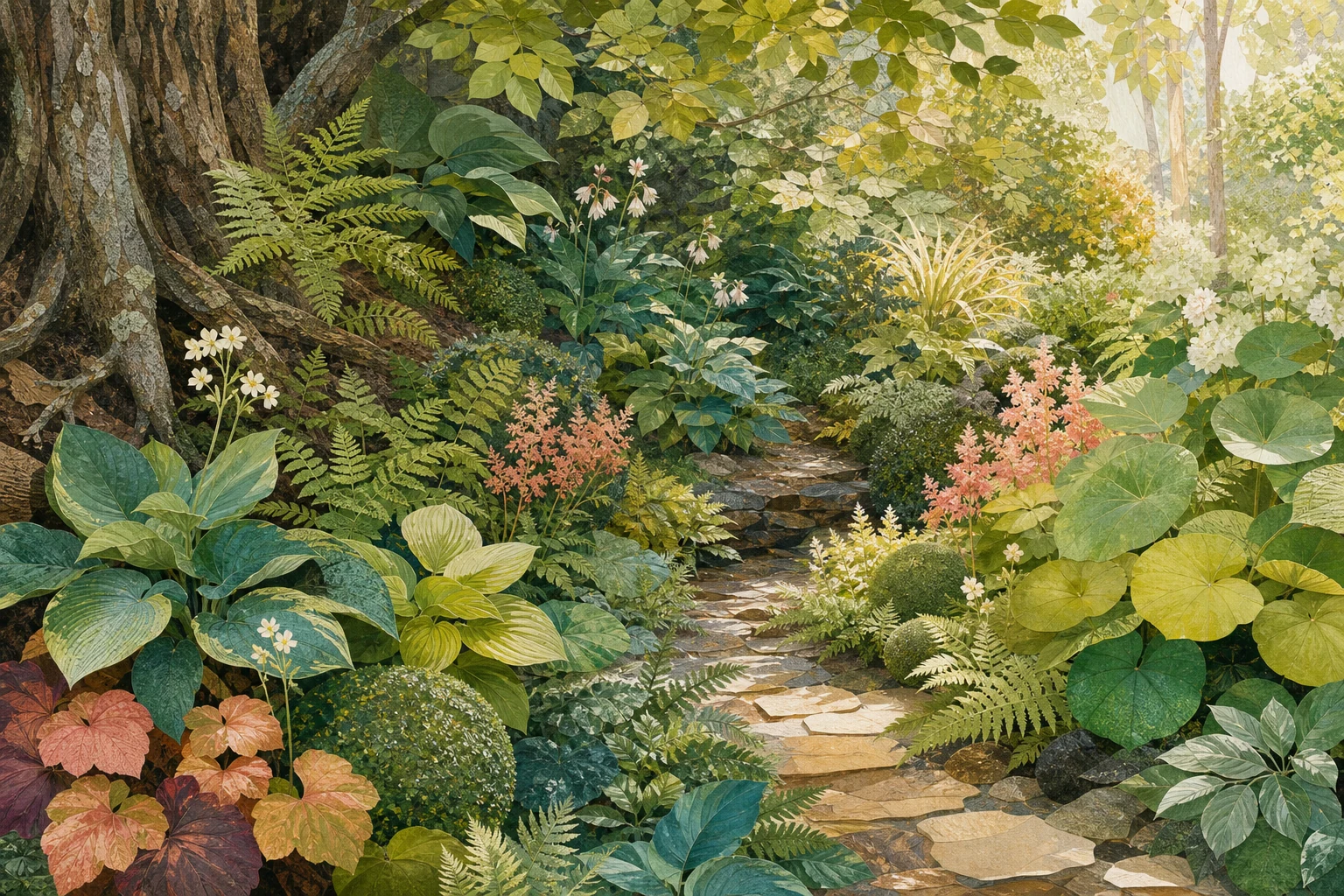
Read shade and moisture as one site condition
Two places that look equally shaded can support very different planting because roots, roof cover, slope, and reflected light change the available water and heat.
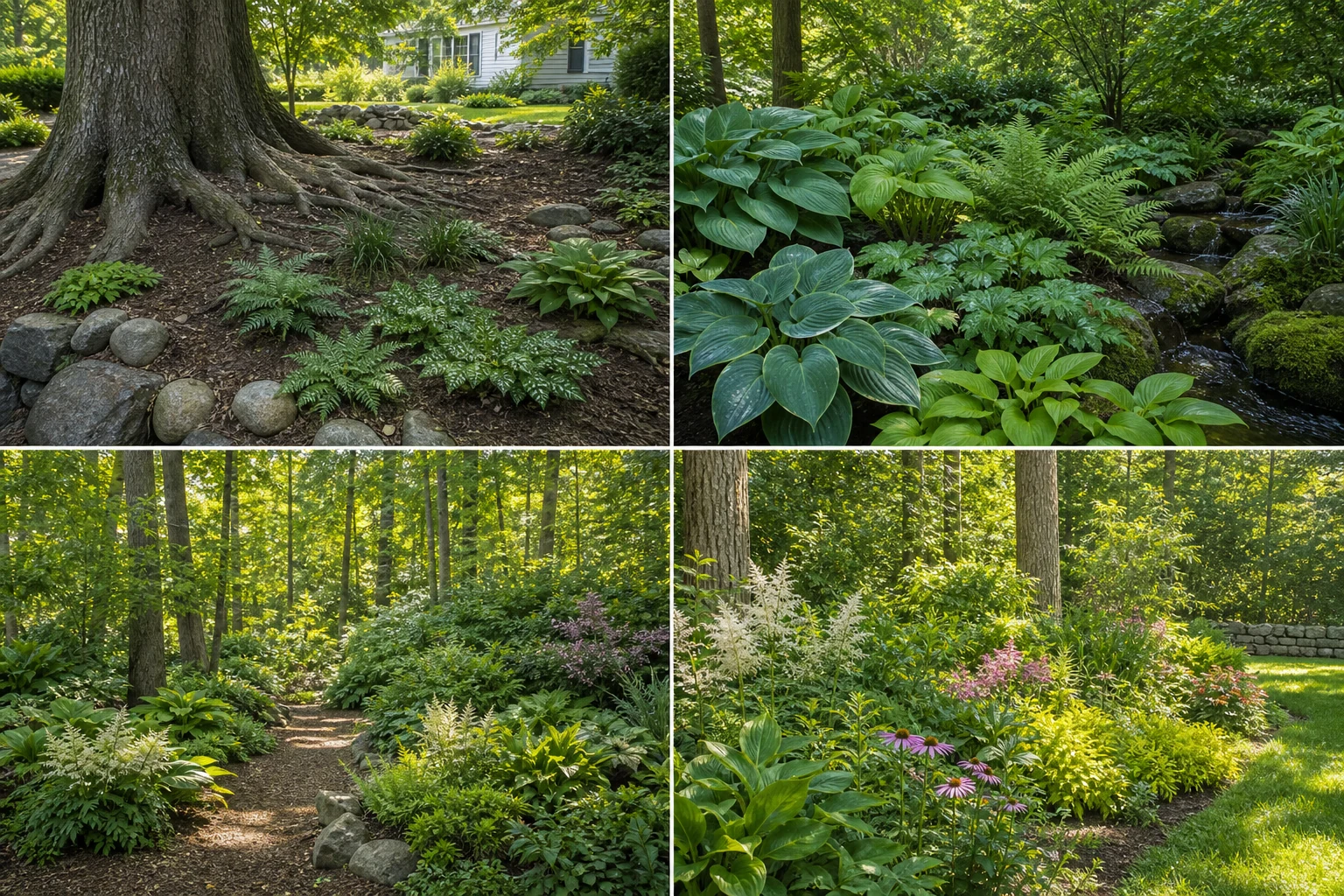
Dry root shade
Competition from established roots limits both moisture and digging space. Protect the tree and use a restrained, locally suitable ground layer.
Cool moist shade
A sheltered, well-drained area can support broader foliage and denser layering, but persistent wetness still needs diagnosis.
Dappled or shifting shade
Moving sun patches can support more plant choices than a dark exposure; observe the pattern across the day and season.
Bright woodland edge
Open sky and filtered light often allow stronger flowering accents while the repeated foliage keeps the composition calm.
Sources: University of Minnesota Extension
Build the shade garden from four foliage roles
Color is valuable, but form and texture remain visible much longer. Use them to create order before deciding which flowers to add.
Repeat one bold leaf and one calm mound, weave in a finer texture, and use flowering accents where the light can support them.
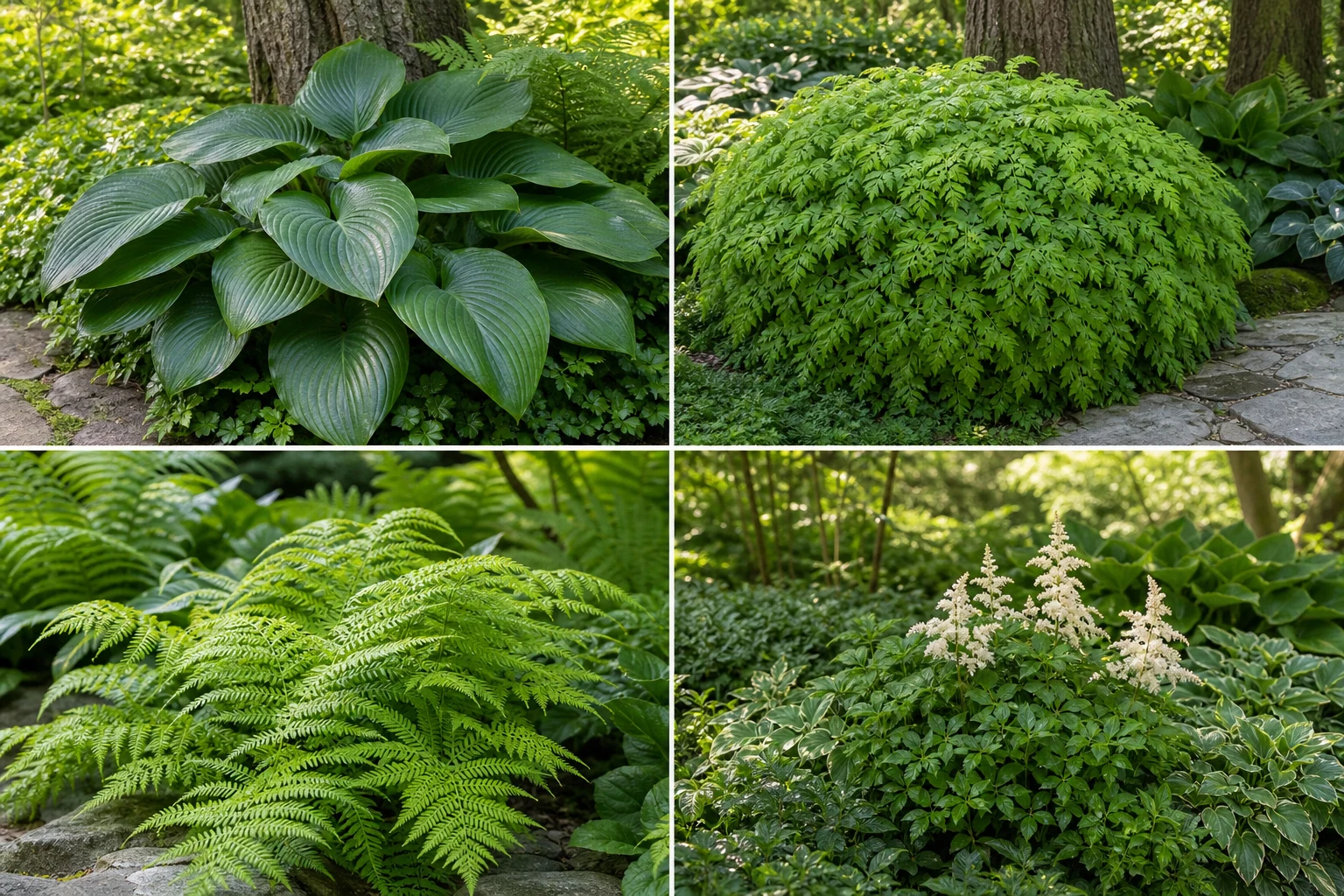
Bold leaf anchor
A broad leaf gives the eye a clear place to rest and reads well from a window or path.
Calm rounded mass
Repeated mounds connect the anchors and keep the bed from becoming a collection of isolated foliage specimens.
Fine-textured contrast
Fern-like or grassy foliage adds movement and makes broad leaves feel more deliberate.
Restrained flower accent
A pale or repeated bloom can lift a dim area, but it should not be responsible for the entire composition.
Sources: University of Florida IFAS Extension
Work around mature trees without treating their roots as empty ground
A shade garden under an established tree begins with tree protection. The available planting space may be smaller than the visible area beneath the canopy.
- 1
Keep grade changes away
Do not bury roots or add a deep new soil layer without qualified local advice; changing soil depth can reduce the air and water reaching roots.
- 2
Use existing gaps
Place small plants where digging is possible without cutting major roots rather than forcing a continuous bed immediately.
- 3
Establish gradually
Water the new planting appropriately without assuming the mature tree and the understory need the same schedule.
- 4
Use containers where soil is unavailable
A few stable containers can add seasonal emphasis without repeated digging through a difficult root zone.
Compose a small shade border that reads from indoors
The long view needs fewer, larger decisions than the close view from the path.
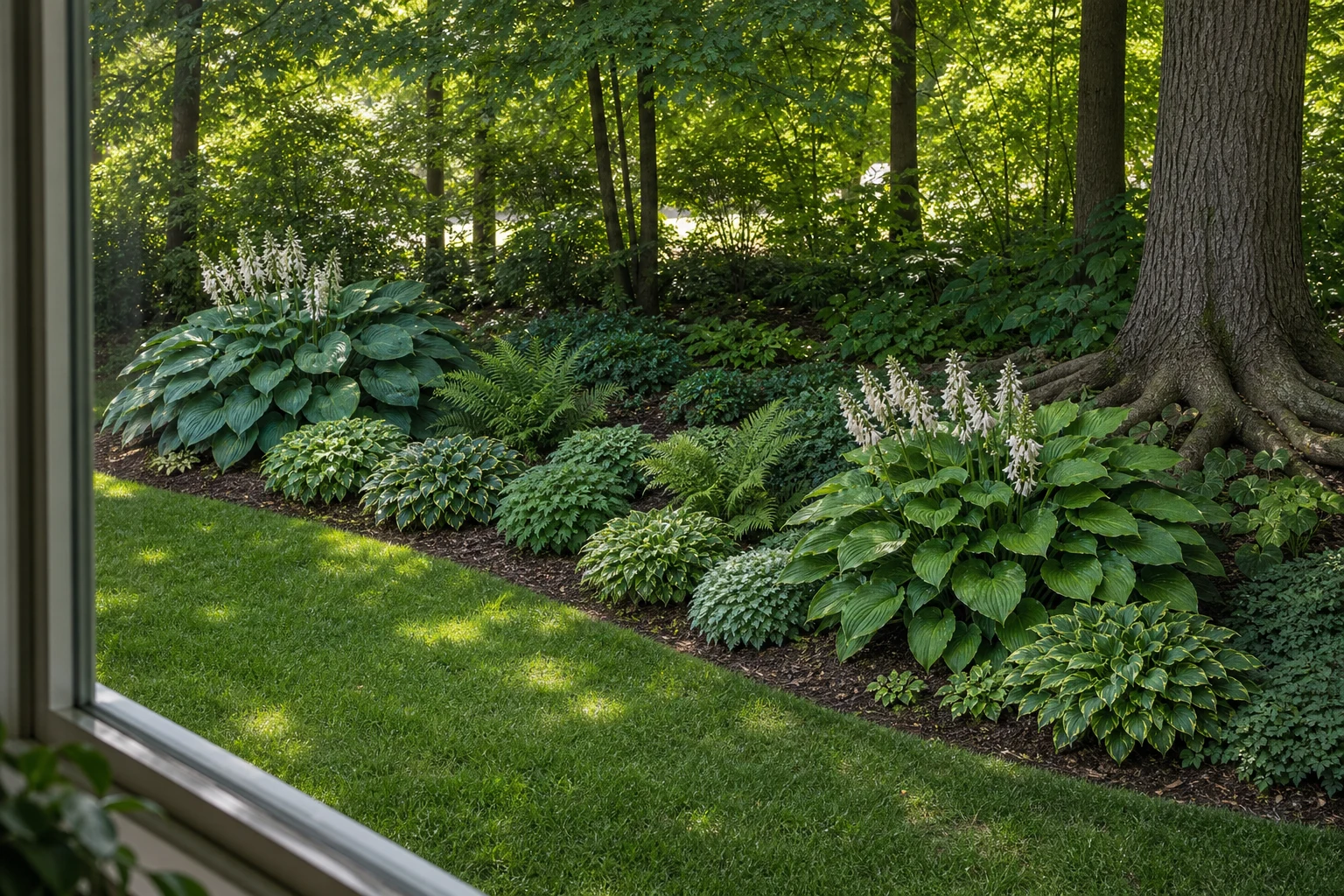
A small border seen from a kitchen window
The site has dappled morning light, afternoon shade, and moderate moisture away from the tree trunk.
- 1
Place two broad-leaf anchors
Set them off-center so they create a rhythm rather than a symmetrical pair.
- 2
Connect them with repeated mounds
Use groups large enough to register from the window, leaving room for mature spread.
- 3
Thread fine texture through two gaps
Keep the contrast visible without scattering it through every opening.
- 4
Add one seasonal flower note
Repeat it near both anchors so the temporary color supports the established structure.
The border remains composed when the flowers finish because the repeated leaf shapes still carry the view.
Frequently asked questions
What grows well in a shade garden?
That depends on both light and moisture. As a cold-climate example, University of Minnesota Extension lists bigroot geranium for dry shade, cinnamon or royal fern for moist shade, and serviceberry or witchhazel among larger woody options for some shaded sites. Those examples are not interchangeable: confirm the exact site's soil, drainage, mature space, hardiness, and root competition before choosing.
How do I make a shade garden colorful?
Use several kinds of color: light and dark foliage, silver or variegated leaves where locally suitable, contrasting stems, and a restrained flowering accent. Foliage usually carries the design longer than flowers.
Can I plant directly under a mature tree?
Sometimes, but protect the tree first. Use existing gaps, avoid cutting major roots or changing the grade, and ask a qualified local arborist when the tree is valuable or the root zone is difficult.
What is the difference between this guide and the shade front yard guide?
This guide covers shade-garden composition across the yard. The shade front yard guide focuses on house interfaces, eaves, foundations, front walks, and tree roots in the public-facing yard.
 Gardenful
See the foliage structure before choosing shade plants
Use your yard photo to explore the large masses and long view, then verify each exact plant against light, moisture, roots, and climate.
Gardenful for iPhone
Download the app free and start with a photo of your yard.

Sources(2)
- [1]Gardening in the Shade
University of Minnesota Extensionhttps://extension.umn.edu/gardening-minnesota/gardening-shade
- [2]Landscape Design with Plants: Creating Outdoor Rooms
University of Florida IFAS Extensionhttps://ask.ifas.ufl.edu/publication/EP449