Gardenful field guide
How to design a woodland garden under mature trees
The short answer
A woodland garden begins with the existing canopy and the root system supporting it. Keep major roots undisturbed and the visible, map the dry, moist, deep, and brighter shade, then plant only in available soil pockets. Add an of smaller trees or shrubs, followed by ferns, sedges, and seasonal ground plants suited to your region.
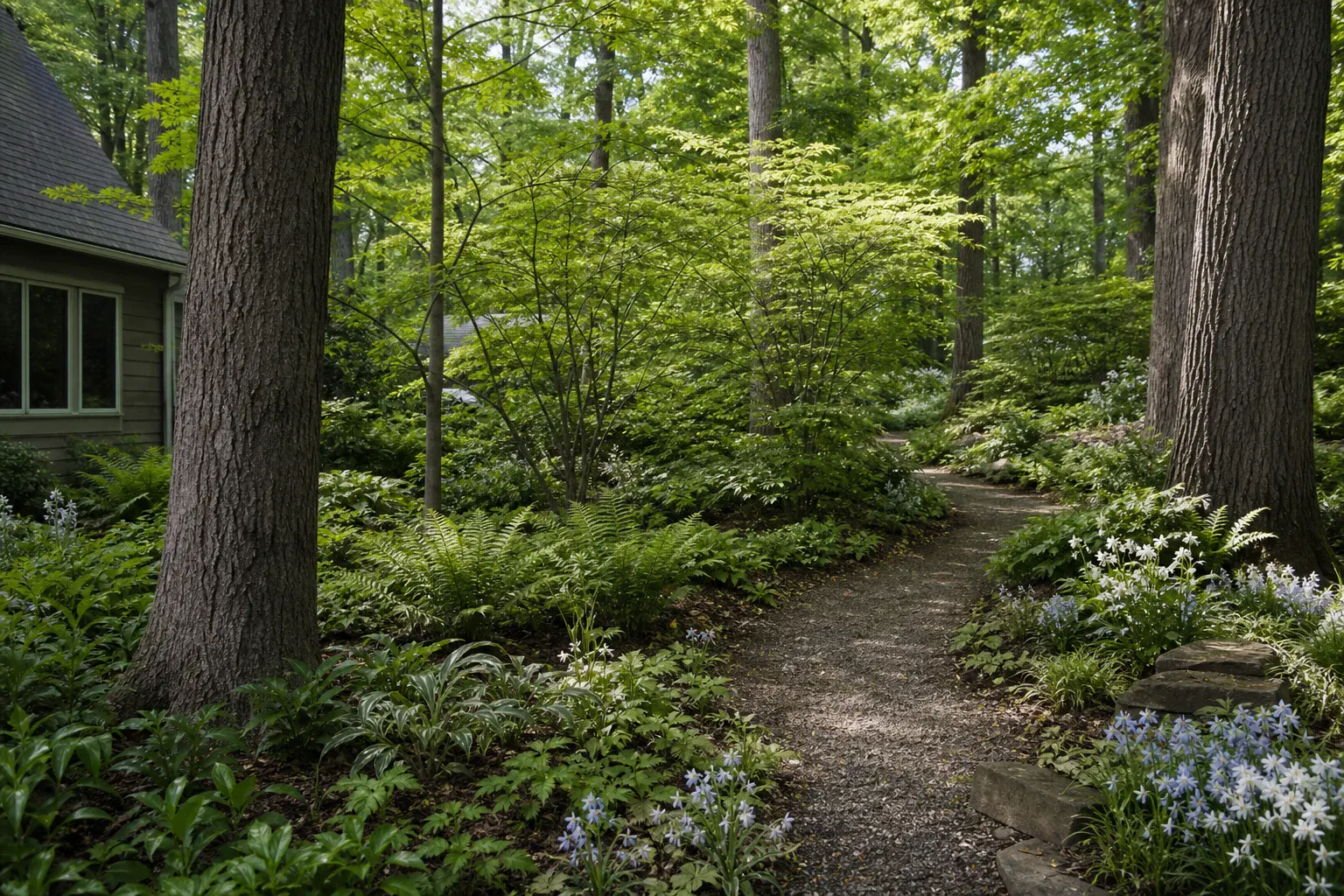
Map the woodland conditions, not just the word shade
Light and moisture can change within a few feet beneath a mature canopy.
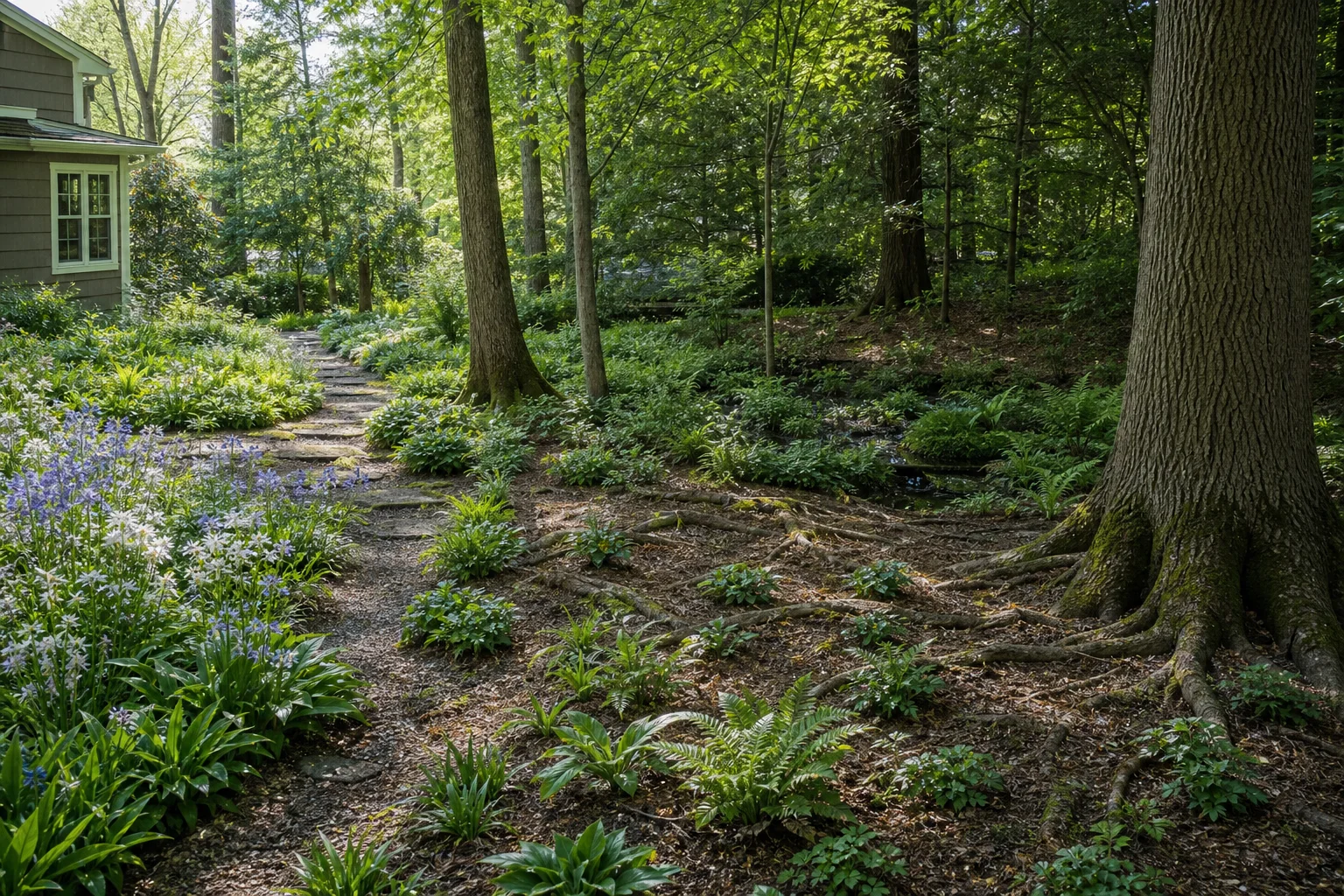
- 1
Watch seasonal light
Record the brighter spring window before deciduous trees leaf out, the summer shade pattern, and any hot sun at the woodland edge.
- 2
Separate dry from moist shade
Dense roots, roof overhangs, slopes, and canopy interception often make shade dry. Low areas or sheltered edges may hold more moisture.
- 3
Mark trunks and major roots
Keep the trunk flare exposed and avoid grade changes, trenches, or broad excavation within the root zone.
- 4
Find the edge
The transition from open sun to filtered shade often supports more flowers and shrubs than the deepest interior. Treat it as a distinct planting zone.
Choose the woodland condition you actually have
These directions can occur in the same yard. Map them before assigning plants.
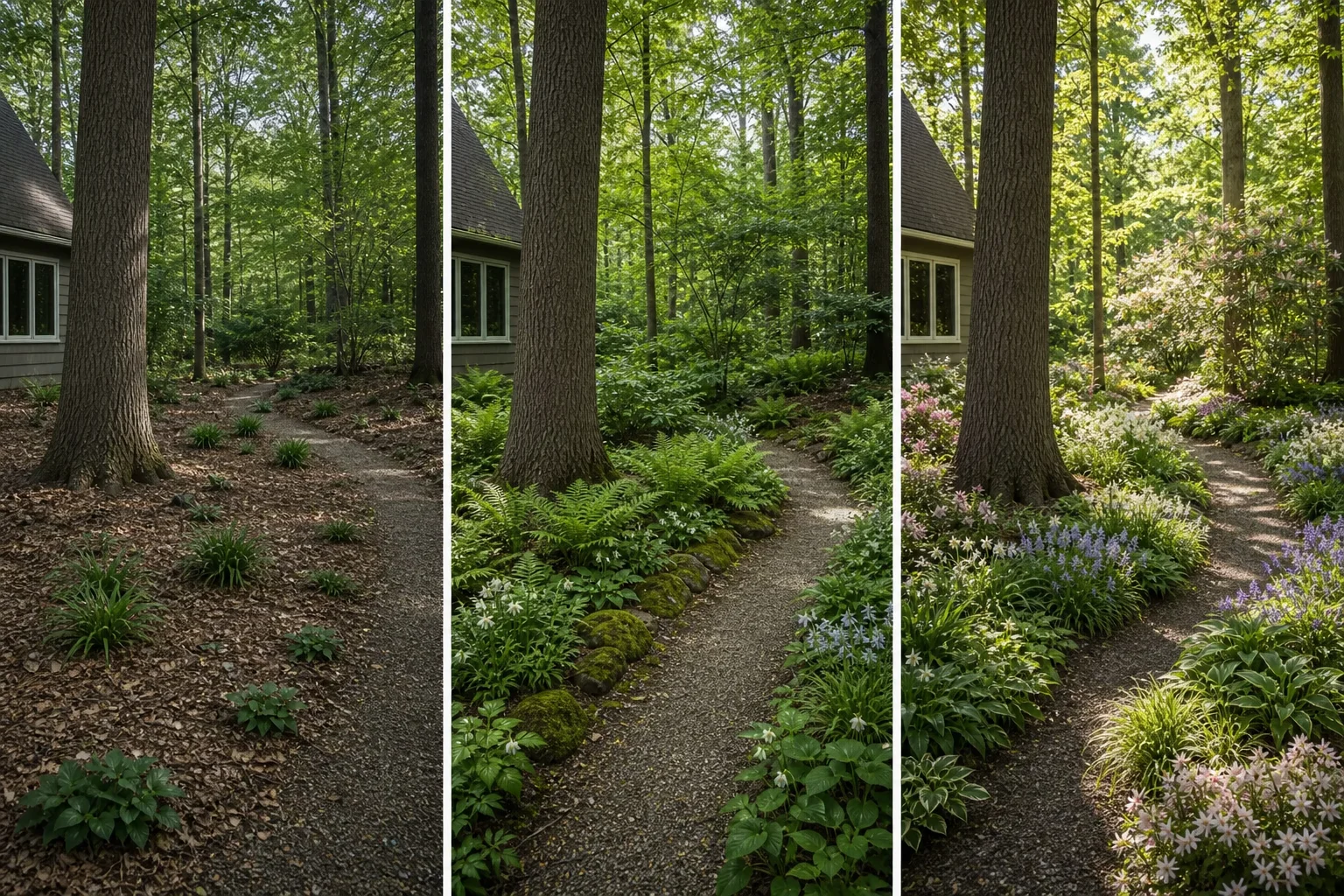
Dry shade
- Design response
- Smaller planting pockets, drought-tolerant shade plants, leaf-litter mulch, and a restrained palette.
- Watch for
- New plants compete with tree roots and may need careful establishment water without saturating the trunk zone.
- Plant emphasis
- Ground layer and tough low shrubs before thirsty flower lists.
Moist filtered shade
- Design response
- A fuller fern, sedge, shrub, and seasonal-flower layer where drainage remains adequate.
- Watch for
- Moist does not mean waterlogged. Check runoff, compacted soil, and standing water.
- Plant emphasis
- Understory + shrub + fern/sedge + seasonal ground layer.
Woodland edge
- Design response
- A brighter transition with more flowering shrubs, grasses, and perennials arranged in repeated masses.
- Watch for
- Afternoon sun and wind can make the edge harsher than the interior.
- Plant emphasis
- Flowering shrub mass + repeated seasonal middle + low edge.
Sources: University of Maryland Extension, Oregon State University Extension
Build the layers without filling every gap
A woodland garden needs depth, but it also needs enough open ground and repetition for each layer to be legible.
The role stays; the exact plant can change
- Canopy
- Existing mature trees and the conditions they create.
- Understory
- Small trees or large shrubs in brighter root-safe pockets.
- Shrub and fern
- Repeated middle masses matched to dry, moist, edge, or deep shade.
- Ground layer
- Sedges, low perennials, leaf litter, and seasonal flowers that knit the soil.
Regional planting directions
Mid-Atlantic direction: Existing oak-like canopy, serviceberry-like understory, spicebush-like shrub layer, Christmas-fern- and Pennsylvania-sedge-like ground structure, and woodland-phlox-like accents can form a regional palette.
Southeast direction: Existing canopy, redbud-like understory, oakleaf-hydrangea-like middle, fern- and blue-wood-sedge-like ground layers, and foamflower-like accents can translate the structure.
Pacific Northwest direction: Vine-maple-like understory, evergreen-huckleberry- and Oregon-grape-like shrub structure, sword-fern-like mass, and redwood-sorrel- or native-violet-like ground layer can create a west-of-Cascades palette.
Use nursery-propagated woodland plants. Do not collect plants from wild populations, and verify exact regional fit and local regulations.
Plant in pockets between roots
The root-safe approach is additive and patient. It avoids the deep, continuous bed preparation used in open ground.
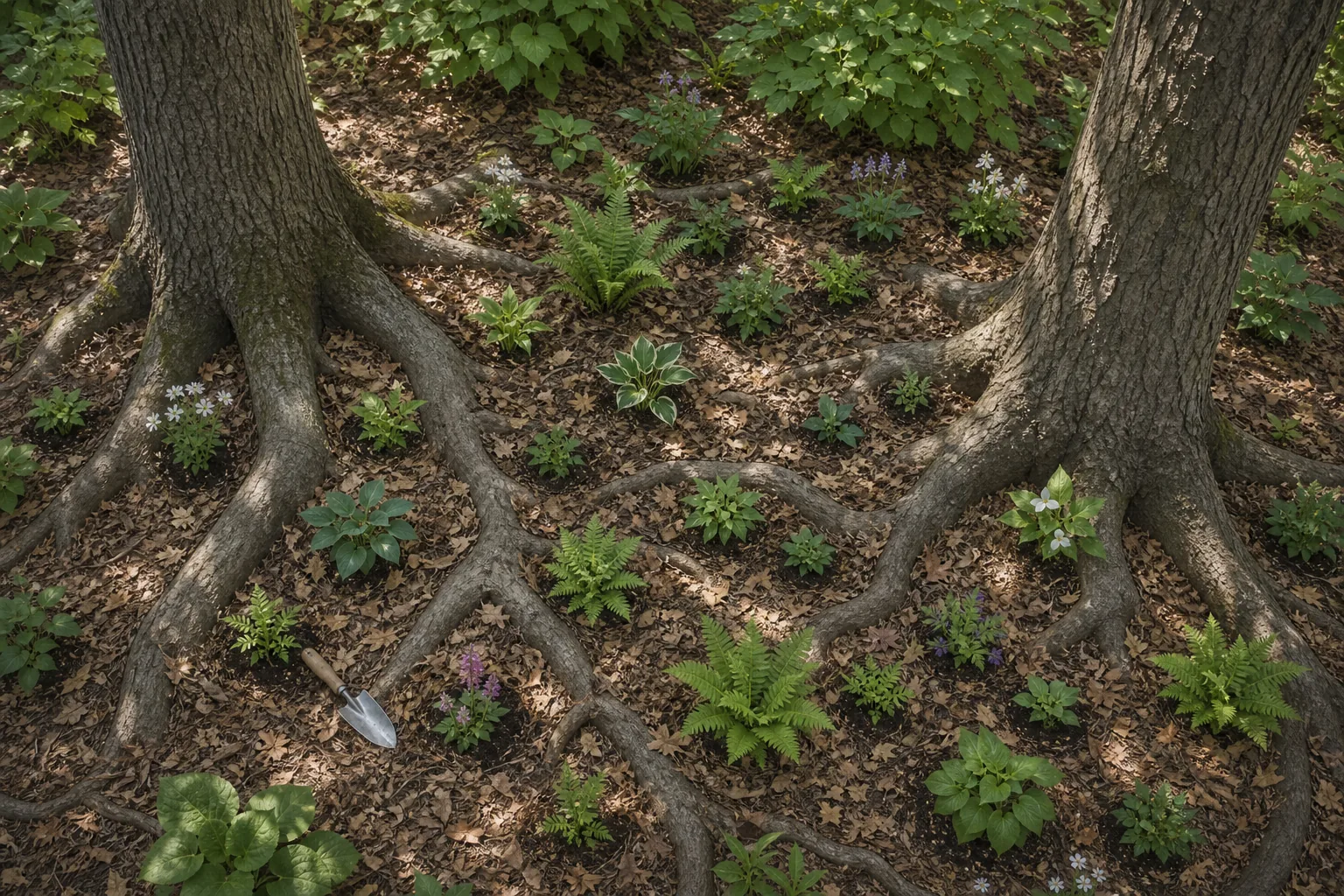
A bare area beneath two mature trees
The canopy is healthy, the shade is mostly dry, and several visible surface roots cross the area.
- 1. Keep trunks visible
- Maintain the existing grade and keep mulch and new soil away from the trunk flare.
- 2. Locate small soil pockets
- Use a hand tool to identify spaces between major roots; reduce plant size or quantity rather than cutting roots to fit.
- 3. Start with repeated ground groups
- Install small plugs or divisions in a few viable pockets, then allow time for them to knit together.
- 4. Establish carefully
- Water the new plant root balls as needed without repeatedly saturating the tree trunk or changing the whole root-zone drainage.
A slower, smaller first planting is safer than excavating a finished-looking bed beneath an established tree.
Verify the tree, site, and plant source
Woodland style should never come at the expense of the mature trees that make it possible.
Tree health: Ask a qualified arborist about declining trees, major root conflicts, grade changes, construction, or drainage problems before planting.
Exact shade and moisture: Match plants to dry, moist, deep, or edge shade rather than relying on a generic shade label.
Regional plant source: Choose nursery-propagated plants and check local invasive status, deer pressure, and ecological fit.
Maintenance pattern: Plan for leaves, paths, establishment water, seasonal dieback, and selective editing instead of a permanently tidy floor.
Frequently asked questions
What are the layers of a woodland garden?
The main layers are canopy, understory trees, shrubs, and a ground layer of ferns, sedges, low perennials, leaf litter, and seasonal flowers. Not every small yard needs every layer.
How do I plant under mature trees without damaging roots?
Keep the existing grade and trunk flare visible, avoid broad excavation, locate small pockets between major roots with hand tools, and use smaller plants rather than cutting roots to make space.
What grows in dry shade?
The answer is regional and site-specific. Confirm the exact light, root competition, soil, and moisture pattern, then use regional extension or botanic guidance to find plants suited to dry shade rather than copying a general list.
Should I remove leaves from a woodland garden?
Suitable leaf litter can protect soil and support woodland processes, but keep it from smothering small plants, blocking drainage, covering paths, or piling against trunks and structures.
 Gardenful
See a layered woodland direction around the trees you have.
Start with a clear photo and the existing trunks, then build smaller regional layers without treating roots as empty ground.
Gardenful for iPhone
Download the app free and start with a photo of your yard.

Sources(4)
- [1]Native Plants for Shade
University of Maryland Extensionhttps://extension.umd.edu/resource/native-plants-shade
- [2]
- [3]Right Plant, Right Place
University of Florida IFAS Extensionhttps://ask.ifas.ufl.edu/publication/EP416
- [4]Landscape Design with Plants
University of Florida IFAS Extensionhttps://ask.ifas.ufl.edu/publication/EP449