Gardenful field guide
How to design a tropical-style garden
The short answer
A tropical effect comes from bold foliage and clear high, middle, and low layers, not a long plant list. Keep the path open, repeat a few broad leaf shapes, and use one warm accent color. Then choose plants for a frost-free, subtropical, or seasonal-temperate plan; each requires a different winter strategy.
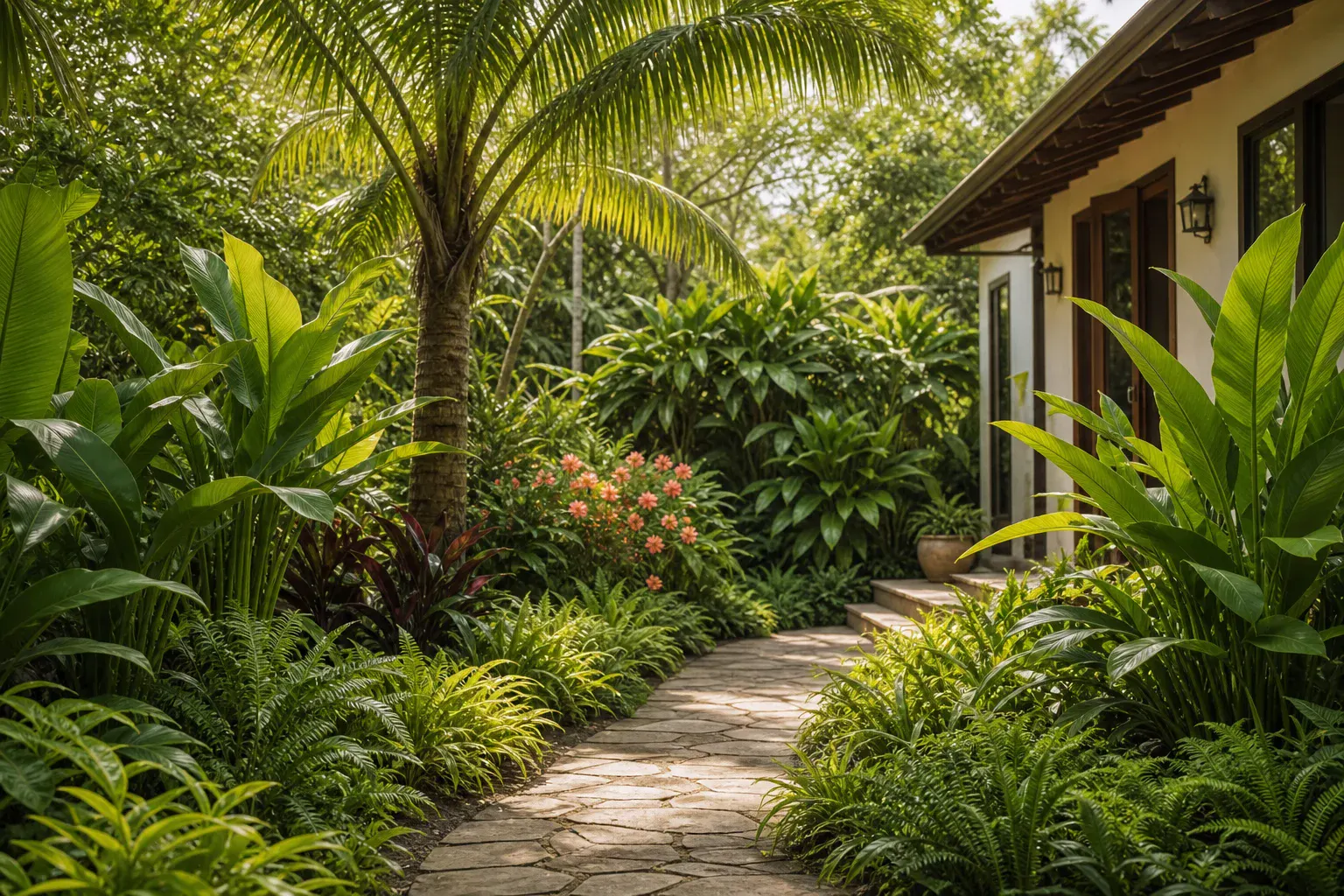
Create lushness with four visible layers
A strong tropical composition feels full because the layers overlap in the view, while the route and destination remain obvious.
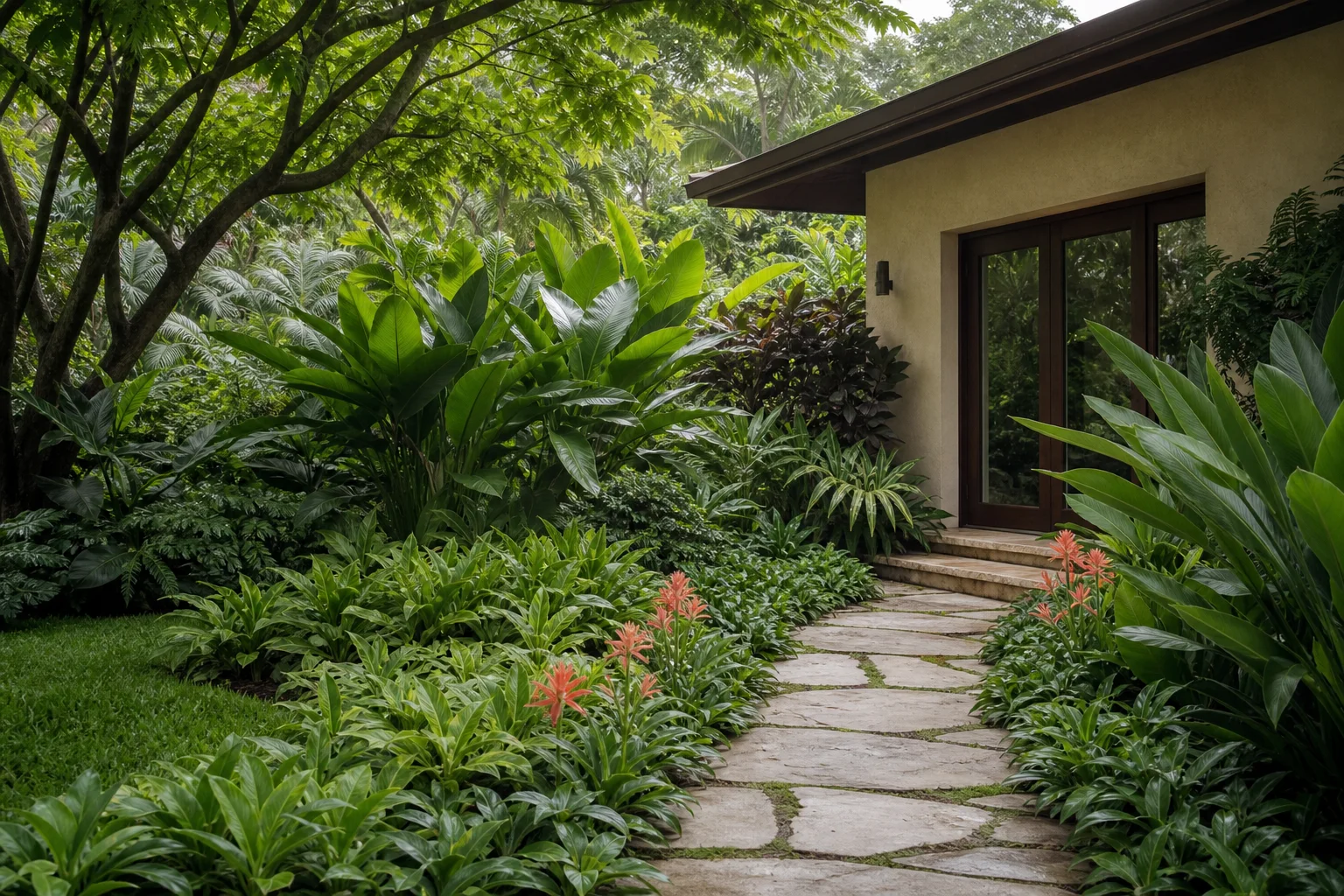
- 1
Set the high layer
Use one appropriately scaled tree, palm-like form, or tall architectural plant to create filtered shade and a vertical rhythm.
- 2
Repeat the broad middle
Group a limited number of large-leaf forms in masses. Repetition lets leaf scale read from a distance and prevents a collector-garden effect.
- 3
Close the lower gaps
Use ferns, sedges, or low foliage suited to the exact light and moisture so soil does not interrupt the layered view.
- 4
Reserve the flower accent
Let one warm color repeat near the door, seat, or turn in the path. Foliage should carry the design outside bloom.
Choose the climate plan before choosing plants
The layering idea transfers. The exact plants and winter strategy do not.
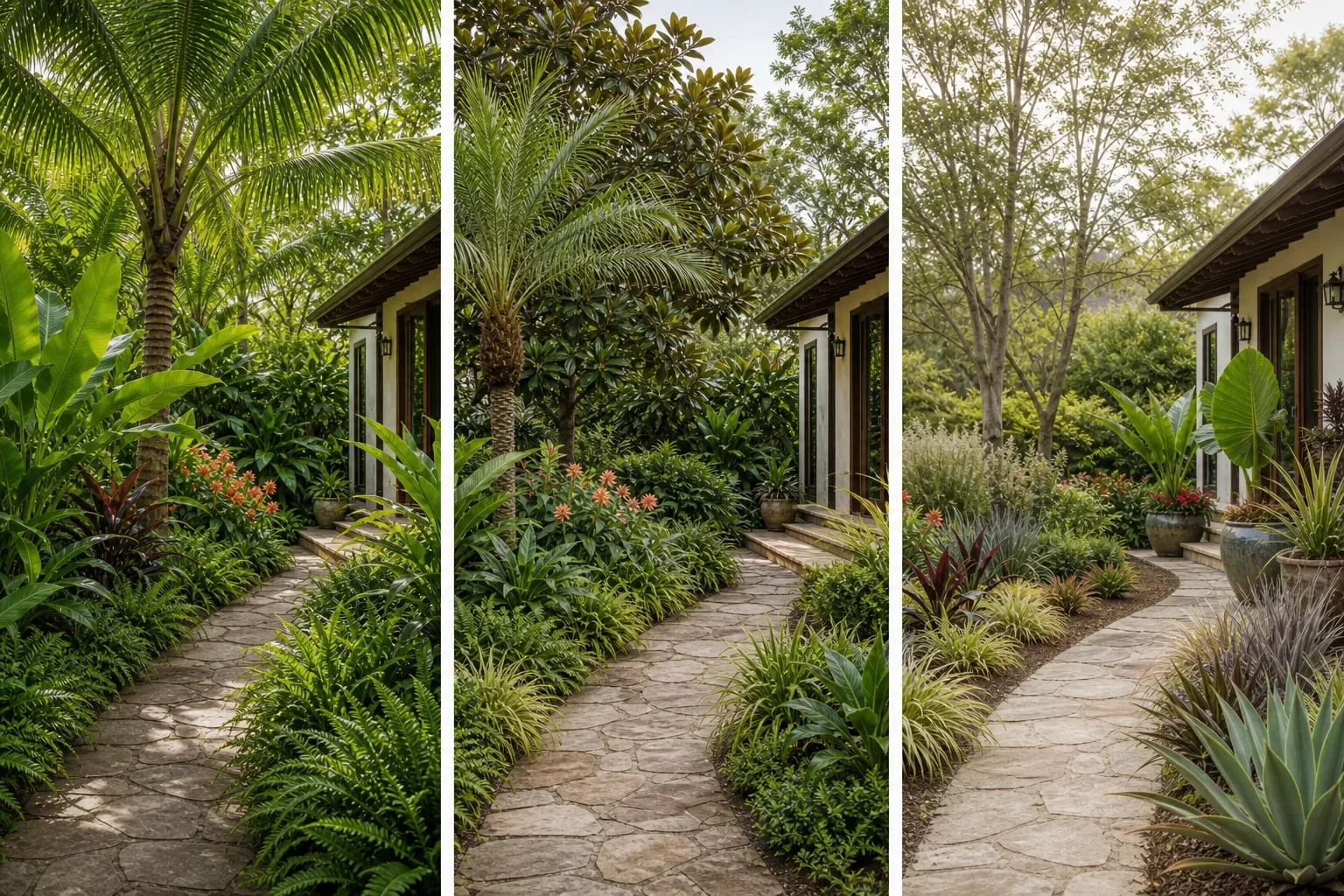
Frost-free tropical
Plan for year-round clearance, drainage, storm resilience, salt or wind exposure, and irrigation.
Use a permanent high canopy, broad evergreen middle layers, warm-season flowers, and dense low foliage.
Humid subtropical
Plan for cold pockets, occasional freeze damage, recovery after winter, and summer humidity.
Use hardier palms or small trees, evergreen foliage, seasonal tropical accents, and regionally suitable ferns or sedges.
Seasonal temperate
Plan the winter view, storage or replacement, irrigation, and the recurring seasonal budget.
Build the warm-season effect with bold hardy foliage plus containers or annual large-leaf plants.
Build the plant cast by form and climate
Choose a small number of roles, then source exact plants from regional guidance. Do not treat a generated tropical scene as an identification chart.
The role stays; the exact plant can change
- Canopy
- A tree or palm-like form sized for the building and storm exposure.
- Broad structure
- A repeated mass of large or paddle-shaped leaves.
- Upright rhythm
- A narrower foliage form that breaks up the broad middle layer.
- Ground layer
- Low foliage matched to shade and soil moisture.
- Warm accent
- One flower or foliage color repeated near destinations.
Regional planting directions
South Florida direction: An appropriately scaled native palm-like canopy, cocoplum- or firebush-like middle structure, coontie-like low foliage, and a Fakahatchee-grass-like rhythm can create a regional interpretation.
Hardy subtropical direction: A dwarf- or needle-palm-like anchor, Florida-anise-like evergreen middle, coontie-like structure, hardy-hibiscus-like accent, and moisture-matched fern or sedge can carry the layers farther north.
Temperate seasonal direction: Container or annual canna-, colocasia-, and coleus-like foliage can make the warm-season layers, with permanent hardy structure designed to remain after those accents are removed.
Where an exact plant is named, verify the exact species or variety, mature dimensions, cold tolerance, toxicity, and local invasive status. Generated imagery only demonstrates planted groups and mood.
Layer a narrow route without making it feel closed
In a side yard or entry court, control the plant depth as carefully as the height.
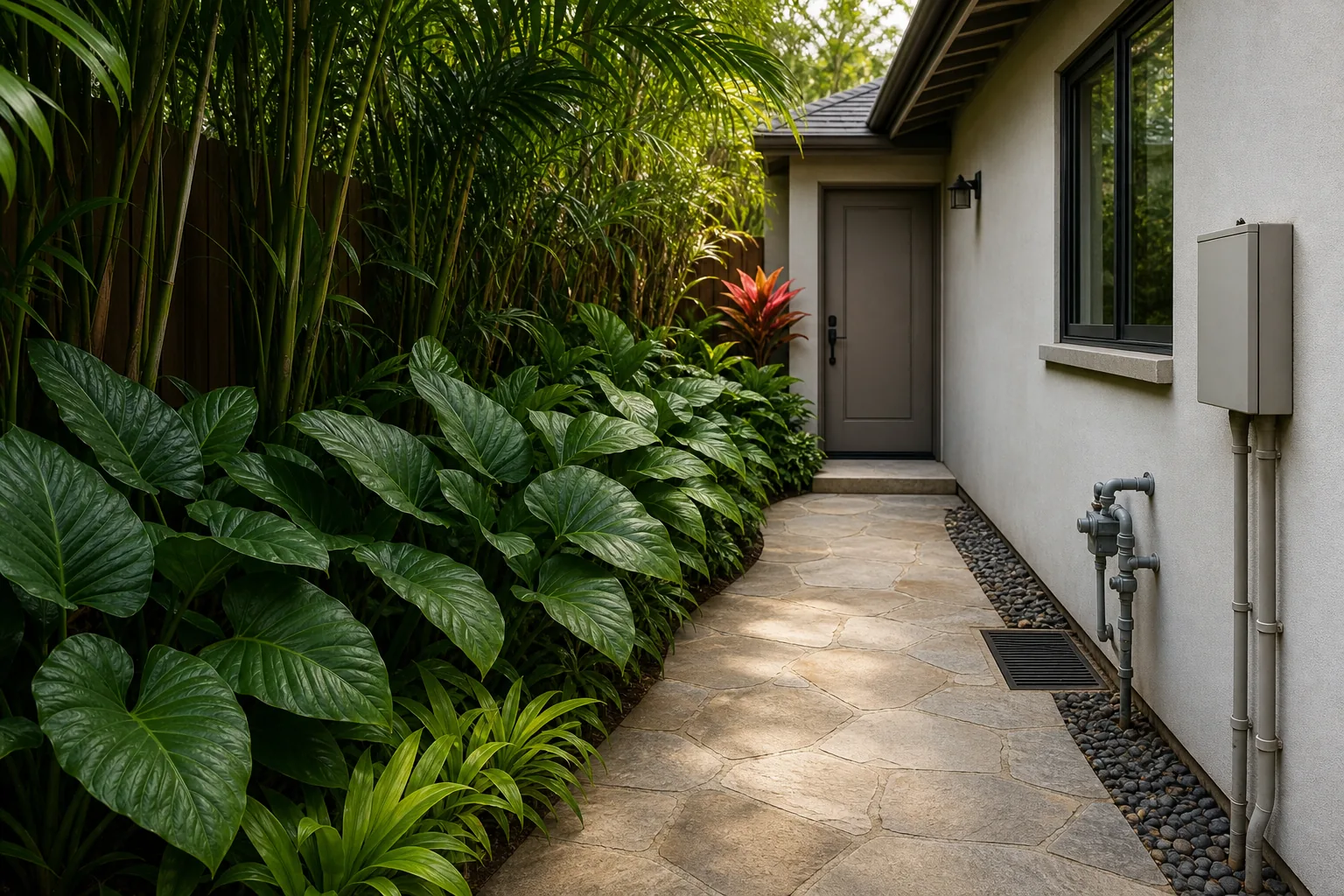
A warm, partly shaded walk to a side door
The route needs to stay accessible while the garden creates a sense of enclosure and a strong view from inside.
- 1. Protect the clear path
- Draw the usable route first and keep every mature leaf and stem outside that envelope.
- 2. Put height on one side
- Use the tallest layer where it will not block windows, utilities, or drainage.
- 3. Repeat one broad-leaf mass
- Group the middle layer instead of alternating many leaf types along the path.
- 4. Place the accent at the turn
- Use one flower or contrasting foliage color where the path changes direction or reaches the door.
The route should feel framed, not invaded. Large leaves need more mature clearance than their nursery size suggests.
Verify climate and maintenance before buying
A tropical look can be permanent, seasonal, or container-based. Be explicit about which one you are building.
Winter plan: Check cold minimums, frost pockets, dieback, lifting, storage, and the garden's appearance after seasonal plants leave.
Mature size: Verify canopy spread, leaf reach, roots, wind behavior, and clearance from roofs, paths, pools, and utilities.
Moisture and drainage: Tropical-looking plants do not all want the same water. Match exact plants to drainage, irrigation, and shade.
Local risks: Screen for invasiveness, toxicity, thorns, fruit drop, storm damage, and nursery availability.
Frequently asked questions
What makes a garden look tropical?
Large leaf scale, overlapping high-middle-low layers, deep foliage contrast, and a restrained warm accent create the effect. The exact plants depend on climate, light, moisture, and winter plans.
Can I make a tropical garden in a cold climate?
You can create a seasonal tropical look with hardy permanent structure plus containers or annual foliage during the warm season. Plan explicitly for lifting, storage, replacement, and the winter view.
How do I design a small tropical garden?
Protect one clear route, put the tallest layer where it will not close the space, repeat one broad-leaf middle mass, and keep the warm accent near a destination. In a small garden, mature leaf reach and winter storage matter as much as height.
How do I keep a tropical garden from looking messy?
Repeat fewer leaf forms in larger groups, protect the path, and use one focal accent. Lushness should come from clear planted layers rather than many unrelated specimens.
Are tropical plants always high-water?
No. Water needs vary widely. Choose exact plants for the site's rainfall, soil, drainage, humidity, and irrigation rather than using the visual style as a watering rule.
 Gardenful
See a layered tropical direction on your own space.
Start with the route and vertical layers, then verify whether the exact plant cast is permanent, seasonal, or container-based.
Gardenful for iPhone
Download the app free and start with a photo of your yard.

Sources(4)
- [1]Gardening in Containers Using Tropical Plants
University of Georgia Cooperative Extensionhttps://extension.uga.edu/publications/detail.html?number=B1338&title=gardening-in-containers-using-tropical-plants
- [2]Landscape Design with Plants
University of Florida IFAS Extensionhttps://ask.ifas.ufl.edu/publication/EP449
- [3]How to Use the Maps
USDA Plant Hardiness Zone Maphttps://planthardiness.ars.usda.gov/pages/how-to-use-the-maps
- [4]Right Plant, Right Place
University of Florida IFAS Extensionhttps://ask.ifas.ufl.edu/publication/EP416