Gardenful field guide
Landscaping ideas for a narrow side yard
The short answer
A narrow side yard has to preserve movement and service access before it can support planting. Measure the clear width with gates, bins, hoses, utilities, and roof overhangs included. Then decide whether the space needs a dependable passage, targeted screening, or a small destination. Put plants in deliberate pockets where their mature width will not close the route.
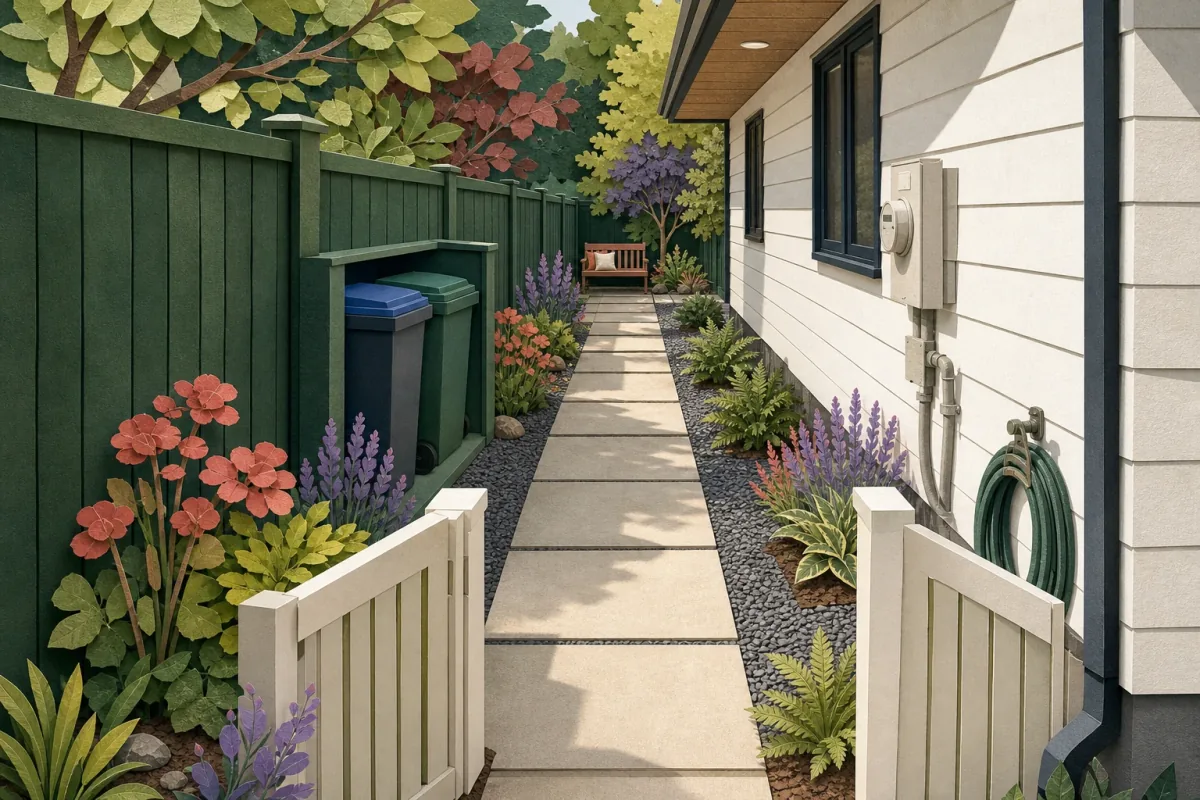
Measure the route in its busiest state
A side yard can look empty in a photograph and still be full of competing uses. Measure it while the gate is open and the things that travel through it are present.
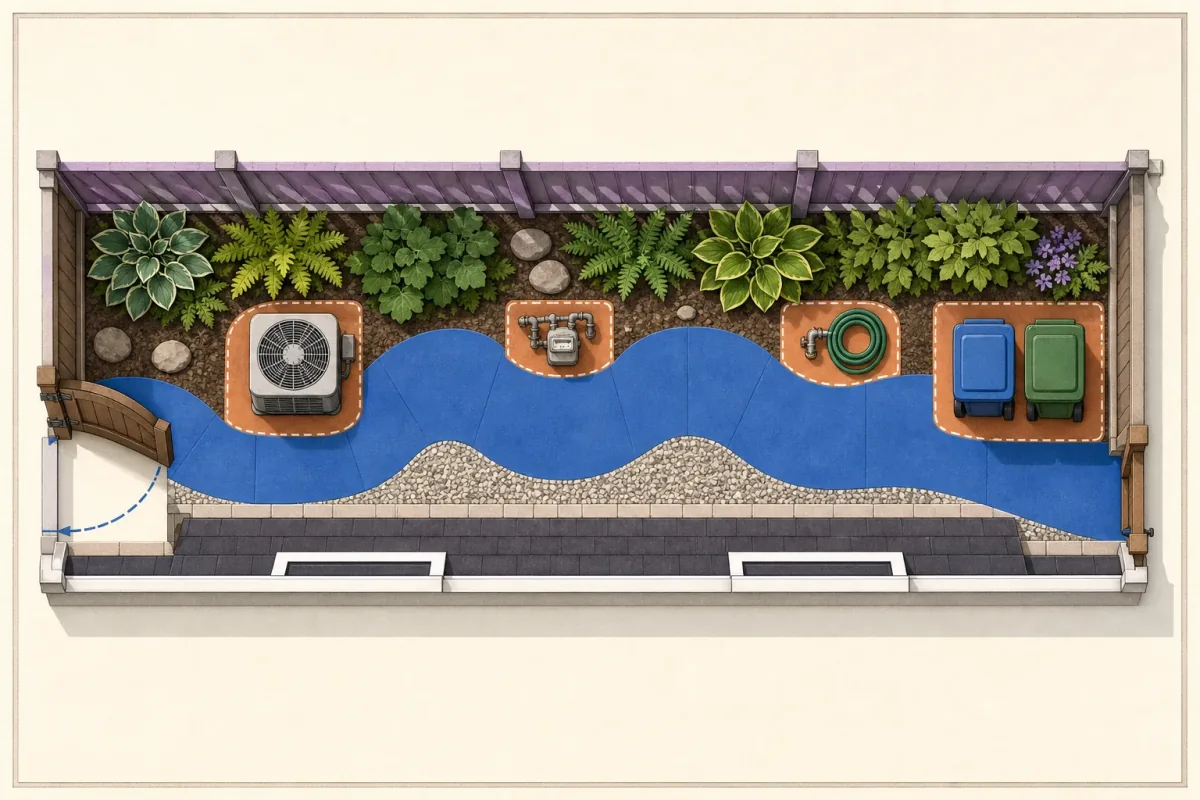
- 1
Walk the largest regular item through
Move the bins, mower, bicycle, stroller, or wheelbarrow along the route and through the open gate. Record the width that movement actually requires.
- 2
Mark service access
Keep meters, shutoffs, condensers, hose points, drains, downspouts, and maintenance clearances visible on the plan.
- 3
Record overhead constraints
Add eaves, windows, vents, wires, lights, and the arc of the gate. A narrow space is shaped in three dimensions.
- 4
Find the dry and wet edges
Roof overhangs may keep one strip unusually dry while downspouts or runoff make another periodically wet. Observe during rain rather than guessing.
Choose one main job for the side yard
A very narrow strip rarely performs every possible role well. Decide what should feel better after the project and let that priority govern the layout.
| Main job | Design direction | What to protect |
|---|---|---|
| Main jobDependable passage | Design directionOne continuous, durable route with planting held in offset pockets. | What to protectDaily movement, drainage, and service access come before bed depth.Useful detailKeep the destination visible so the passage does not feel like a dead end. |
| Main jobTargeted screening | Design directionOne screen placed at the actual window or seated sightline. | What to protectPreserve light, airflow, gate movement, and boundary access.Useful detailLayer narrow forms rather than planting a continuous oversized hedge. |
| Main jobSmall destination | Design directionA brighter pocket at the end with a seat, pot, or specimen plant. | What to protectThe route must still reach and serve the destination comfortably.Useful detailUse the focal point to pull the eye through the space. |
Sources: University of Florida IFAS Extension, University of Florida IFAS Extension
Place planting in pockets, not a continuous squeeze
When both boundaries are planted evenly, the route can feel tighter and maintenance becomes harder. Alternate the moments of enclosure and release.
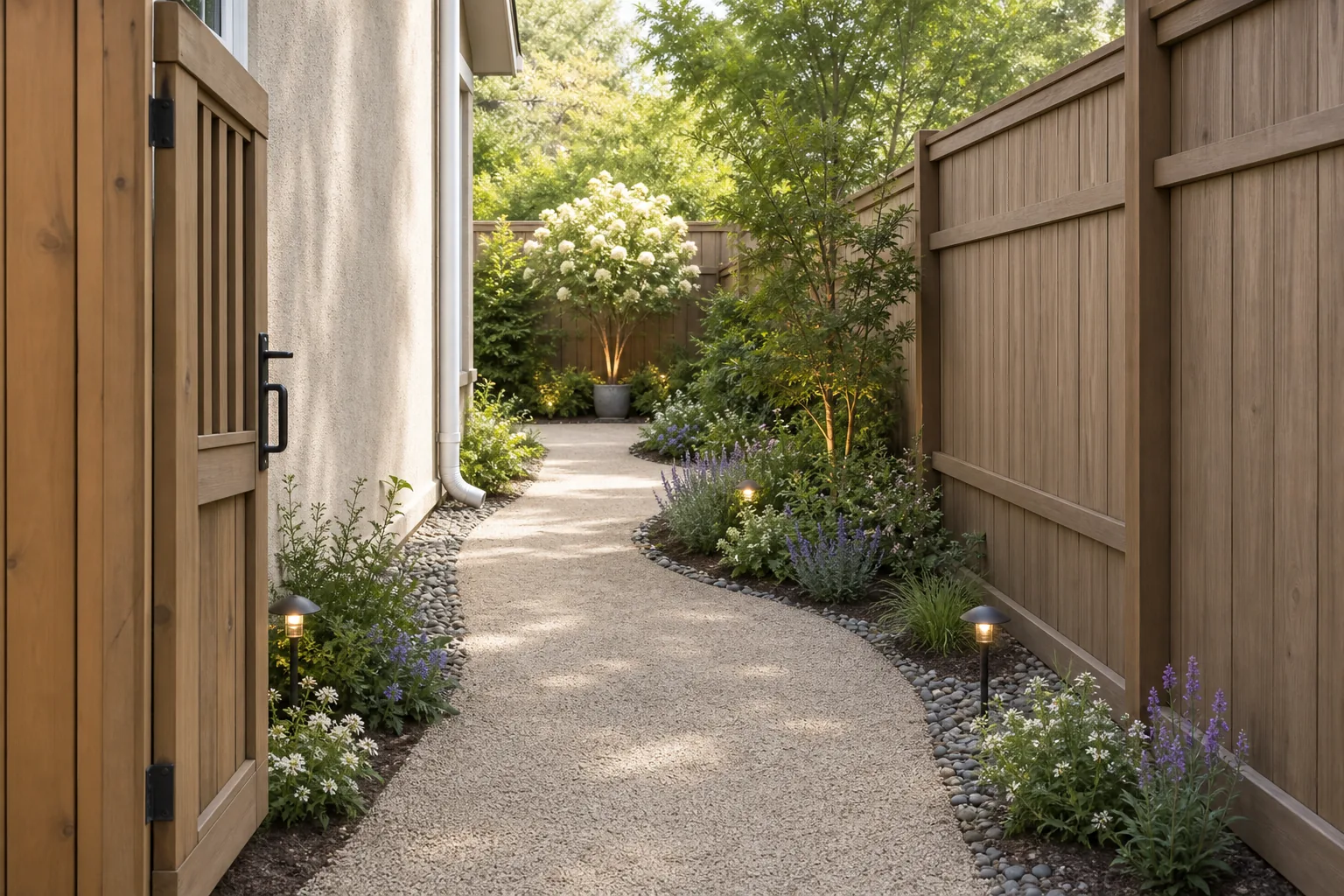
Keep one legible path, offset the planting masses, and repeat a restrained palette from the entrance to the destination.
- 1
Entrance cue
Keep the gate swing and latch fully clear.
Use one modest plant group or container near the gate to signal that the passage is intentional.
- 2
Middle pause
A change in rhythm can make the side yard feel less tunnel-like.
Widen one bed only where the route can bend gently around it without compromising access.
- 3
Far focal point
A clear destination is usually stronger than many small decorations.
Finish the sightline with one object or plant mass suited to the light at the end of the route.
Draw the mature outline of every plant into the clear route. Nursery-pot size is not a spacing plan.
Choose plants for the side yard's microclimates
The label “shade” is not specific enough. A is a small area with its own light, temperature, moisture, or wind. A side yard can contain reflected heat, cold pockets, dry eaves, damp soil, and sudden shafts of sun within a few steps.
The role stays; the exact plant can change
- Dry eave
- Little rain reaches the soil, even when the wider yard is wet.
- Reflected wall
- A bright wall can add heat and glare despite limited hours of direct sun.
- Damp low point
- Runoff or slow drainage changes which roots can tolerate the pocket.
- Gate exposure
- Wind, foot traffic, pets, and repeated contact make this a tougher planting position.
How to choose the exact plants
Use form and foliage first: In low light, leaf shape, contrast, and a clear plant outline often carry the design more reliably than a plan built around nonstop flowers.
Choose naturally narrow growth: Look for plants whose mature shape fits the pocket without constant shearing. Confirm the exact plant variety, because common names can cover very different sizes.
Keep irrigation serviceable: Place watering where it can be inspected without blocking the route or repeatedly wetting walls and walking surfaces.
Check the side yard at full size
Tape the intended route and mature plant widths on the ground if the clearances are difficult to imagine.
The gate opens fully and its latch remains reachable
Bins, tools, bicycles, and maintenance equipment can pass the mature planting
Meters, utilities, drainage, condensers, windows, and vents remain accessible
Surface water has a safe route and the walking surface does not create a new drainage problem
Plants fit each pocket's observed light, water, wind, and mature dimensions
Lighting supports the route without shining unnecessarily into neighboring windows
Do not use planting to hide a drainage, boundary, or utility problem. Resolve the underlying issue with the appropriate local professional.
Frequently asked questions
How can I make a narrow side yard look wider?
Keep one continuous route, avoid matching walls of planting on both sides, and alternate planted pockets with open sections. A clear focal point at the far end and a repeated small palette can create depth without filling the passage.
What can I plant in a shady side yard?
First distinguish dry shade, damp shade, reflected heat, and brief direct sun. Then choose locally appropriate plants whose mature width fits the route. Foliage shape and contrast often matter more than long bloom in this setting.
How wide should a side yard path be?
The required width depends on users, equipment, accessibility needs, local rules, and the materials used. Measure the largest regular item and preserve service access, then confirm code or accessibility requirements locally rather than relying on a universal number.
How do I add privacy in a narrow side yard?
Screen the exact sightline with one narrow, layered planting pocket or an appropriate supported climber. Avoid a continuous oversized hedge that closes the route, darkens the passage, or blocks maintenance access.
Can Gardenful visualize a narrow side yard?
Yes. Use a photo taken along the full route with both boundaries, the gate, and the far end visible. Gardenful can help compare planting directions, but you should verify drainage, utilities, boundaries, construction, and exact plants locally.
 Gardenful
See a calmer side-yard layout.
Keep the whole route in frame and compare a few purposeful planting pockets before buying narrow plants one at a time.
Gardenful for iPhone
Download the app free and start with a photo of your yard.

Sources(3)
- [1]Florida-Friendly Landscape Pattern Book
University of Florida IFAS Extensionhttps://edis.ifas.ufl.edu/publication/EP439/pdf
- [2]Basic Principles of Landscape Design
University of Florida IFAS Extensionhttps://edis.ifas.ufl.edu/publication/EP375/pdf
- [3]Gardening in the Shade
University of Minnesota Extensionhttps://extension.umn.edu/gardening-minnesota/gardening-shade