Gardenful field guide
How to design a garden for a windy yard
The short answer
Wind changes across a yard as buildings, fences, and planting redirect it. Watch the site on several windy days and notice where air enters, speeds up, and becomes calmer. Plant a partly open layer of shrubs or small trees along the exposed edge, then put the seat or flower bed on the sheltered side.
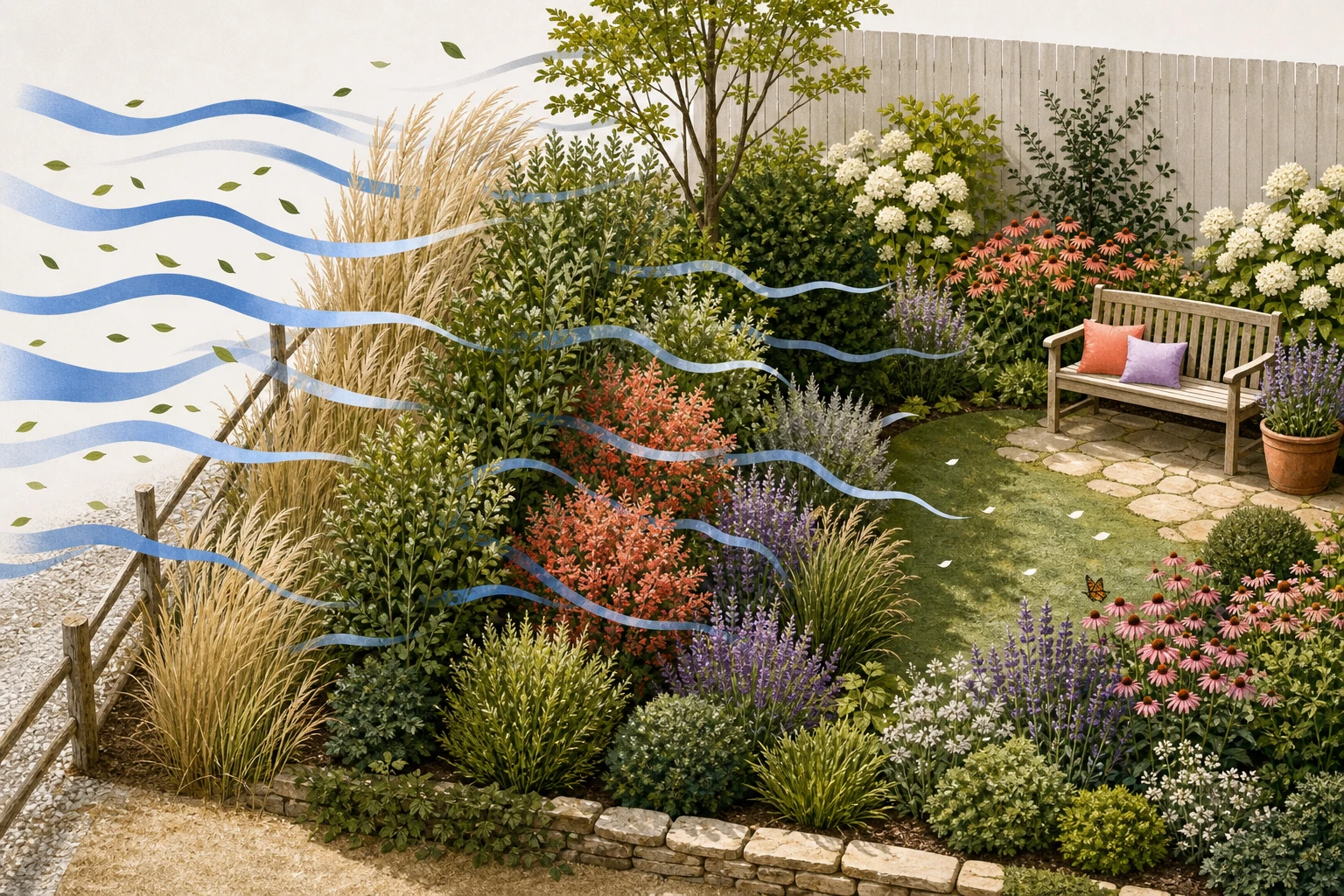
Find the exposed edge and the calm pocket
A weather report tells you the regional wind. The yard shows how buildings, fences, and vegetation reshape it.
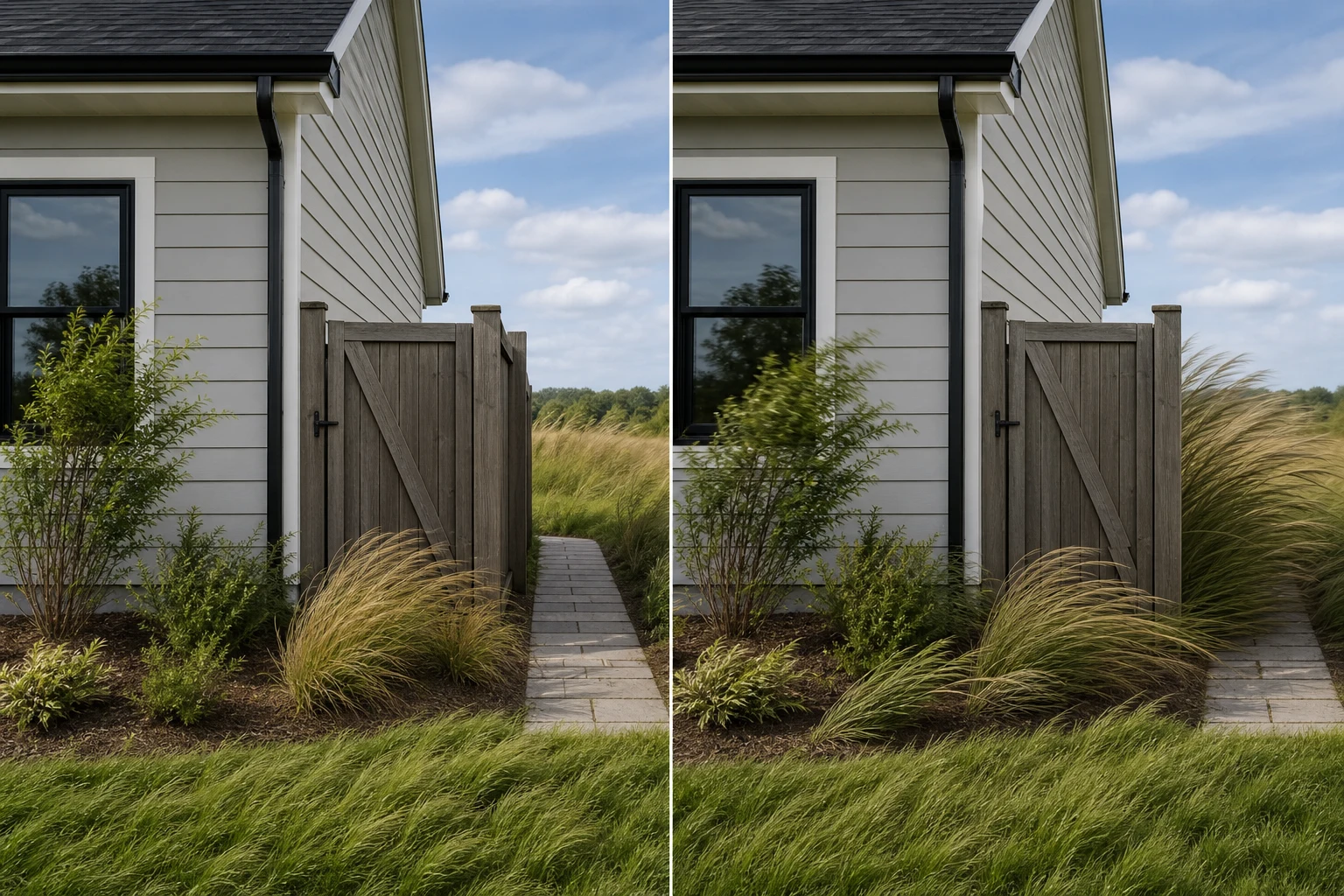
- Ordinary wind
- Funneled through the gap
- 1
Watch several ordinary windy days
Note the direction, time, and season instead of designing around one storm.
- 2
Find acceleration points
Corners, gates, and narrow passages can funnel wind into a stronger local stream.
- 3
Look for sheltered evidence
Calmer leaf movement, settled debris, and protected growth reveal usable pockets.
- 4
Name the place to protect
Prioritize one entrance, seat, young tree, or flower bed rather than trying to still the whole property.
Choose a response that fits the scale of the yard
A residential planting filter, a fence, and a farm windbreak are different projects. Utah State Extension describes 60 to 80 percent density as useful protection for a small area such as a residential lot: enough material to slow wind while still letting some air pass.
| Response | Useful effect | Watch for |
|---|---|---|
| ResponseLayered planting filter | Useful effectA broad edge with room for staggered shrubs and small trees that fit the site. | Watch forThe protection develops as plants mature and still needs establishment care.Before buildingMature size, root space, fire guidance, utilities, and local climate. |
| ResponsePorous fence plus planting | Useful effectA smaller yard that needs an immediate boundary and softer planted edge. | Watch forA fence changes turbulence and may require permits or structural design.Before buildingWind load, property line, code, and construction details. |
| ResponseSheltered pocket only | Useful effectA patio or bed that can move behind the house, wall, or existing vegetation. | Watch forThe rest of the yard remains exposed.Before buildingSeasonal sun, drainage, and access in the new position. |
Sources: Utah State University Extension
Shelter a seat without enclosing the whole yard
The planting earns its place by improving one used destination.
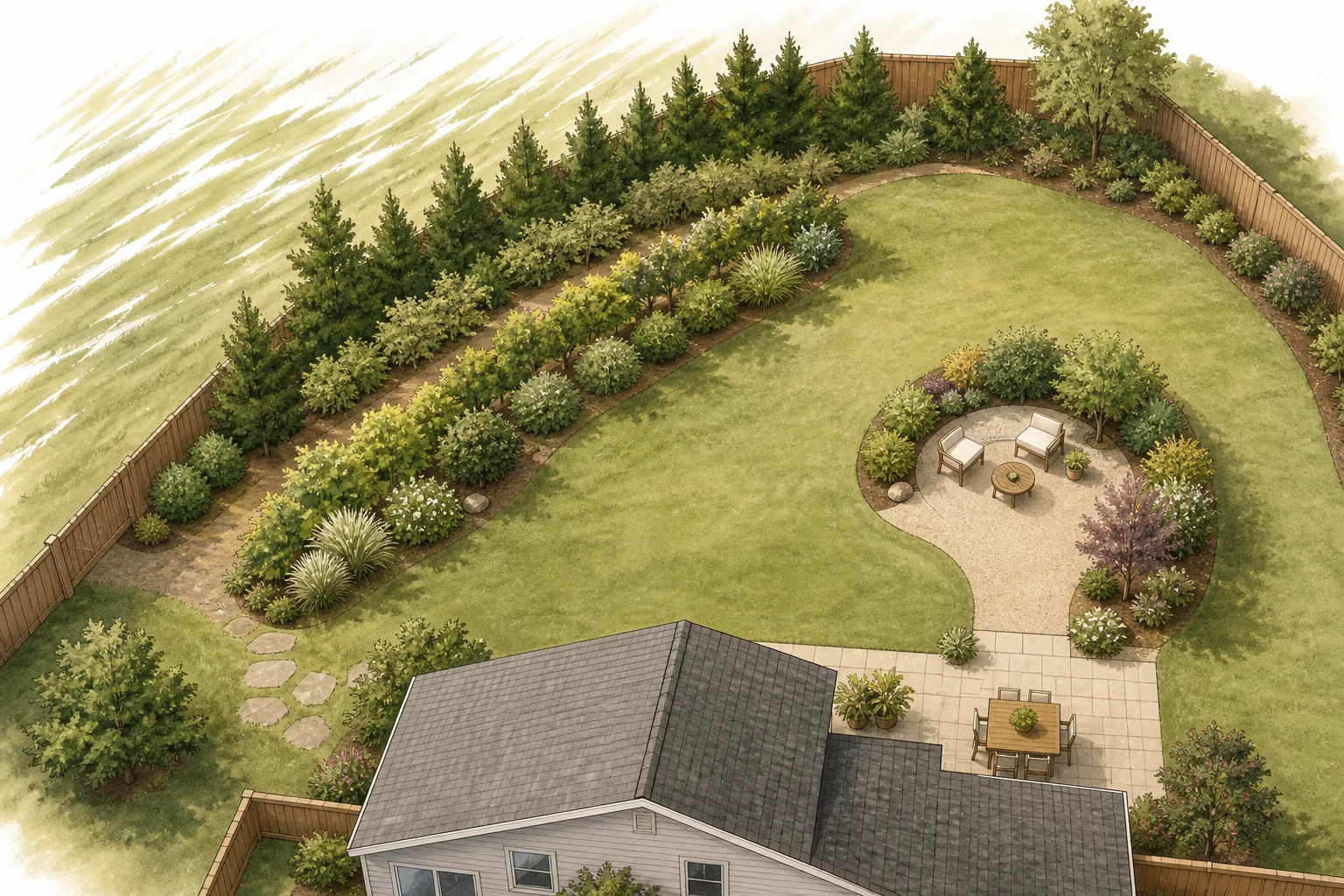
A patio exposed from the northwest
Wind enters along the fence, crosses the lawn, and makes the far patio uncomfortable. The yard has room for a staggered planted band.
- 1
Set the tallest layer away from the seat
Use locally appropriate woody structure with enough mature space and a safe relationship to the house.
- 2
Stagger the middle layer
Avoid a single dense line. Overlapping shrubs and flexible plants let some air pass while breaking the direct stream.
- 3
Keep one maintenance route
Preserve access to the fence, plants, and utilities as the screen fills in.
- 4
Place delicate flowers in the lee
Use the calmer side for plants whose stems, moisture, or flowers need more protection.
The goal is a calmer patio and planting pocket, not a windless property.
Check the site before you plant
Look beyond everyday breezes. Slopes, buildings, wildfire guidance, snow, and severe storms may change the safe location or scale.
Local wind and storm pattern: Ask a regional extension source or qualified professional about prevailing and damaging winds.
Mature roots and canopy: Keep utilities, foundations, overhead lines, paths, and neighboring property clear.
Fire and snow guidance: Follow local spacing, fuel, snow-drift, and defensible-space rules where they apply.
Establishment support: New plants still need appropriate staking, water, and monitoring until roots anchor them.
Frequently asked questions
What plants are best for a windy garden?
Look for plants with flexible growth, strong roots, and a mature size that fits the space. Then narrow the list for your local cold, heat, salt, soil, and moisture.
Should a windbreak be solid?
No. A layered, partly open filter lets some air through, which slows the wind more gently than a solid wall. Put it across the wind you want to soften and extend it beyond the area you want to protect.
Can a fence fix a windy patio?
A fence may help, but it can also create turbulence and must meet structural, property-line, and permit requirements. Sometimes moving the seat into an existing sheltered pocket is the simpler first move.
 Gardenful
Make one part of the yard more comfortable.
Use Gardenful to compare a layered planted edge, then check its mature size and position against the wind you observe.
Gardenful for iPhone
Download the app free and start with a photo of your yard.

Sources(2)
- [1]
- [2]Observe a Landscape Through All Seasons
Oregon State University Extensionhttps://extension.oregonstate.edu/sites/extd8/files/2018-07/design_principles_7.pdf