Gardenful field guide
How to landscape under mature trees without harming them
The short answer
The established tree is the most valuable and least replaceable part of an under-tree garden. Protect it first: do not pile soil around the trunk, cut major roots to force in a bed, or till the area. Map visible roots, shade, dry pockets, and rain reach. Start with correctly placed mulch, then add a small number of plants only where they can go in with little root disturbance.
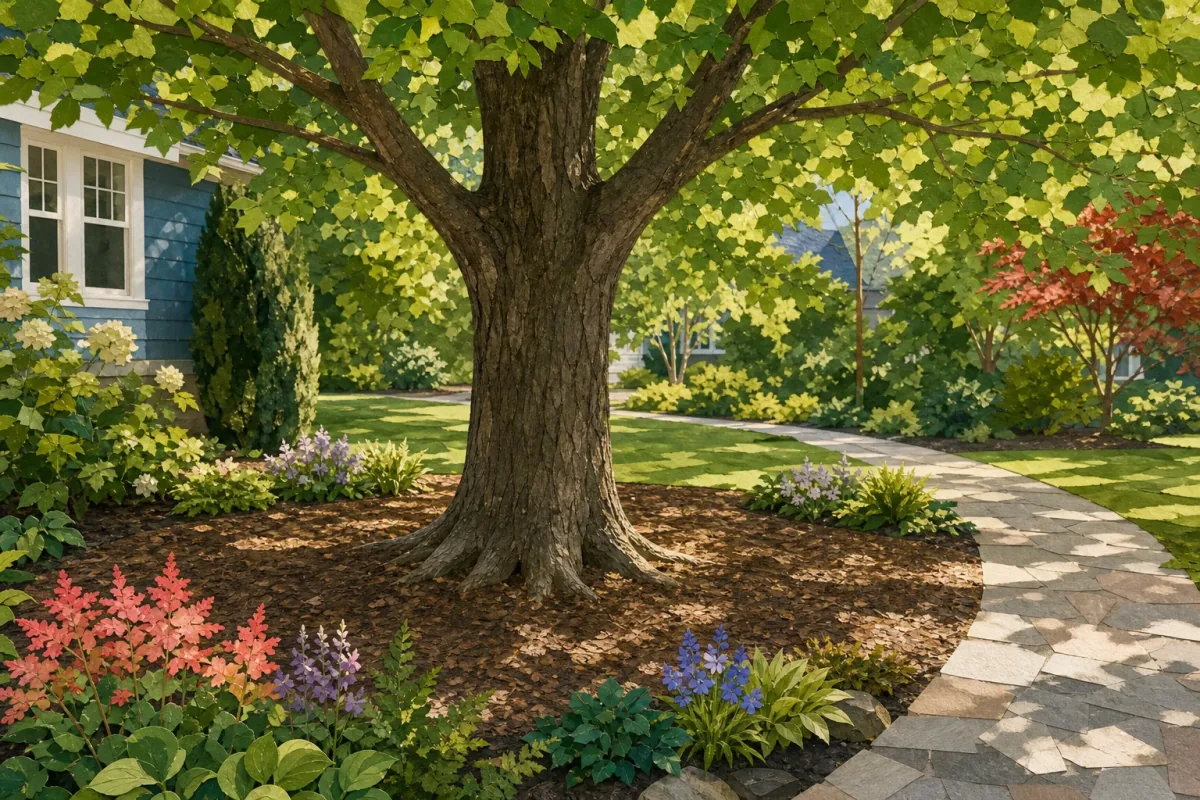
Treat the root zone as occupied ground
A mature tree's roots extend well beyond the trunk, often through the same shallow soil where a new garden would be planted. The safest design begins by accepting those roots as a permanent site condition.
Avoid rototilling, trenching, deep edging, and broad grade changes below the canopy. These operations can sever or bury roots while also changing the air and water conditions around them.1
Do not assume a neat ring at the drip line contains the root system. Mark exposed roots and use an arborist's guidance when the tree is valuable, stressed, declining, or close to proposed construction.
Keep the root flare, the widening base where trunk meets roots, visible. Soil or mulch piled against the trunk can hold unwanted moisture against bark and hide developing problems.
Map the conditions below the canopy
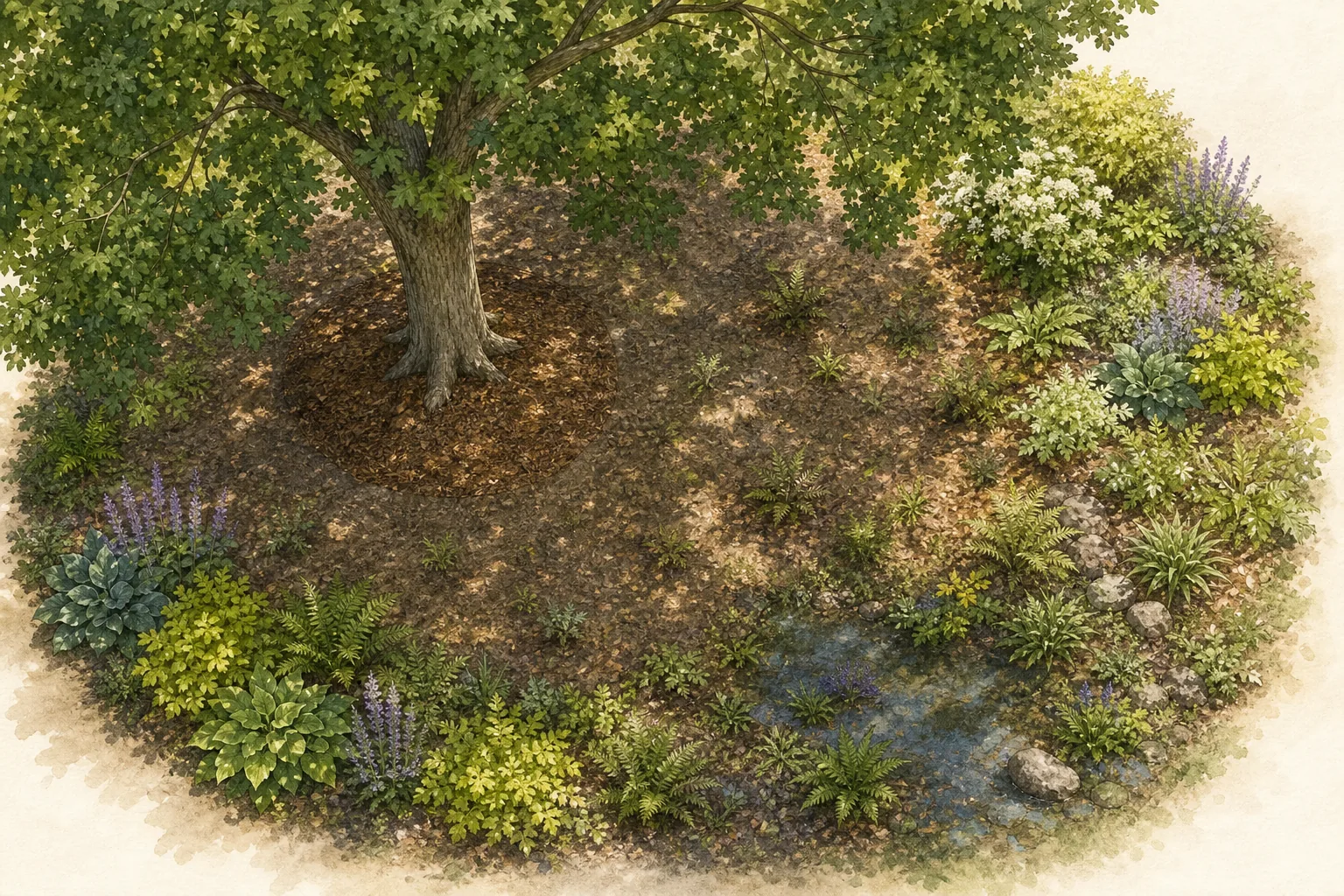
The space under one tree can range from bright outer edge to deep, dry shade. Map the differences before assigning plants.
Choose for the hardest condition in each pocket: existing roots, moisture after rain, hours of light, and competition from the tree.
- 1
Trunk and major-root zone
Mulch can unify the ground without pretending every area needs plants.
Keep this area visually quiet, free of excavation, and clear enough to inspect the trunk flare.
- 2
Dry inner canopy
Use few plants only if they fit both shade and root competition.
Dense roots and intercepted rainfall can make this soil drier than the word “shade” suggests.
- 3
Brighter outer edge
Repeat groups here rather than pushing planting toward the trunk.
Filtered or angled light may support a broader understory palette, especially where roots leave usable pockets.
- 4
Downslope or wet pocket
Match exact plants to that moisture pattern and local soil.
Water can collect unevenly under the canopy. Observe after rain and do not assume the tree makes the whole area dry.
Sources: University of Minnesota Extension
Choose the least disruptive treatment that solves the problem
A quiet mulched understory can be the finished design. Add plants or a route only when they serve a clear use.
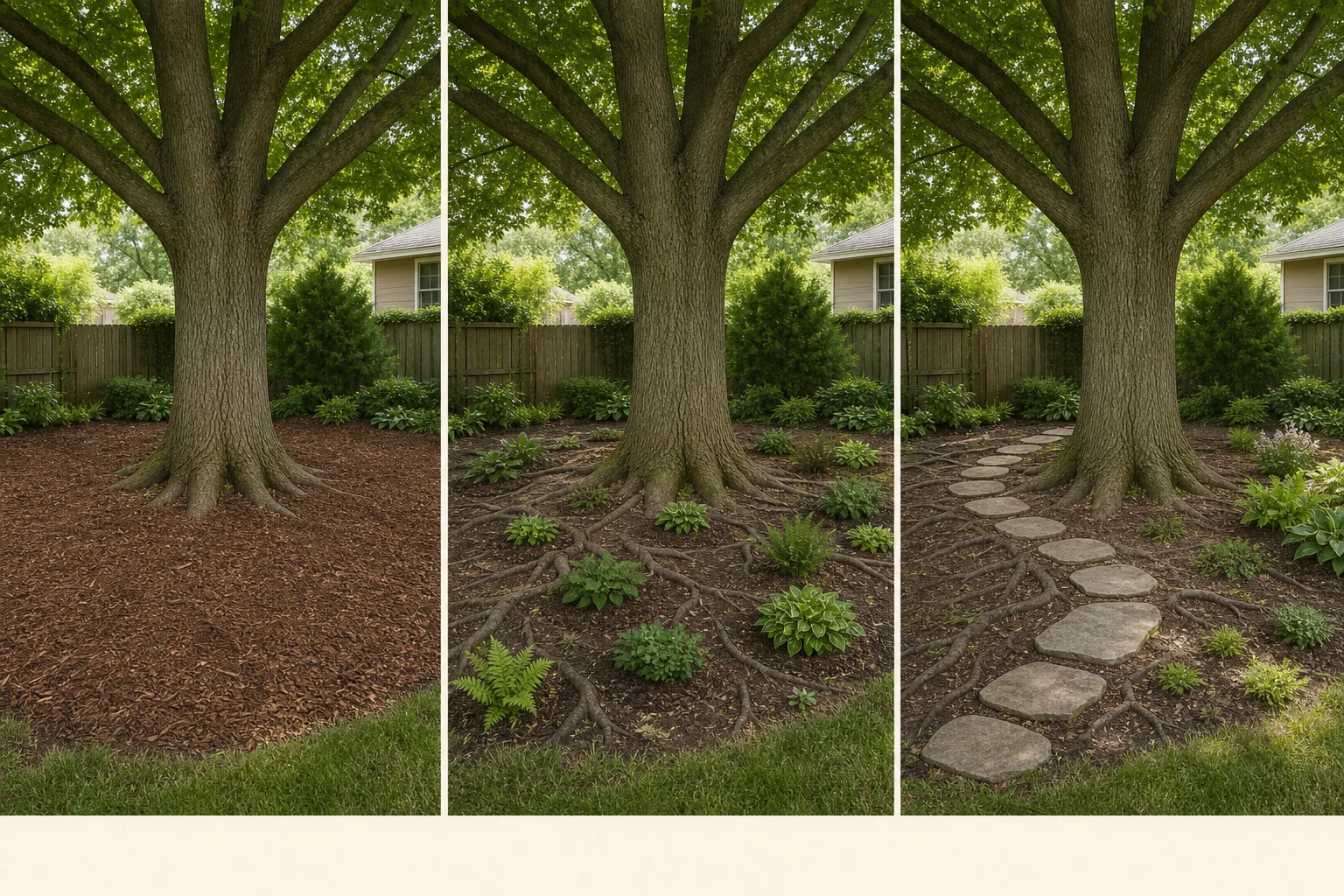
Mulch only
- Use it when
- Roots are dense, the tree is stressed, or the site needs a clean, low-disturbance surface.
- Design benefit
- Simplifies the view and protects soil without requiring planting holes.
- Main caution
- Keep mulch shallow and away from the trunk; do not create a volcano shape.
Small planting pockets
- Use it when
- There are natural gaps between roots and locally suitable small plants can establish there.
- Design benefit
- Adds an understory layer while limiting excavation.
- Main caution
- Stop and move the hole when a substantial root is encountered.
Light foot route
- Use it when
- People already cross the root zone and a defined route would reduce random compaction.
- Design benefit
- Concentrates movement and clarifies access.
- Main caution
- Choose an arborist-informed, permeable approach that avoids root cutting and grade change.
Sources: Penn State Extension, Colorado State University Extension
Add an understory in small, reversible moves
Choose a few small plants that tolerate the verified site, then install them between roots instead of forcing a dense finished look on day one.
- 1
Pass 1
Mark
Lay out broad plant masses and leave the trunk and visible roots open.
- 2
Pass 2
Probe
Check each proposed pocket gently before removing soil.
- 3
Pass 3
Plant small
Use small nursery stock and move the pocket rather than cutting a substantial root.
- 4
Pass 4
Mulch and monitor
Replace a shallow mulch layer, water during establishment, and watch both tree and understory.
Keep the planting low-risk
Repeat a limited palette: Use a few compatible ground-layer plants in visible groups. A restrained composition is easier to place around irregular roots than a collection of singles.
Expect slower establishment: The tree already controls much of the available light, water, and root space. Plan care around competition rather than expecting open-bed performance.
Verify locally: Select exact plants through a regional extension source or knowledgeable nursery, considering climate, soil, deer, invasive status, and the tree species itself.
Care for the tree and understory as one system
The new plants should not come at the tree's expense. Recheck the whole area through the first seasons.
Mulch against bark: Pull it back so the root flare remains visible and air can reach the trunk base.
Repeated wilting below a dry canopy: Check the root-zone moisture instead of watering by a fixed calendar. Tree and understory needs may not be identical.
Compaction returning along shortcuts: Redirect foot traffic or clarify the intended route before adding more plants.
Tree decline or construction stress: Pause additional work and consult a qualified arborist rather than diagnosing a valuable mature tree from appearance alone.
Avoid raised beds around a mature trunk. Added soil can bury roots and change oxygen and moisture conditions across the existing root system.
Frequently asked questions
Can I build a raised flower bed around a mature tree?
Usually that is a poor default because added soil can bury the root flare and alter oxygen and moisture conditions around existing roots. Ask a qualified arborist about the specific tree and site before changing grade within its root zone.
What is the safest landscaping under a mature tree?
A broad, shallow mulch layer kept away from the trunk is often the lowest-disturbance starting point. If conditions allow, add a limited number of small plants in natural pockets between roots rather than tilling or excavating the whole area.
Why is it so dry under my shade tree?
The canopy can intercept rainfall while the tree's roots compete strongly for available water. Eaves, slope, soil, and irrigation can create additional differences, so check actual moisture in several pockets before choosing plants.
Can I cut tree roots to install plants or edging?
Do not cut substantial roots to force a layout. Move the planting pocket or edge instead, and consult a qualified arborist before work that could affect important roots or a valuable tree.
Can Gardenful visualize planting under a tree?
Yes, once you have identified where low-disturbance planting is appropriate. Keep the trunk, visible roots, canopy, and full ground area in the photo. Verify tree health, root protection, and exact plants locally.
 Gardenful
See an understory that respects the tree.
Start with the protected root zone, then compare a quiet mulch-and-planting composition before selecting exact local plants.
Gardenful for iPhone
Download the app free and start with a photo of your yard.

Sources(3)
- [1]
- [2]Gardening in the Shade
University of Minnesota Extensionhttps://extension.umn.edu/gardening-minnesota/gardening-shade
- [3]Mulching Trees and Shrubs
Colorado State University Extensionhttps://extension.colostate.edu/resource/mulching-trees-and-shrubs/