A front garden that belongs with your house
Craftsman bungalow landscaping ideas
The short answer
Craftsman bungalows usually have a low roof, generous eaves and a porch that gives the house much of its character. A good front garden keeps those features visible: use lower planting across the porch, place taller accents to the sides and make the walk to the steps easy to follow. Repeat a material already on the house, such as brick or stone, then choose plants for the actual sun and soil. The house suggests the layout; your climate decides the planting.
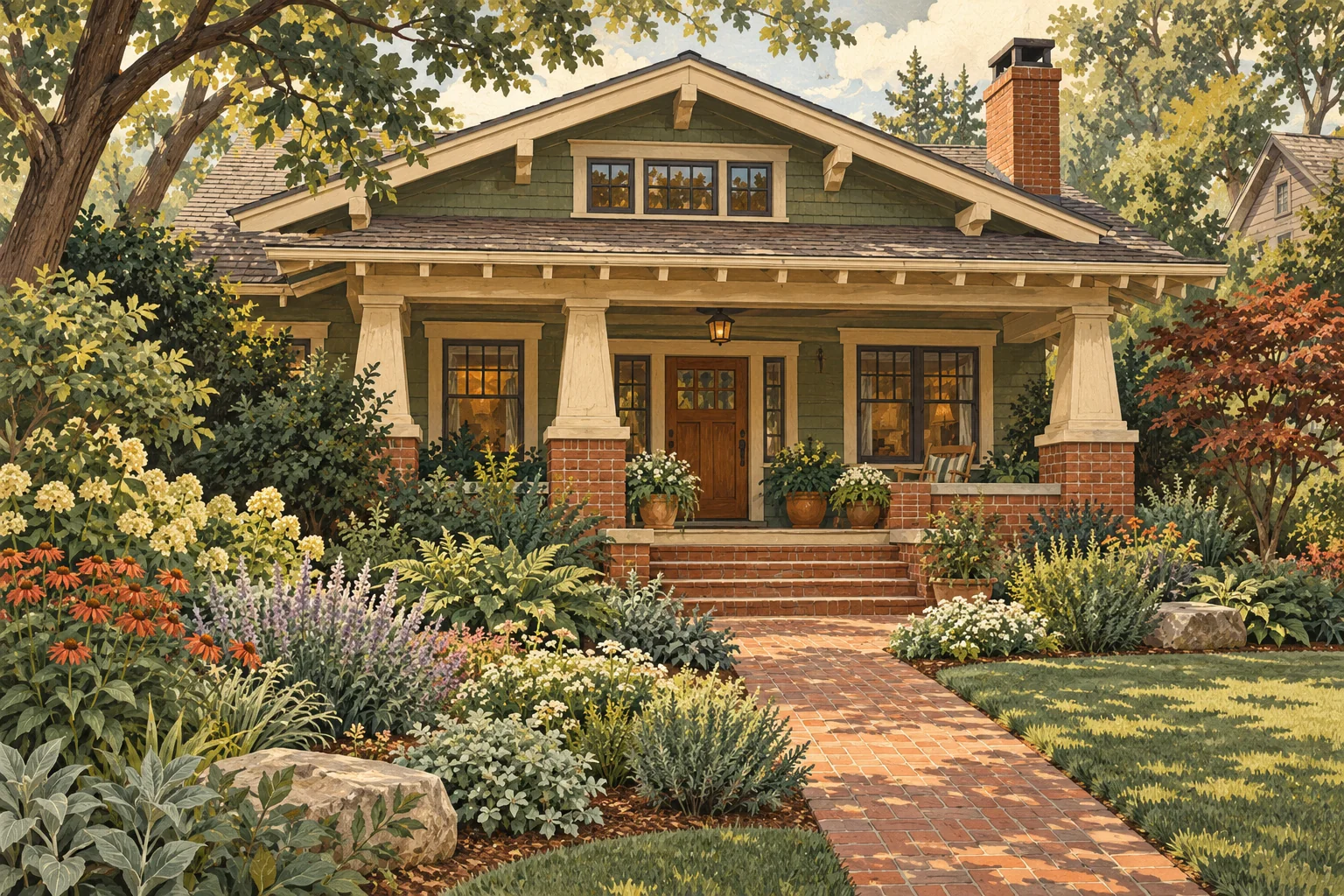
Use the porch, roof and materials as your starting point
Craftsman is an architectural style; bungalow describes a compact house form often built in that style. Broad porches, overhanging roofs, exposed rafters and sturdy columns are useful clues. You don't need a perfectly preserved historic example to use the same landscaping principles.1
Start with the part of the house you like most. If it's the brick porch piers, echo that warm color in the path or edging. If it's a stone base, one related stone surface may be enough. Repeating a material usually feels more connected than adding several unrelated finishes.
The planting can be loose and flower-filled, mostly native or relatively tidy. A Craftsman house doesn't require one historical plant list. Keep the important lines of the building visible and let the garden style reflect how you want to live with the yard.
Check the planting from the porch as well as the street
A shrub can look well placed from the sidewalk and still block the view from a porch chair.
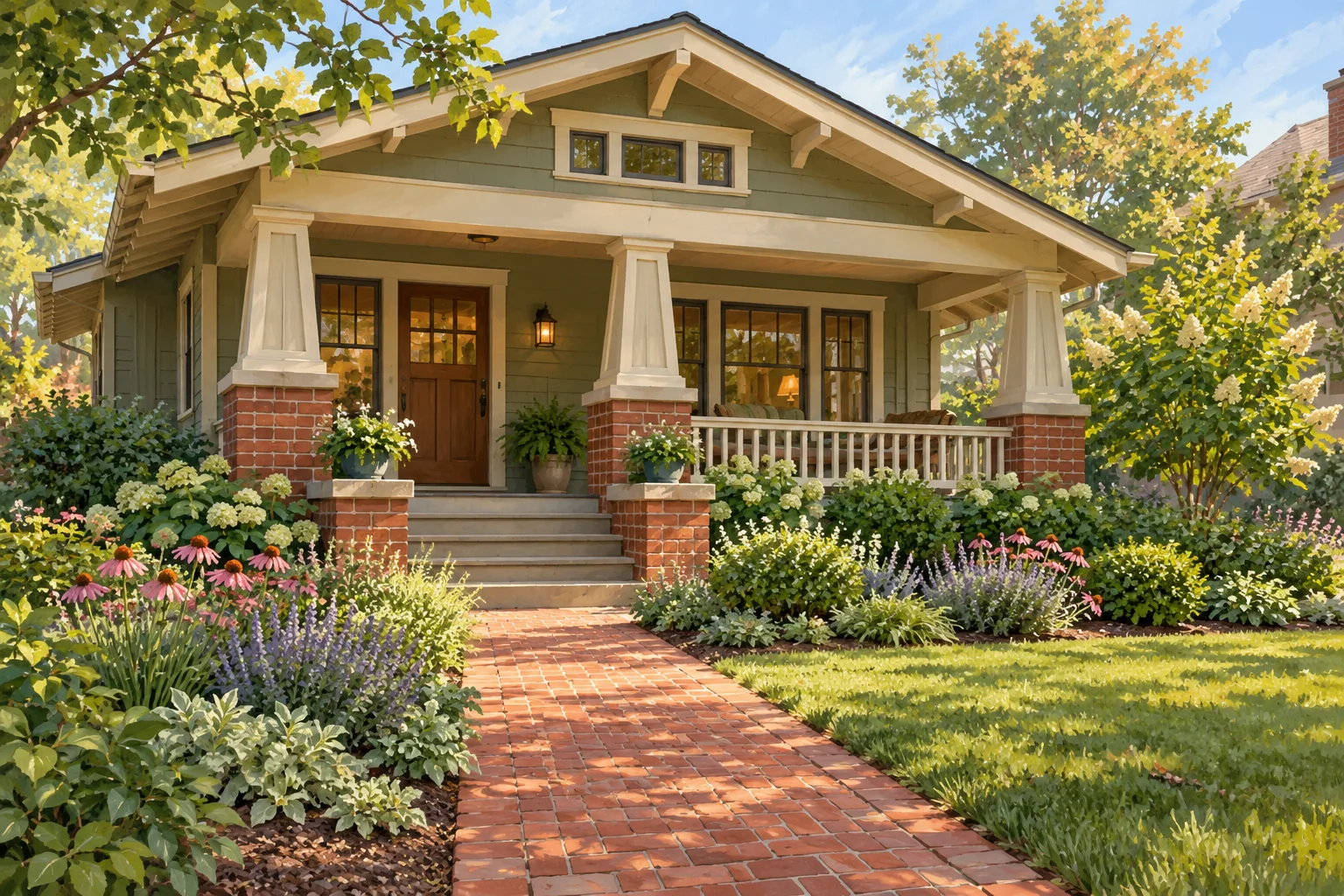
An open center with taller planting to the side
For a bungalow with front steps and a sitting area, keep lower plants across the main view and put a taller shrub beyond the porch's outer edge. The goal is to frame the porch without turning it into a screened room.
- 1
Sit where you will use the porch
Look toward the street and along the path. Note the places where you want privacy and the places where seeing out matters. A side screen may solve the privacy problem without covering the whole front.
- 2
Mark the mature plant heights
Use the expected height above the bed, including flower stalks. A low porch may need perennials across the center rather than another row of shrubs.
- 3
Leave the steps and piers readable
Keep plants from spilling into the approach or hiding the step edges. Let some of the masonry show so the house still has a visible base.
The shaded strip beneath deep eaves may also be dry
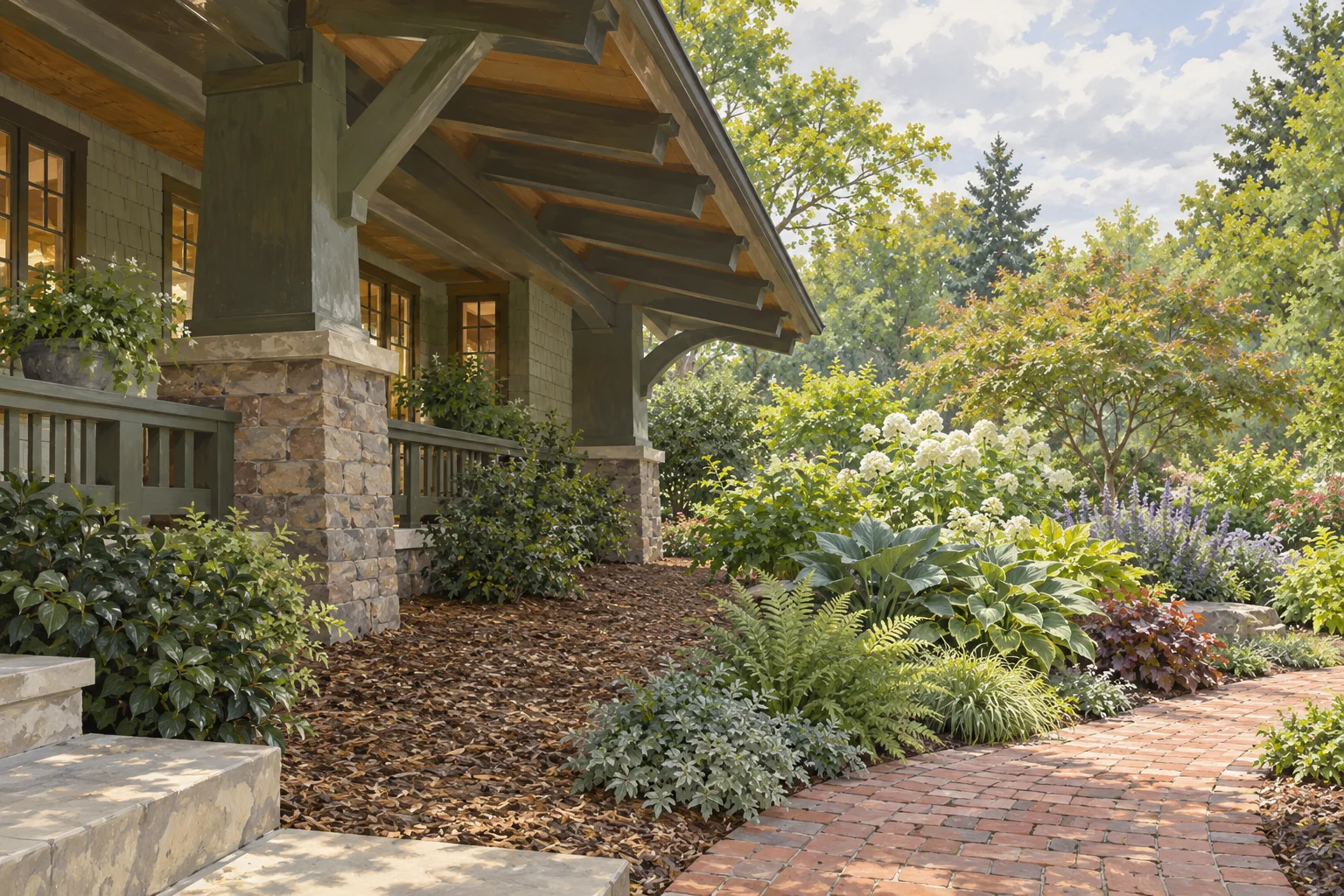
Deep overhangs can keep rainfall off the soil beside the house. That makes the strip beneath them different from a shady woodland bed. Check the soil after rain before choosing a moisture-loving plant simply because the label says shade.3
A clear maintenance strip can be the most useful finish directly beside the wall or porch. Move the main planting outward where it has better light, rain and room to grow. Keep vents, drainage outlets and access points open, and follow local building or fire guidance for the area beside the house.
An enclosed porch or later addition may change the original sun and rain pattern. Design for the house as it is now. Historic photographs are useful for ideas, but they won't tell you how today's bed drains or how much summer shade it receives.
Choose plants for the site, then carry the house's shapes through them
Borrow an approach that matches your yard’s sun, soil and climate.
| Front-yard condition | What to plant | How to keep it in scale |
|---|---|---|
| Front-yard conditionSunny, well-drained Midwestern bed | What to plantRepeated low grass mounds with a separate flowering edge | How to keep it in scaleUse taller stems beside the porch, not across low windows |
| Front-yard conditionMoist, sheltered eastern shade bed beyond the eaves | What to plantBroad coral-bell leaves beside finer fern foliage | How to keep it in scaleKeep a visible access gap against the building |
| Front-yard conditionWarm southern site needing evergreen shape | What to plantLocally suitable compact shrubs, such as dwarf yaupon | How to keep it in scaleCheck the actual variety's width before repeating a row |
In a small front yard, give the entrance enough room
If the steps are off-center, let the path lead naturally to them. You don't need matching beds on both sides of an asymmetrical porch. Repeat a plant or material to connect the sides while allowing the shapes to differ.
Below a window, choose plants whose mature tops stay below the view you want to keep. Allow space beside the building and the walk for their full width. If a bed is too shallow for both shrubs and a flower row, a single lower layer can look more generous than crowded planting.2,4
Consider a 4-foot-deep bed along a walk. A shrub expected to spread 4 feet would occupy all that depth before allowing any wall access or path clearance. A narrower plant, a wider bed or a different location solves that problem more reliably than constant trimming.
Check local historic-district rules before changing a prominent path, fence, porch or retaining wall. A planting refresh may need little construction, and preserving a useful existing walk can leave more of the budget for the garden itself.
Try a fuller border and a simpler one in the same view
Take one photo from the sidewalk and another from the porch. Mark the windows, steps and architectural details you want to keep visible. Those two views reveal different problems, so don't judge the design only from the street.
In Gardenful, start with the street-facing photo and describe the character you want: loose flowers around brick steps, a calmer evergreen border or lower native planting. Ask to keep the porch columns and entrance visible. Compare the ideas with your porch view, then check the suggested plants for the bed's conditions.
Frequently asked questions
What plants look good in front of a Craftsman house?
Lower repeated plants across the porch and taller accents to the sides often fit its proportions. The actual plants depend on sun, soil and climate: grasses and flowers can work in sunny beds, while broad leaves and ferns suit appropriate shade. Avoid a tall continuous row that hides the house's main details.
Does a Craftsman bungalow need a formal garden?
No. A clear path and repeated materials can connect a loose, flower-filled garden to the house. Keep the architecture readable, then choose a planting style you enjoy and can maintain.
How do I landscape a bungalow with a low porch?
Check the view while seated on the porch. Use lower planting across that view and put taller privacy planting to the side where needed. Choose by mature height and width so the garden remains usable after it fills out.
 Gardenful
Bring out what you love about your house.
Explore a front garden that frames the porch, suits your style and leaves the entrance welcoming. Start with a photo of your bungalow in Gardenful.
Gardenful for iPhone
Download the app free and start with a photo of your yard.

Sources(11)
- [1]Bungalow style
City of Longmont Historic Preservationhttps://longmontcolorado.gov/planning-and-development-services/historic-preservation/bungalow-style/
- [2]Landscape design: aesthetic characteristics of plants
University of Florida IFAS Extensionhttps://ask.ifas.ufl.edu/publication/EP433
- [3]Foundation plantings
Michigan State University Extension via Ask Extensionhttps://ask.extension.org/kb/faq.php?id=192451
- [4]Right plant, right place: plant selection and siting
University of Florida IFAS Extensionhttps://ask.ifas.ufl.edu/publication/EP416
- [5]
- [6]
- [7]Japanese forest grass photograph
NC State Extensionhttps://plants.ces.ncsu.edu/plants/hakonechloa-macra-samurai/
Photograph by Kathleen Moore, CC BY 2.0; resized and converted to WebP for responsive display.
- [8]CC BY 2.0
Creative Commonshttps://creativecommons.org/licenses/by/2.0/
- [9]CC BY 4.0
Creative Commonshttps://creativecommons.org/licenses/by/4.0/
- [10]
- [11]Yaupon holly
NC State Extensionhttps://plants.ces.ncsu.edu/plants/ilex-vomitoria/