Garden bed edges
Landscape edging ideas: choose the edge by the job
The short answer
Landscape edging should solve a boundary problem: mowing, spreading turf, loose mulch, or a small change in level. Choose the type for that job, not the material display. A cut edge makes the lightest visual line, a flush edge can simplify mowing, a buried barrier can slow spreading turf, and a raised border can retain a small difference in level. If the edge must hold back a meaningful slope, treat it as a wall or grading problem.
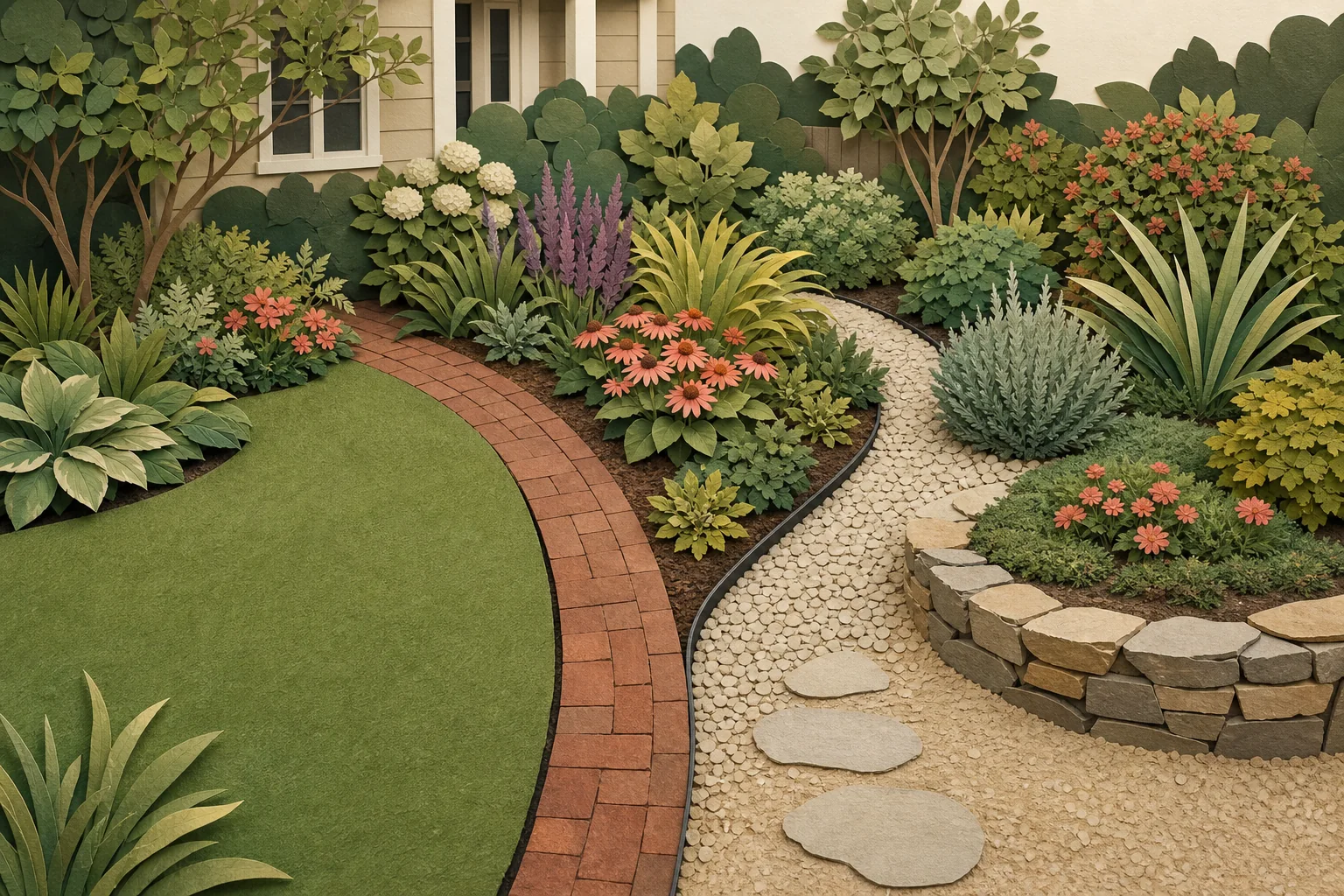
Start with what crosses the line
An edge can look decorative, but its useful work happens where grass, mulch, feet, mower wheels, water, and soil meet.
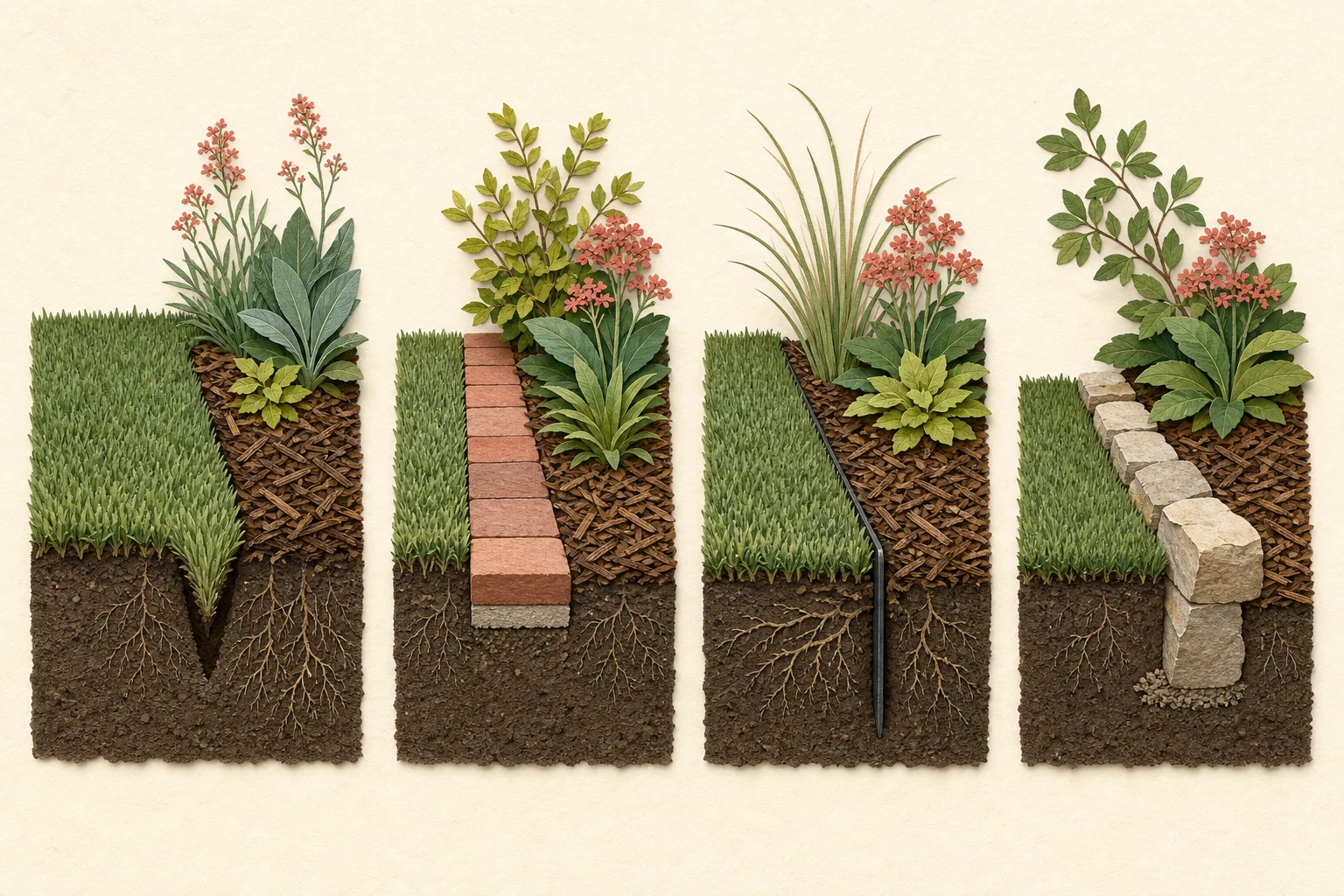
- Cut edge
- Flush mowing edge
- Buried divider
- Raised border
Walk the full boundary and mark the actual failure: grass running into the bed, mulch washing onto paving, a mower that cannot reach the edge, feet cutting a corner, or soil sitting higher on one side. One property can need more than one edge treatment. For one concrete reference, Illinois Extension describes a hand-cut bluegrass edge about four inches deep and wide, renewed once or twice a year. Treat that as a regional starting point, not a specification for every turf or soil.1
Do not ask a thin strip of plastic or steel to retain a meaningful slope. When soil pressure, erosion, steps, or drainage changes are involved, the project has moved beyond a simple visual divider.
Match the edge to its main job
Material matters after the function is clear. These four systems cover most ordinary bed-to-lawn and bed-to-path decisions.
Cut edge
Best for a nearly invisible, flexible boundary
A renewed soil cut creates the quietest line and bends easily around broad curves. It needs recutting, while the soil type and turf growth determine the useful depth.
Flush mowing edge
Best for a lawn edge that reduces trimming
Brick, pavers, or another stable surface sits close to the surrounding grade so a mower wheel can pass over it. Installation quality and an even walking surface matter.
Thin buried divider
Best for a discreet physical separator
Steel or aluminum can create a restrained line where turf or loose material needs more resistance than a cut edge provides. Metal can be durable, but installation and frost movement still need attention.
Raised border
Best for a visible edge with minor retaining work
Stone, brick, or timber can make the boundary visible and hold a modest level difference. Keep it out of normal foot travel unless the top and adjoining surfaces are designed safely.
Work one lawn-to-flower-bed edge
This example separates a mulched perennial bed from lawn on nearly level ground. It is a decision model, not an installation specification.
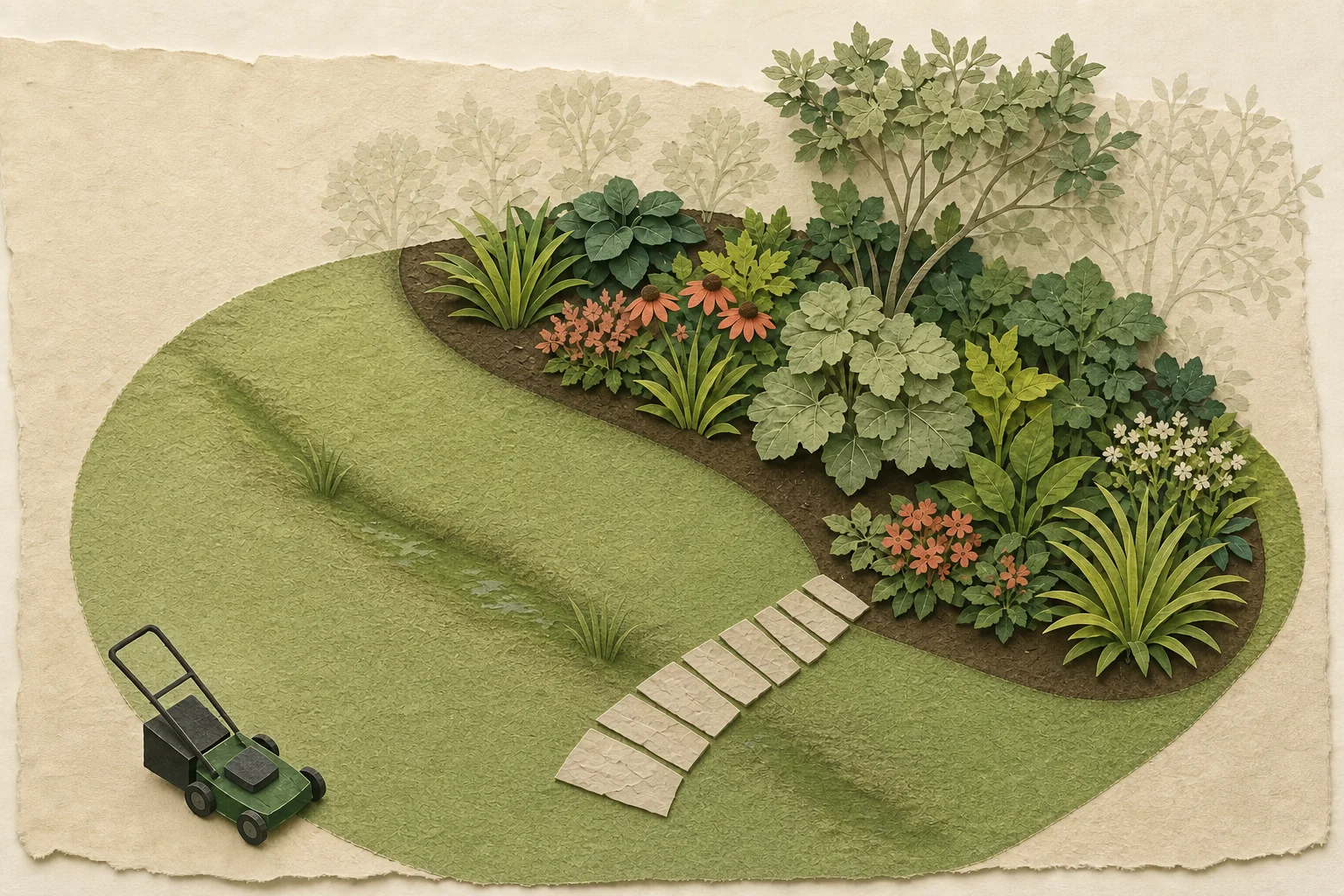
A curved bed that is hard to mow cleanly
Grass creeps into the mulch, the trimmer damages low plants, and a sharp decorative curve creates several tight mower turns.
- 1
Simplify the line
Replace the small wiggles with one broad curve that the mower can follow. The bed shape should improve the remaining lawn, not leave narrow turf points.
- 2
Choose a maintainable section
For the bluegrass condition in the Illinois example, test a hand-cut edge about four inches deep and wide. If rolling a mower wheel is the priority, compare that upkeep with a stable flush course instead.
- 3
Keep plant crowns behind the working line
Place low foliage far enough inside the mature bed that it can soften the edge without becoming the thing the mower or edging tool hits.
- 4
Review after one wet season
Look for washed mulch, settling, heave, encroaching grass, and any point that has become a trip or mower hazard.
The design improvement comes first from the calmer bed line. The edging system simply helps that line remain legible.
Match the edge to the garden's line and materials
The edge should feel related to the paving, walls, and planting. It shouldn't introduce a new decorative material just to outline the bed.
Repeat one material or one line quality; do not outline every surface.
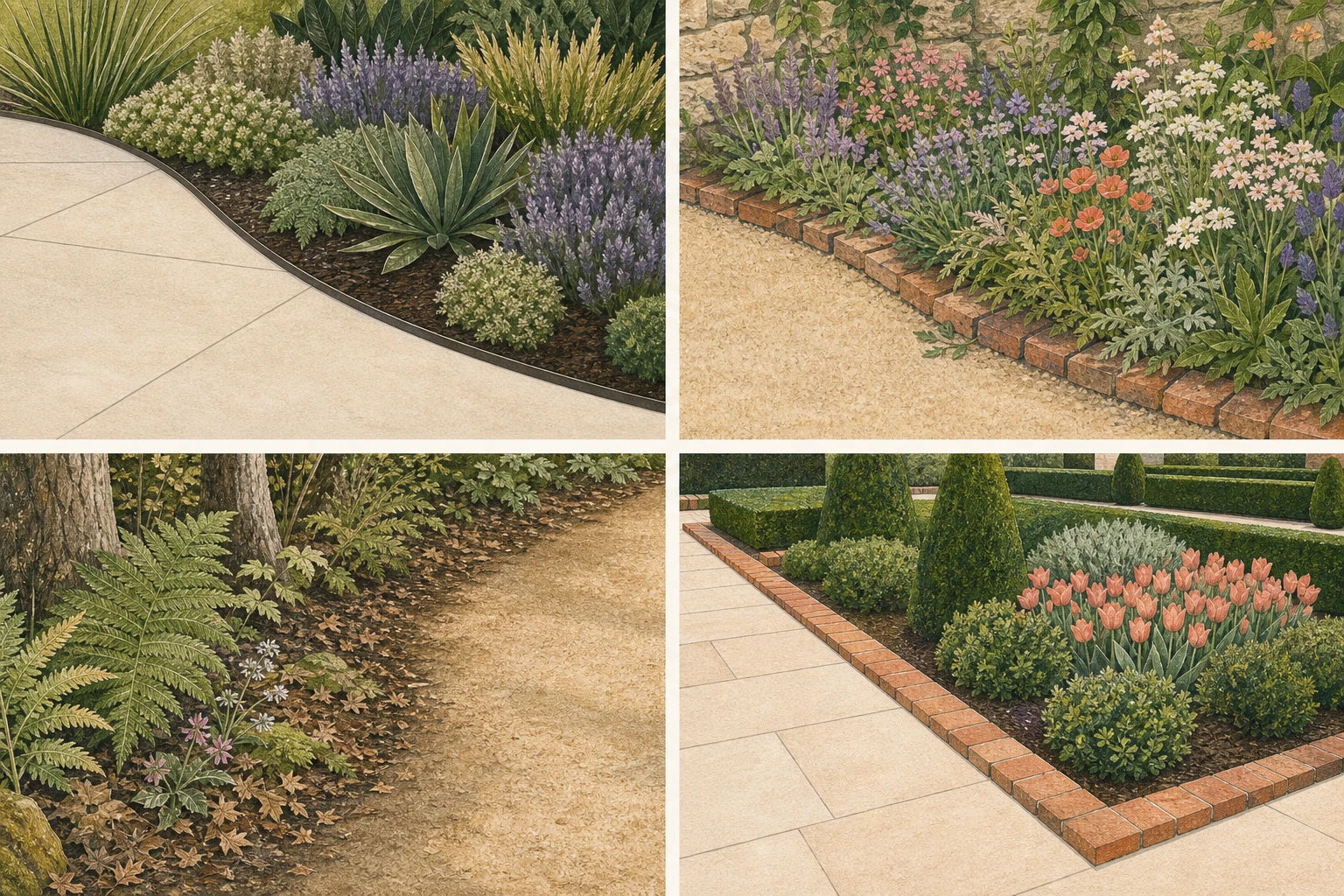
Modern or restrained
The plant masses remain dominant
Use a straight or broad-radius line with a thin, low-contrast divider or a precise flush edge.
Cottage or informal
The edge reads as structure beneath abundance
Use a cut edge, old brick, or local stone with enough planting overlap to soften the boundary.
Woodland or naturalistic
The transition feels gradual
Use the least visible system that contains the path or mulch, and let leaf litter and ground layer soften it.
Formal
The boundary reinforces symmetry and order
Use consistent alignment, repeated dimensions, and a durable material that can maintain a crisp geometric line.
An edge does not need to match the house literally. It should feel related to the paving, walls, beds, and overall level of formality.
Sources: NC State Extension, University of Florida IFAS Extension
Check the edge before you dig
Even a shallow garden trench is digging. Resolve utilities, drainage, and walking safety before installation.
Contact 811: Request utility marks and follow the instructions from your state 811 center before putting a shovel into the ground.
Keep water moving safely: Do not create a raised lip that traps runoff against a building, sends water onto a neighbor, or concentrates erosion.
Protect the walking surface: Keep rigid or raised materials stable, visible, and out of the normal step path. Recheck them after settling and freeze-thaw cycles.
Plan for mature plants: Set the edge where the bed needs to be at maturity, not directly beneath the current tips of young shrubs.
Name the maintenance task: Decide who will recut, trim, reset, sweep, or inspect the edge and how often the chosen system makes that likely.
Frequently asked questions
What is the lowest-maintenance landscape edging?
No edge is maintenance-free. A correctly installed flush hard edge can reduce trimming, while a cut edge is simple and flexible but needs renewal. The lowest-maintenance choice is the one matched to the actual grass, mulch, grade, mower, climate, and traffic.
Does landscape edging stop grass?
It can slow grass at the boundary, but performance depends on the grass species, rooting or rhizome depth, the edge depth, joints, and upkeep. Treat claims of permanent control cautiously.
Should edging sit above the lawn?
That depends on its job. A flush mowing edge stays near grade; a containment or raised edge may sit higher. Any raised lip needs to be stable, visible, and safely placed.
Do I need to contact 811 for garden edging?
Yes. The national 811 service says any digging, including a small flower bed, requires contacting your state 811 center before work begins.
 Gardenful
Draw the boundary before you shop the material.
Photograph the bed, simplify the line, name what must cross or stop there, and then choose the lightest edge that does the work.
Gardenful for iPhone
Download the app free and start with a photo of your yard.

How this guide was built
We organized common edging systems by the boundary job rather than by a gallery of materials.
Extension guidance supports edges as functional transitions that clarify beds, contain mulch, reduce trimming, and relate to the larger landscape.
The illustrations are conceptual sections. Soil, frost, slope, drainage, traffic, utilities, accessibility, and manufacturer instructions determine the actual installation.
Sources(5)
- [1]Bed Edges
University of Illinois Extensionhttps://extension.illinois.edu/blogs/ilriverhort/2015-05-24-bed-edges
- [2]How to Plan and Maintain a Perennial Garden
University of Maryland Extensionhttps://extension.umd.edu/resource/how-plan-and-maintain-perennial-garden
- [3]
- [4]Landscape Design: Arranging Plants in the Landscape
University of Florida IFAS Extensionhttps://ask.ifas.ufl.edu/publication/EP449
- [5]811 Before You Dig
Common Ground Alliancehttps://811beforeyoudig.com/Before-You-Dig/