Lower-care yards
Low-maintenance landscaping ideas that reduce recurring work
The short answer
Lower-maintenance landscaping comes from designing out repeated work, not finding plants that need nothing. Start with the chores you want to reduce: mowing, edging, pruning, watering, weeding, cleanup, or replacement. Change the layout that creates those chores, then use a short palette of plants that fit the site at mature size.
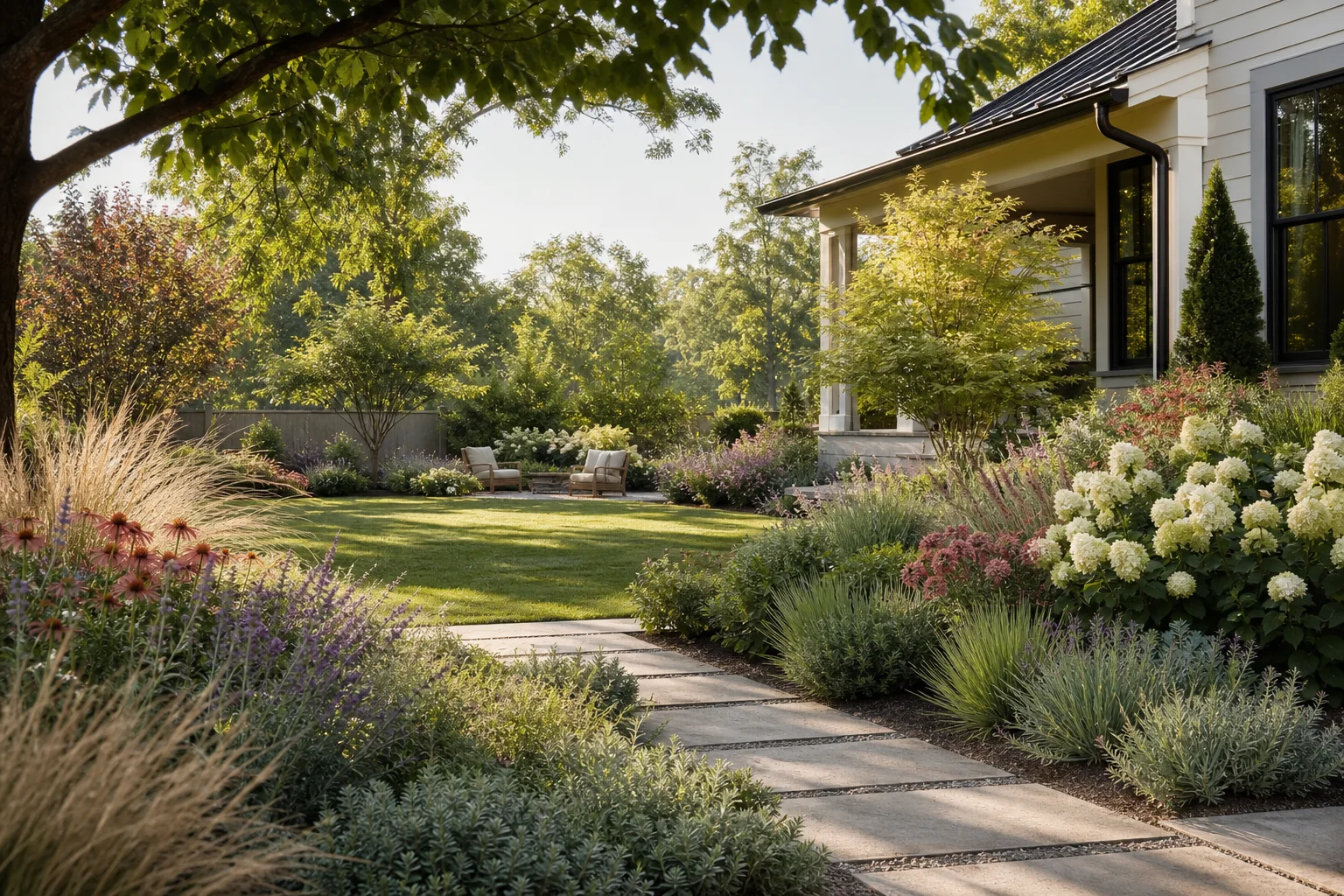
Map the work before changing the yard
Low maintenance is personal. A plant lover may accept seasonal cutting but hate weekly edging; another household may prefer mowing to irrigation repair.
Mowing and trimming: Mark tight turns, isolated lawn pockets, steep areas, obstacles, and edges that require a second tool.
Pruning: Identify plants repeatedly cut to stay below windows, off paths, or inside a space too small for mature size.
Watering: Find mismatched zones, hand-watered exceptions, overspray, dry corners, leaks, and plants with unusually high demand.
Weeding and cleanup: Record bare soil, invasive spread, leaf traps, difficult rock mulch, and beds that cannot be reached comfortably.
Replacement: Notice plants that repeatedly fail because the site, climate, browsing pressure, or household use does not fit.
Choose the two recurring tasks that cost the most time or frustration. Design those out first.
Redesign the shapes that cause repeated work
Maintenance is strongly affected by bed geometry, access, plant spacing, and how many exceptions the yard contains.
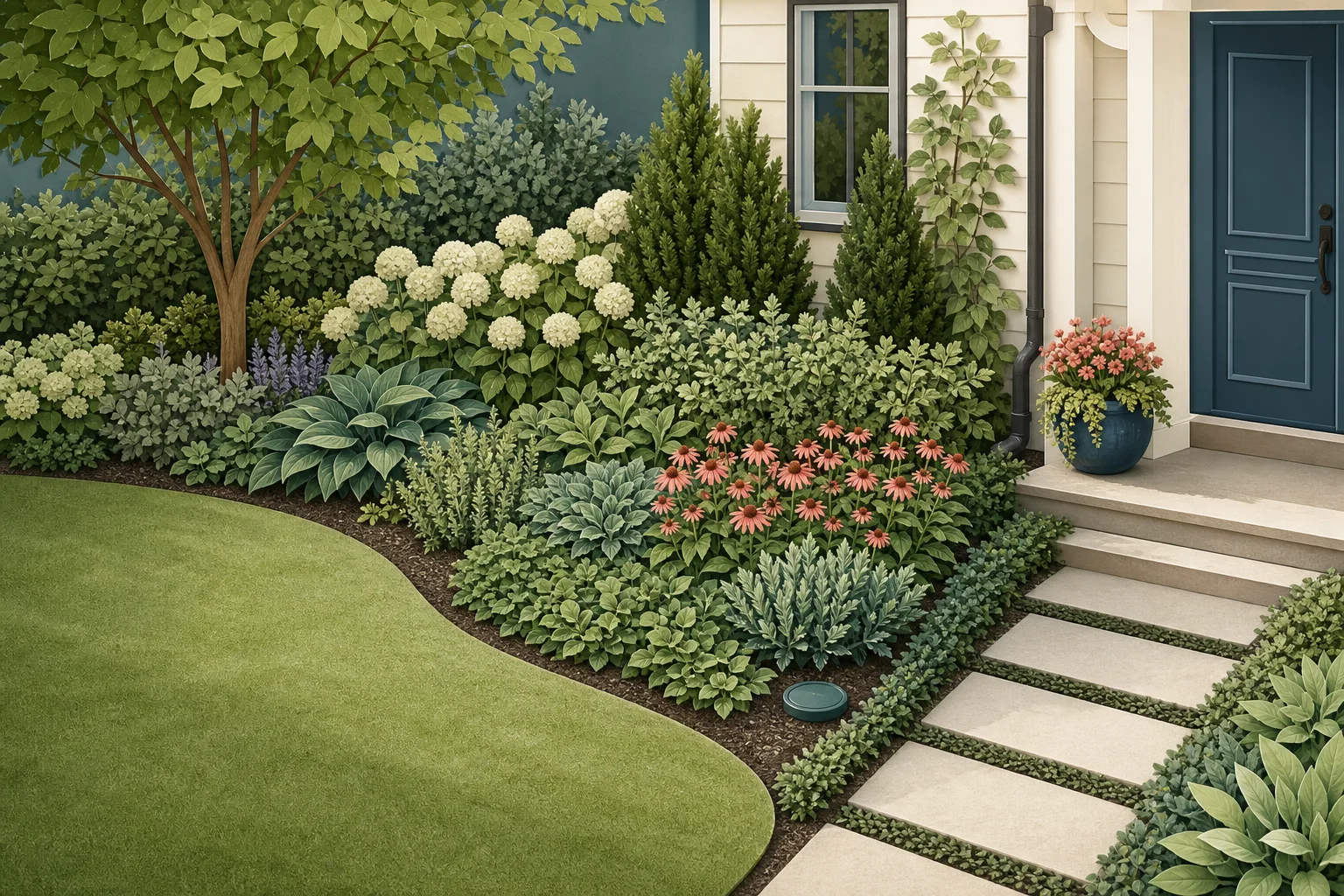
Use simple working shapes, broad repeated masses, covered soil, and direct access to every system.
- 1
Simple lawn shape
Reduces turns and trimming
Keep lawn only where it has a use and shape remaining areas for continuous mowing without narrow leftovers.
- 2
Broad plant masses
Reduces exceptions
Repeat fewer plant types in groups sized for maturity instead of maintaining many isolated specimens.
- 3
Covered soil
Reduces open weed space
Use locally suitable plant coverage or mulch while plants establish, with a plan for replenishment and weed monitoring.
- 4
Reachable systems
Makes care faster
Keep valves, drains, walls, fences, utilities, and pruning access visible and usable.
Sources: University of Minnesota Extension, University of Florida IFAS Extension
Remove fragmented edges and high-care exceptions
A yard can contain durable plants and still demand constant work when every surface and specimen has its own boundary.
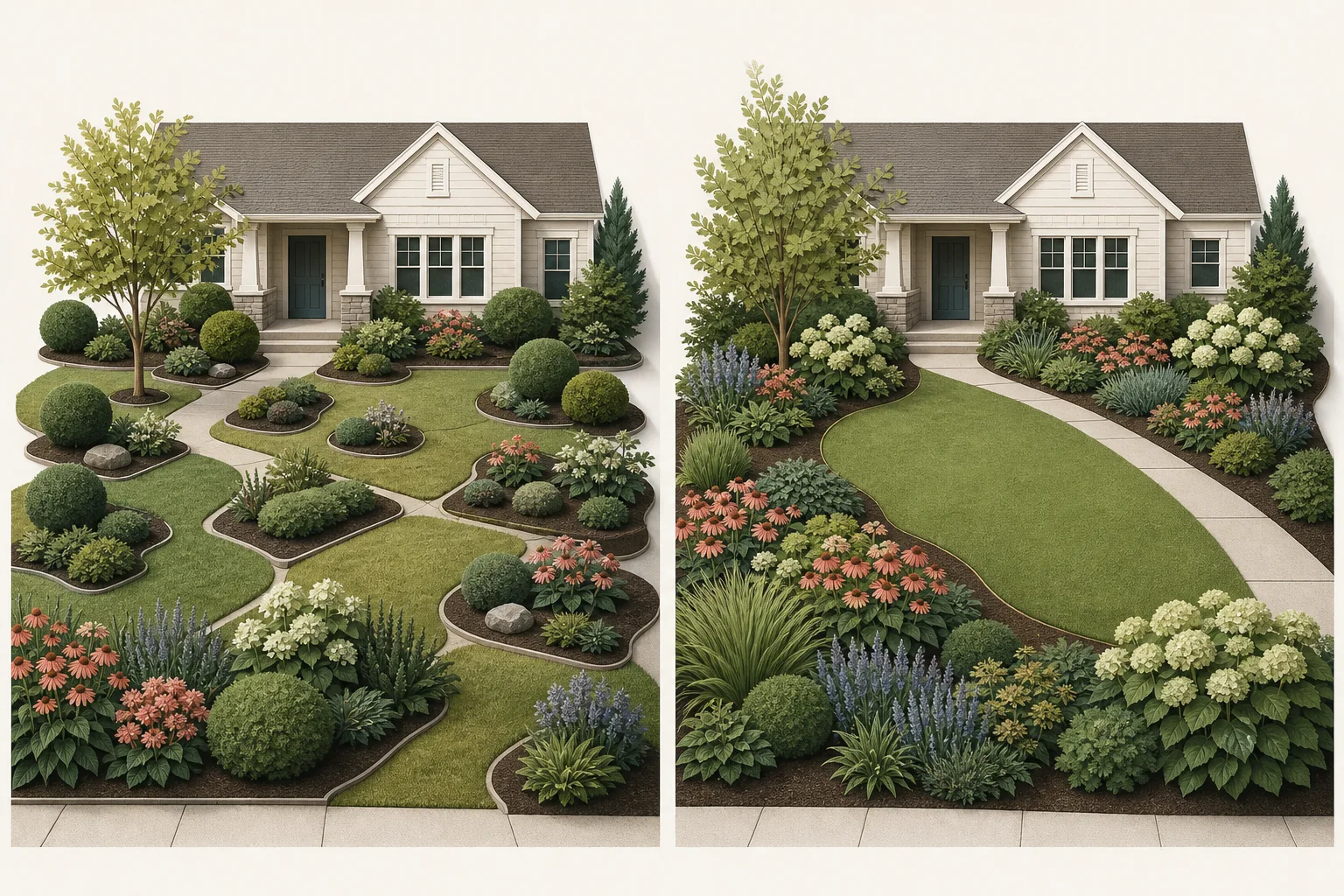
- Many recurring exceptions
- Fewer working shapes
A tiny lawn island still needs mowing. A clipped shrub still needs pruning. Decorative rock still collects weeds and organic debris. Count the recurring task each feature creates rather than judging it by installation-day appearance.
The simplified yard does not remove care. It consolidates it: one mowable area, one repeated plant language, one connected mulch zone, and one small seasonal container where change is easy.
Choose plants that fit without repeated correction
The right plant reduces intervention because its normal behavior belongs in the available space and site.
- 1
Match the site
Verify sun, soil, drainage, climate, water, wind, salt, browsing, and other local pressures.
- 2
Draw mature size
Leave room for the plant's normal form rather than planning to prune an oversized choice into submission.
- 3
Check how it moves
Understand reseeding, suckering, runners, dropped fruit, leaf litter, and invasive potential.
- 4
Repeat proven performers
Use a short palette in broad groups after confirming it fits the site and is appropriate locally.
- 5
Keep experiments contained
Put higher-care seasonal plants in one reachable bed or container instead of distributing them through the yard.
A slow-growing plant is not automatically low maintenance, and a native plant is not automatically tidy or suitable for every site.
Write a short maintenance plan before planting
A lower-care garden still has establishment, inspection, and seasonal work.
List the first-year watering and weed checks, then the normal seasonal tasks for pruning, division, mulch, irrigation, leaves, and storm cleanup.
Assign access. Make sure the person doing the work can reach every plant, edge, valve, drain, wall, and fence without damaging another part of the landscape.
Set a review date after the first full growing season. Remove failed exceptions, adjust spacing, and repeat what genuinely performed well.
Frequently asked questions
What is the lowest-maintenance landscaping?
The lowest-maintenance design is the one matched to your site and the chores you are willing to do. Simple working shapes, fewer well-fitted plants, covered soil, and clear access usually matter more than one specific style or material.
Does replacing lawn with rock reduce maintenance?
Not automatically. Rock can remove mowing, but weeds, blown soil, leaves, heat, access, and future planting can create different work. Compare the full recurring maintenance before converting a large area.
Are native plants low maintenance?
A locally native plant can be well adapted and ecologically valuable, but maintenance depends on site fit, growth behavior, design, establishment, and the look you expect. Choose the exact plant for the exact place.
 Gardenful
Simplify the yard where the work repeats.
Use a photo that includes the awkward lawn edges, service routes, and overgrown plants. Explore a calmer layout in Gardenful, then build a local plant palette that fits the site and your care budget.
Gardenful for iPhone
Download the app free and start with a photo of your yard.

Sources(2)
- [1]Lawns and Landscapes
University of Minnesota Extensionhttps://extension.umn.edu/yard-and-garden/lawns-and-landscapes-minnesota
- [2]Designing a Low-Maintenance Landscape
University of Florida IFAS Extensionhttps://ask.ifas.ufl.edu/publication/EP442