Water-wise garden design
Xeriscape garden ideas that still feel like a garden
The short answer
A good xeriscape is not a yard covered in rock. It is a garden that puts water where it earns its keep: near useful lawn, gathering spaces, and plants with similar needs. Start by mapping the site's water, shade, drainage, and existing trees; then replace one low-value lawn area with repeated, climate-suitable plant masses and a soil-covering mulch.
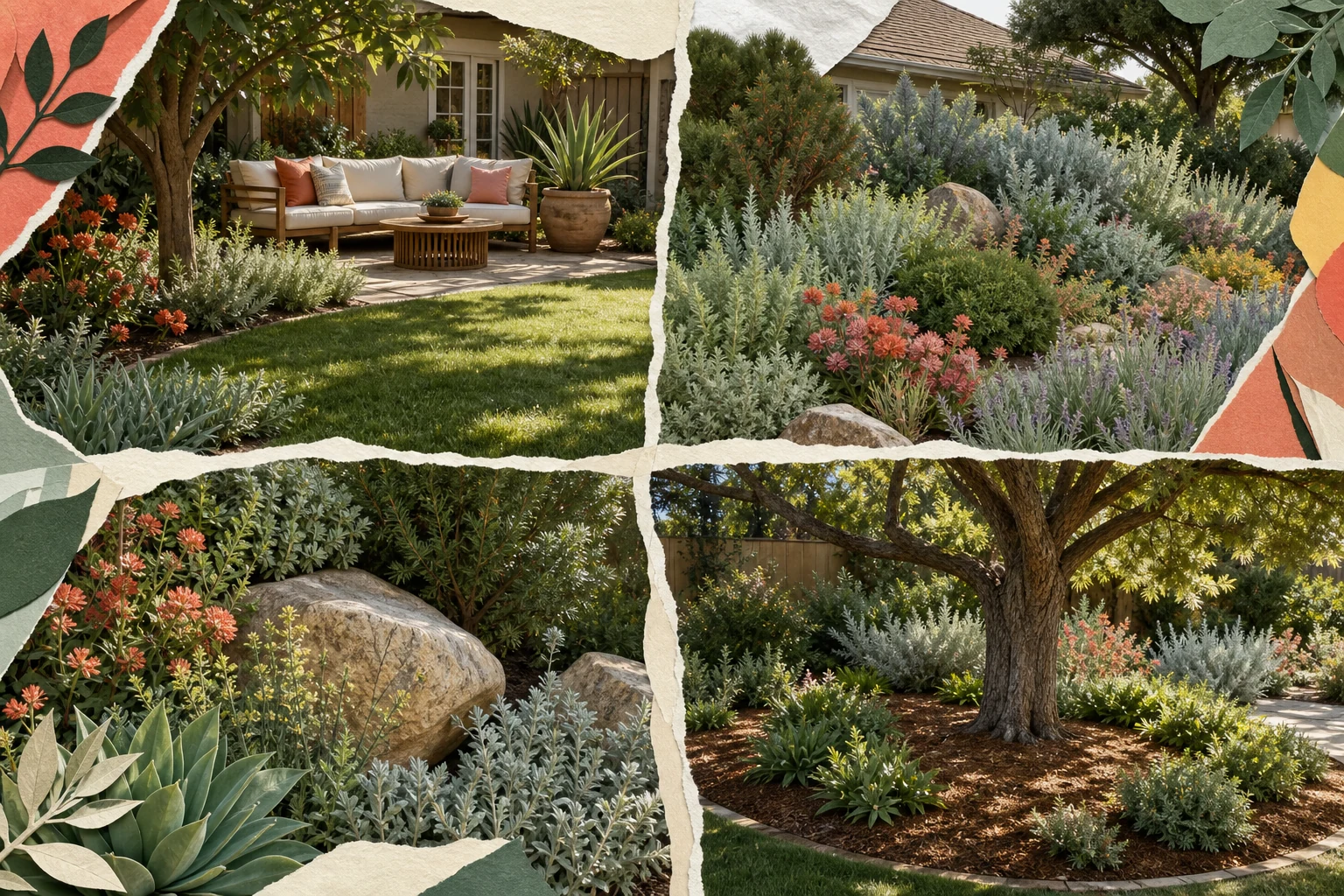
Map four water zones before choosing xeriscape plants
The useful question is not whether the whole yard should use less water. It is where different amounts of water are justified by use, shade, and existing plants.
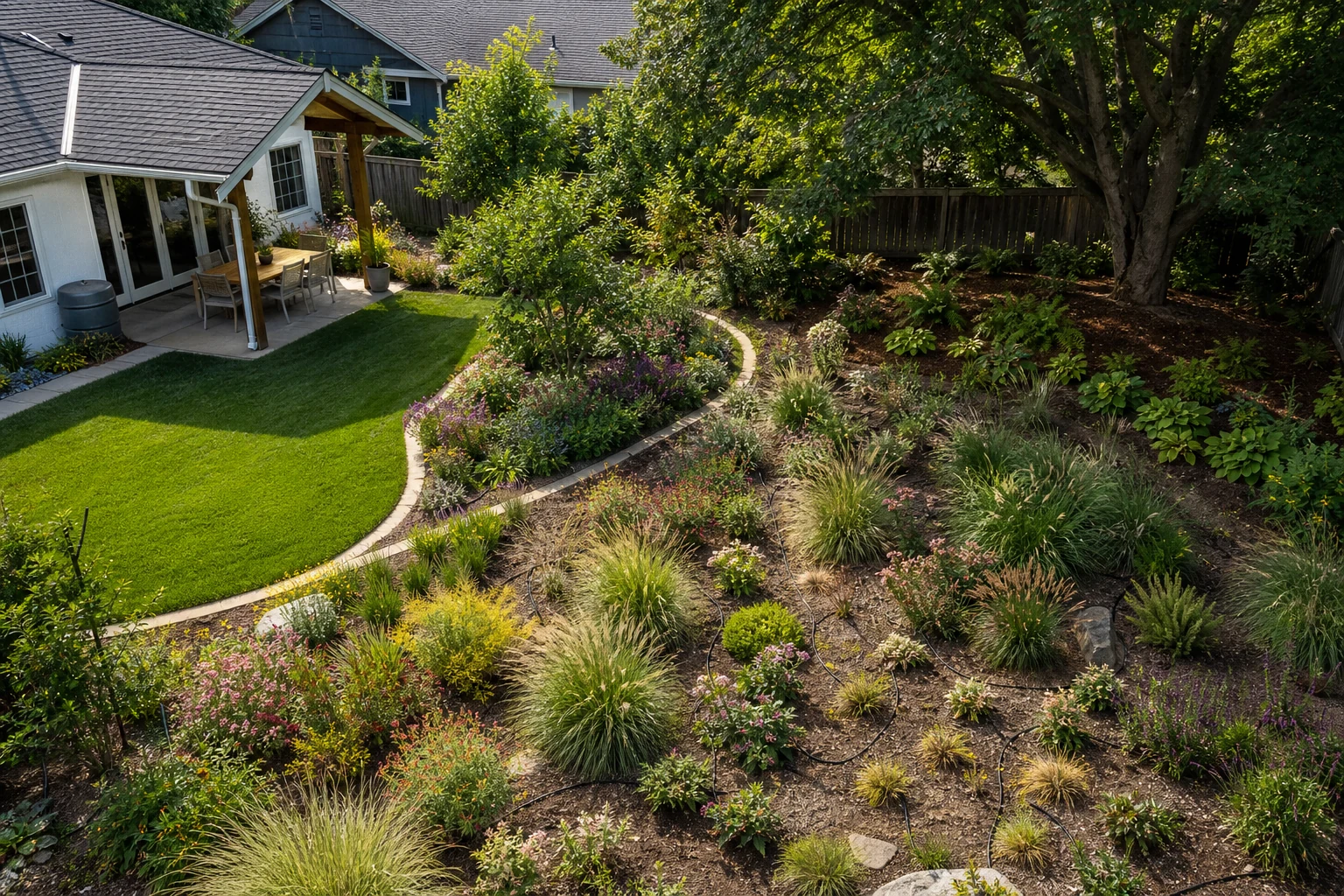
- 1
A small social zone
Keep higher-water lawn only where it supports play, seating, circulation, or a clear visual pause.
- 2
A moderate transition zone
Use it near entries and patios where a slightly lusher planting earns daily attention.
- 3
A broad low-water zone
Put the largest share of repeated, site-fit planting in sunny ground that does not need frequent foot traffic.
- 4
A protected tree zone
Treat an established tree and its roots as a separate system before changing turf or irrigation around it.
Sources: Colorado State University Extension, Colorado State University Extension
Convert one useful piece of the yard at a time
A phased retrofit gives you time to watch runoff, weeds, irrigation, and plant establishment before committing the whole yard.
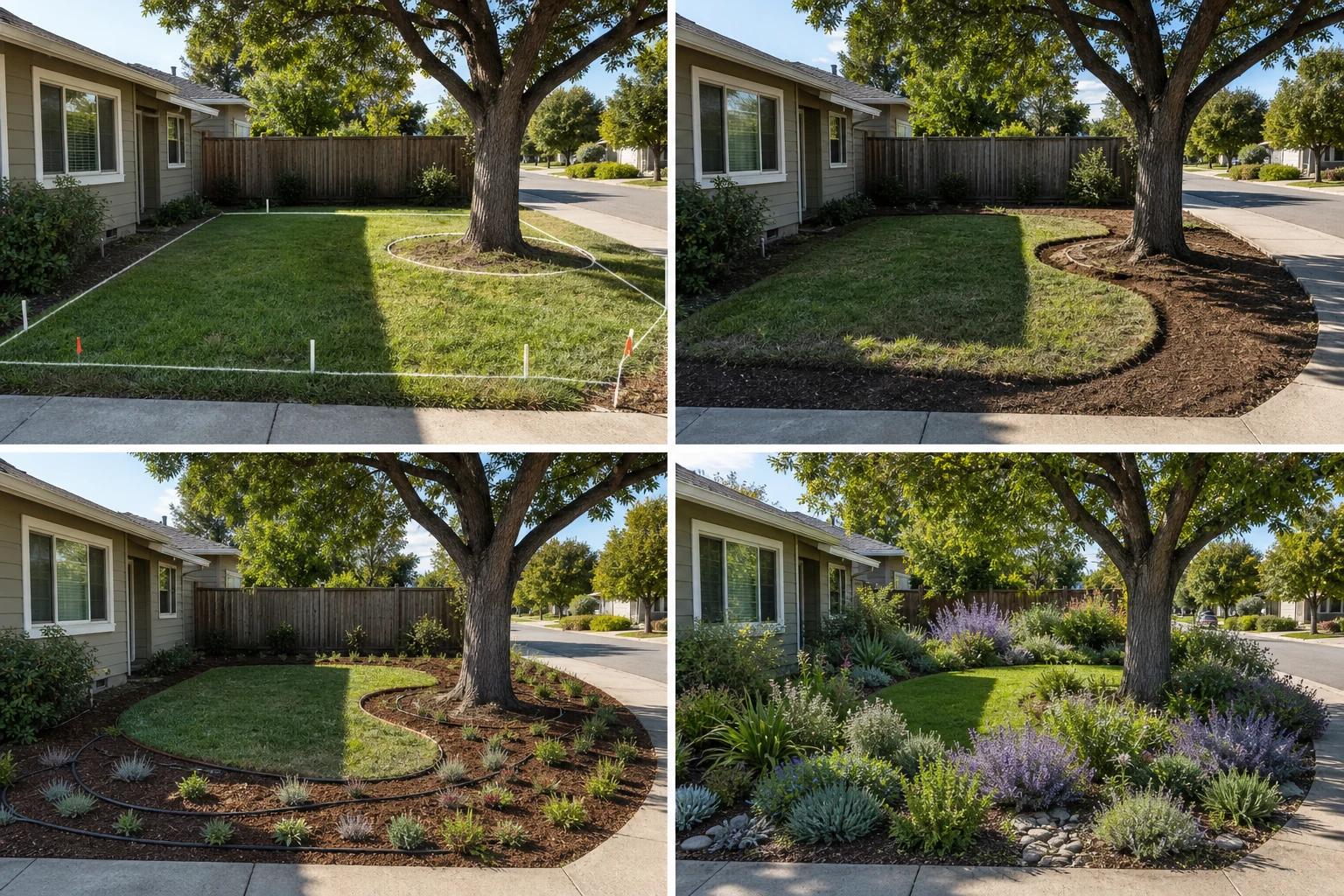
1
Mark what stays
Outline the lawn that still has a job, the root area around established trees, utilities, access routes, and runoff paths.
2
Remove one low-value edge
Start with a strip that is awkward to mow, hot, narrow, or rarely used—not the most complicated part of the property.
3
Install water and soil cover first
Adjust irrigation for the new zone, prepare the soil as local guidance recommends, and cover exposed soil while young plants establish.
4
Expand after a full season
Use what you learned about weeds, watering, survival, and maintenance to plan the next conversion area.
Build the planting from roles, not a drought-tolerant shopping list
Low-water plants can still look scattered when every purchase has a different shape and color. Give each plant a job and repeat the important ones.
Use one durable structural form, two or three repeated middle masses, a lower soil-covering layer, and restrained seasonal accents within the same water zone.
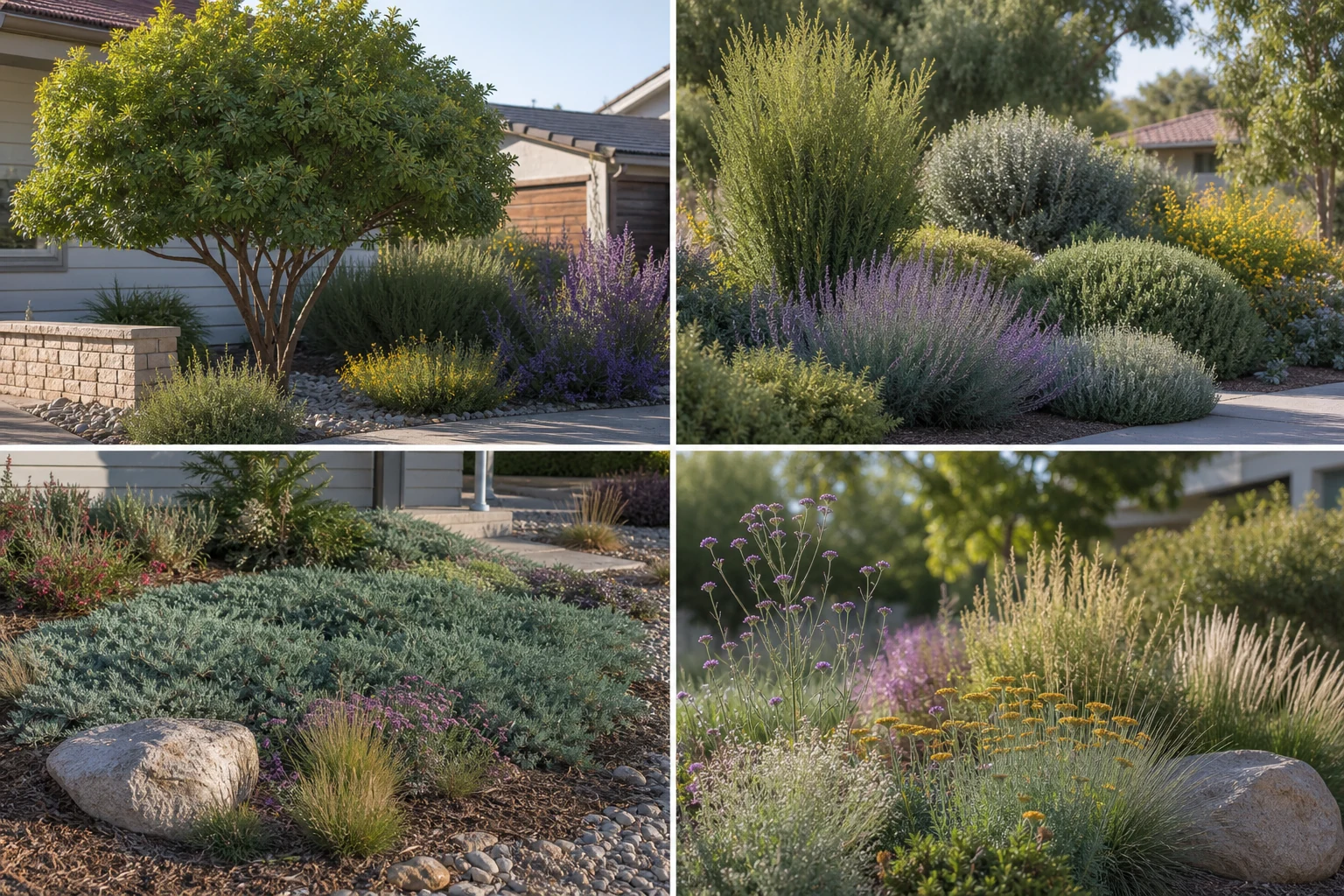
Structure
A shrub, grass, or compact tree carries the composition beyond its flowering season.
Repeated middle
Several groups of the same rounded or upright form make the bed readable from a distance.
Living or mineral cover
A compatible ground layer or locally appropriate mulch reduces bare-soil glare and helps the bed feel finished.
Seasonal emphasis
A few flowering or seedhead accents create a peak without making temporary color the only source of order.
Choose exact plants only after checking climate, winter hardiness, mature size, drainage, water zone, and local invasive-species guidance.
Sources: US EPA WaterSense, University of Florida IFAS Extension
Check the shortcuts that make xeriscapes harder to live with
Water-wise does not mean water-free or maintenance-free. Most problems begin when the design ignores establishment, heat, roots, or access.
Establishment water: New drought-tolerant plants still need planned watering while their roots establish; the schedule changes with soil, weather, plant, and season.
Rock heat: Large exposed gravel fields can store and radiate heat. Use rock for a clear function and check whether organic mulch is better around particular plants.
Tree irrigation: Removing irrigated turf can also remove water an established tree had been receiving. Get local arboricultural advice before changing that system.
Maintenance routes: Leave a practical way to reach valves, downspouts, fences, and the center of deeper beds without stepping through plants.
Frequently asked questions
Does xeriscape mean no lawn?
No. A water-wise design can keep a compact lawn where it supports play, seating, circulation, or another clear use. The goal is to stop irrigating turf that has no useful job.
Is a xeriscape garden maintenance-free?
No. It can reduce mowing and, after establishment, unnecessary irrigation, but it still needs weed control, irrigation checks, plant establishment, selective pruning, and periodic mulch or surface maintenance.
Should I replace the whole lawn at once?
Usually not. Converting one manageable edge first lets you test irrigation, weeds, plant fit, and maintenance before changing the whole yard.
Can I use gravel everywhere in a xeriscape?
Gravel can be useful for paths, drainage-compatible surfaces, or a specific regional character, but large exposed fields may add heat and do not prevent every weed. Match the surface to the site and plant needs.
What plants can I use in a xeriscape garden?
It depends on your climate, winter cold, summer heat, sun, soil drainage, and how often the bed will be watered. In parts of the Mountain West, such as Colorado's Front Range, blue grama, blanket flower, and a locally suitable penstemon are possible examples. In a hot Southwestern garden, desert willow, autumn sage, and a locally suitable agave may fit. These are regional examples, not one shopping list. Start with a local low-water plant list, then group plants that share the same light, drainage, and watering needs.
 Gardenful
Test a planting-led xeriscape direction on your yard
Use a photo to explore the major plant masses first, then verify exact plants, irrigation, and local suitability before buying.
Gardenful for iPhone
Download the app free and start with a photo of your yard.

Sources(6)
- [1]Xeriscaping: Retrofit Your Yard
Colorado State University Extensionhttps://extension.colostate.edu/resource/xeriscaping-retrofit-your-yard/
- [2]Water-Wise Landscape Design Steps
Colorado State University Extensionhttps://extension.colostate.edu/resource/water-wise-landscape-design-steps/
- [3]Low-Water Native Plants for Colorado Gardens
Colorado State University Extensionhttps://www.extension.colostate.edu/docs/pubs/native/FrontRangeSm.pdf
- [4]Landscaping Tips
US EPA WaterSensehttps://www.epa.gov/watersense/landscaping-tips
- [5]Water-Wise Landscape Design in 5 Easy Steps
University of Arizona Cooperative Extensionhttps://extension.arizona.edu/sites/extension.arizona.edu/files/pubs/az1497.pdf
- [6]Landscape Design with Plants: Creating Outdoor Rooms
University of Florida IFAS Extensionhttps://ask.ifas.ufl.edu/publication/EP449