Rock garden design
Rock garden ideas that look natural and stay planted
The short answer
A convincing rock garden reads as one landform, not a collection of stones and small plants. Start with drainage and the shape of the ground. Use one local-looking stone type, partially bury a few anchor rocks, follow the slope with smaller companions, and repeat three or four plant forms in the pockets between them. A rock garden can reduce thirsty planting, but it is not maintenance-free.
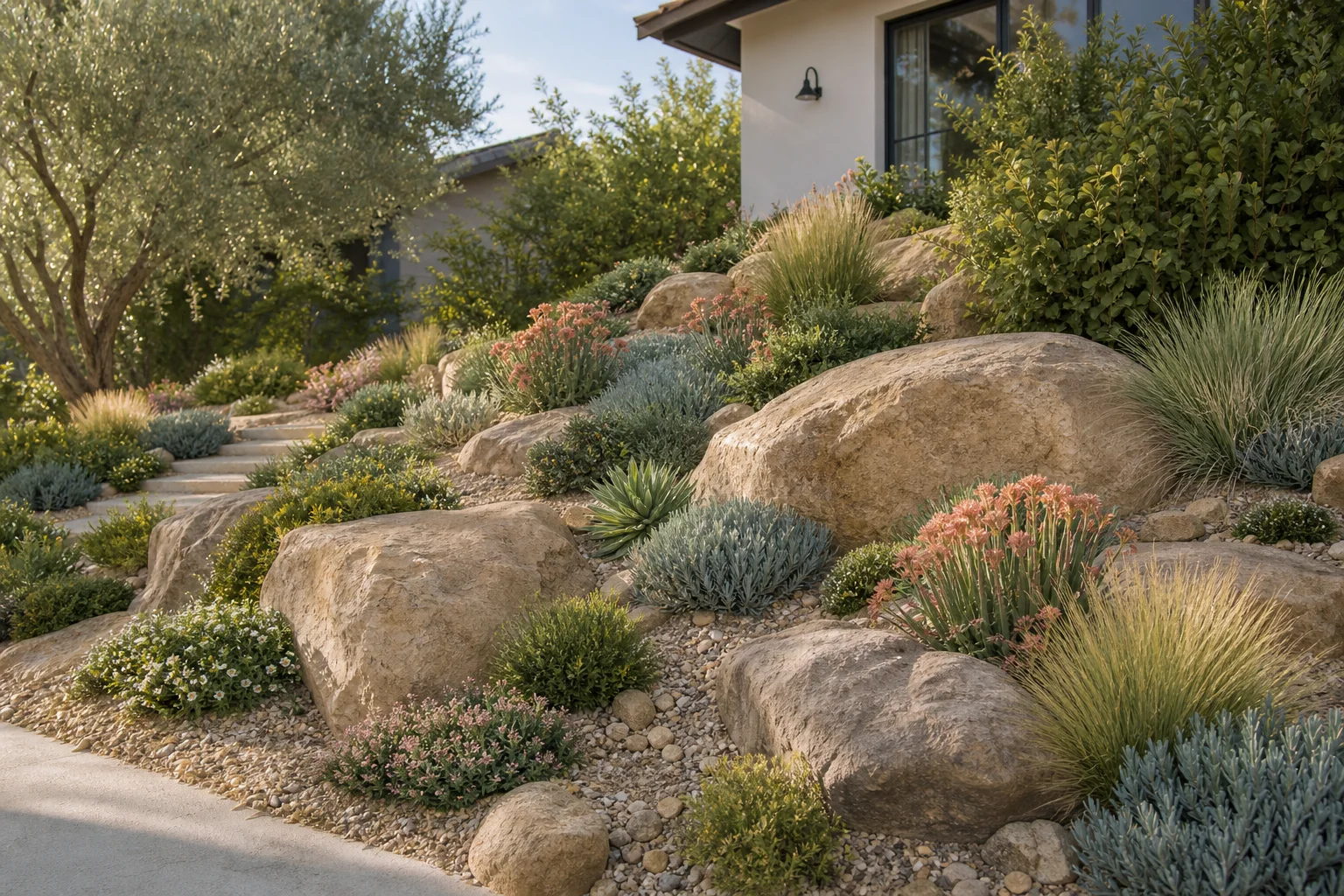
Choose a place where a rock garden solves a real problem
A sunny slope, fast-draining bank, or awkward dry pocket can support the idea. A wet hollow or a flat patch covered with decorative rock usually needs a different solution.
Watch the site after rain. Water should move through the planting pockets without collecting against the house, washing soil downhill, or crossing a path. Rock-garden plants are often selected for drainage, but exact moisture tolerance still varies by species and region.1
Notice the existing landform. A rock garden looks believable when stone seems to emerge from the slope. If the site is flat, build only a subtle rise that connects to the surrounding grade rather than an isolated mound.
Call 811 before digging and confirm buried utilities, irrigation, property lines, and any local restrictions. Large rock placement and major grade changes may need a contractor.
Place the large stones first, then plant the gaps
A natural-looking rock garden has a few obvious anchors. Smaller stones and planting support that structure instead of competing with it.
Let the slope set one direction for the stones, drainage, and planting.
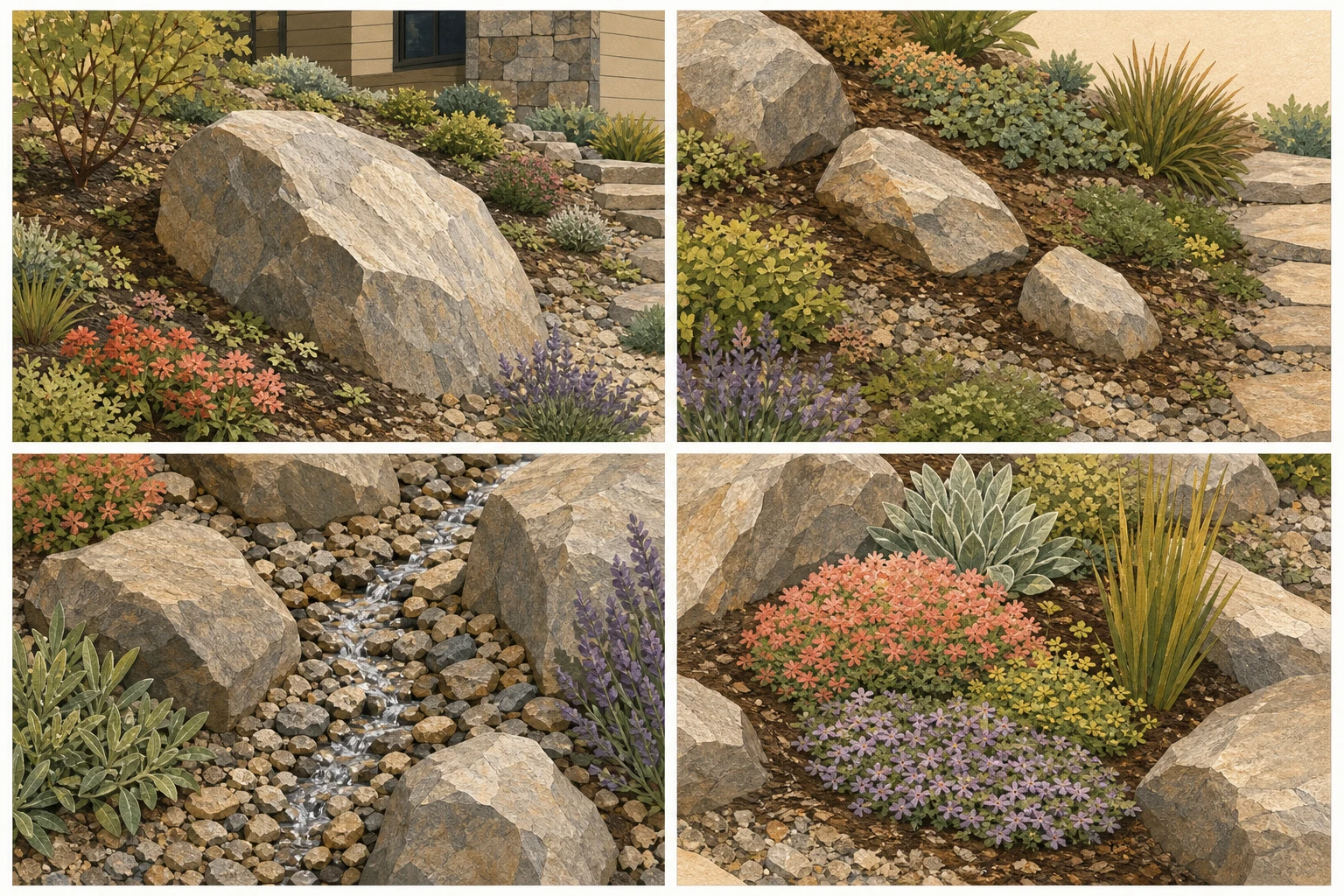
Anchor rocks
Establishes scale and direction
Set a small number of substantial stones into the slope so part of each base disappears into the ground.
Companion stones
Connects the anchors
Use smaller pieces of the same stone to continue the slope's direction. Avoid spacing them like an edging border.
Drainage seams
Makes water movement legible
Keep a gravelly route open where runoff can move without washing planting soil downhill.
Planted pockets
Makes the garden feel planted
Make a few broad soil pockets that can hold mature groups. You don't need a plant in every crevice.
Sources: Colorado State University Extension, NC State Extension
Replace the scattered-rock look with one readable landform
Many small stones set at equal intervals create visual noise and more edges to weed. A hierarchy gives the same area a calmer shape.
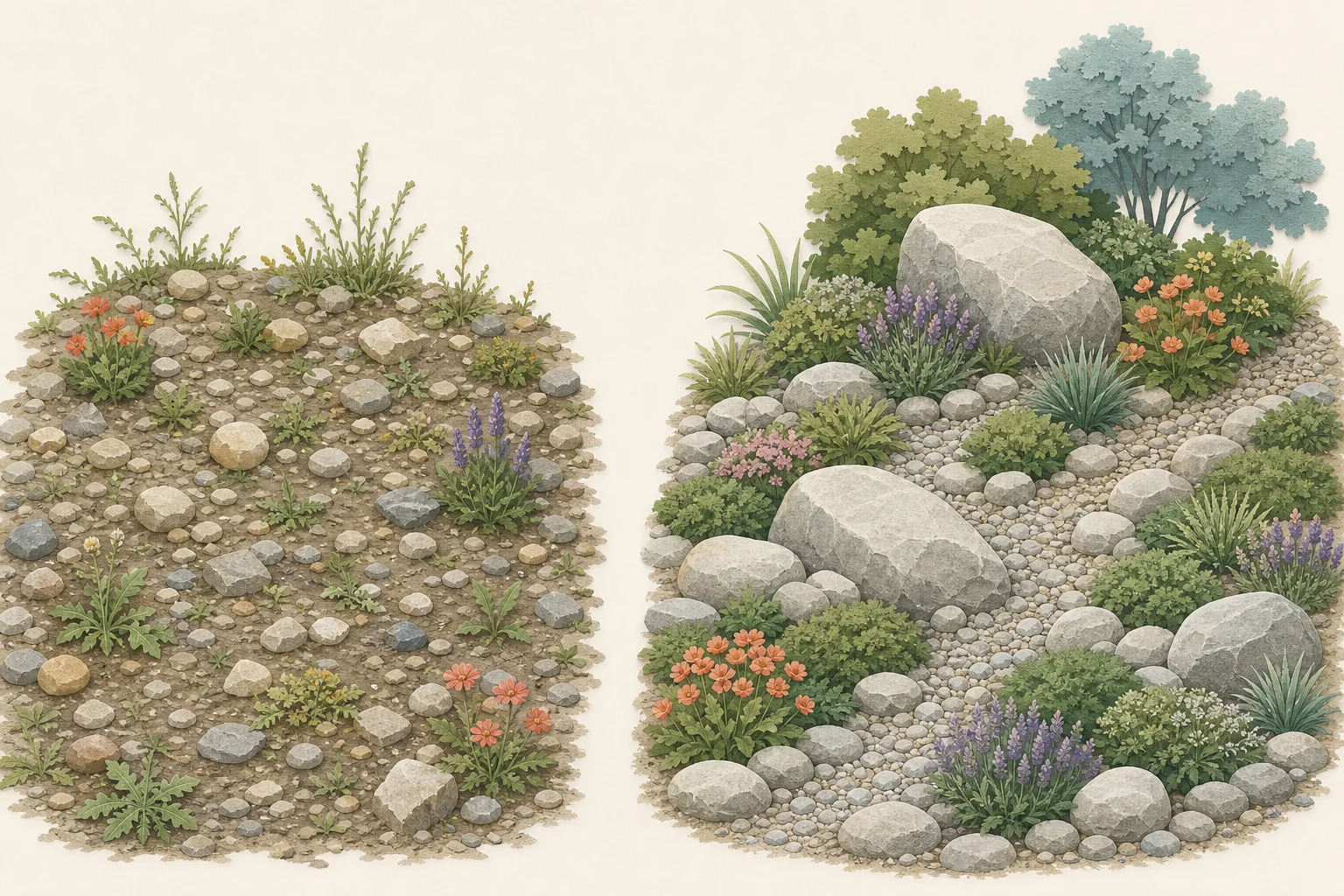
- Scattered objects
- One landform
On the scattered side, equal-sized rocks, isolated plants, and exposed gaps make every object feel separate. The layout has no clear beginning, direction, or resting point.
On the composed side, two anchor rocks lead the eye along the slope. Smaller stones support that line, while repeated plant masses cross several pockets and make the whole area feel connected.
Choose plant shapes before species
Choose the forms the composition needs before choosing species. The exact plants still depend on climate, soil, sun, moisture, and local invasive guidance.
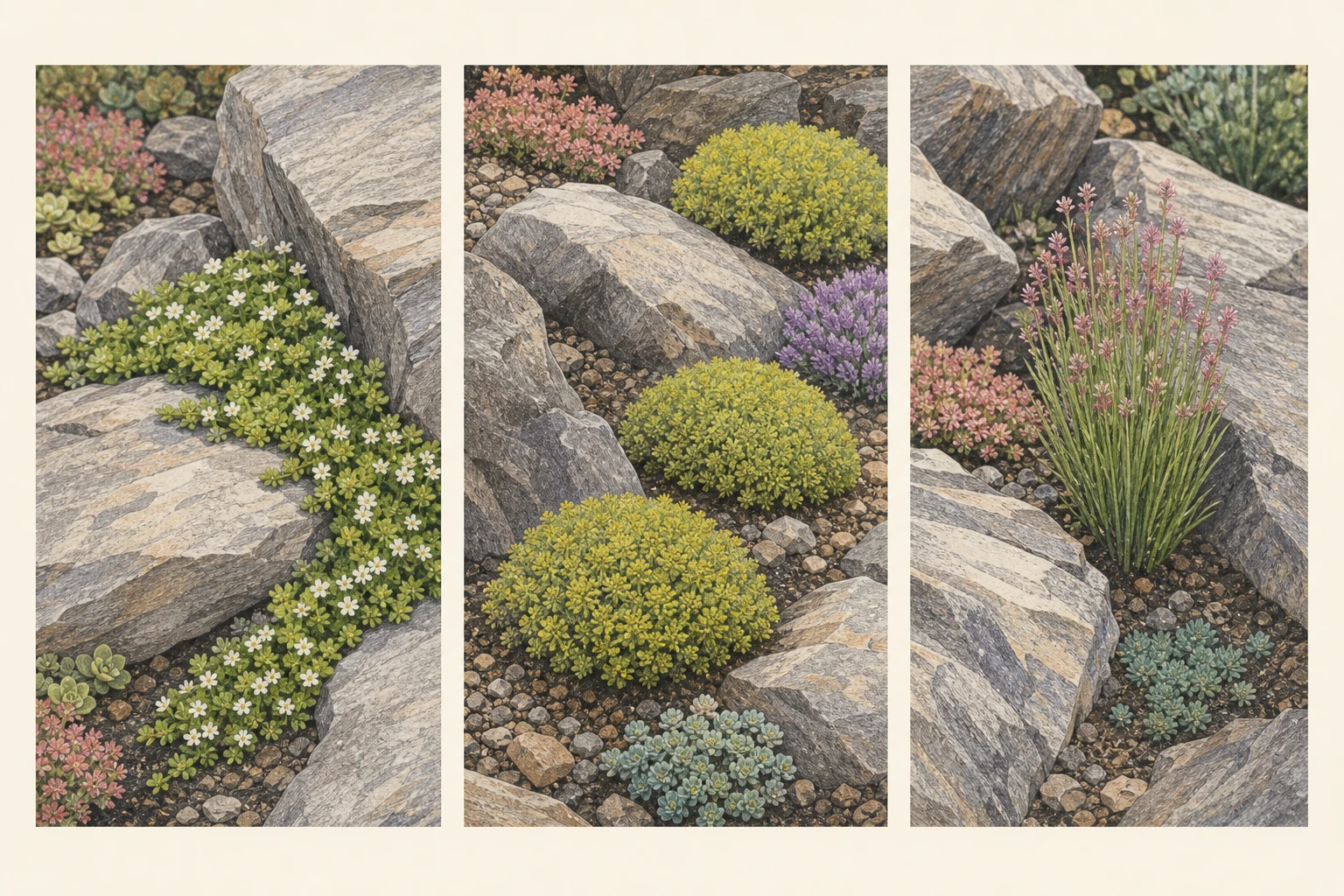
Low carpet
Connects the ground plane
A spreading or mat-forming plant covers selected soil pockets and softens one edge without swallowing every stone.
Mounding cushion
Provides the main rhythm
A compact rounded form repeats between anchors and remains legible from the main viewpoint.
Upright tuft
Adds height without bulk
A narrow grass-like or vertical form adds contrast at a few intentional points.
Verify mature spread, cold hardiness, drainage tolerance, establishment water, and invasive status with a local Extension office or knowledgeable nursery.
Plan for weeds, movement, and plant growth
Rock does not end maintenance. It changes the work and can make later corrections harder.
You can reach every pocket: Provide stepping or access points that do not require balancing on loose rock or compacting plant roots.
The soil stays covered: Use appropriate planted coverage or mulch in pockets rather than assuming stone alone prevents weeds.
Stone is not overheating the wrong plants: Exposed rock can increase heat around roots in some sites. Match mulch and plant choice to local conditions.
Aggressive spreaders are contained: Check how each plant moves by seed, runner, or root before putting it among difficult-to-move boulders.
A rock garden succeeds through editing, weed control, and plant replacement just like any other designed planting.
Frequently asked questions
Are rock gardens low maintenance?
They can reduce mowing and support plants adapted to dry, well-drained sites, but they still need weed control, editing, establishment water, and occasional replacement. Loose stone can also make access and later changes more difficult.
Should landscape fabric go under a rock garden?
Do not treat fabric as a universal answer. Soil, organic debris, spreading plants, drainage, and future planting all affect the choice. Ask a local professional about the assembly for your site and keep fabric away from places where plants need to spread or the soil needs amendment.
What plants belong in a rock garden?
Choose locally suitable plants by behavior first: low carpets, compact mounds, and a few upright tufts. Then verify hardiness, drainage, mature spread, water needs, and invasive status for your region.
 Gardenful
See whether a rock garden belongs in your yard.
Start with a photo that includes the slope, house, path, and existing drainage clues. Use Gardenful to explore the visual direction, then verify grading, stone placement, and exact plants locally.
Gardenful for iPhone
Download the app free and start with a photo of your yard.

Sources(3)
- [1]Rock Garden Plants
Colorado State University Extensionhttps://extension.colostate.edu/resource/rock-garden-plants/
- [2]Landscaping With Rock or Not?
Colorado State University Extension, Pueblo Countyhttps://pueblo.extension.colostate.edu/landscaping-with-rock-or-not/
- [3]