Gardenful field guide
Landscaping ideas for the front of a ranch house
The short answer
A ranch house already has a strong horizontal shape, so the landscape should balance it rather than disguise it. Make the front door easy to find, place one tree or tall shrub where it balances the house without blocking windows, and organize the rest into a few broad planted groups. Bring some beds forward for depth and avoid a continuous row of equal shrubs.
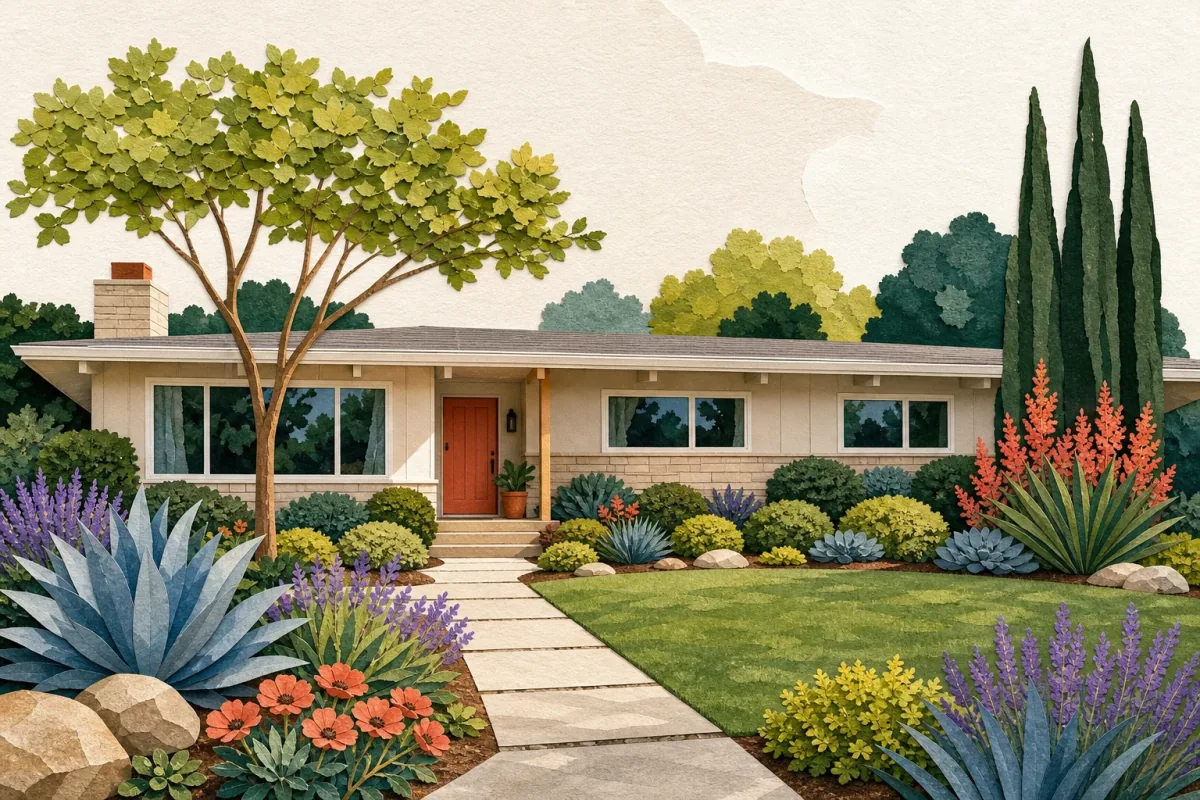
Read the front of the house from the street
Use a straight-on photograph and a simple measured sketch. The goal is to see the architecture before a row of nursery plants obscures it.
- 1
Find the visual center
Note whether the door, a picture window, chimney, garage, or roof projection currently attracts attention. Decide where a visitor should look first.
- 2
Mark windows and service access
Measure the space below windows and around meters, hose connections, vents, and maintenance routes. Nursery height is not the design height.
- 3
Trace the arrival route
Make the front walk and turn toward the door legible from the driveway and sidewalk. Planting should frame that movement rather than force a guess.
- 4
Choose one place for height
Locate a tree or taller planted group away from the center of the house so it balances the long roofline without screening the windows.
Replace the shrub row with a clear hierarchy
The familiar row of identical foundation shrubs emphasizes the full length of the house and often outgrows the windows. A few connected masses create depth without making the yard busy.
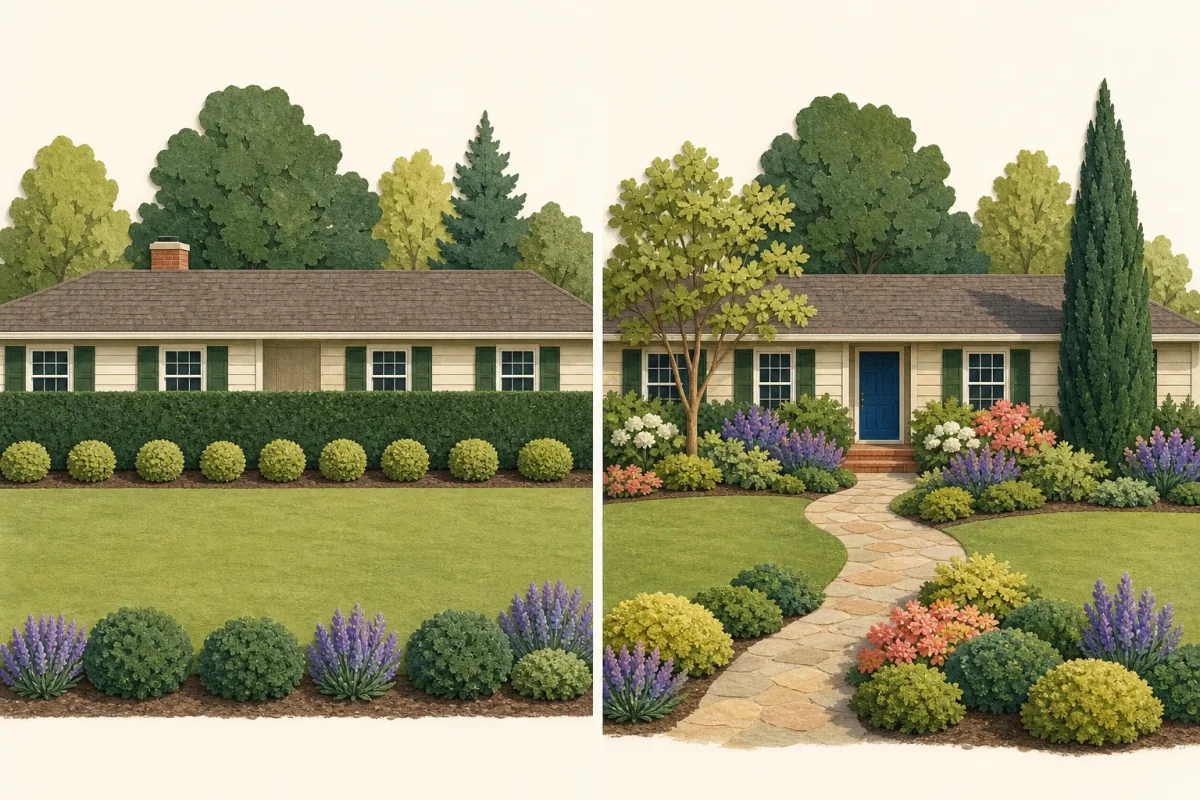
- Flat shrub row
- Clear hierarchy
| Layout | What it does | Why it can fail | Better move |
|---|---|---|---|
| Continuous hedge | What it doesCreates one strong horizontal line. | Why it can failCan make the house feel longer, hide the foundation uniformly, and demand frequent size control. | Better moveBreak the line at the entry and vary depth rather than height at every window. |
| Many specimens | What it doesDisplays several individually attractive plants. | Why it can failScattered singles compete for attention and often lose unity from the street. | Better moveRepeat fewer plant roles in larger visible groups. |
| Entry, anchor, and masses | What it doesCreates a visual destination and balances the long front of the house. | Why it can failRequires measuring mature size and leaving deliberate open space. | Better moveCheck the composition from the street, driveway, and front window. |
Sources: University of Florida IFAS Extension, University of Florida IFAS Extension
Build the front planting in four passes
Work from the largest spatial decision to the smallest. This keeps a long house from becoming a series of unrelated plant purchases.
A ranch house with an off-center door and wide picture window
The existing walk reaches the door, the lawn spans most of the foreground, and the planting bed is too narrow for the shrubs currently clipped below the window.
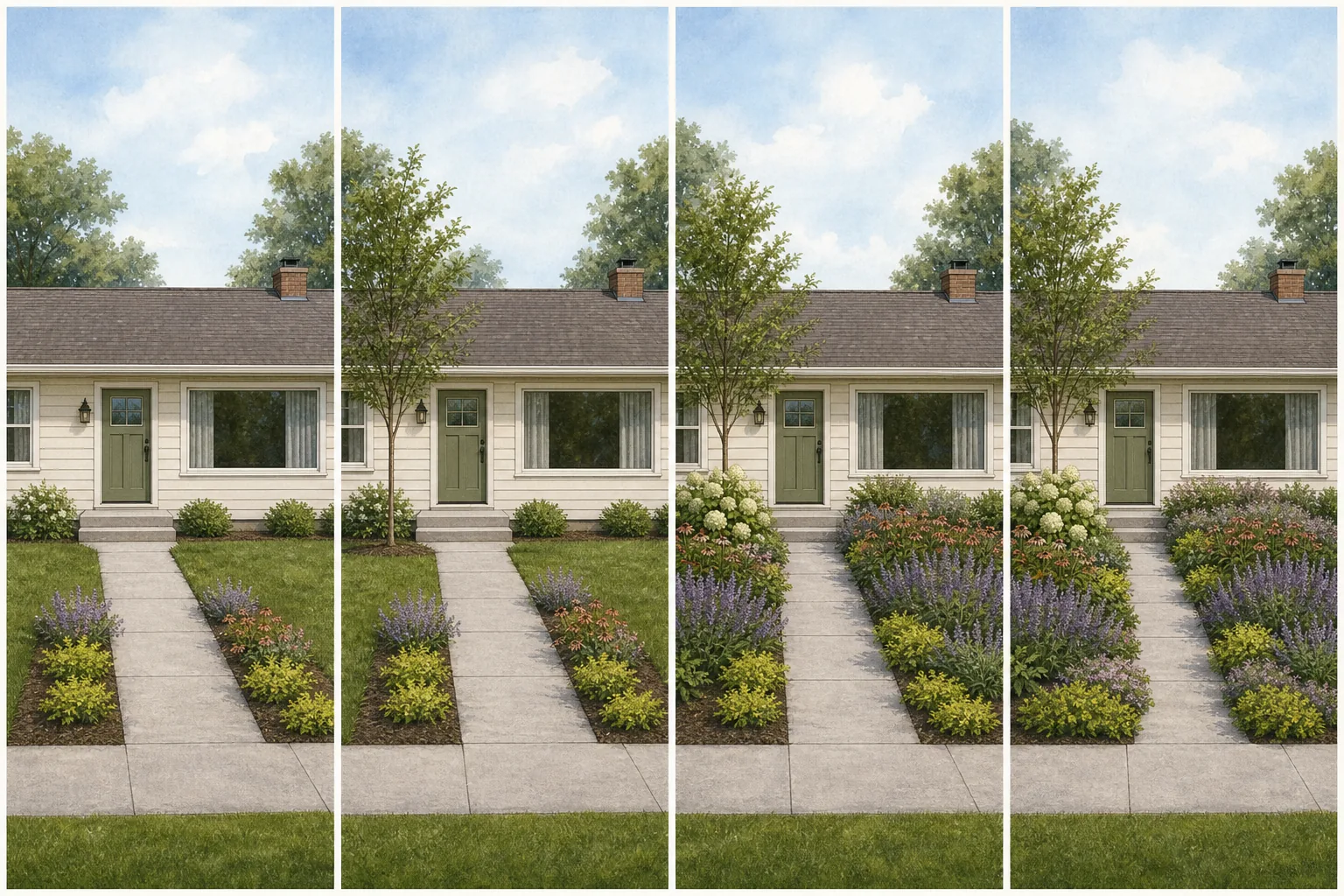
1
Clarify the entry
Widen or shape the planted opening around the walk so the door has breathing room and a repeated low layer guides the last part of the route.
2
Place the vertical anchor
Use a locally suitable small tree or taller shrub near one outer portion of the facade, with mature canopy, roots, utilities, and sightlines verified.
3
Create two broad masses
Repeat one structural shrub and one middle-layer plant in groups that relate across the entry instead of mirroring every plant exactly.
4
Keep the window layer low
Use a restrained groundcover or low perennial mass where the mature height truly fits, rather than relying on permanent shearing.
The architecture supplies the long line. Planting should add entry emphasis, depth, and one measured change in height rather than another unbroken stripe.
Check the design from four useful viewpoints
A front planting can work up close and still look unresolved from the places that matter most.
- From the street
- Confirm that the door reads clearly, the main masses are large enough to see, and the vertical anchor does not split the facade awkwardly.
- From the driveway
- Keep vehicle sightlines, the route to the door, trash or service access, and snow-storage needs clear where relevant.
- From inside
- Protect the view and daylight at picture windows. Frame useful views rather than placing every tall plant against the glass.
- At mature size
- Draw plant width and height over the measured facade. Verify foundation clearance, eaves, utilities, walks, and the long-term pruning burden.
Choose exact plants only after measuring the available height and width. A compact label is not a substitute for reliable mature dimensions in your climate.
Frequently asked questions
What looks good in front of a ranch house?
A clear front-door approach, one well-placed vertical anchor, a few broad repeated planting masses, and a low layer beneath windows usually work better than an unbroken row of equal shrubs. Exact plants depend on the site and region.
How do I make a ranch house look less long?
Do not repeat the roofline with a continuous hedge. Emphasize the entry, place one offset vertical anchor, and bring one or two planting masses forward to create depth across the facade.
Should foundation plants cover the foundation?
They can soften the transition between house and ground without forming a solid screen. Preserve inspection and maintenance access, respect the building, and choose mature sizes that fit below windows and away from utilities.
Where should a tree go in front of a ranch house?
Often an offset position near an outer portion of the facade provides useful vertical balance, but the exact location must account for mature canopy and roots, utilities, foundation clearance, road sightlines, and the view from windows.
Can Gardenful redesign ranch house foundation planting?
Gardenful can help you compare planting-led directions on a clear front photo. Verify exact plants, mature dimensions, utilities, building clearance, and any hardscape or drainage work locally.
 Gardenful
See a clearer front planting on your ranch house.
Use a straight-on photo that includes the full facade, entry walk, windows, and enough yard to judge the main planting masses.
Gardenful for iPhone
Download the app free and start with a photo of your yard.

Sources(3)
- [1]Residential Landscape Design
University of Florida IFAS Extensionhttps://edis.ifas.ufl.edu/publication/EP375/pdf
- [2]Landscape Design with Plants: Creating Outdoor Rooms
University of Florida IFAS Extensionhttps://ask.ifas.ufl.edu/publication/EP449
- [3]Drawing a Landscape Plan: The Base Map
University of Florida IFAS Extensionhttps://ask.ifas.ufl.edu/publication/EP456