Make a rose border feel complete
What to plant around roses
The short answer
Lower flowering plants can soften a rose border and keep it attractive between rose blooms. Catmint and hardy geranium are useful choices for suitable sunny beds; mealycup sage and compact globe amaranth offer summer color in warmer gardens. Choose plants that share your roses' light and watering needs, and leave the bases accessible for pruning, watering and clearing fallen leaves.

Look at the rose before filling the gaps
A rose with flowers high on bare stems needs a different neighbor from a broad shrub rose already touching the path. Look at the whole plant, including its expected mature shape. The best companion finishes the bed without taking over the space the rose needs.
Most roses need full sun and moist, well-drained soil. Choose companions that can live with that routine. Then check the exact rose variety's height, width and local performance: two plants sold as shrub roses can make very different-sized shrubs.1
For a climbing rose, leave a route to the support so you can tie in and prune the canes. Keep vigorous climbers and sprawling groundcovers out of that working space. If the rose is already crowded or in poor health, address that problem before adding another layer.
Compare an airy foreground with a leafier one
You can make a useful combination with one repeated companion. These two perennials offer an airy or a leafier foreground; for a long, hot summer, compare the seasonal options below.
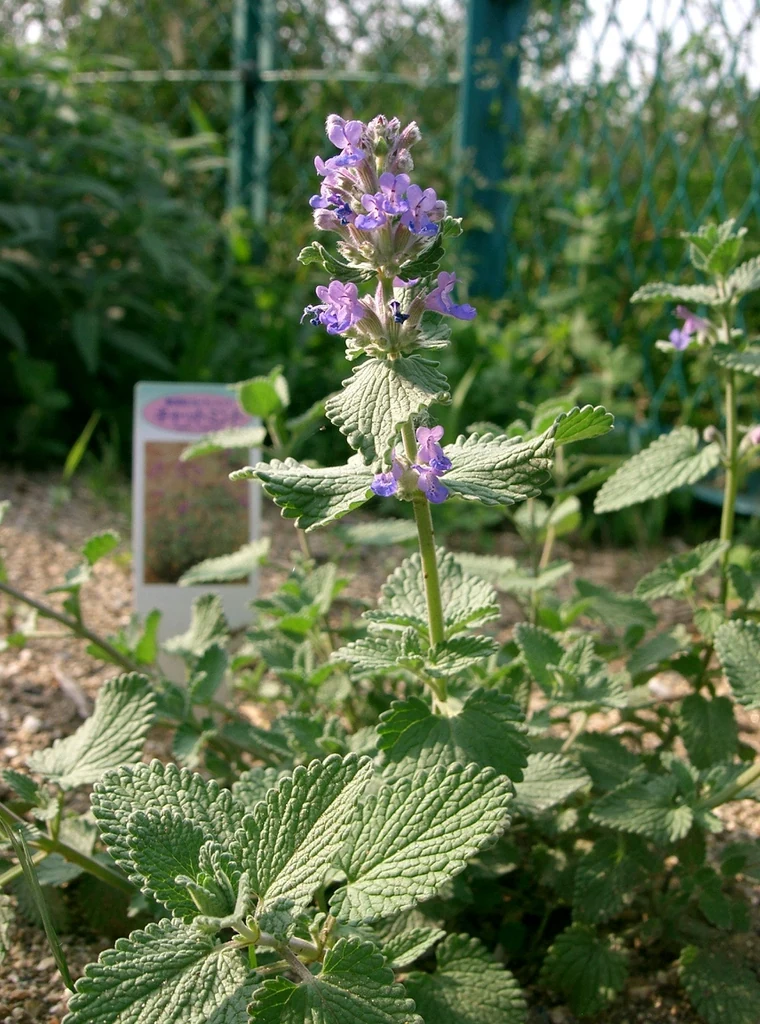
Catmint's finer flowering stems
The many small flowers make a softer, airier foreground. Choose a compact variety where the path leaves little room for spreading stems.
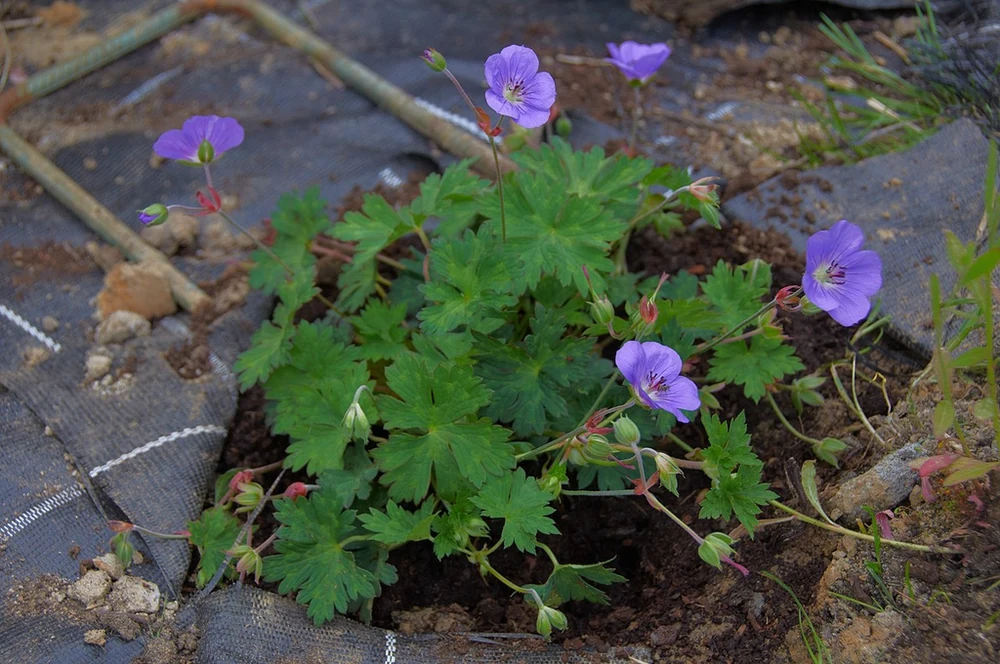
Hardy geranium's broader leaves
The divided leaves create a fuller-looking layer beneath the roses, with larger open flowers. Leave room for the stems to spread.
A soft blue-purple edge for a cooler-climate rose bed
Example: an upper Midwest or northeastern garden around zones 5–6, with locally hardy shrub roses, full sun and soil that drains well but receives regular moisture.
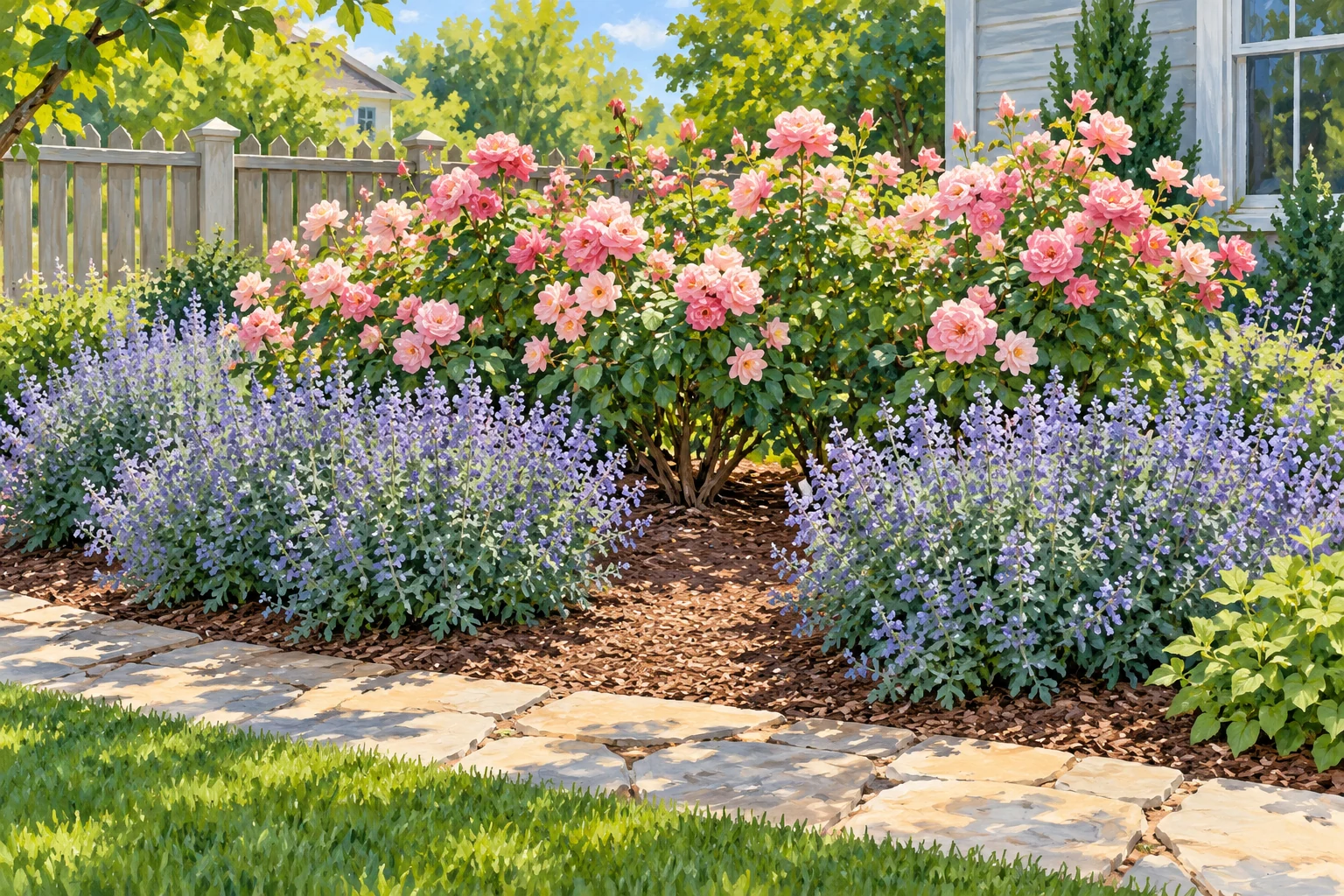
Use catmint (Nepeta × faassenii) for a loose blue-purple foreground. Choose a compact variety if the bed is shallow: some varieties can spread about 3 feet wide, so a small pot doesn't mean a small mature plant. Keep its foliage away from the rose's base, and shear it after flowering if needed to refresh the shape.3
Hardy geranium 'Rozanne' is another option for a low, spreading layer, with violet-blue flowers and divided leaves. It grows in sun or part shade with good drainage and moisture. Its long stems need space, so use a drift beside the roses rather than wedging one into every gap.4
Pick catmint for an airier foreground or geranium for a leafier one. In a deeper bed you can use separate groups of both, but repeating one plant along the visible front often gives a small rose border a clearer shape. Check that the rose itself is winter-hardy for your location before copying the combination.
A flowering foreground for a long, hot summer
Example: a sunny southeastern rose bed with well-drained soil, watering during dry periods and locally suitable shrub roses. The companions can be grown as seasonal color where frost ends their display.
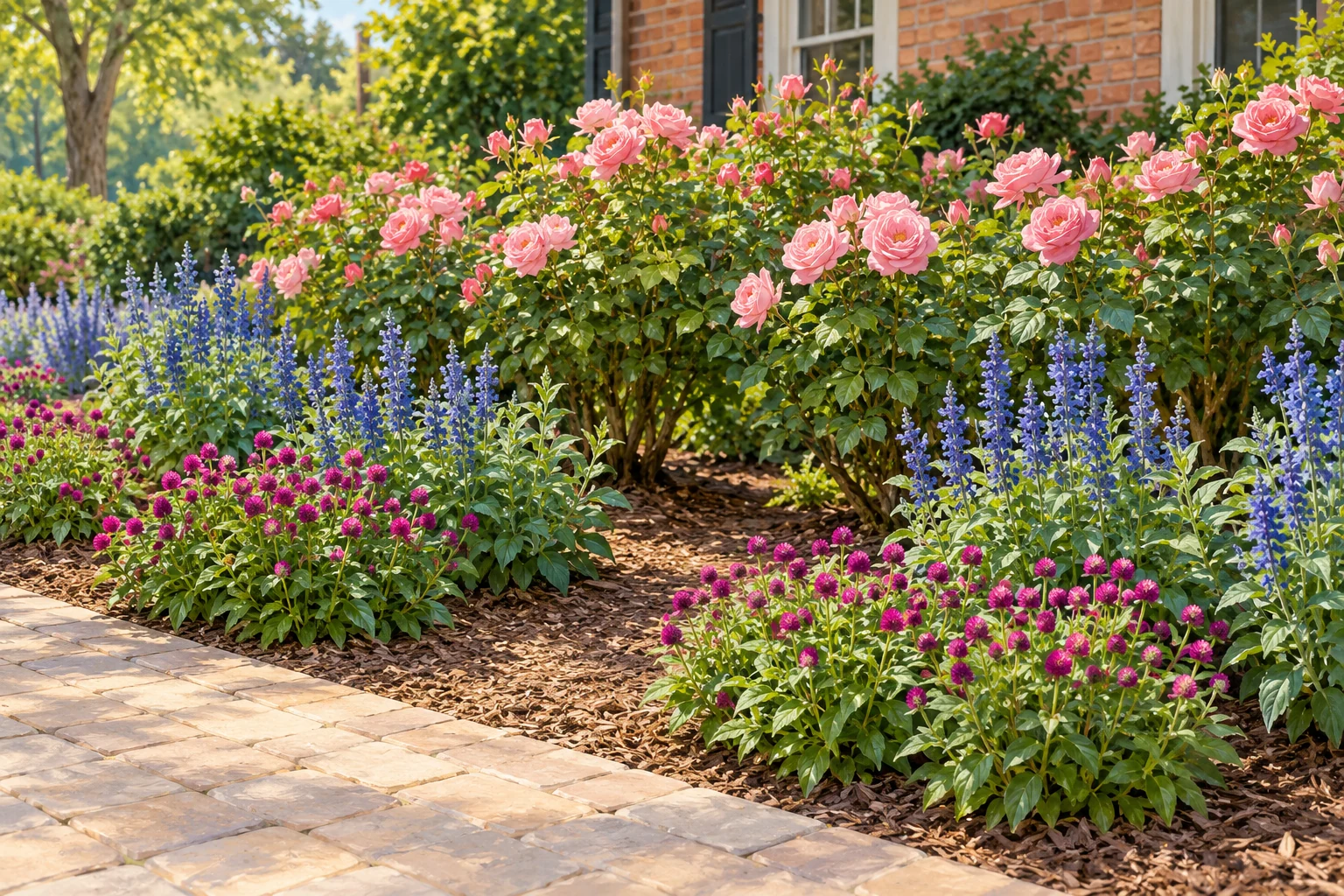
Mealycup sage (Salvia farinacea) adds narrow blue flower spikes beside the roses' rounder blooms. It handles heat and grows well in sunny, well-drained soil. Choose a variety whose height stays below the rose display; use the nursery label rather than assuming every salvia is the same size.5
Compact globe amaranth (Gomphrena globosa), such as the low Buddy series, offers a different foreground: small round flowerheads on shorter plants. It needs sun and drainage and tolerates heat. Keep the tall, airy types for places where their height is useful instead of substituting them blindly for a low edge.6
Try one companion in a short repeated group first. If you use both, keep them in distinct patches so the flower shapes are easy to see. Seasonal plants let you change the color next year, but they also mean replacement planting and establishment watering; they won't provide a permanent winter border.
Leave a way to reach the rose after everything grows
Set out the mature shapes before you decide how many companions to buy. In a very shallow bed, one low repeated companion or a clear mulched edge may fit better than a mixed border.
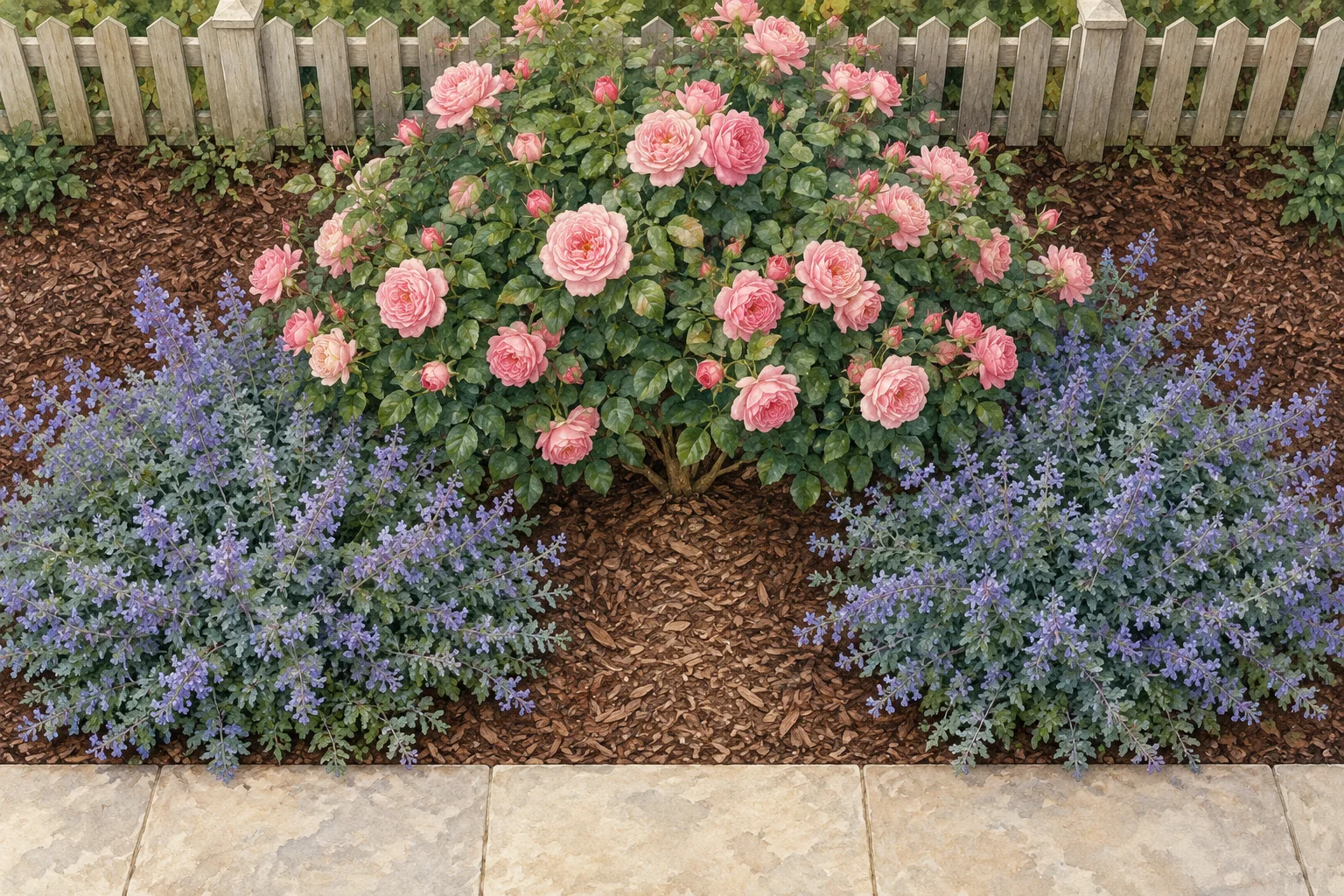
A rose and a lower companion
Suppose your rose variety is expected to reach 4 feet wide and the chosen companion 2 feet wide.
- 1
Start with the mature outlines
Half the rose's width is 2 feet and half the companion's width is 1 foot. Their centers would be 3 feet apart if the mature outlines just met. Add the room needed for airflow and access.
- 2
Add room for air and maintenance
Leave more space where the variety or humid conditions call for it. Keep a mulched opening from the accessible edge so you can reach the rose without standing on other plants.
- 3
Put companions where you see the gap
A front sweep can soften bare stems from the path without making a complete ring around the shrub. With a climbing rose, place the lower group to one side so the support remains reachable.
Avoid hiding a rose-care problem under more planting
Crowded foliage can limit air movement and make care harder. Keep fallen leaves and suspect growth visible enough to inspect and remove when needed. A dense companion planting isn't a substitute for choosing a suitable rose and managing its health.2
Be cautious with lavender in a regularly watered rose bed. The flowers can look lovely together, but the plants may need different moisture conditions. Choose for the care routine you actually have. Avoid vigorous groundcovers that spread into the rose's base, and don't cut major established roots to fit another plant.
Once you have a promising combination, photograph the roses and the open bed around them. Tell Gardenful what you want to keep and whether you prefer a soft blue foreground, a tidy low edge or brighter summer flowers. Compare the planting idea with the available space, then use the suggested plants and quantities to start your nursery shortlist.
Frequently asked questions
What can I plant in front of roses?
Lower catmint or hardy geranium can soften the front of a suitable sunny rose bed. For summer color in warmer gardens, consider a compact mealycup sage or globe amaranth variety. Check mature size, shared watering needs and room for care before buying.
Can I plant directly under a rose bush?
Use open soil around the rose without crowding its base or damaging established roots. A group toward the front or side can hide bare stems from the main viewpoint while keeping the shrub accessible. A complete carpet underneath can make inspection, watering and leaf cleanup harder.
How far from a rose should I plant companions?
Start with the mature widths of both plants, then allow extra room for air movement and maintenance. There isn't one correct trunk-to-plant distance for a miniature rose, broad shrub rose and climber. Sketch the mature outlines and keep an access opening.
Will companion plants stop aphids or rose diseases?
Don't rely on them to do that. Choose companions for compatible care and a border you enjoy, while continuing to inspect the roses and follow local pest and disease guidance. Crowding the bed can make airflow and treatment access worse.
 Gardenful
Picture a rose border that feels complete.
Keep the roses you love and explore the planting around them in Gardenful. Start with your yard photo, then take a locally checked plant shortlist to the nursery.
Gardenful for iPhone
Download the app free and start with a photo of your yard.

Sources(8)
- [1]How to Select and Use Roses in Garden
Iowa State University Extension and Outreachhttps://yardandgarden.extension.iastate.edu/how-to/how-select-and-use-roses-garden
- [2]Planting roses
Illinois Extensionhttps://extension.illinois.edu/roses/planting
- [3]Blue catmint
NC State Extensionhttps://plants.ces.ncsu.edu/plants/nepeta-x-faassenii/
Photograph by KENPEI, CC BY-SA 4.0; converted to WebP; shown without cropping.
- [4]Geranium 'Rozanne'
NC State Extensionhttps://plants.ces.ncsu.edu/plants/geranium-rozanne/
Photograph by Wouter Hagens, CC BY-SA 3.0; resized and converted to WebP, with responsive cropping.
- [5]Mealycup sage
NC State Extensionhttps://plants.ces.ncsu.edu/plants/salvia-farinacea/
- [6]Globe amaranth
NC State Extensionhttps://plants.ces.ncsu.edu/plants/gomphrena-globosa/
- [7]
- [8]