Boundary planting
Fence line landscaping ideas with room to mature
The short answer
A works when it leaves enough room to inspect and maintain the fence, keeps gates and neighbor-side growth clear, and repeats a few plants along the long view. Measure mature width from the fence, observe the changing sun and moisture, and decide whether the job is softening, screening, flowering, or circulation before choosing plants.
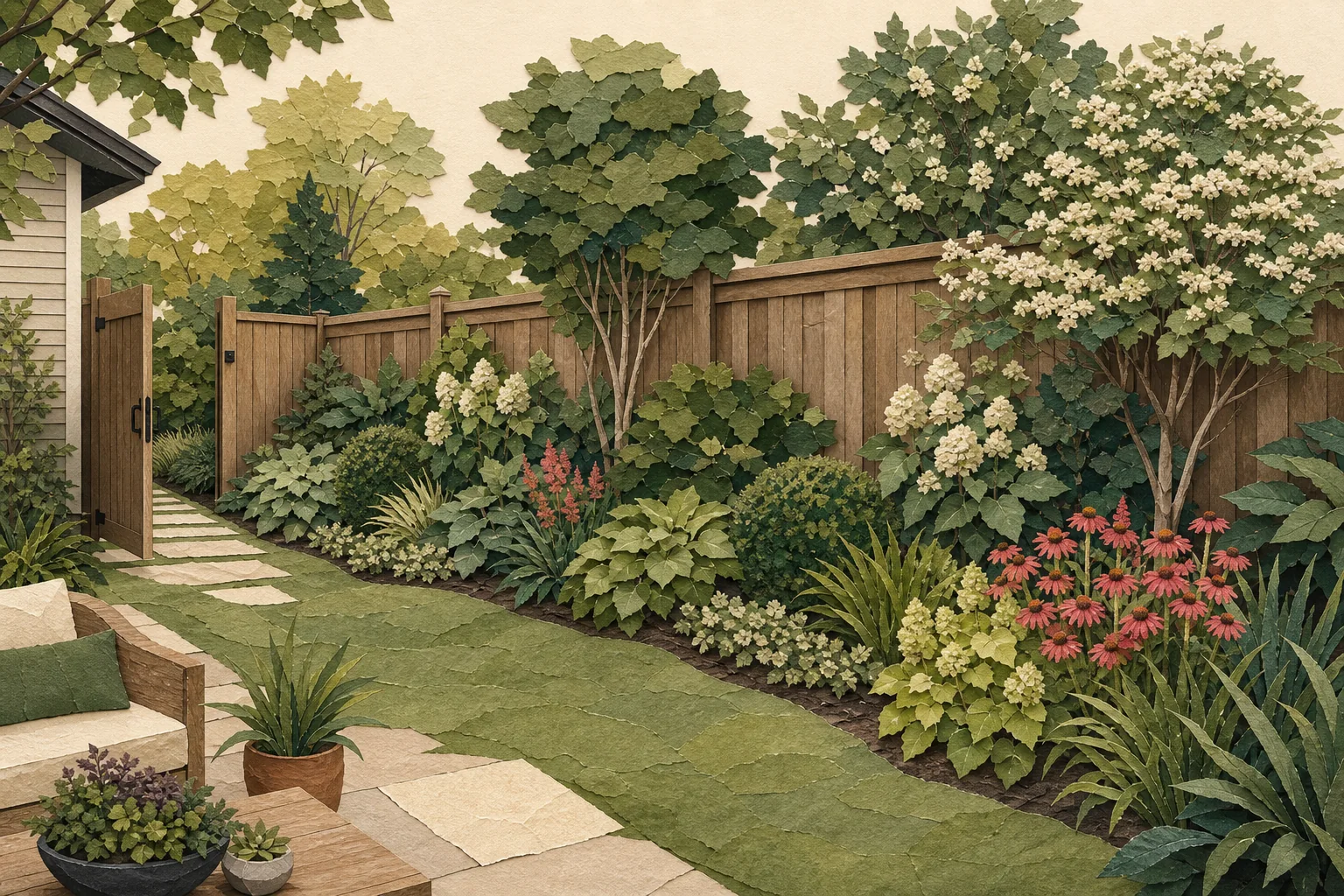
Decide what the fence line needs to do
A boundary can support several outcomes, but one should lead. Otherwise the long bed becomes a sequence of unrelated fixes.
Soften the fence
Best when privacy already exists
Use repeated mounding foliage and a few vertical accents so the structure recedes without becoming completely hidden.
Improve privacy
Best for one or two exposed views
Map the exact sightline and place enough mature height only where it interrupts that view. A fence-line bed is not automatically a full privacy screen.
Create a flowering border
Best for a visible garden edge
Build a sequence of persistent foliage, repeated perennials, and seasonal events instead of choosing one different flower for every section.
Protect a route
Best beside a frequently used boundary
Use planting to define a path, gate, play edge, or service corridor while keeping the working width open.
Draw the mature width from the fence
The nursery pot is not the setback. The plant must fit when branches, flowers, and maintenance access are all at their fullest.
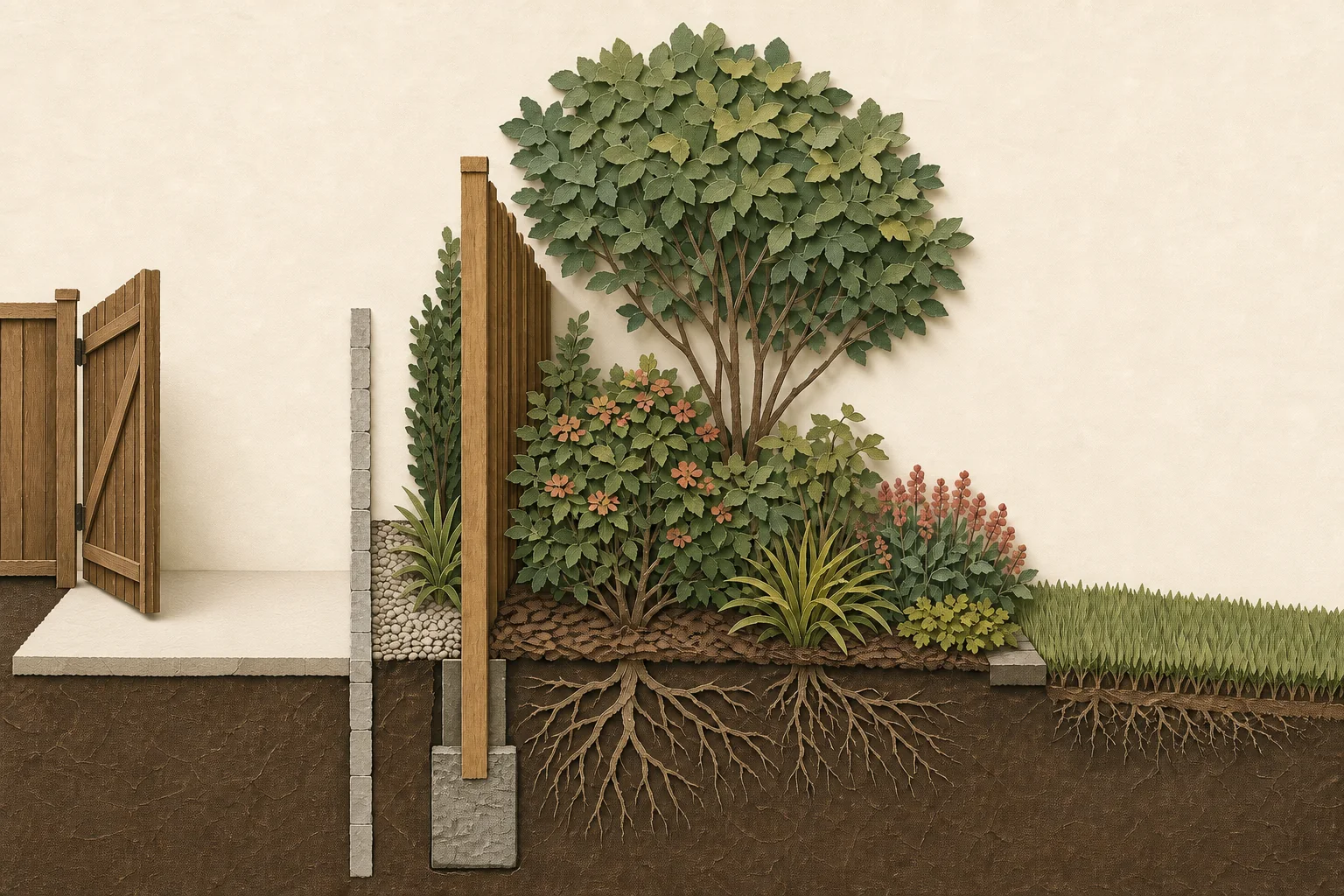
- Fence access
- Mature plant mass
- Open route
Mark the property line, fence posts, gates, hinges, latches, utilities, drains, and any section that needs painting, repair, or inspection. Then draw each exact plant at mature width, leaving the working access the fence actually requires.3,1
Observe both sides of the bed after rain and through the day. Fences can create shade, reflected heat, wind shelter, or a drier pocket, but the pattern depends on orientation, material, gaps, roof lines, and neighboring plants. Measure the site instead of assuming every fence line is dry shade.
Do not let a suggested plant cross the property line by design. Ownership, pruning rights, fence responsibility, and boundary rules vary; use a survey or local advice when the line is uncertain.
Repeat a few plant roles along the fence
Long, narrow beds magnify random spacing. A short role-based palette creates rhythm without becoming a hedge.
Repeat the main mass across the run; concentrate variety at gates, corners, and viewpoints.
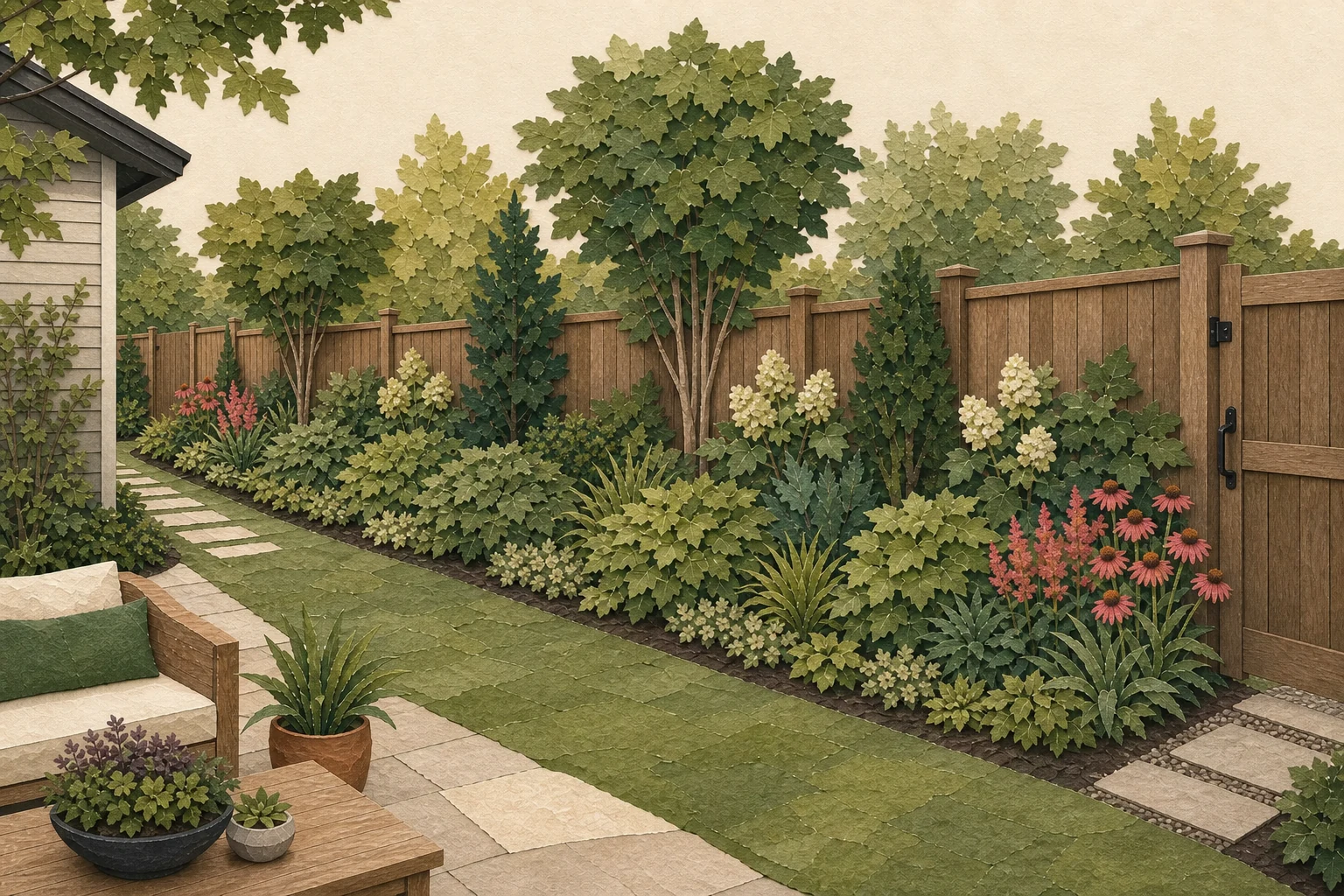
- 1
Background structure
Use where the bed has sufficient depth
A few upright or spreading forms organize the fence without filling every foot at the same height.
- 2
Main repeated mass
Use as the visual connector
Repeat one mounding shrub, grass-like plant, or durable perennial in broad groups along the run.
- 3
Seasonal group
Use near views and pauses
Two or three concentrated flower groups create a sequence without scattering color evenly.
- 4
Low route edge
Use only where the boundary needs clarity
A restrained ground layer separates the bed from path or lawn while preserving access.
Prairie dropseed, little bluestem, and switchgrass illustrate different grass habits in one sunny Illinois reference. Growth and self-seeding vary by species, variety, and site, so choose a locally appropriate plant and check current regional invasive guidance.
Sources: University of Florida IFAS Extension, Colorado State University Extension, USDA National Invasive Species Information Center, University of Illinois Extension
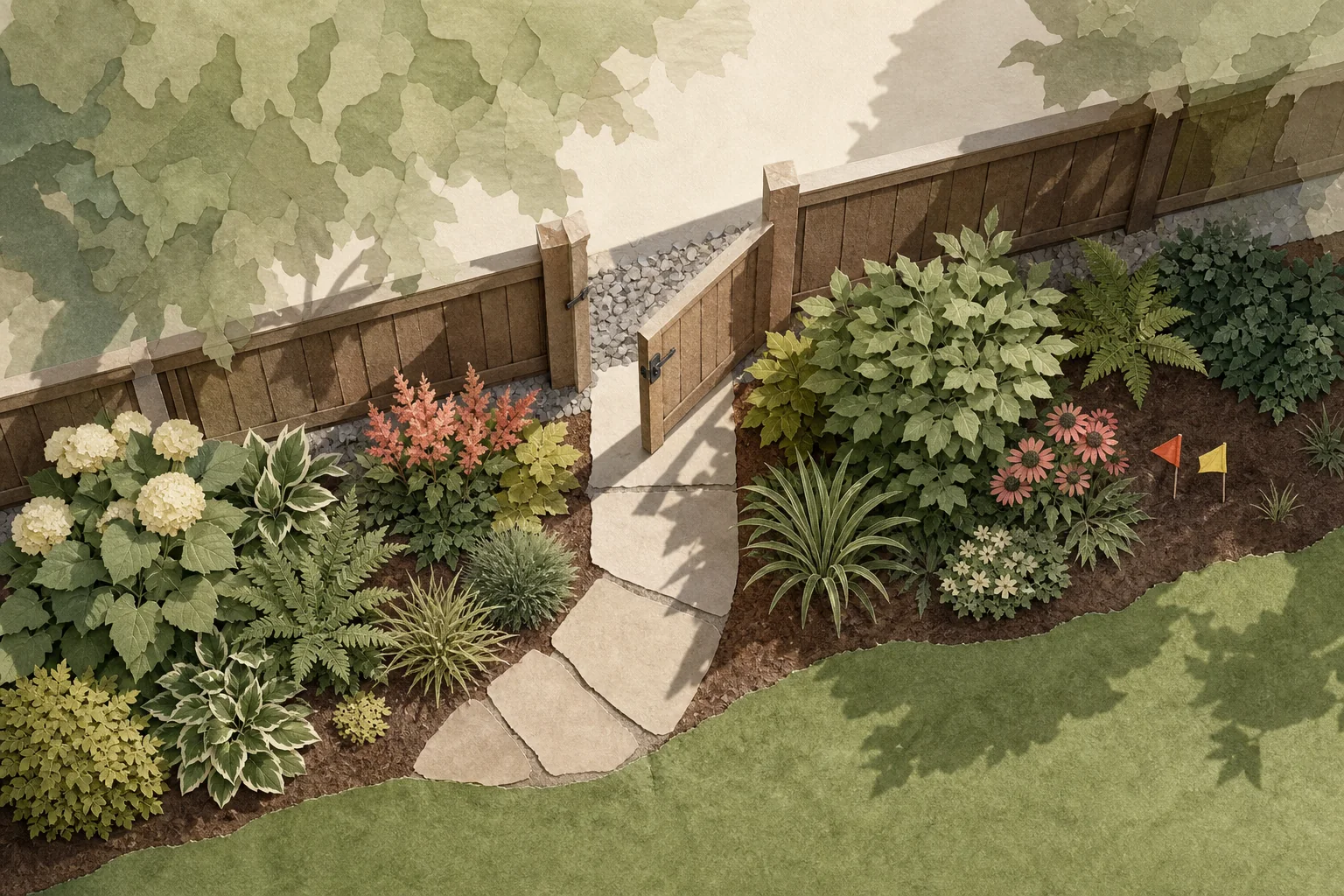
Plan planting around a partly shaded gate
This example softens the boundary while keeping the gate, maintenance route, and neighboring property clear.
A partly shaded backyard boundary
The gate sits near the house, midday sun reaches the far half, and a patio views the whole fence at an angle.
- 1
Keep the gate bay open
Reserve the full swing, latch access, and a clear landing on both sides before planting.
- 2
Use a few background moments
Place larger forms at the far corner and selected interior points rather than creating a continuous wall.
- 3
Repeat the main mass through the run
If the light changes, use different plants with a similar mounding form and foliage value. Let mature width determine the final quantity.
- 4
Put the brightest seasonal group near the patio view
Concentrate detail where people pause, leaving the far run simpler and easier to maintain.
The fence disappears visually because the planting has depth and rhythm, not because every board is covered.
Check the fence line before planting
A good plan respects the structure, property line, site conditions, and future maintenance.
The boundary is known: The fence and property line are not assumed to be the same, and neighbor-side growth is not part of the plan.
The fence remains serviceable: Posts, panels, hinges, latches, paint surfaces, drains, and utilities can still be reached.
Mature width fits: Exact plant outlines stay inside the planting envelope without constant shearing.
The microclimate is measured: Light and moisture were observed along the full run instead of assigned from one end.
Utilities and invasive status are checked: Contact 811 before digging and verify every plant against current local invasive guidance.
Frequently asked questions
How far should plants be from a fence?
Use the exact plant's mature radius plus the access needed to inspect or maintain that fence. A plant expected to spread six feet cannot be treated like its one-foot nursery pot.
What is the difference between fence-line landscaping and privacy landscaping?
Fence-line landscaping may soften, flower, or organize a boundary. Privacy landscaping starts with a specific sightline and adds enough height and density only where that view needs interruption.
Should I use the same plants along the whole fence?
Repeat one main plant form, but do not force one species through incompatible sun, moisture, or soil. Where conditions change, use plants with similar height, mass, and foliage value so the rhythm remains legible.
How do I landscape a fence that changes from sun to shade?
Observe the run in sections and keep the shared design cue at the level of form, foliage value, or repeated grouping. Exact plants can change with the exposure while the overall rhythm stays consistent.
 Gardenful
Leave room for the fence and the plants.
Choose the boundary job, draw the mature envelope, protect the gate and access, then repeat one useful plant rhythm through the run.
Gardenful for iPhone
Download the app free and start with a photo of your yard.

How this guide was built
The page distinguishes a general fence-line border from a dedicated privacy screen.
Extension design guidance supports mature-size planning, repetition, groups, access, and environmental fit.
Property, fence, and pruning law is intentionally not summarized because it varies. The guide offers practical checks rather than legal conclusions.
Sources(7)
- [1]
- [2]Landscape Design: Arranging Plants in the Landscape
University of Florida IFAS Extensionhttps://ask.ifas.ufl.edu/publication/EP449
- [3]Landscape Design: Drawing a Planting Plan
University of Florida IFAS Extensionhttps://ask.ifas.ufl.edu/publication/EP456
- [4]Perennial Gardening
Colorado State University Extensionhttps://extension.colostate.edu/resource/perennial-gardening/
- [5]Landscaping With Native Grasses
University of Illinois Extensionhttps://extension.illinois.edu/blogs/garden-scoop/2020-06-13-landscaping-native-grasses
- [6]Species Lists
USDA National Invasive Species Information Centerhttps://www.invasivespeciesinfo.gov/subject/lists
- [7]811 Before You Dig
Common Ground Alliancehttps://811beforeyoudig.com/Before-You-Dig/