Entry planting
Front porch landscaping ideas that make the entrance clearer
The short answer
The front porch is an arrival space, so its planting should clarify the threshold rather than crowd it. Keep the door, steps, handrails, lights, and house number visible; place permanent structure in the ground; use containers for movable seasonal emphasis; and repeat one color or foliage shape across both.
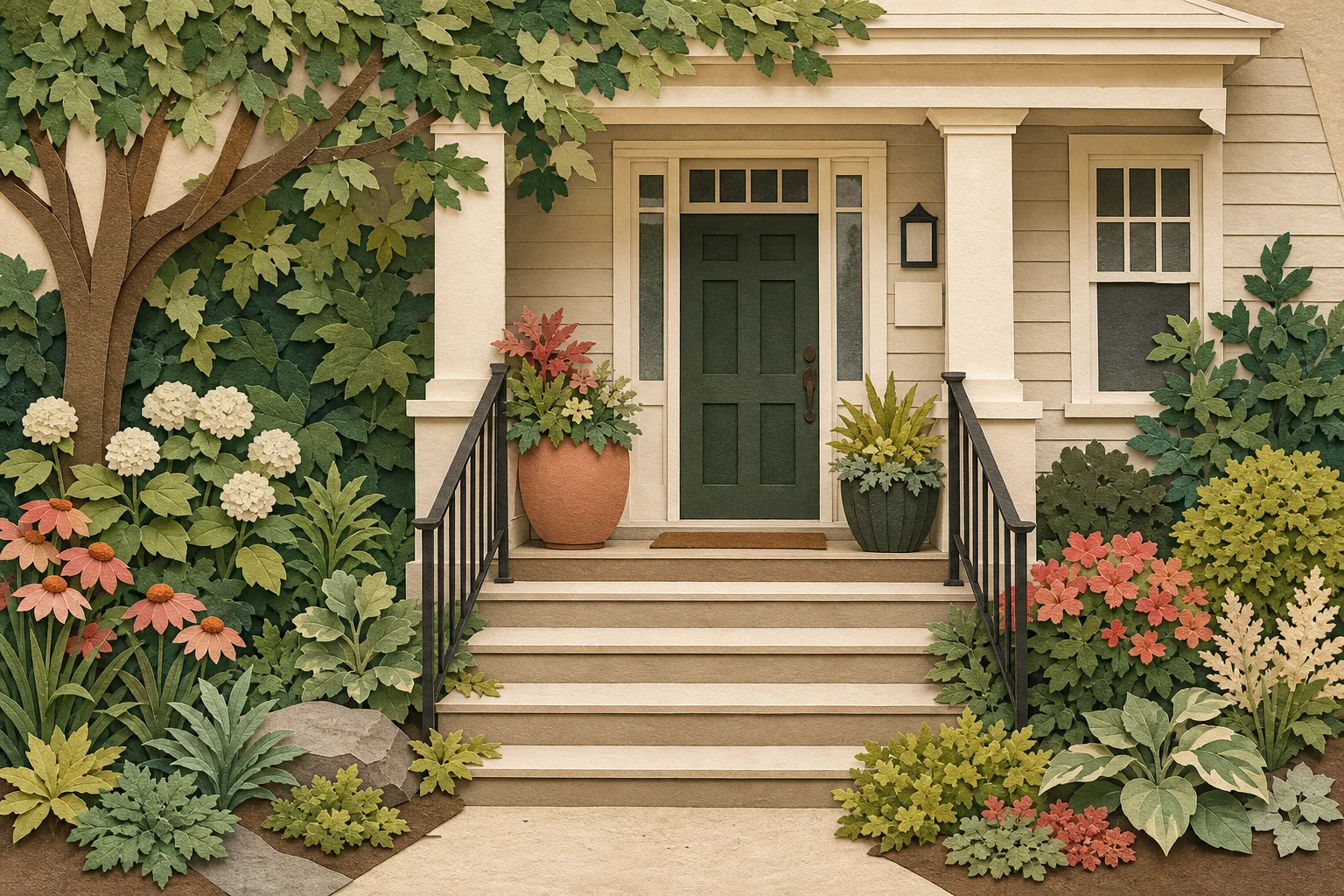
Draw the clear arrival zone first
The most useful porch design starts with everything that should remain easy to see, reach, open, and walk past.
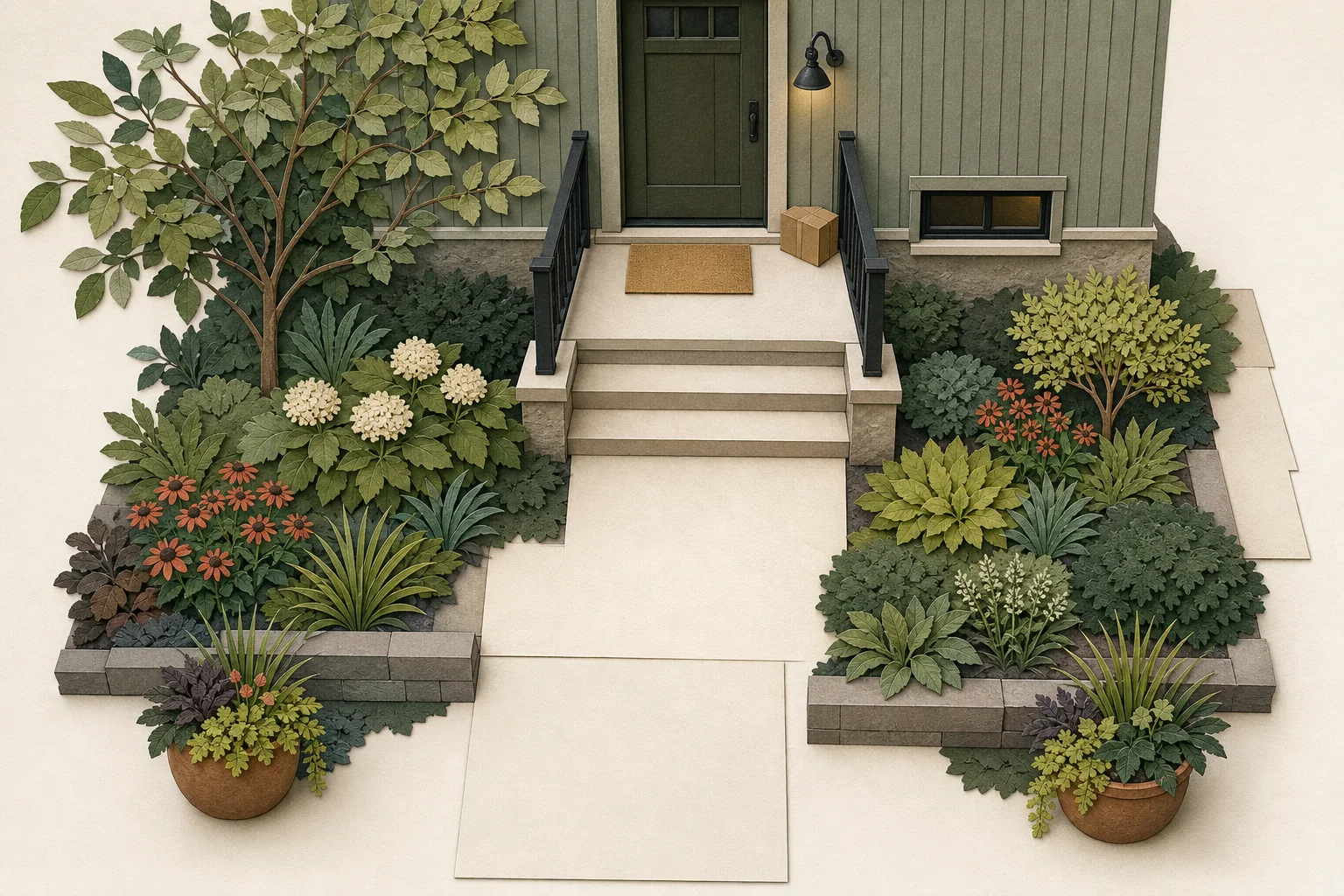
- Keep visible
- Keep walkable
- Plant outside the route
From the sidewalk, mark the front door, first step, handrails, door swing, light, address, mailbox or package area, and the route a visitor actually takes. Use planting to frame those features rather than filling every empty corner.1,2
Then check the view from inside. A plant that looks small from the street may block a low window, cover a railing, scrape a person on the steps, or hide the porch light at mature size.
Put permanent structure in the ground and changeable emphasis in pots
Beds and containers can share a palette, but they have different root space, watering, winter, and maintenance realities.
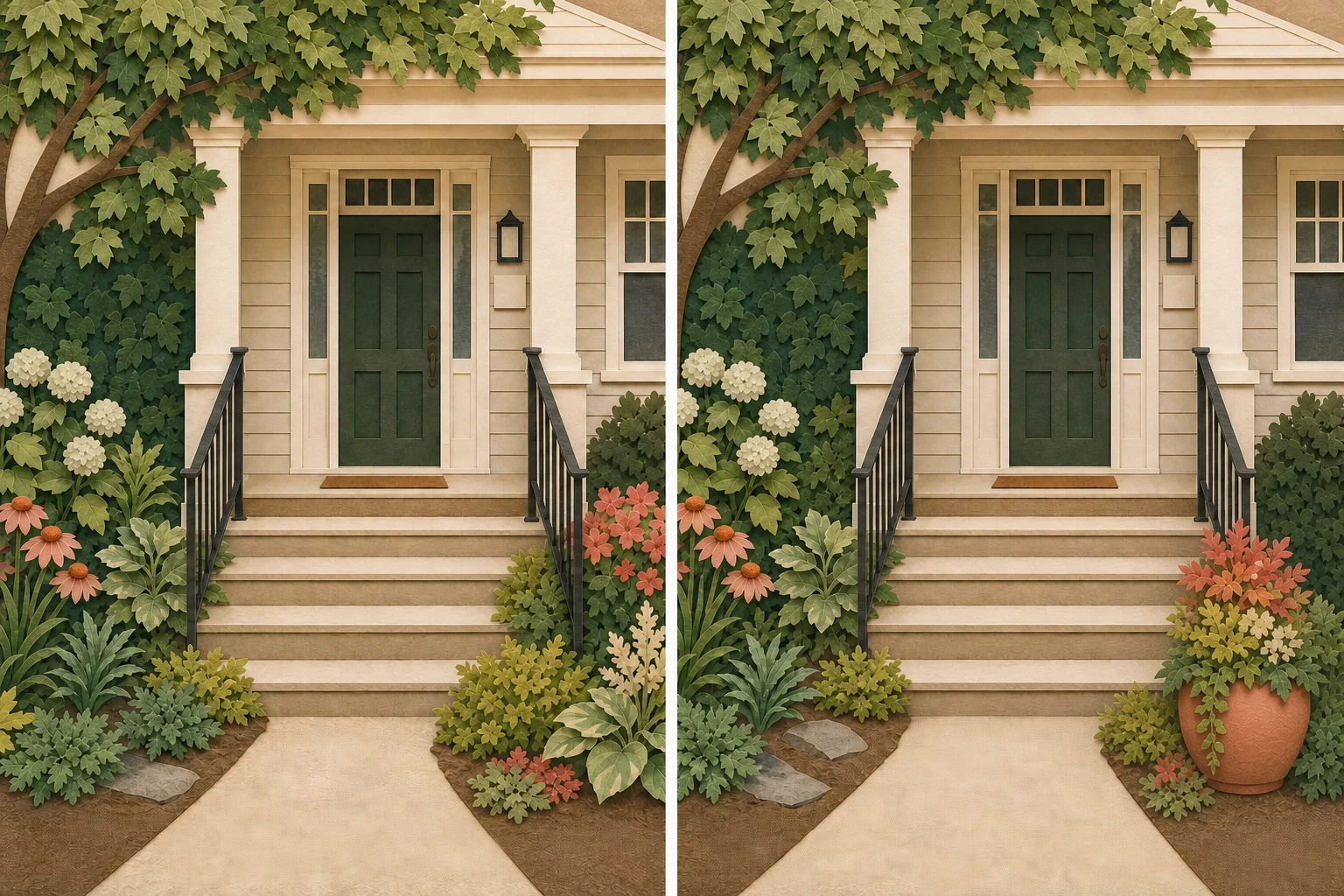
- Permanent structure in the ground
- Changeable emphasis in one pot
| Planting place | Use it for | Main tradeoff | Verify first |
|---|---|---|---|
| In-ground porch bed | Use it forPermanent structure and a low connective layer | Main tradeoffMust fit the house and route at maturity | Verify firstLight, mature width, utilities, roof water |
| Large porch container | Use it forOne seasonal focus or movable foliage mass | Main tradeoffDries faster and needs seasonal care | Verify firstDrainage, weight, stability, compatible plants |
| Small accent pot | Use it forA brief color echo on a broad landing | Main tradeoffCan make the approach look cluttered and dries fastest | Verify firstClear step, landing, and door route |
Sources: NC State Extension, University of Missouri Extension, Penn State Extension
Use thriller, filler, and spiller as container roles
The familiar three-part recipe is useful when the plants share light, water, temperature, and root-space needs. Check every candidate for toxicity and local invasive status.
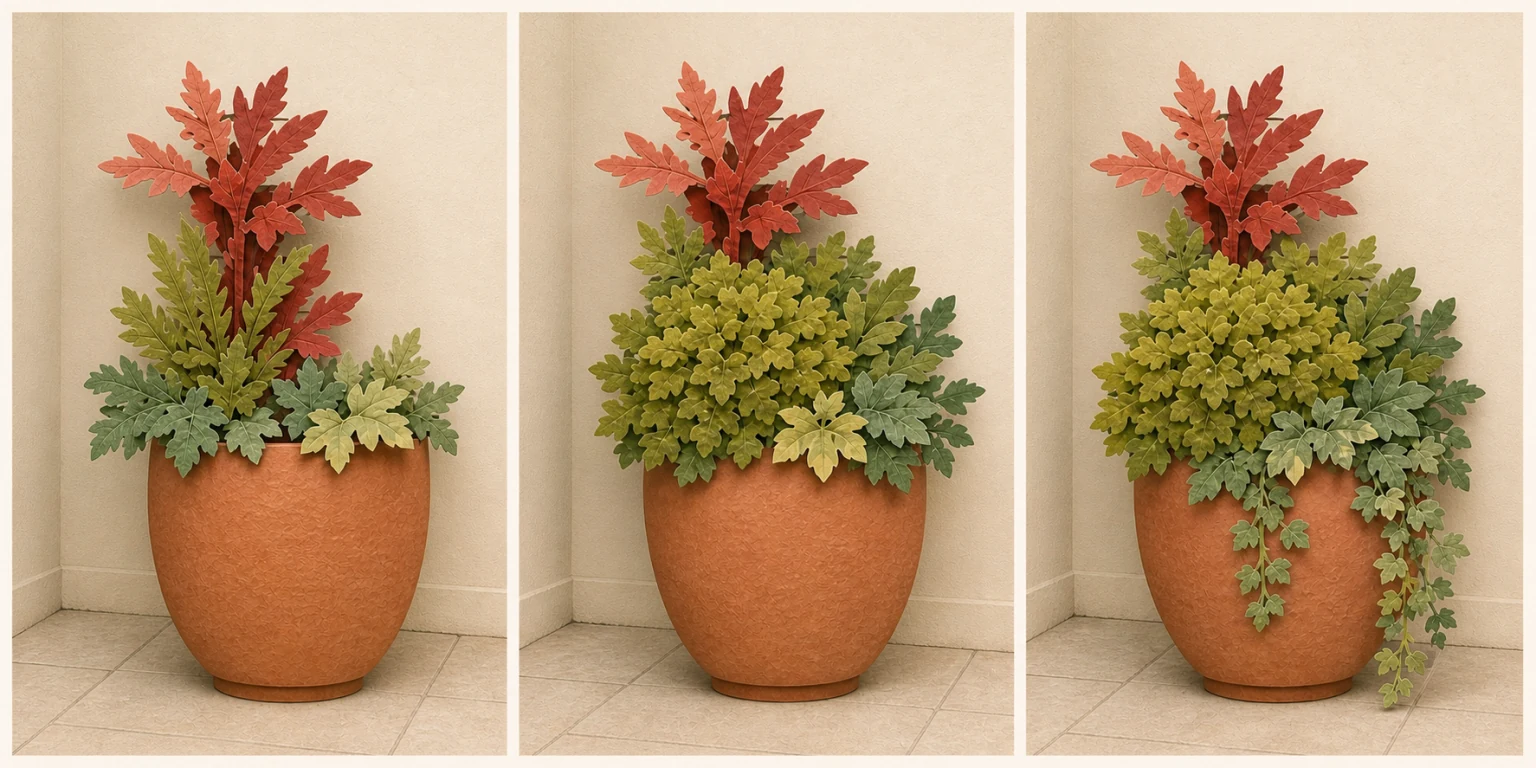
Thriller: establish the focal form
One clear lead
Use one upright, sculptural, or strongly contrasting plant. Penn State examples include canna, caladium, and tall ornamental grasses.
Filler: make the main mass
A readable middle
Use one or two mounding plants to connect the focal form to the rim and carry most of the visual volume. Coleus is one named example, with varieties for different light levels.
Spiller: soften the rim selectively
A grounded edge
Trailing petunia or sweet potato vine can soften one safe section of the rim. A pot does not require a spiller on every side.
Plan a porch with one sunny and one shaded side
This example uses form and repetition instead of forcing matching plant recipes into two different exposures.
A centered door with asymmetrical light
The left side receives afternoon sun. The right side sits under a deeper roof and stays brighter shade. Both sides are visible from the street.
- Repeat the containers, not the exact plants
- Use the same pot shape and color on both sides, then choose different plants for the two exposures. Repeat a foliage color or plant form so the pots relate without forcing incompatible plants to match.
- Repeat one visual cue
- Echo a chartreuse leaf, burgundy accent, or soft white flower so the two different recipes still feel related.
- Keep the sunny side lower near the rail
- Place the taller focal form away from the handrail and preserve the view from the porch chair or front window.
- Connect the porch to the bed
- Repeat one foliage color or mounding form in the nearby in-ground planting rather than adding more pots.
Symmetry can come from container size, placement, and visual weight. The plants do not need identical growing conditions to create a balanced entry.
Run the porch check at mature size
Review both the permanent bed and the fullest expected container growth.
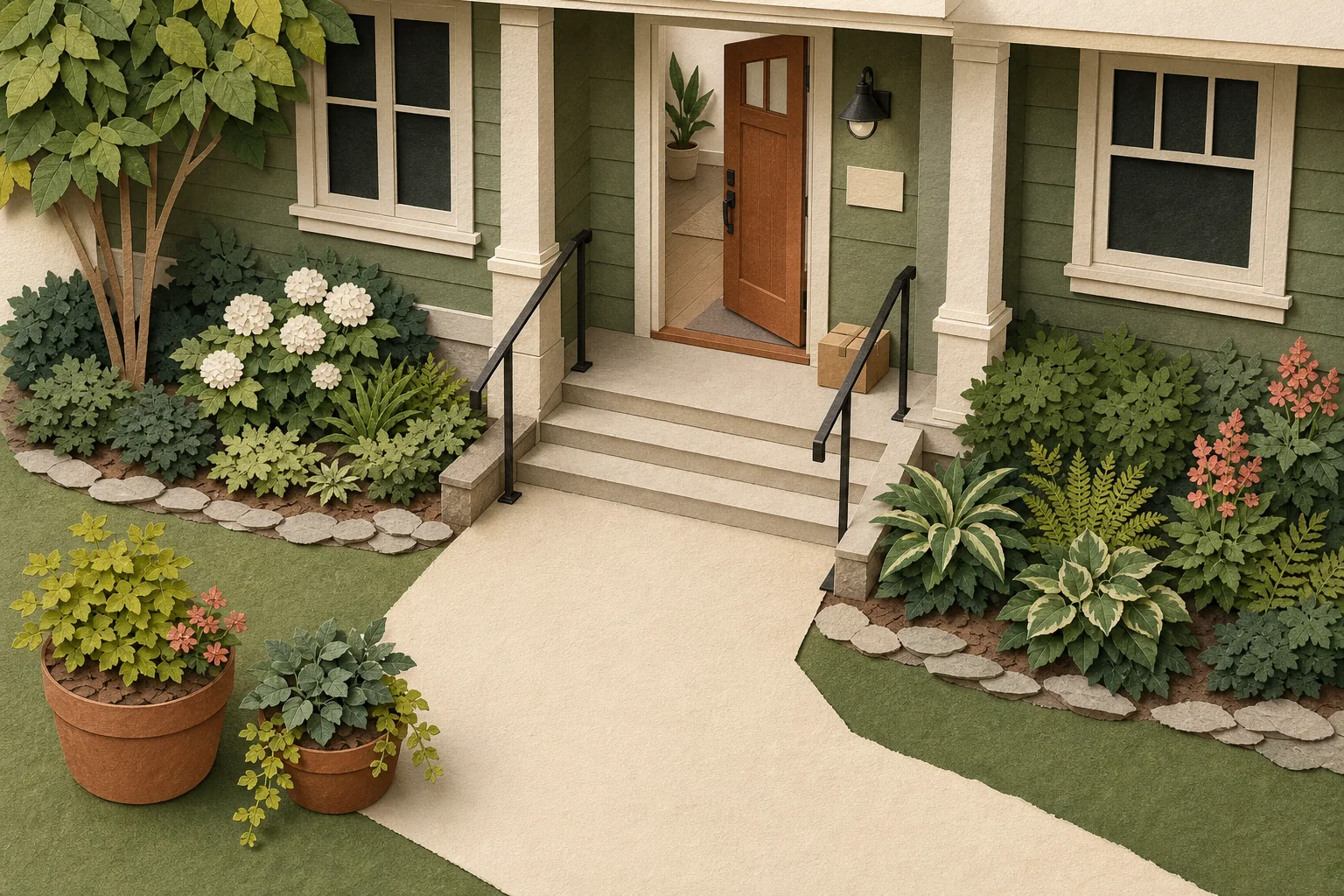
The door still leads: The entrance remains the strongest visual destination from the sidewalk.
The route stays clear: No mature foliage, thorns, pot rims, saucers, or trailing stems narrow the steps, rail, landing, or door swing.
The house can still be read: Windows, address, light, vent, meter, and inspection points remain visible and reachable.
Plants in each pot agree: Every shared container has compatible light, water, temperature, and soil needs.
The care route is realistic: Water can reach the plants without running across the walking surface, and heavy containers do not need constant moving.
Frequently asked questions
How many planters should I put on a front porch?
Use the fewest containers that create a clear focal or balancing job without narrowing the route. One large composition often reads more calmly and holds moisture better than several small pots.
Do front porch planters need to match?
They can match in shape, color, scale, or visual weight without containing identical plants. Different light exposures may require different plant recipes.
What is thriller, filler, and spiller?
It is a container-design recipe: one focal plant, one or more mounding plants that make the main mass, and an optional trailing plant that softens the rim. All plants still need compatible growing conditions.
Can I use Gardenful to design porch containers?
Gardenful is strongest for planting-led yard and bed directions from a photo. Use the container roles in this guide for pots, and use Gardenful to connect the porch to the surrounding in-ground landscape.
 Gardenful
Make the door easier to find.
Photograph the full arrival, protect the route and sightlines, then add one permanent plant rhythm and one seasonal container focus.
Gardenful for iPhone
Download the app free and start with a photo of your yard.

How this guide was built
The page combines residential entry-design principles with extension guidance for compatible container plantings.
The porch is treated as a circulation and sightline problem first, then as a planting composition.
The thriller-filler-spiller framework is used only for containers. It is not presented as a universal in-ground garden formula.
Sources(4)
- [1]
- [2]Landscape Design: Arranging Plants in the Landscape
University of Florida IFAS Extensionhttps://ask.ifas.ufl.edu/publication/EP449
- [3]
- [4]