Long-lived flower beds
Perennial garden design: plan the calendar, not just the bed
The short answer
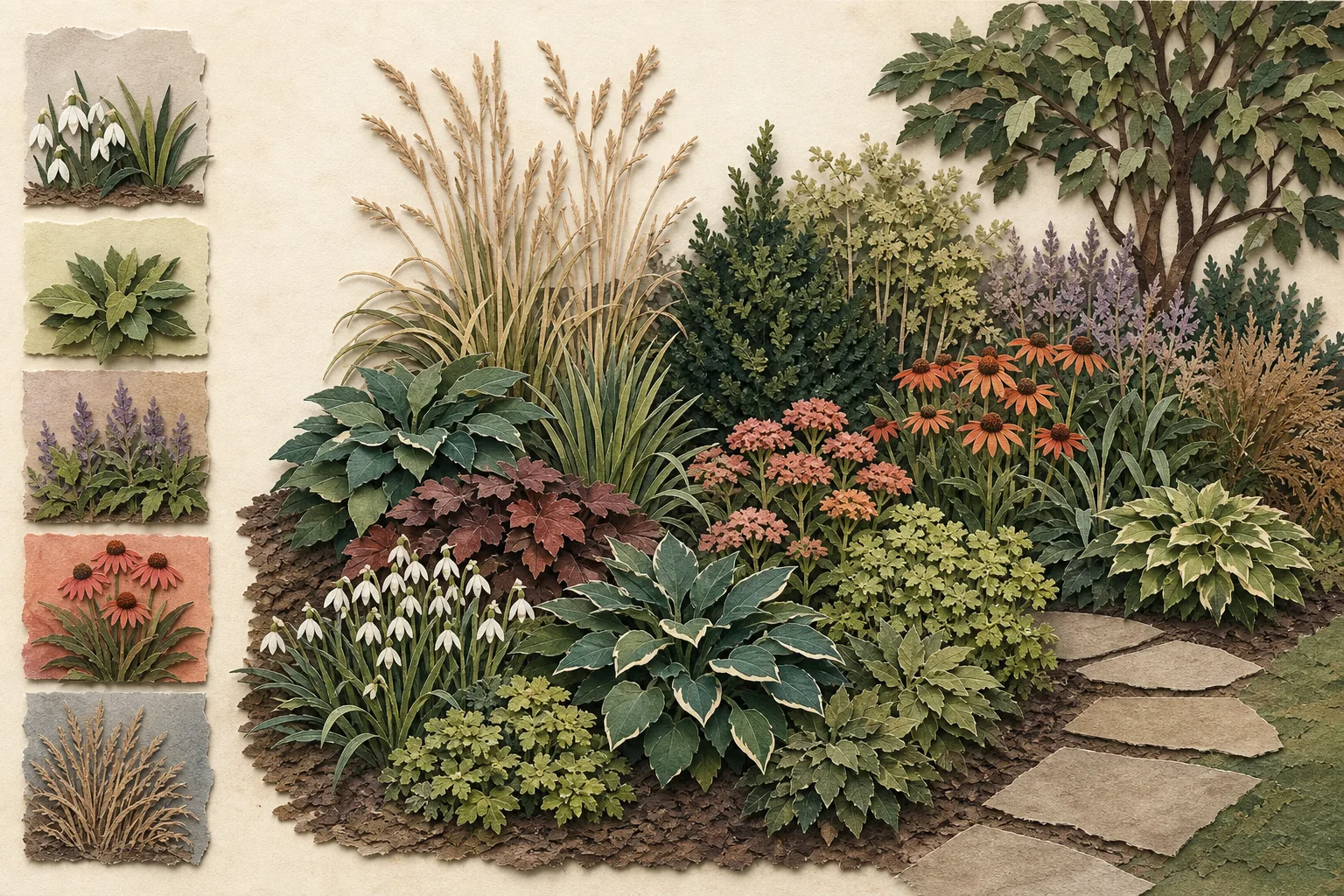
Perennial gardens change shape, color, and behavior from season to season and year to year. Design yours on three plans at once: a scaled bed plan for mature width, a for bloom and foliage, and a for clumping, spreading, self-seeding, division, dormancy, and support. The behavior map is what turns a promising first-year layout into a garden you can still manage in year five.
Map the site and the way each plant changes
Perennials return, but they do not all return in the same way. Design for their change, not only their mature silhouette.
Measure the bed, access, existing plants, sun, wind, soil, drainage, and irrigation. Plan at mature size and group plants with compatible environmental needs. A bed that is difficult to reach will also be difficult to weed, divide, and edit.1,5
Use a small number of persistent forms, such as compact shrubs, climate-appropriate evergreen foliage, ornamental grass structure, a ground layer, or a clear bed edge, to connect the design before adding bloom color.
For every candidate, record whether it stays in a clump, travels by roots, self-seeds, flops, goes dormant early, needs division, or leaves useful winter stems. Confirm the exact species and cultivar rather than treating “perennial” as one behavior.
Make a ledger for contribution and care
A plant list hides timing. A ledger reveals whether the whole bed peaks in one month and disappears in the next.
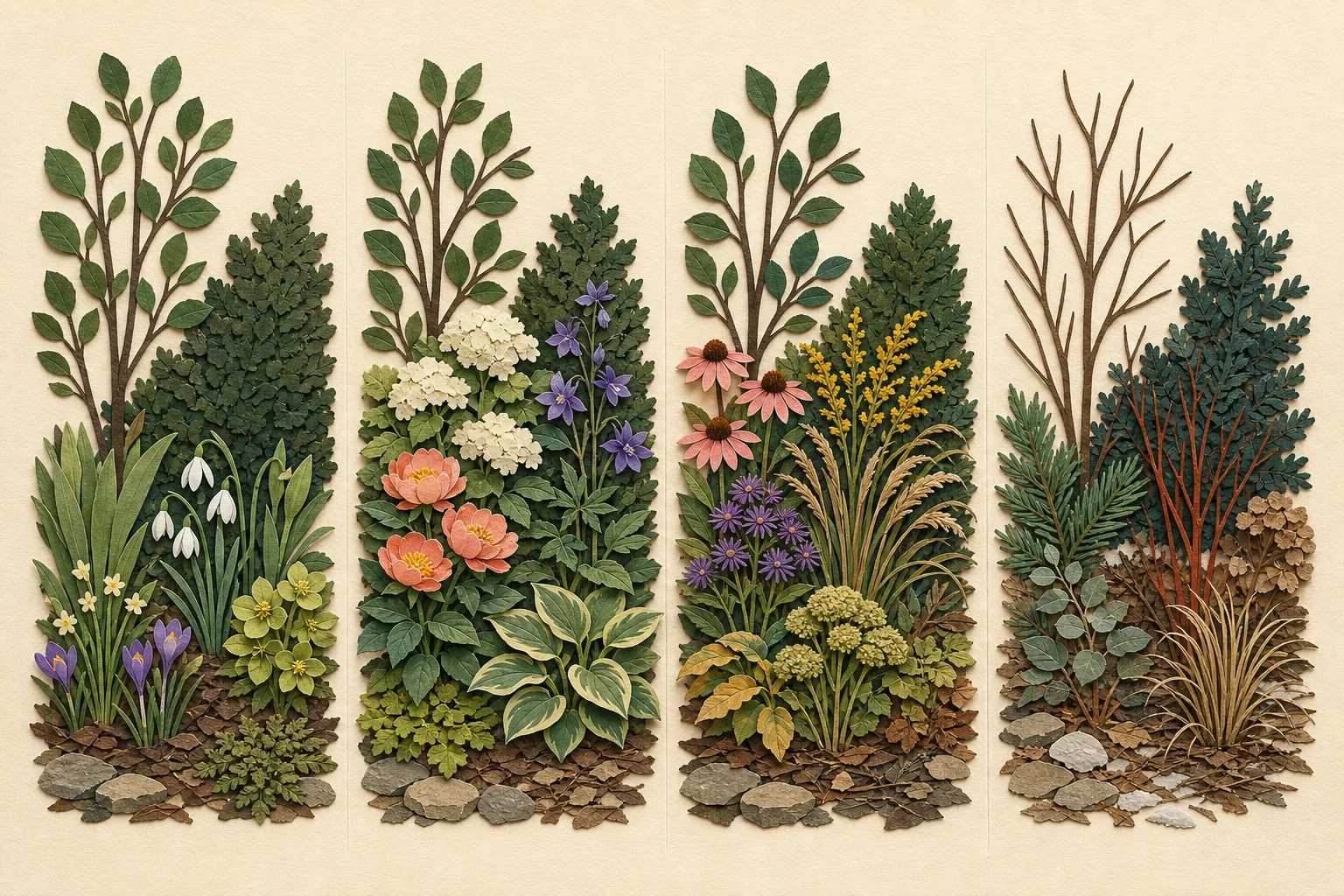
- Spring
- Early summer
- Late season
- Winter
For each candidate, record the months of useful foliage, bloom, seed head or stem interest, dormancy, cutback, division, staking, and likely replacement. Treat published bloom windows as local estimates because weather, elevation, and site conditions shift timing.1,2,3
Then scan vertically by month. If one month has no persistent structure, foliage, or event, fix the gap with the smallest useful change, often one longer-holding foliage plant or one concentrated group rather than several new species.
Decide where spreading, seeding, and flopping are okay
Plants do more than sit where you put them. Some creep sideways, drop seedlings, lean, or disappear after bloom. Decide where you can manage each habit before arranging the bed.
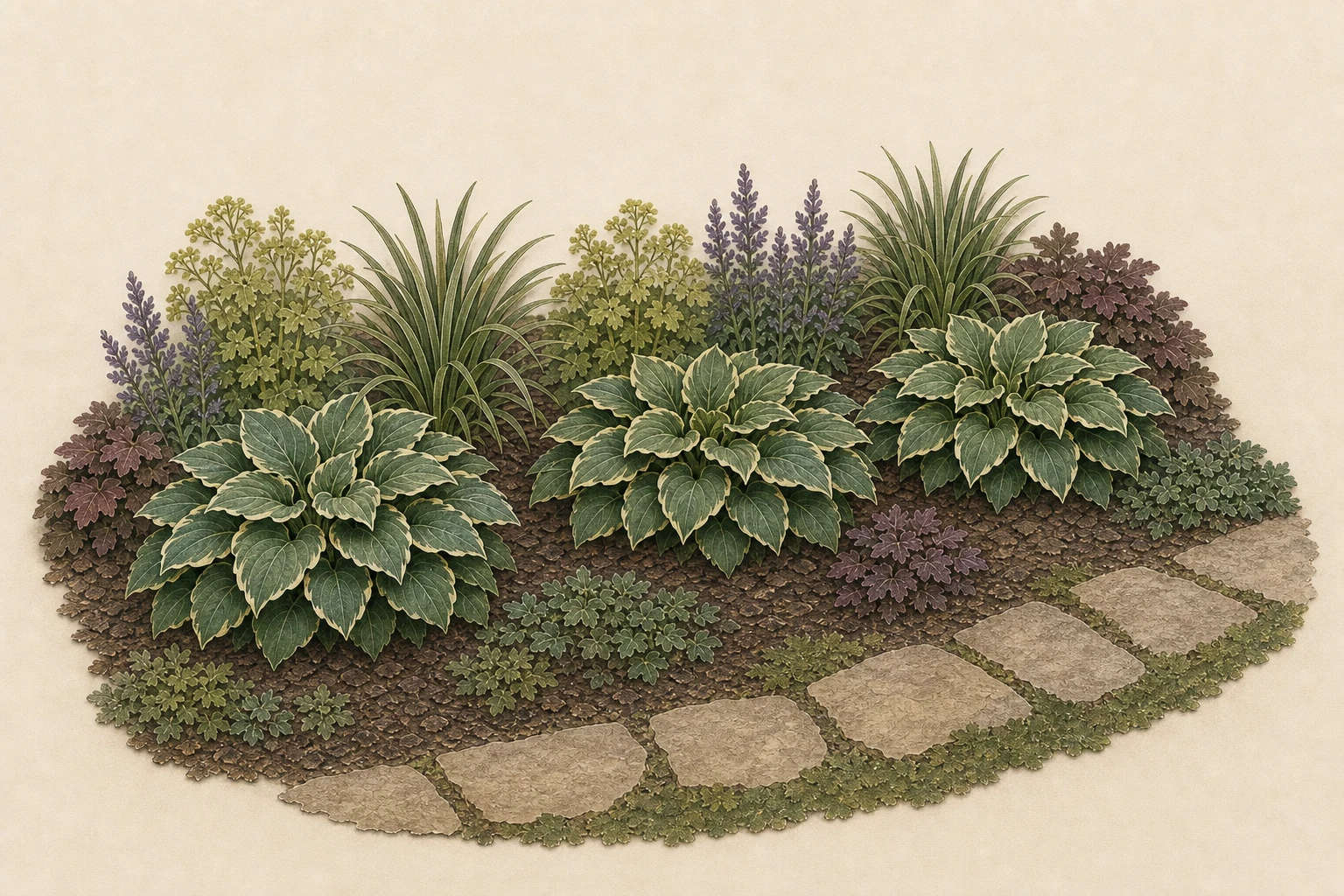
Use plants that stay put for the backbone
Use dependable clump-forming plants for the main repeated mass where the outline should remain predictable.
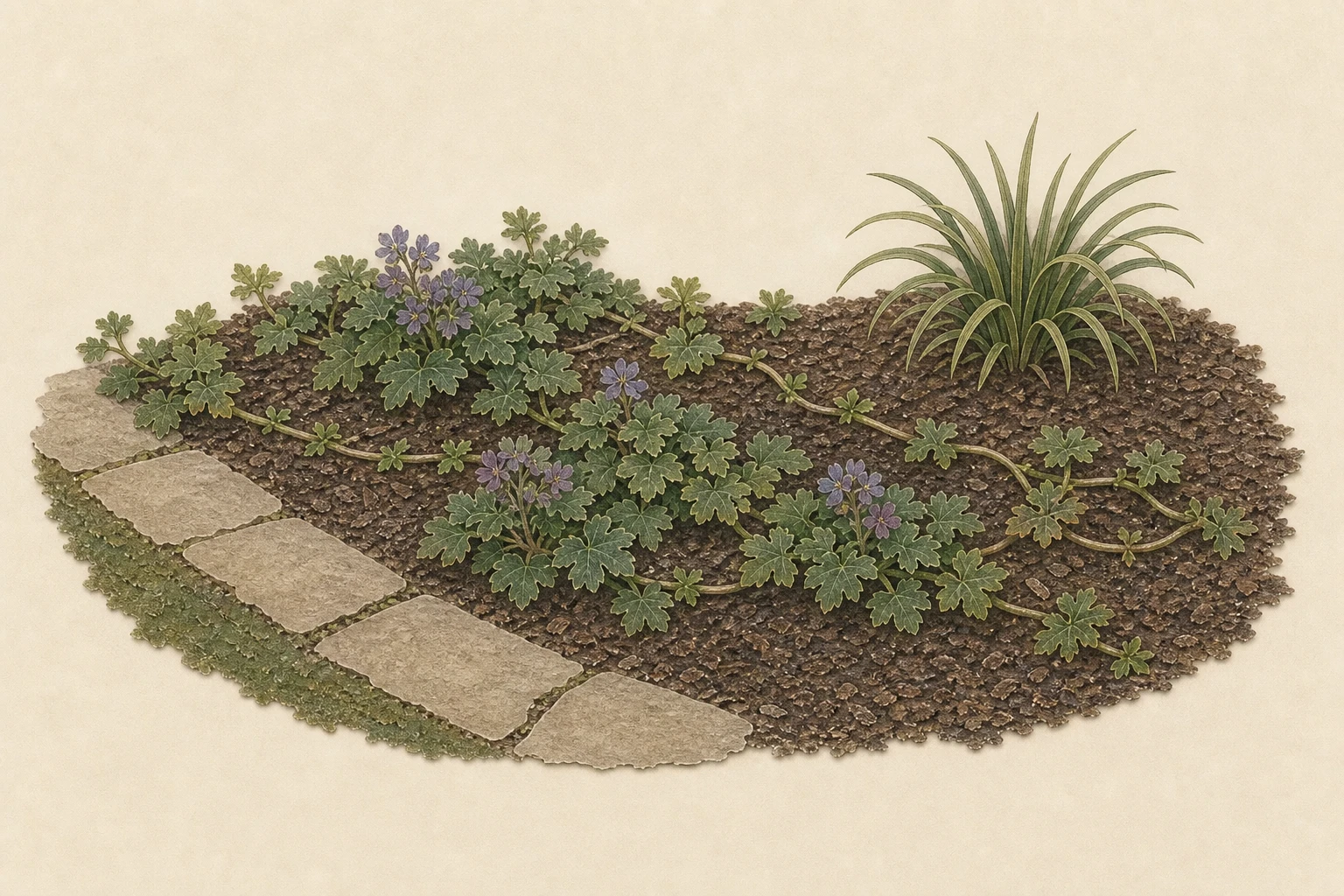
Give spreaders an edge you can reach
Allow spreading only where it can be edited from the edge and will not invade crowns, paving, neighboring property, or a delicate group.
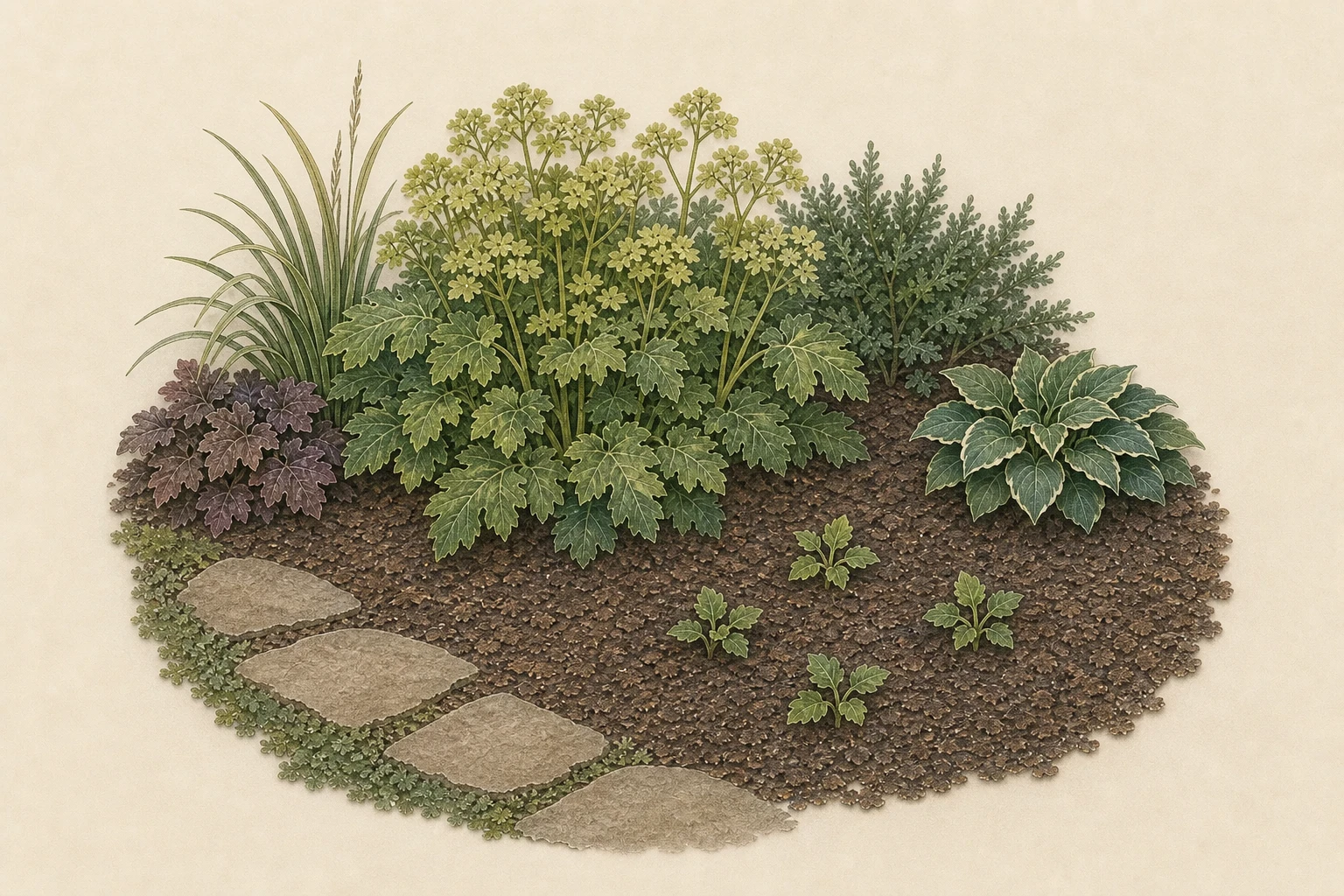
Let seedlings appear only where you can edit them
Choose a visible zone where seedlings or replacements are welcome. Keep them out of formal edges and hard-to-reach pockets.
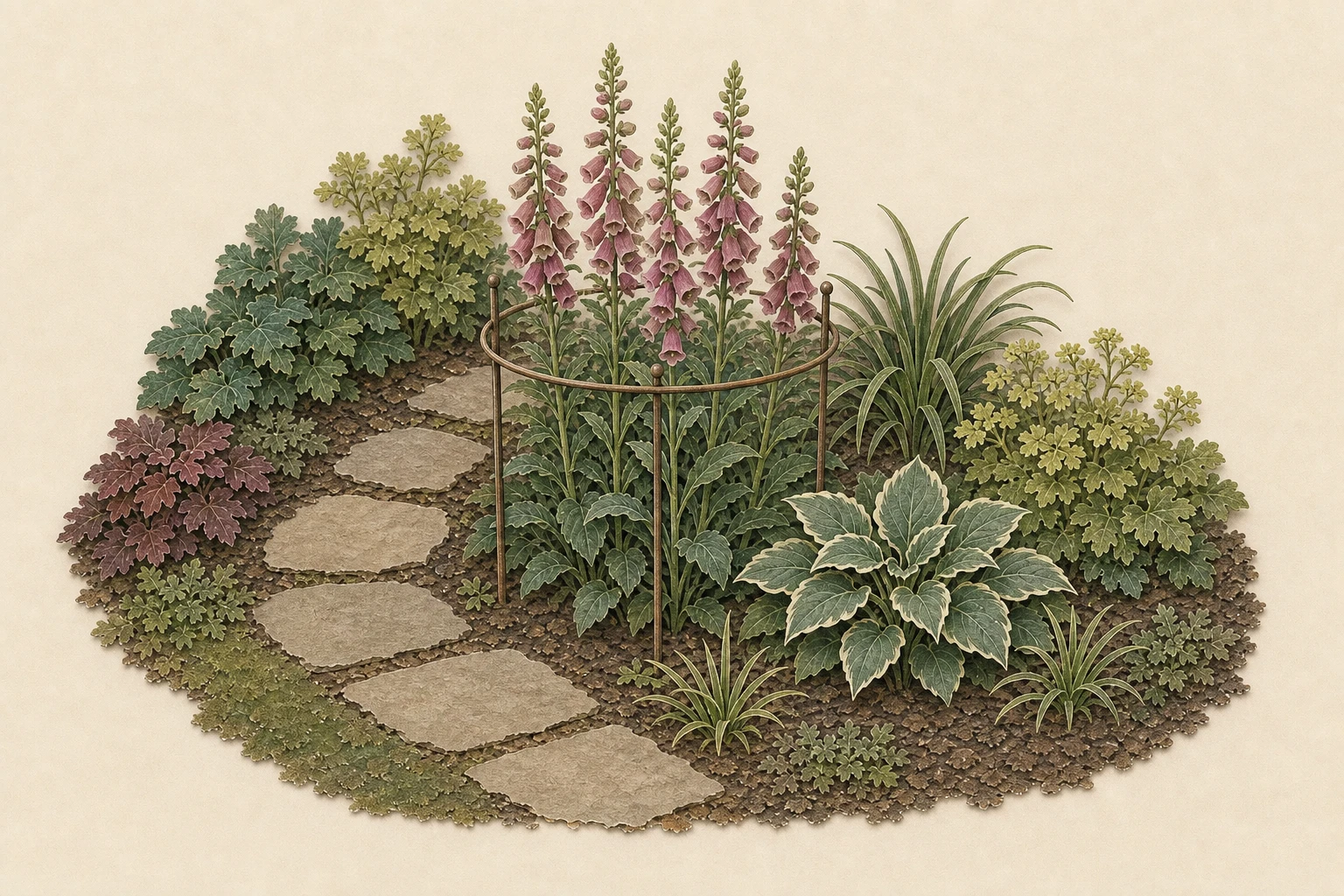
Keep support-dependent plants within arm's reach
Put plants that may need staking, pinching, or post-bloom cutting where you can reach them without crossing the bed.
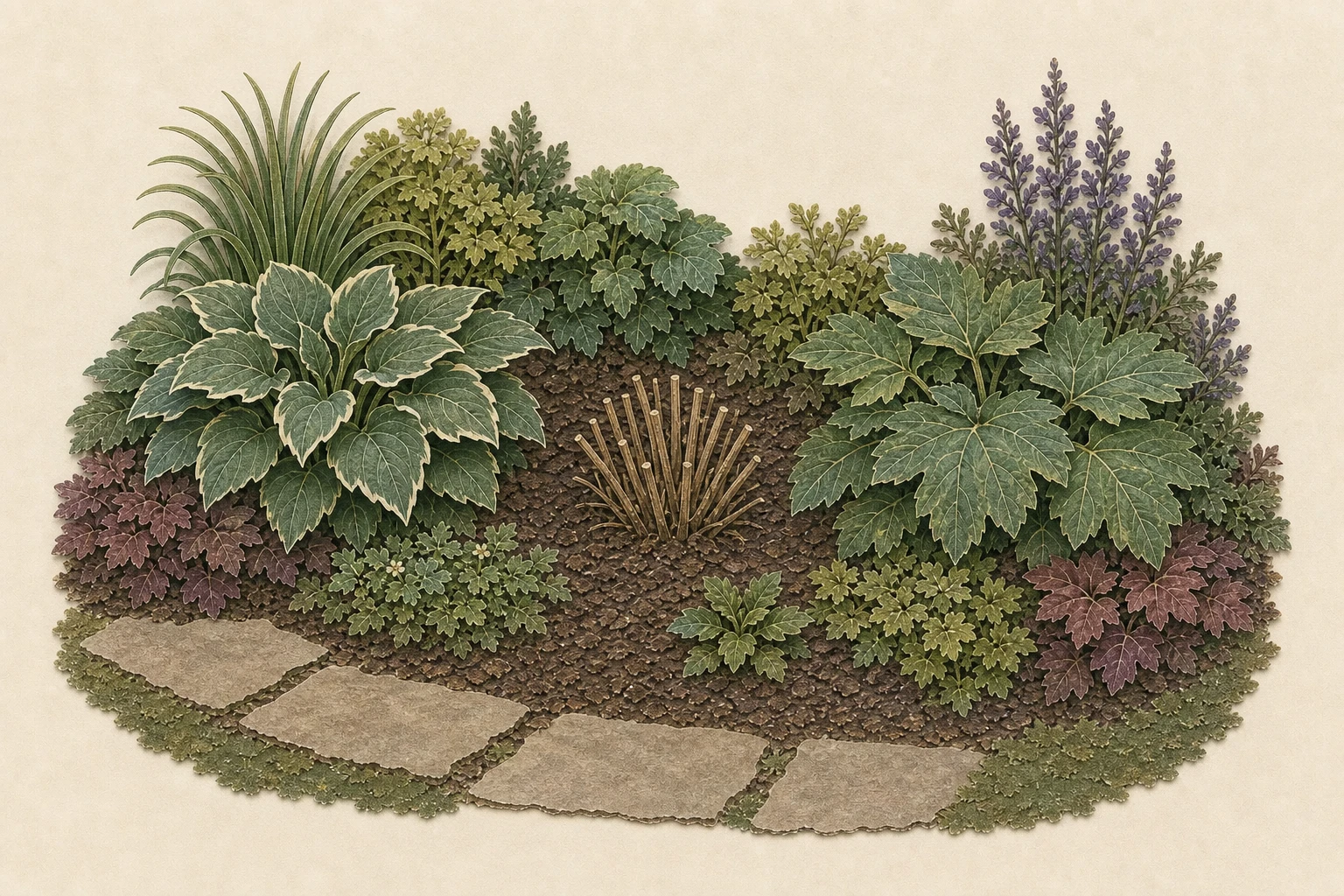
Cover temporary gaps with neighboring foliage
Pair early-dormant or periodically divided plants with a neighboring foliage mass that can cover the temporary opening without crowding the crown.
Plan a sunny perennial border around plant behavior
This regional example starts with documented plant tendencies, then leaves exact quantities to the mature spacing of the selected cultivar.
A sunny border viewed from a patio
The bed is reachable from the lawn edge, already has compact structural shrubs at both ends, and needs a more useful dry-season middle.
- Choose a stable dry-site mass
- Iowa State names sedum, coreopsis, blazing star, and many ornamental grasses as drought-tolerant examples. For an Iowa-like sunny site, screen among those by exact mature form, hardiness, and local status, then repeat one choice as the main mass.
- Assign the editing-heavy plant
- Keep any self-seeder, runner, or plant that needs post-bloom cutting near the lawn edge where seedlings and stems can be reached.
- Plan the division gap
- Colorado State notes that some perennials may need division after three to five growing seasons. Pair the division candidate with a neighboring foliage mass that can soften the temporary opening.
- Keep one open stepping point
- Preserve a discreet access point for division, pinching, deadheading, and editing instead of compacting soil between crowns.
The design is not finished when the colors align. It is finished when every expected behavior has a place and a reachable response.
Plan the work before you call the bed low-maintenance
Perennial gardens shift over time. A realistic plan includes editing, not only establishment.
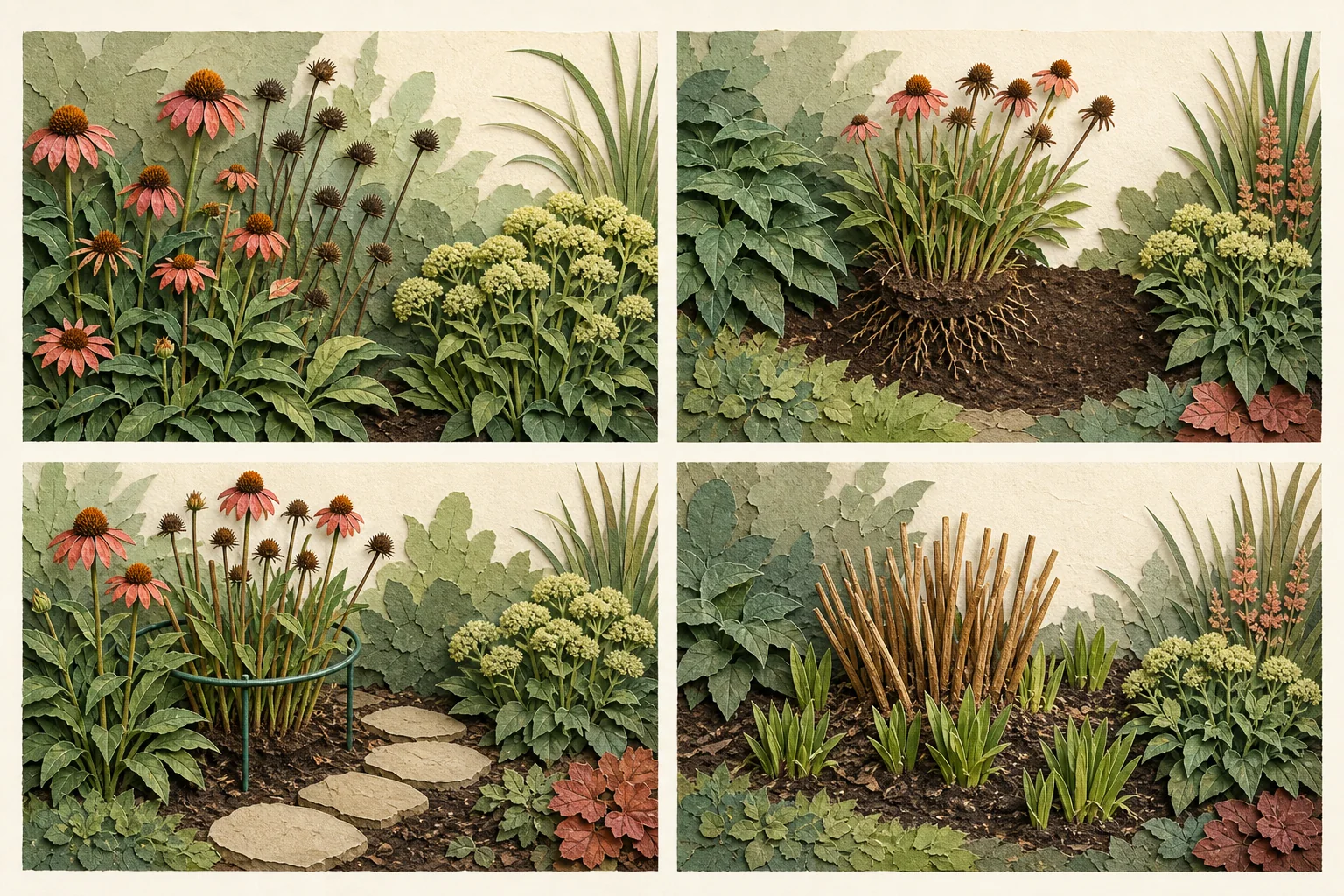
- After bloom
- Division window
- Winter structure
- Seasonal reset
Deadheading choice: Decide which plants are cut after bloom and which seed heads remain for structure, wildlife, or winter interest.
Division window: Know which clumps may need division, how often to inspect them, and how a temporary gap will be handled.
Support and cutback: Avoid staking-dependent plants where support is undesirable, and record the preferred local cutback season.
Spread and self-seeding: Choose where movement is welcome and where a spreading or seeding plant would become a recurring edit.
Invasive and local fit: Check current regional invasive lists, climate, soil, and household safety before buying exact plants.
Frequently asked questions
How do I design a perennial garden that blooms all season?
Use a seasonal ledger to compare bloom, useful foliage, and structure month by month. Keep persistent structure and a repeated main mass, then repair weak periods with a few concentrated seasonal groups.
How many kinds of perennials should I use?
There is no universal number. Start with the smallest palette that covers the site's conditions, persistent structure, one main mass, and the seasonal gaps you identified. Repetition usually reads more clearly than one of everything.
Should tall perennials always go in the back?
Not automatically. Use mature height, transparency, viewing direction, and focal hierarchy. An airy taller plant can rise through a mass, while a dense tall plant may block everything behind it.
How often do perennial gardens need dividing?
It depends on the plant and its performance. Colorado State notes that some perennials may need division after three to five growing seasons, while others need it less often or not for that reason. Watch for crowding, weak flowering, a thinning center, or a plant exceeding its assigned zone, and follow species-specific local guidance.
 Gardenful
Give every plant a season and a behavior.
Draw the mature plan, make the seasonal ledger, assign where each plant may move or need care, and verify exact local fit before buying.
Gardenful for iPhone
Download the app free and start with a photo of your yard.

How this guide was built
The guide separates the perennial design job from general flower-bed inspiration and from a species list.
Institutional sources support site selection, mature layout, compatible water groups, bloom succession, foliage and form, access, division, deadheading, and seasonal maintenance.
The example is role-based because bloom time, lifespan, hardiness, invasiveness, and growth habit vary by exact plant and location.
Sources(6)
- [1]Perennial Gardening
Colorado State University Extensionhttps://extension.colostate.edu/resource/perennial-gardening/
- [2]How to Plan and Maintain a Perennial Garden
University of Maryland Extensionhttps://extension.umd.edu/resource/how-plan-and-maintain-perennial-garden
- [3]
- [4]Landscape Design: Arranging Plants in the Landscape
University of Florida IFAS Extensionhttps://ask.ifas.ufl.edu/publication/EP449
- [5]Landscape Design: Drawing a Planting Plan
University of Florida IFAS Extensionhttps://ask.ifas.ufl.edu/publication/EP456
- [6]Species Lists
USDA National Invasive Species Information Centerhttps://www.invasivespeciesinfo.gov/subject/lists