Planting west of the Cascades
Pacific Northwest garden plants for sun and dry shade
The short answer
The Pacific Northwest west of the Cascades has wet winters and dry summers, a contrast that shapes what grows well in a garden. Even a shady bed beneath a tree can be dry by August. Ferns and low evergreen planting can make a leafy border where moisture suits them, while a sunnier bed offers room for flowers. These examples help you choose a combination for the light and summer moisture in your own yard.
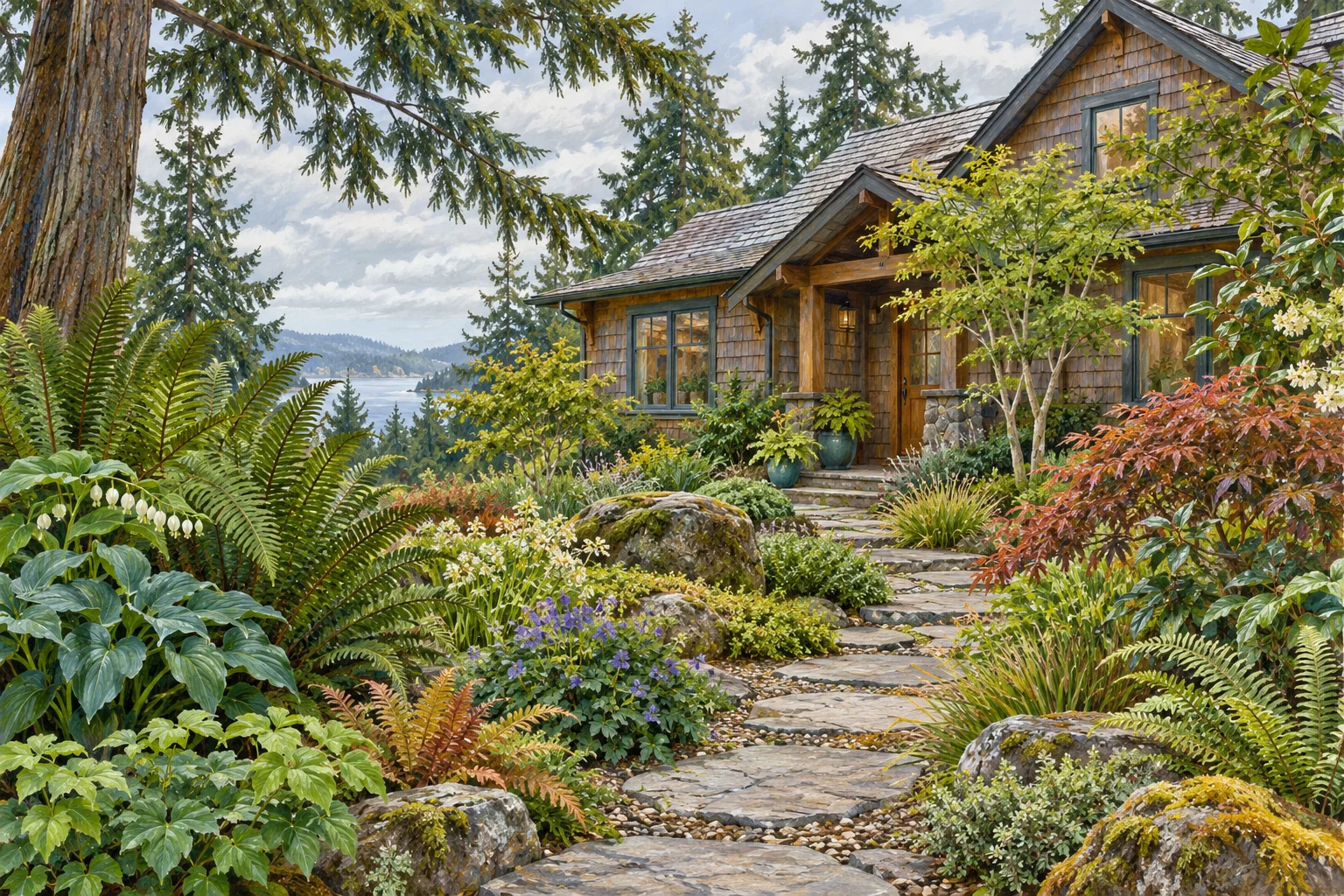
Find the sunny edge and the summer shade
In lower-elevation gardens west of the Cascades, a shaded tree-side bed and an open sunny border can offer very different looks. Check both in a dry spell: a tree canopy can intercept rain, and established roots compete for moisture. Shade alone does not make a bed damp.
Let the two sides of the garden look different
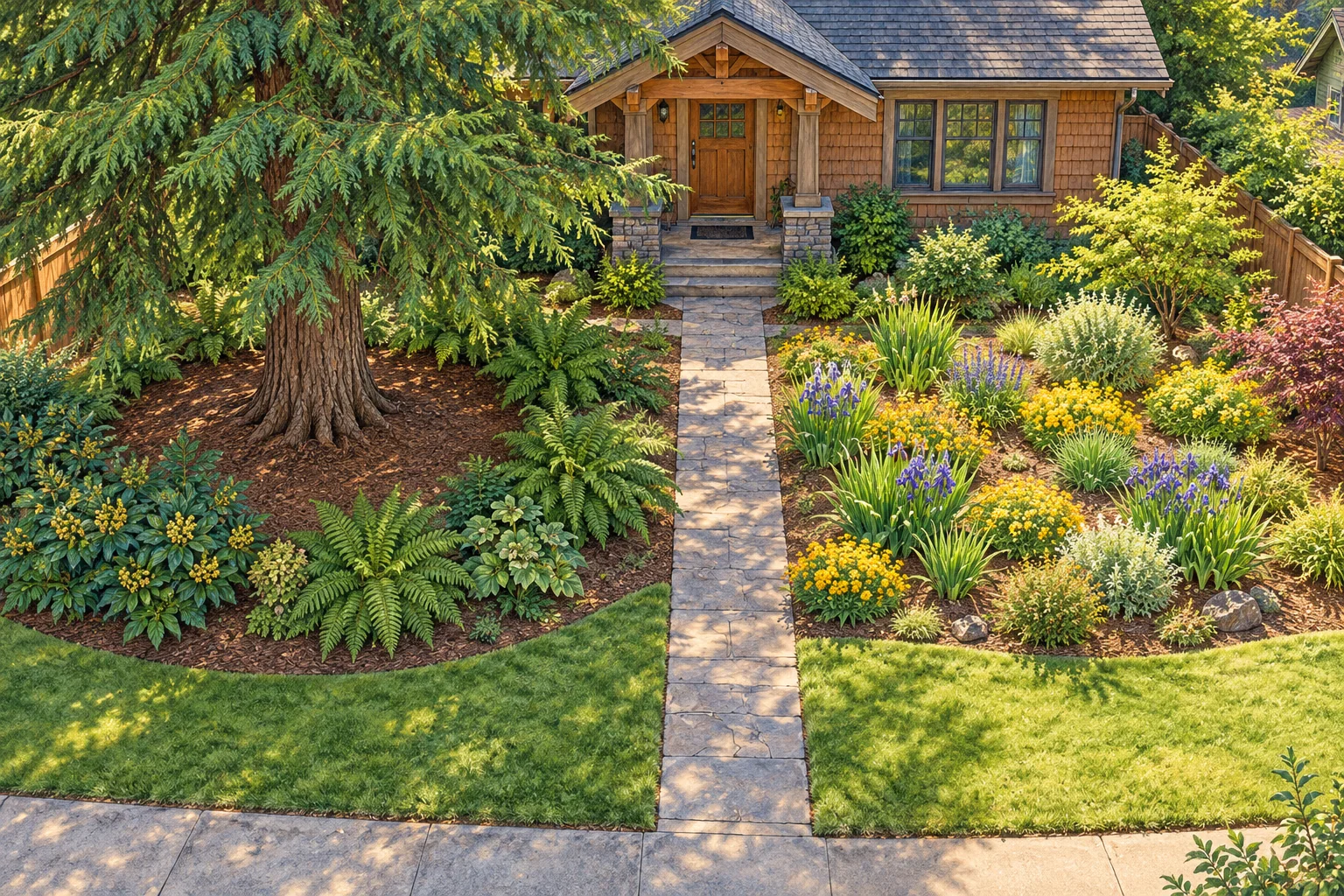
You can connect a leafy woodland edge and a sunnier flower border with one clear route. Keep the planting around the tree in suitable gaps between roots; use the brighter bed for lower foliage and spring-flowering stems. The path and repeated plant groups make the two areas feel like one garden.
Keep a woodland edge green after spring flowers finish
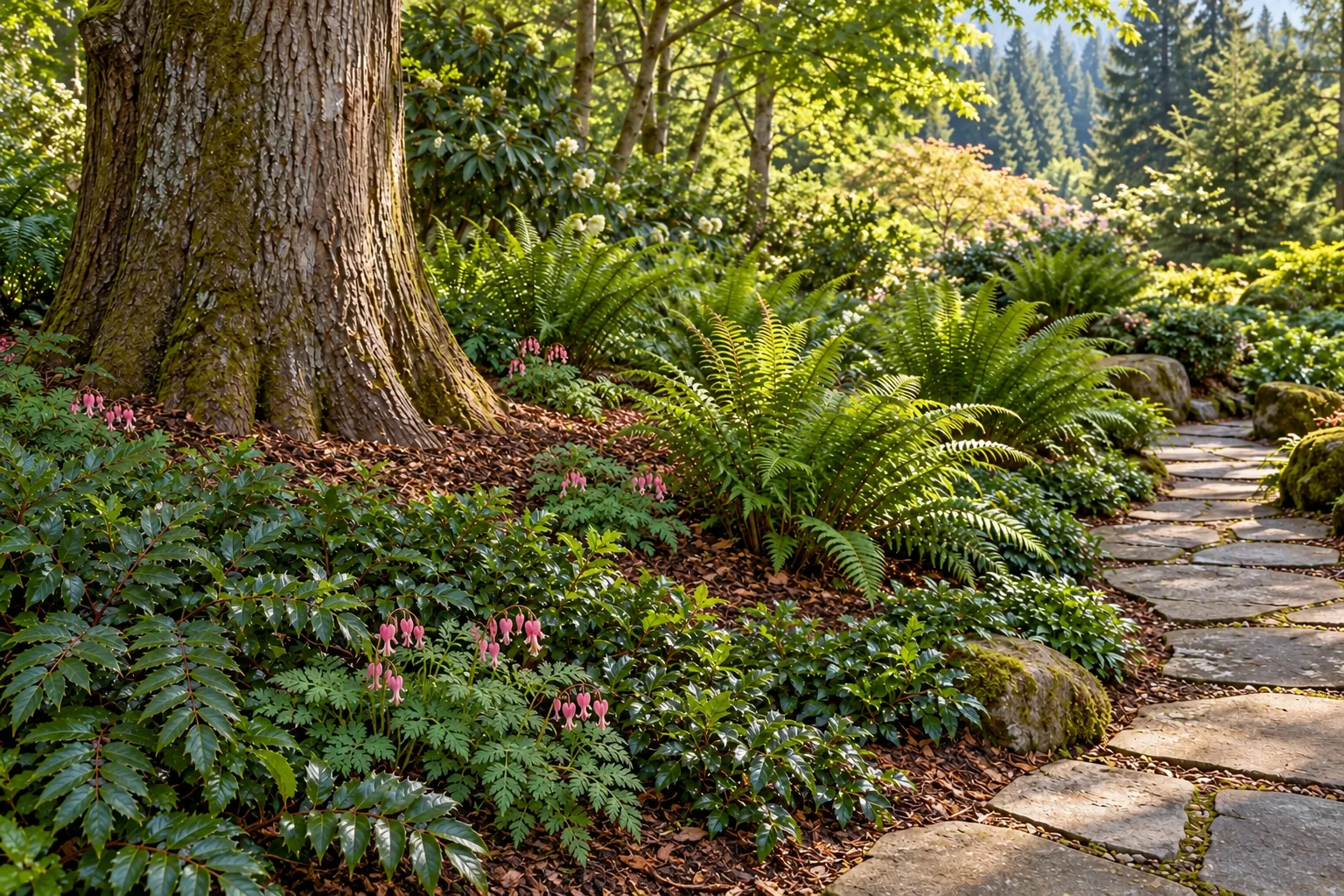
For an established, partly shaded western Oregon or Washington bed, consider western sword fern (Polystichum munitum) with low Oregon grape (Berberis nervosa, also sold as Mahonia nervosa). The fern gives an upright, arching shape; the lower shrub connects the spaces between. Both appear in regional water-wise plant guidance, but young plants still need establishment water.5
Where the soil stays moister in spring, Pacific bleeding heart (Dicentra formosa) can add a temporary flowering layer. It may die back during summer drought. Put that seasonal plant among lasting foliage so its disappearance doesn't leave the whole border looking empty.5
Work at the edge of the tree's planting space rather than digging a fresh bed through major roots. Keep the trunk base uncovered and use small plants only where there are suitable gaps. If roots leave nowhere to plant safely, a mulched area beside the fern border can be the finished design.
See what stays after the spring flowers disappear
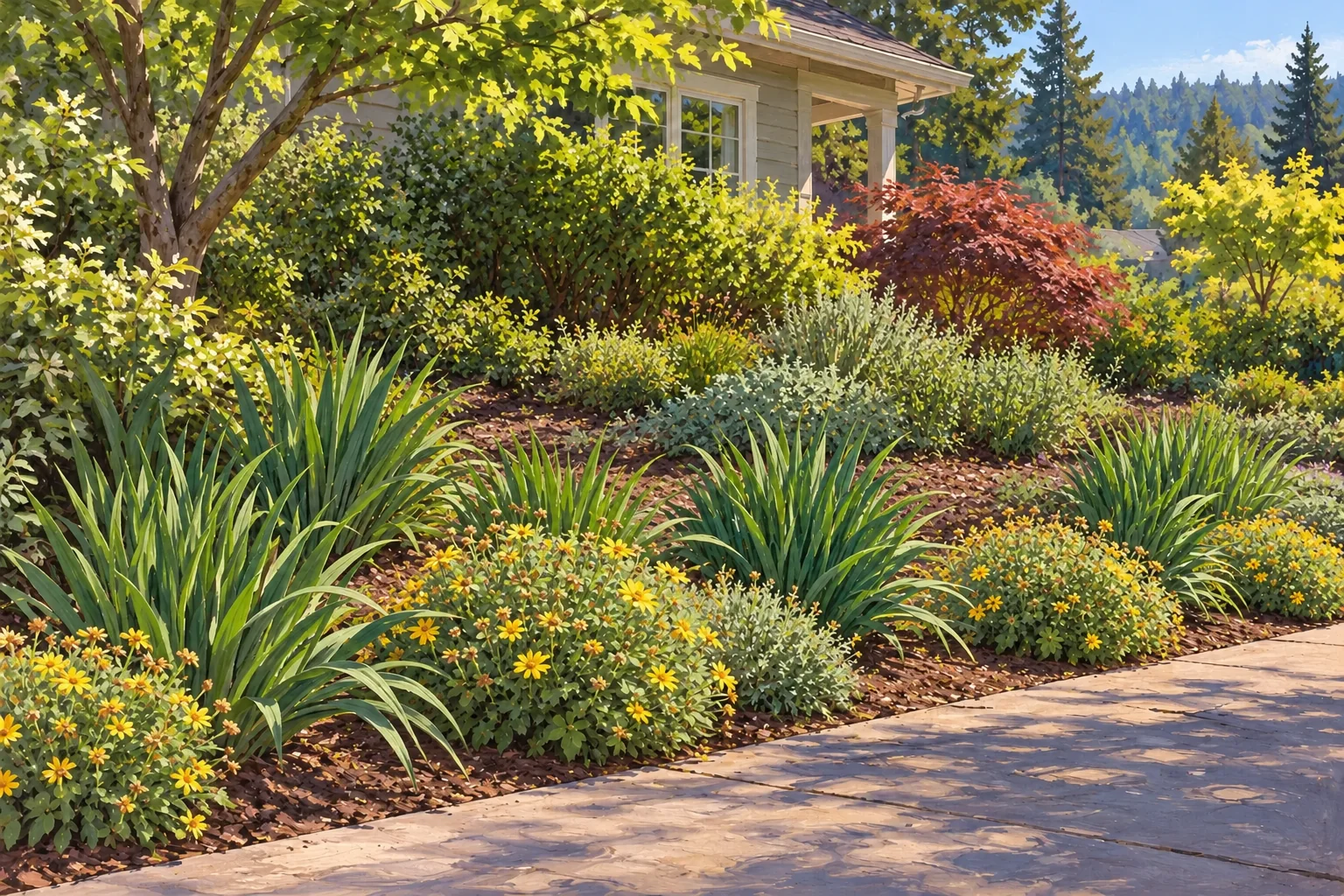
In an open, sunny western Oregon bed, Oregon iris and Oregon sunshine can hold the planting pattern while common camas brings a taller spring display. The summer view matters just as much as the flowers.
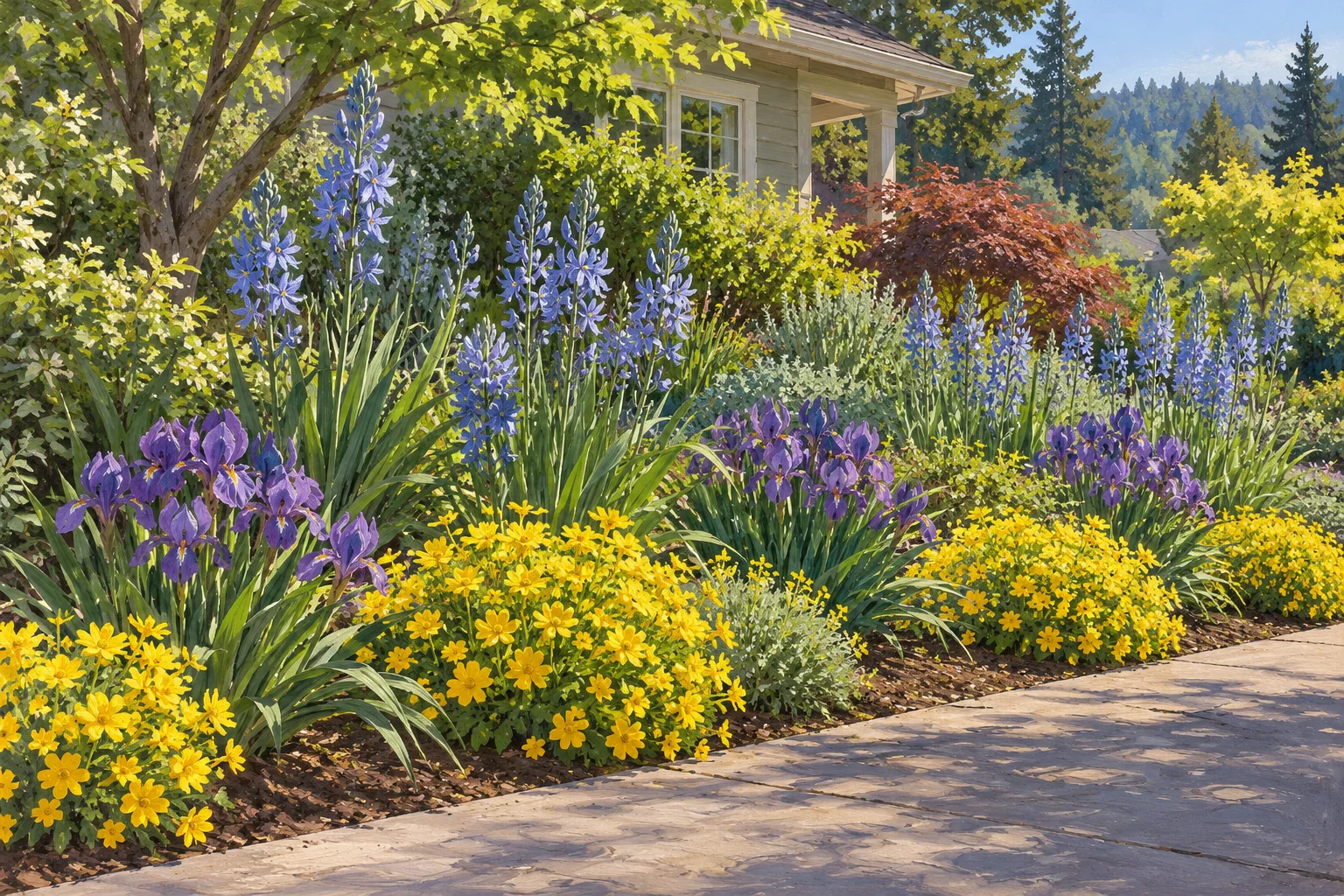
Spring: flowers rise through the lower planting
Oregon iris (Iris tenax) and Oregon sunshine (Eriophyllum lanatum) form the lower groups. Where winter and spring moisture suit it, common camas (Camassia quamash) can rise through nearby space. Keep the lower plants near the walk and the taller seasonal stems farther into the bed.
Late summer: the pattern stays as the bulbs rest
Camas goes dormant in summer, while the lower foliage continues the planting. Mark the bulbs on your sketch so a gap does not invite accidental digging. Winter-wet and summer-wet are different conditions: don’t water the whole border heavily just because the bulbs disappear. A bed that stays wet all summer needs a different combination.
Six plants for shade, spring flowers and summer sun
Ferns and low Oregon grape give the tree-side bed lasting foliage. Iris, sunshine and camas suit brighter openings, but they handle summer moisture differently. Bleeding heart adds spring flowers where the soil stays moister, then may retreat in a dry summer. Keep sun-loving flowers and woodland choices in the conditions that suit them.
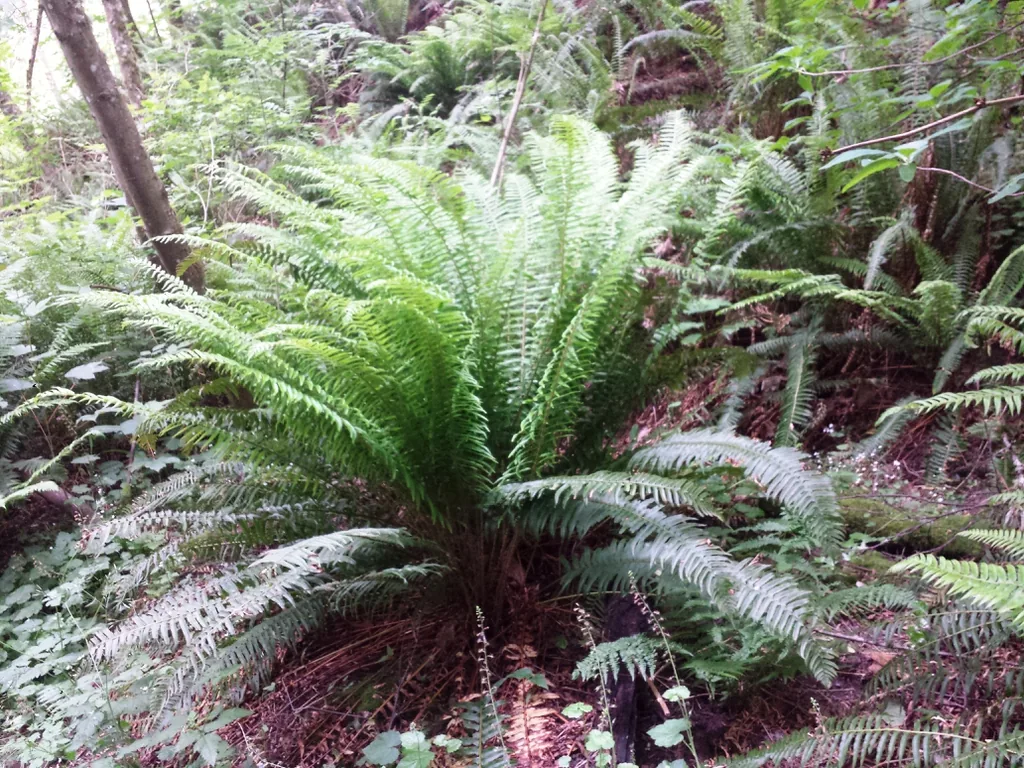
Sword fern
Polystichum munitum
Large evergreen fronds give a shaded bed its main shape; allow room for the mature clump.
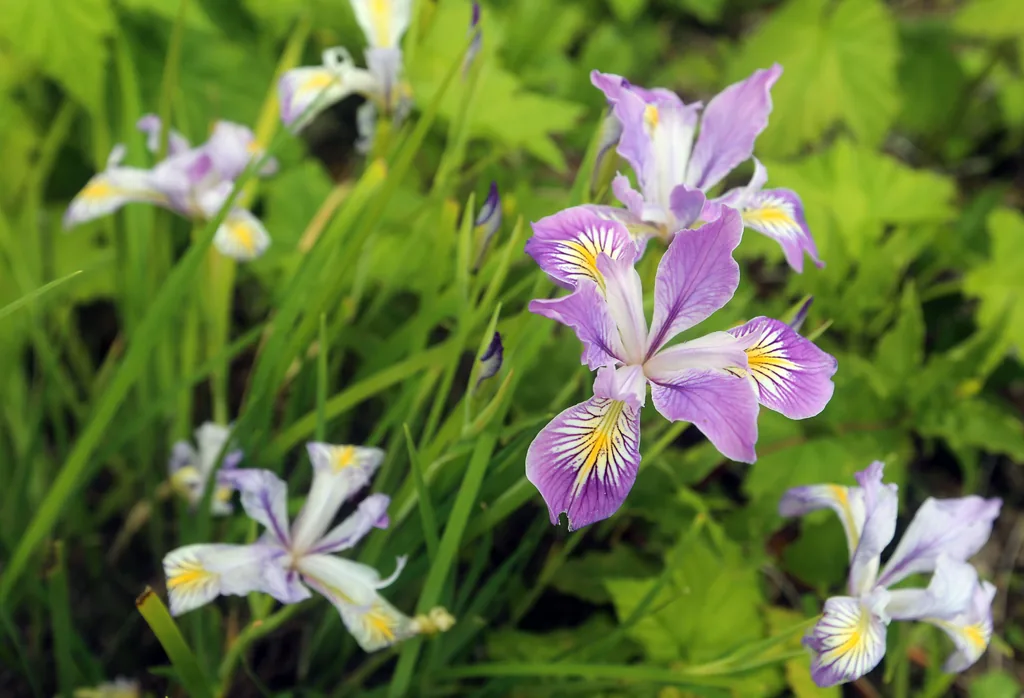
Oregon iris
Iris tenax
Purple spring flowers rise above narrow leaves in sunny or lightly shaded, well-drained ground.
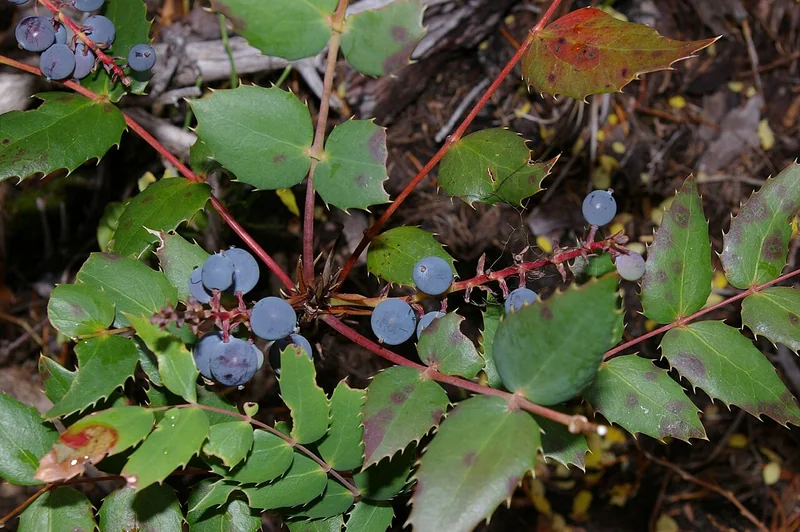
Low Oregon grape
Berberis nervosa (syn. Mahonia nervosa)
A spreading layer of evergreen leaflets fills shaded ground beneath taller plants.
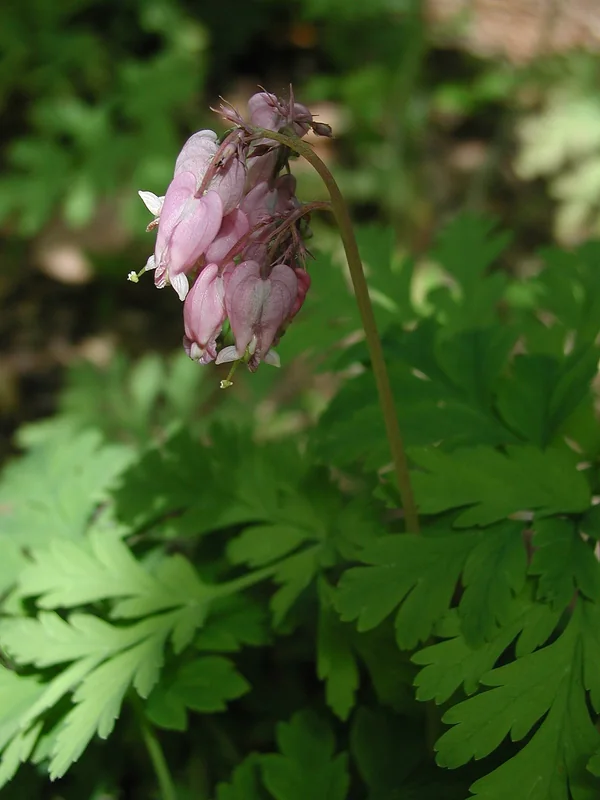
Pacific bleeding heart
Dicentra formosa
Pink flowers and fine foliage brighten moist spring shade; foliage may die back when summer turns dry.
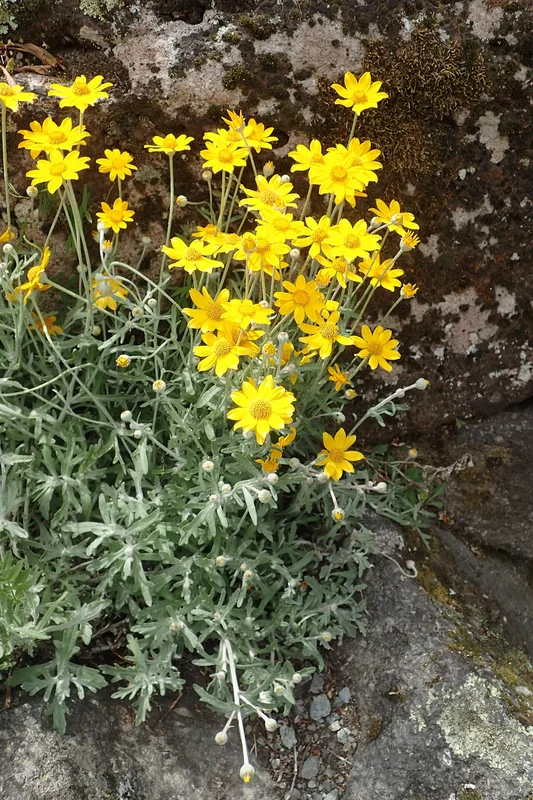
Oregon sunshine
Eriophyllum lanatum
Yellow flowers and gray-green foliage suit an open, sunny bed that drains well.
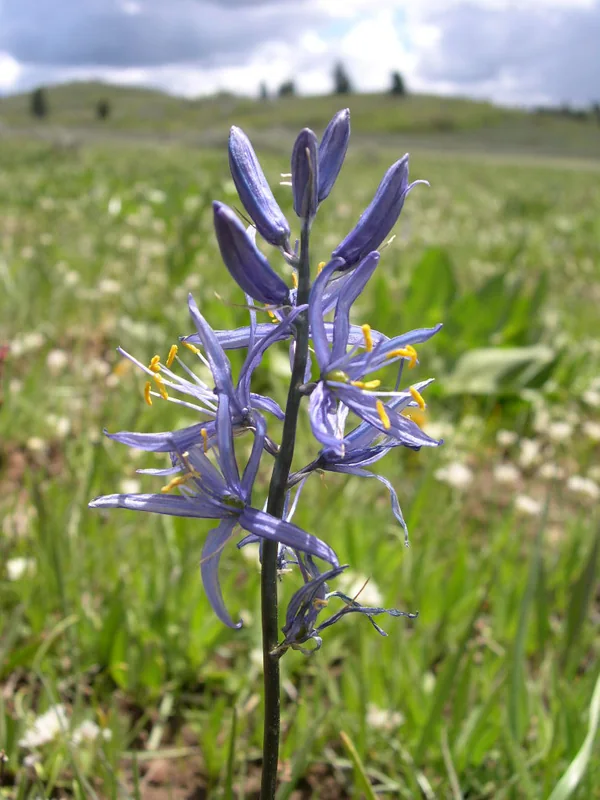
Common camas
Camassia quamash
Blue spring flower spikes suit sunny ground that is moist in spring; leave space for their summer dormancy.
Water according to the bed, not the regional forecast
Rainy winters don't remove the need to care for new plants through their first dry summers.
New plants in any bed
What to watch: The nursery root ball can dry before roots explore the soil.
What to do: Check root-ball moisture and establish a watering plan before summer.
Established summer-dry planting
What to watch: Extra water can change growth and spread, or harm plants adapted to dry summers.
What to do: Group compatible plants and reduce irrigation as they establish.
Moist woodland planting
What to watch: A dry spell may exceed what the selected plants tolerate.
What to do: Keep access to water or choose plants for the drier conditions.
Take a summer photo before finalizing the plant list
A spring nursery trip shows you what looks good in spring. Save a photograph of your own bed in late summer too: note the shade, dry patches and gaps left by seasonal plants. Bring both views to a local native nursery and ask which plants fit the same moisture conditions.
Choose the larger fern or shrub first and allow its mature width before adding smaller plants. Repeat a few groups instead of collecting one of everything. You can keep the woodland feel with a much simpler plant list than a forest contains.
On an exposed coast, in a sheltered valley or east of the Cascades, check which plants fit the local conditions. These examples focus on western Oregon and Washington; colder winters and different rainfall east of the mountains change the shortlist.4
Frequently asked questions
What grows in dry shade in the Pacific Northwest?
West of the Cascades, western sword fern and low Oregon grape are useful candidates to investigate. Match the actual light and moisture, give new plants establishment water, and avoid damaging existing tree roots. Very dry, root-filled ground may be better left mulched.
Do Pacific Northwest native plants need summer watering?
New plants usually need help through dry summers. After establishment, requirements depend on habitat: some plants tolerate summer drought, while moist-woodland plants may need additional water. Group those needs instead of using one schedule throughout the yard.
Can I use this planting in eastern Washington or Oregon?
Use the design ideas, but replace the plant list with locally suited choices. These examples are for the wetter-winter, summer-dry climate west of the Cascades. Winter cold, rainfall and soils differ east of the mountains.
 Gardenful
Picture a greener border in the space you have.
Start with a photo in Gardenful. Explore a planting idea that works around the trees, paths and features you want to keep.
Gardenful for iPhone
Download the app free and start with a photo of your yard.

Sources(12)
- [1]Sword fern photograph
brewbookshttps://plants.ces.ncsu.edu/plants/polystichum-munitum/
CC-BY-SA 2.0. Converted to WebP.
- [2]Oregon iris photograph
USFWS - Pacific Regionhttps://commons.wikimedia.org/wiki/File:USFWS_iris_tenax_(23722480842).jpg
Public domain. Converted to WebP. Flower detail.
- [3]
- [4]
- [5]
- [6]Native Plants for Deep Shade
King County Native Plant Guidehttps://green2.kingcounty.gov/gonative/Article.aspx?Act=view&ArticleID=10
- [7]Low Oregon grape photograph
brewbooks from near Seattle, USAhttps://commons.wikimedia.org/wiki/File:Mahonia_nervosa_-_Oregon_grape.jpg
CC BY-SA 2.0. Resized and converted to WebP.
- [8]Pacific bleeding heart photograph
Linda McMahan / Oregon State Universityhttps://commons.wikimedia.org/wiki/File:Western_bleeding_heart_(dicentra_formosa)_is_an_example_of_native_ground_cover_that_can_be_used_to_suppress_weeds_and_help_the_soil_retain_water.jpg
CC BY-SA 2.0. Resized and converted to WebP.
- [9]Oregon sunshine photograph
Krzysztof Ziarnek, Kenraizhttps://commons.wikimedia.org/wiki/File:Eriophyllum_lanatum_kz01.jpg
CC BY-SA 4.0. Resized and converted to WebP.
- [10]Common camas photograph
Thayne Tuasonhttps://commons.wikimedia.org/wiki/File:Camassia_quamash-5-25-04.jpg
CC BY-SA 4.0. Resized and converted to WebP.
- [11]
- [12]