Planting ideas for humid summers
Southeast garden plants for heat, clay and shade
The short answer
Long, hot, humid summers give many Southeast gardens a lush, leafy character, but the soil beneath that greenery can range from heavy clay to quick-draining sand. The sunny and shaded examples here focus on the Piedmont (the inland hills east of the Appalachians) and non-tropical coastal lowlands. They show how to combine flowers and lasting foliage, with enough space for the plants to fill out without crowding the border.
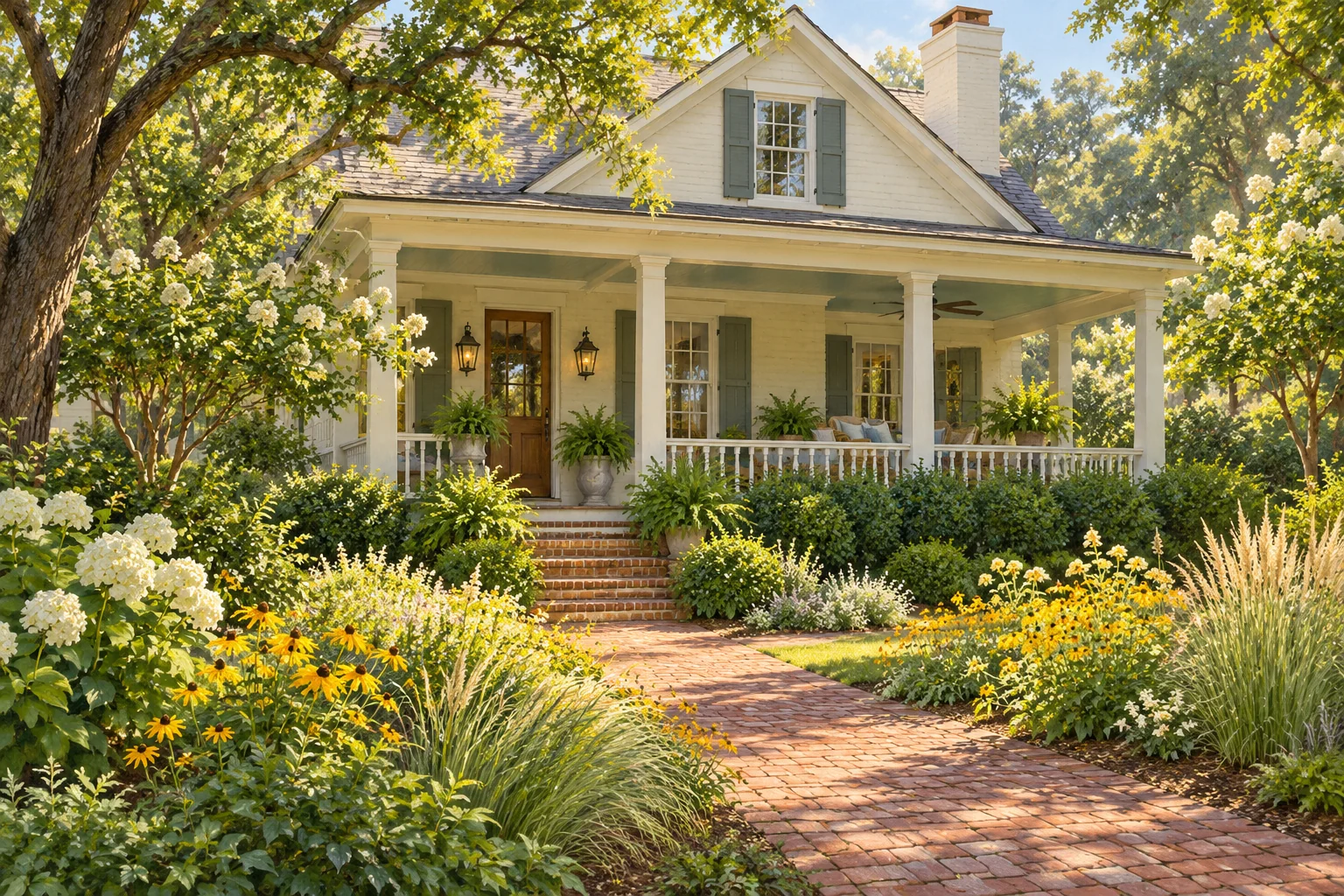
Two planting styles for a humid-summer garden
A sunny border that has something left after spring flowers
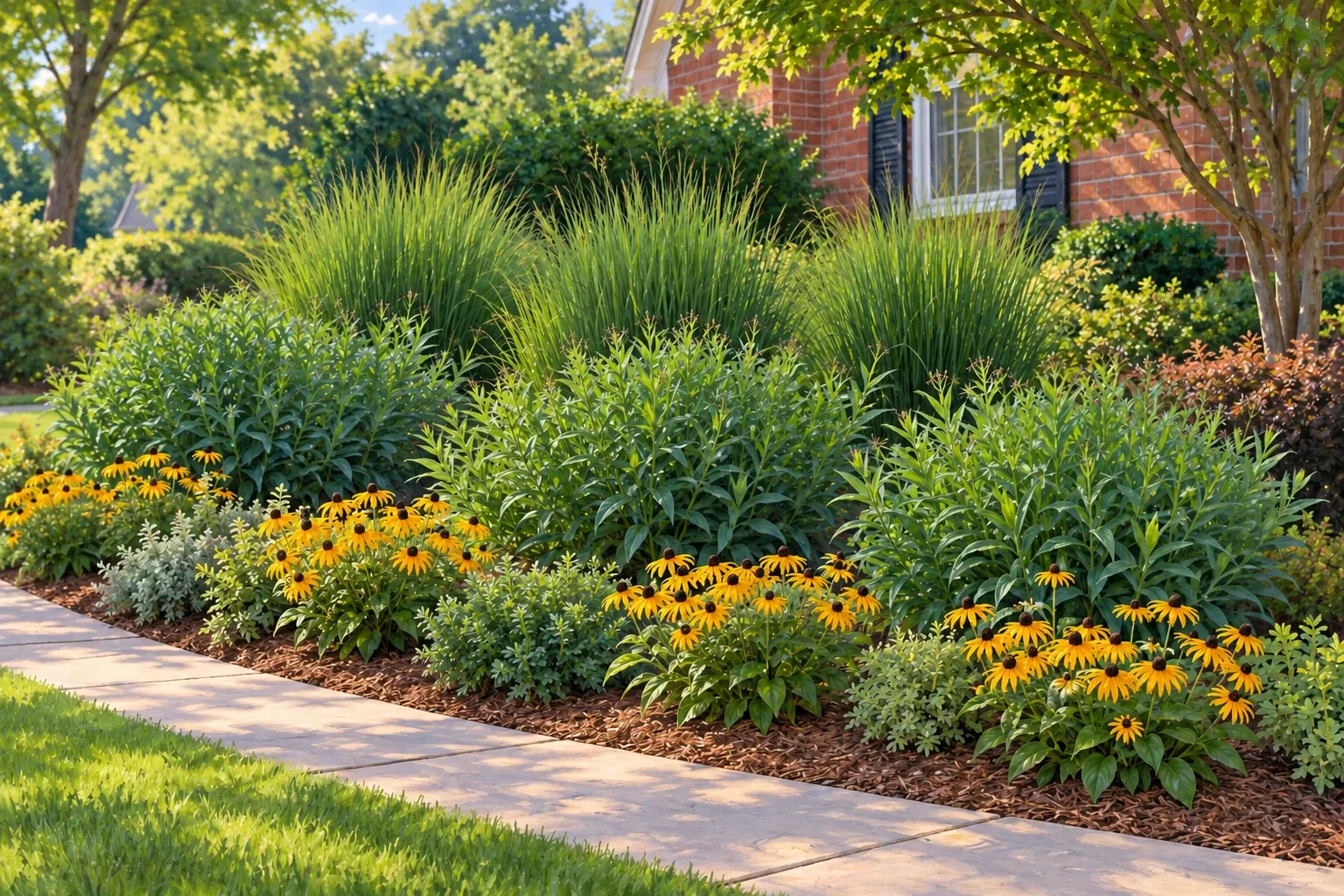
In a sunny Piedmont bed with moisture-retentive but well-drained soil, consider eastern bluestar (Amsonia tabernaemontana), black-eyed Susan (Rudbeckia fulgida) and a locally suitable compact switchgrass. Bluestar gives spring flowers and a leafy summer mass. Black-eyed Susan adds yellow later, while the grass changes the outline and texture.1,9,10
Place the grass where its flowering height won't cover a window or lean across a path, then repeat the flowering perennials between it. Bluestar needs enough sun to hold its shape, and black-eyed Susan spreads, so keep an edge you can reach to divide or reduce a clump. A narrow bed can use just the two perennials, as the plan below shows.1,9
Use different leaf shapes in a moist, shaded bed
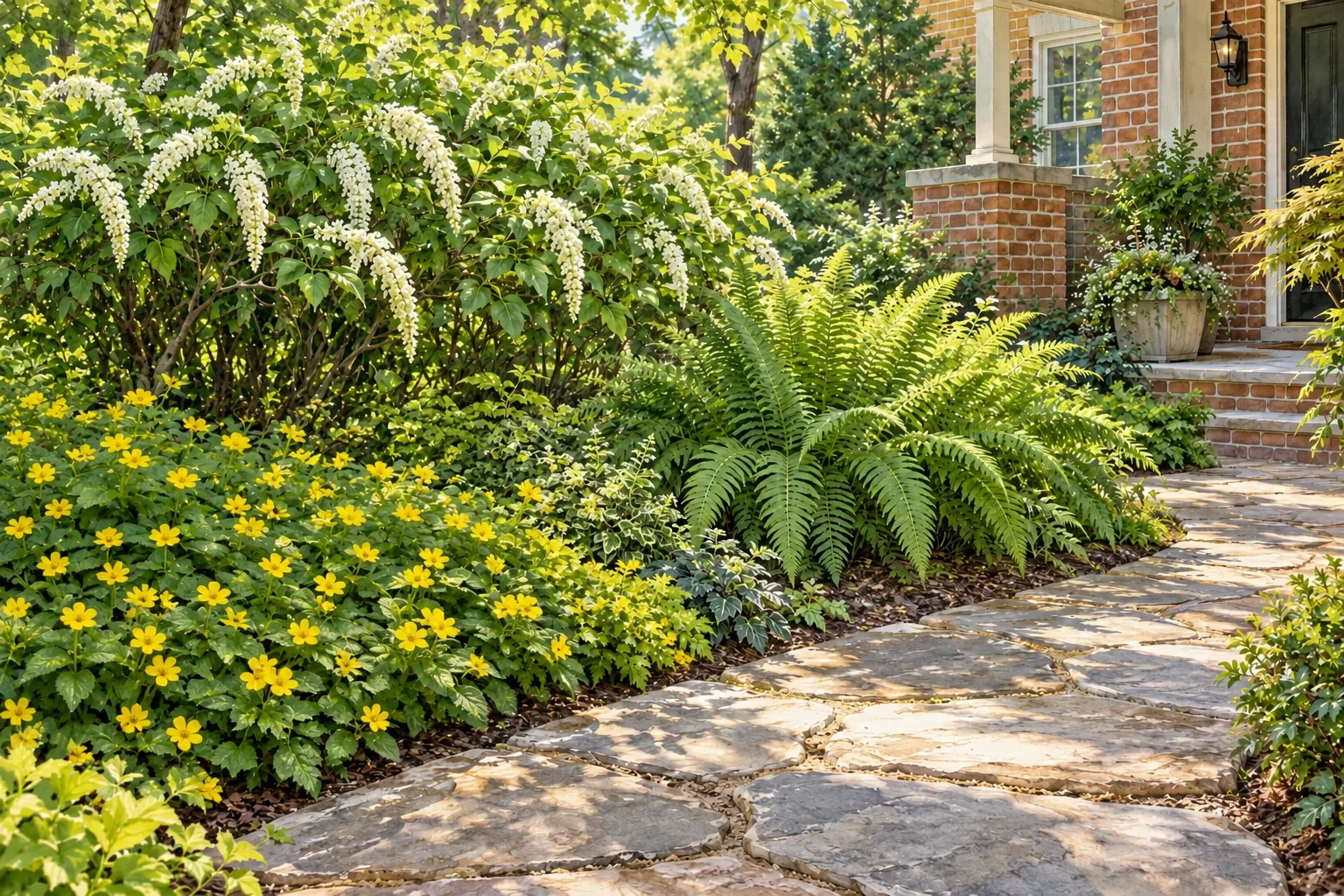
For bright shade with moist, well-drained soil, try Virginia sweetspire (Itea virginica), Christmas fern and green-and-gold (Chrysogonum virginianum). Sweetspire provides the larger shape and late-spring flowers; fern fronds break up its broader leaves; the low groundcover softens the front.2,12,13
Give sweetspire room to spread behind the lower plants, using a compact variety where space is limited. Its tolerance of wetter soil doesn't make the whole combination suitable for standing water. For a dry bed beneath mature trees, choose a different moisture-matched planting and use only suitable gaps between roots, keeping the trunk base uncovered.2
Plants for sunny borders and leafy shade
Compare plants for the two planting ideas: leafy clumps and upright grasses for the sunny border, then arching shrubs, ferns and low groundcover for moist shade.
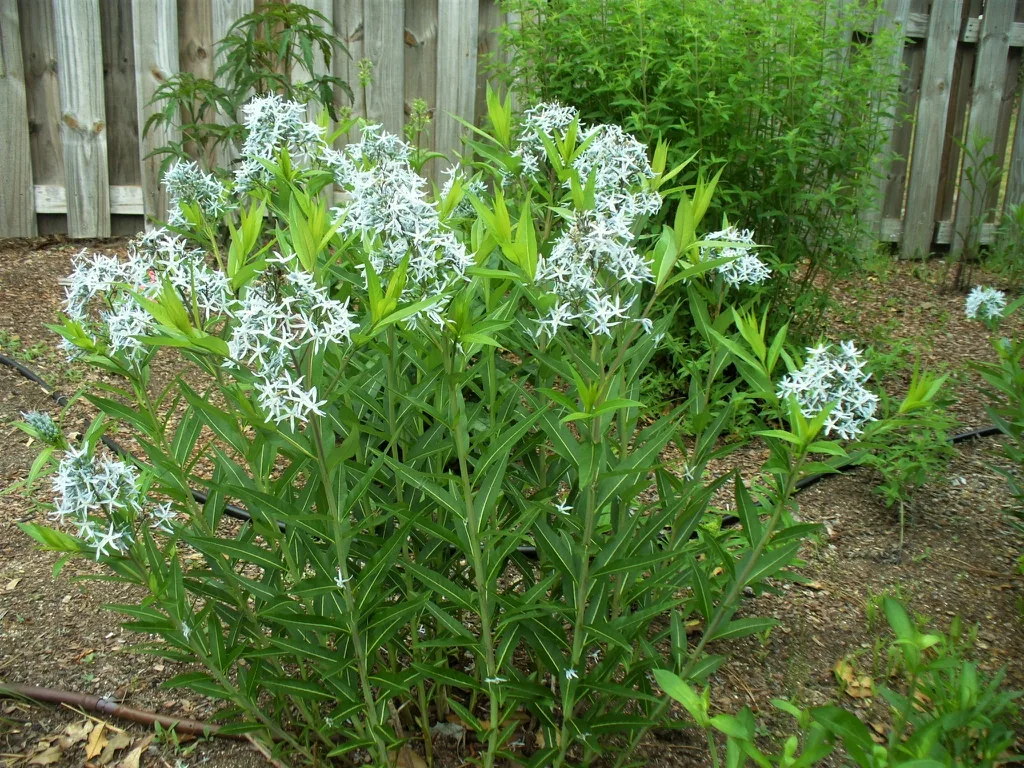
Eastern bluestar — sunny border
Amsonia tabernaemontana
Pale spring flowers give way to a full, leafy summer clump. Allow room for the foliage in a sunny, well-drained bed.
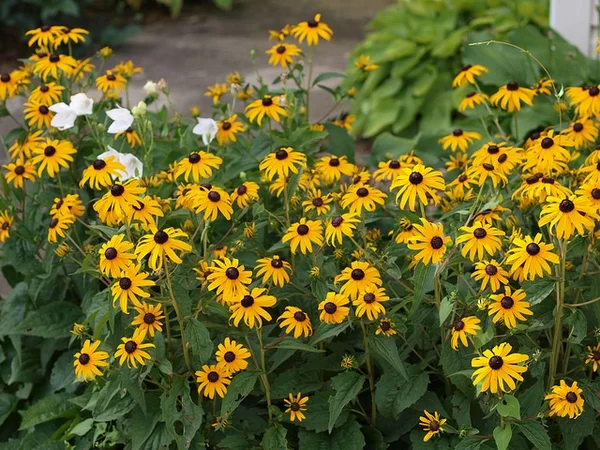
Black-eyed Susan — sunny border
Rudbeckia fulgida
Yellow summer flowers brighten a sunny border. Keep an accessible edge where you can reduce the clumps as they spread.
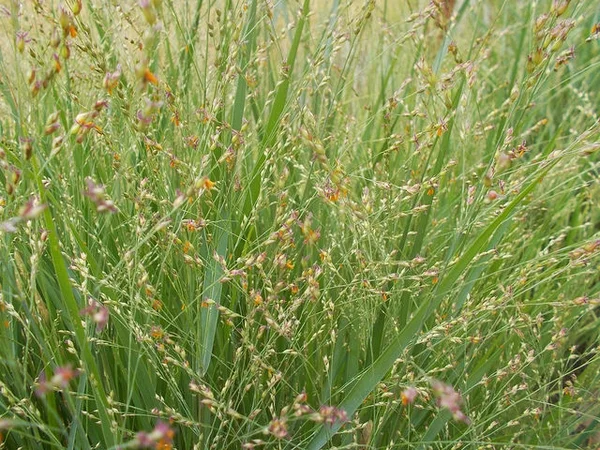
Switchgrass — sunny border
Panicum virgatum
Upright leaves and airy seedheads add a different shape. Choose a locally proven compact variety whose flowering height fits your bed.
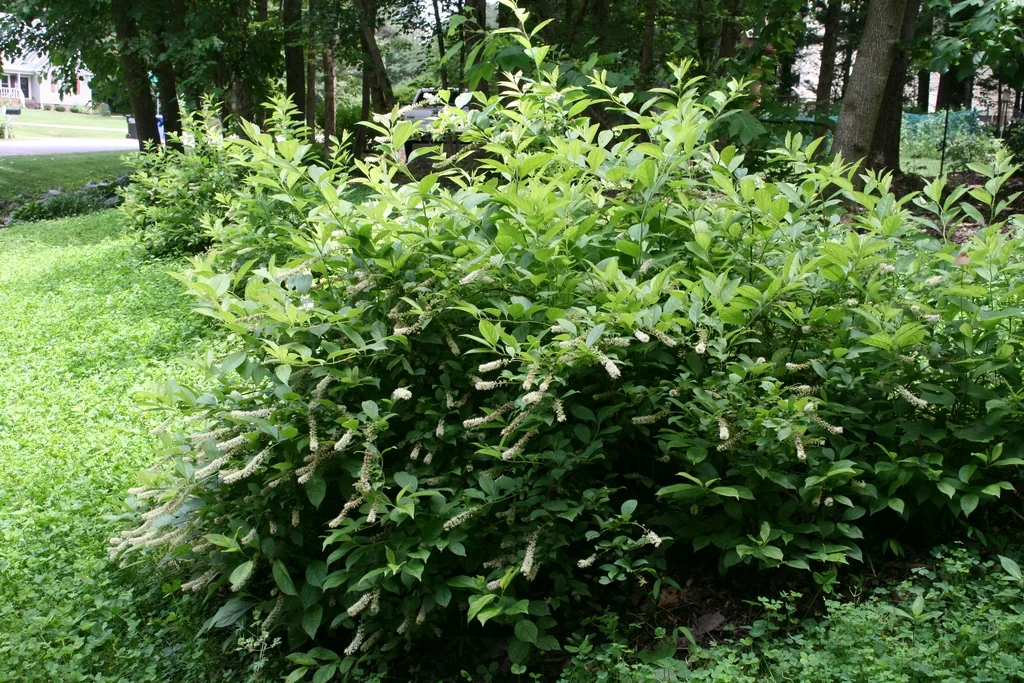
Virginia sweetspire — moist shade
Itea virginica
Arching branches and white spring flower tassels suit a moist, partly shaded border. Leave room for new shoots around the shrub.
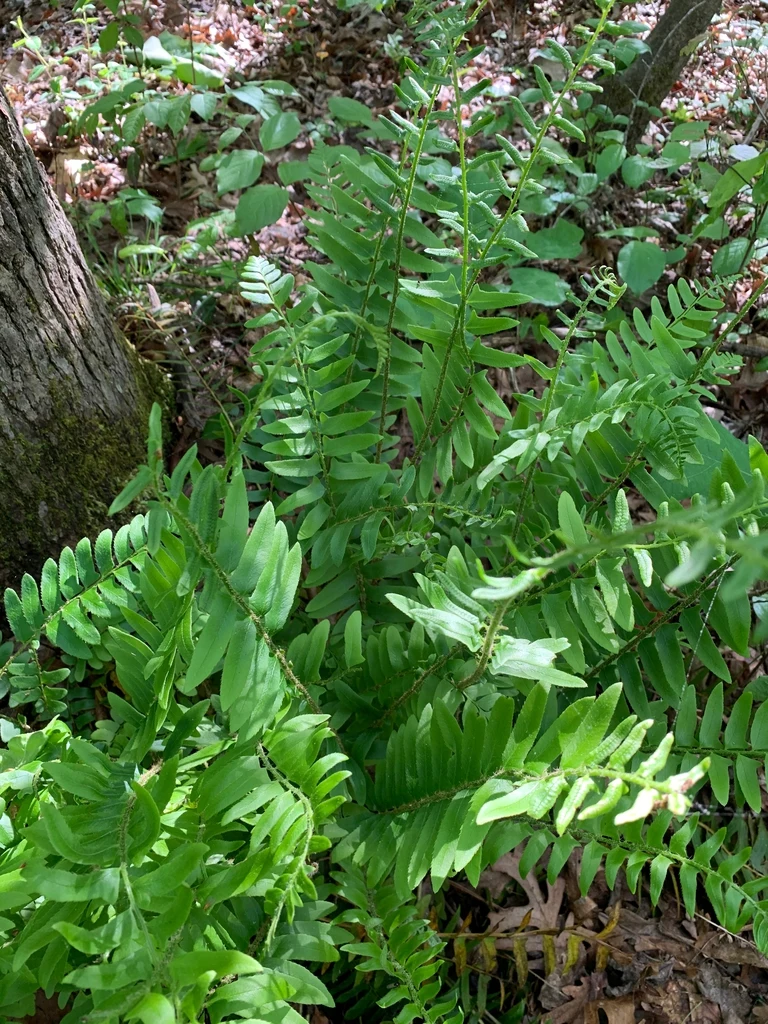
Christmas fern — moist shade
Polystichum acrostichoides
Evergreen fronds stand out beside broader leaves in shade. Choose soil that drains, rather than a waterlogged pocket.
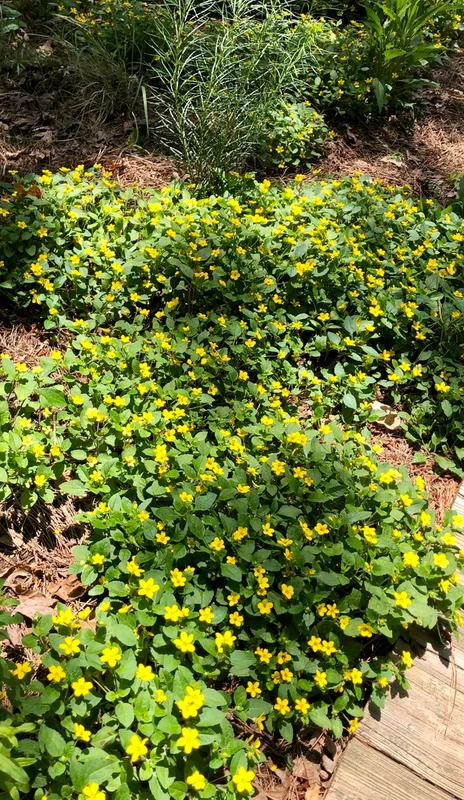
Green-and-gold — moist shade
Chrysogonum virginianum
Low leaves and yellow spring flowers soften a partly shaded edge with moist, well-drained soil.
Sources: Susan Strine, NC State Extension [9] [10] [12], Chris Alberti, Cathy Dewitt
Keep the sunny border simple beneath a low window
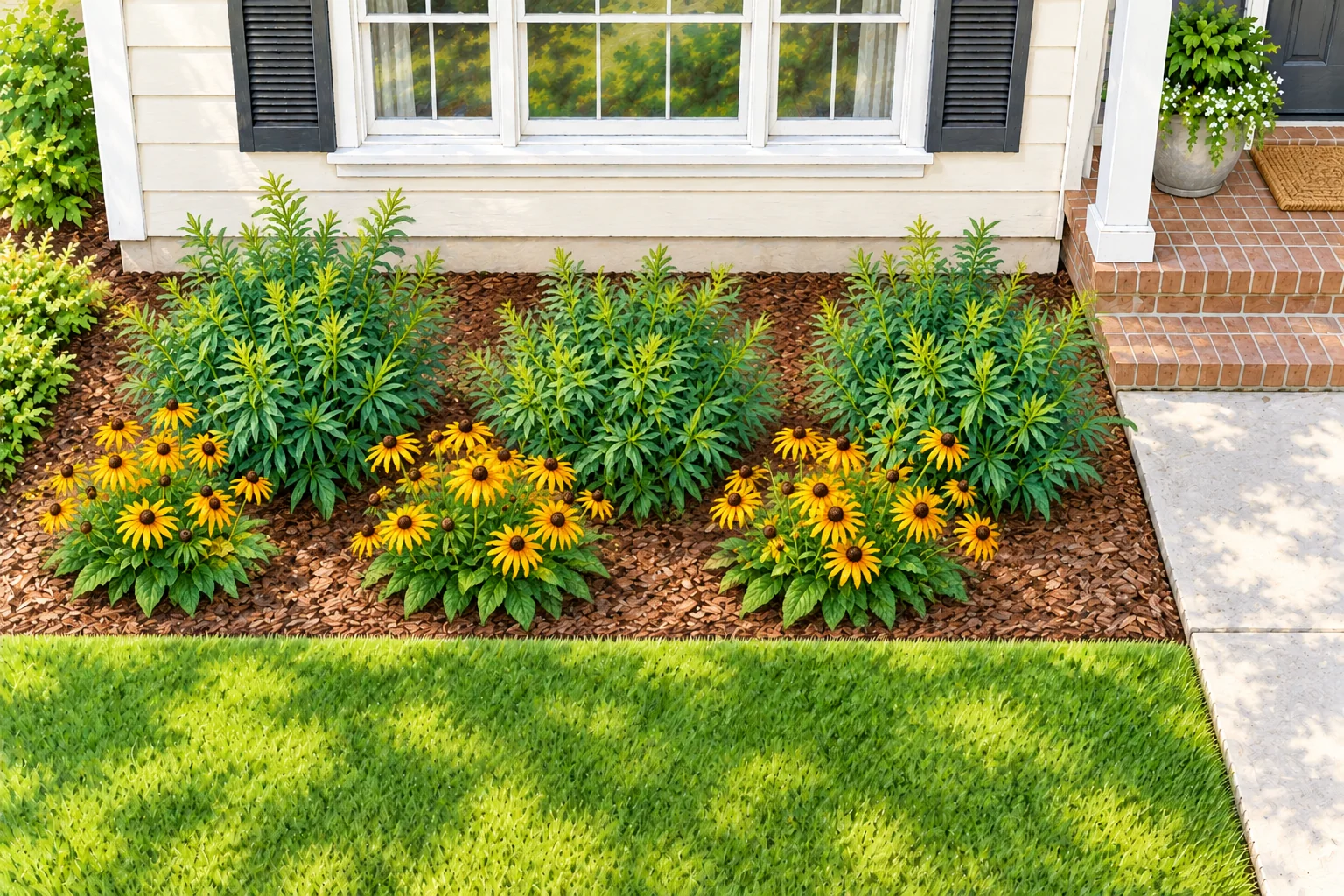
A shallow bed can still look generous. Here, repeated bluestar and black-eyed Susan carry the composition without the taller grass.
Two plant groups, with room to fill out
This layout adapts the sunny, well-drained Piedmont example. Choose varieties whose mature height and width fit beneath your window and inside the bed.
- 1
Leafy mounds below the window
Repeat bluestar where its mature foliage fits below the sill. Its summer leaves give the border substance after the spring flowers fade.
- 2
Yellow flower groups between the mounds
Keep black-eyed Susan in a few recognizable groups rather than filling every gap. Leave enough room to reach the clumps when they need reducing.
- 3
A clear edge along the walk
Keep the mature outlines inside the bed. If both plants cannot fit at their full width, simplify the planting further instead of planning to hold it back with constant pruning.
Buy for the mature border, not the nursery display
Small pots make it tempting to fill every patch. In a long growing season, the gap you dislike now may be the room a plant needs next summer.
Pack perennials between young shrubs
What can happen later: The shrubs eventually shade or crowd them.
A better first choice: Mark the shrub's mature outline before filling the remaining space.
Choose flowers for every month
What can happen later: Too many separate plants make a small border difficult to read and care for.
A better first choice: Keep strong foliage and use a few flowering groups in succession.
Copy a plant that thrives in a cooler-climate garden
What can happen later: Heat and humidity may change its performance.
A better first choice: Look for local trial or extension recommendations for the same visual role.
Sources: Clemson Cooperative Extension
Use the example to ask a more useful nursery question
Instead of asking for “easy plants for the South,” describe the bed: afternoon sun, clay that drains, a low window, and a preference for yellow flowers with green foliage. Ask which locally proven varieties fit those conditions and how wide they will become. These two examples focus on the Piedmont and moisture-retentive non-tropical coastal sites; sandy coastal soils and subtropical gardens need different plant choices.
Before buying, check local invasive-plant guidance and the nursery label's exact name. Similar common names can refer to plants with very different habits. Keep your final list short enough that you can explain why each plant belongs.
Frequently asked questions
What plants work in a sunny Southeast garden?
For a Piedmont bed with well-drained, moisture-retentive soil, eastern bluestar, black-eyed Susan and a compact locally suited switchgrass are a useful combination to investigate. Choose varieties for the bed's mature space and local winter temperatures. A sandy coastal site or a waterlogged bed needs adjustments.
Do I need to remove clay soil before planting?
Usually the first step is to check drainage and compaction, not remove all the clay. Clay can support a good garden. If water remains trapped or construction has compacted the bed, solve that specific problem before choosing plants or adding amendments.
Can I use a Southeast planting guide in Florida?
Some ideas transfer, but these examples focus on the Piedmont and non-tropical Coastal Plain. Florida's conditions vary considerably, and subtropical gardens need a locally appropriate plant list. Use UF/IFAS guidance for your part of the state rather than transferring the examples unchanged.
 Gardenful
Find a planting style you'll enjoy through summer.
Use Gardenful to picture a garden around your home, then refine the suggested plant list for your light, soil and local climate.
Gardenful for iPhone
Download the app free and start with a photo of your yard.

Sources(17)
- [1]Eastern bluestar photograph
Susan Strinehttps://plants.ces.ncsu.edu/plants/amsonia-tabernaemontana/
CC BY 2.0. Converted to WebP.
- [2]Virginia sweetspire photograph
Chris Albertihttps://plants.ces.ncsu.edu/plants/itea-virginica/
CC BY 4.0. Converted to WebP.
- [3]
- [4]
- [5]
- [6]
- [7]Growing Perennials
Clemson Cooperative Extensionhttps://hgic.clemson.edu/factsheet/growing-perennials/
- [8]
- [9]Black-eyed Susan
NC State Extensionhttps://plants.ces.ncsu.edu/plants/rudbeckia-fulgida/
Photograph by F. D. Richards, CC-BY-SA 2.0; resized and converted to WebP, without cropping. The adaptation retains the same license.
- [10]Switchgrass
NC State Extensionhttps://plants.ces.ncsu.edu/plants/panicum-virgatum/
Photograph by Andrey Zharkikh, CC BY 4.0; resized and converted to WebP, without cropping.
- [11]Virginia Sweetspire
NC State Extensionhttps://plants.ces.ncsu.edu/plants/itea-virginica/
- [12]Christmas Fern
NC State Extensionhttps://plants.ces.ncsu.edu/plants/polystichum-acrostichoides/
Photograph by Kristyna Culp, CC BY 4.0; converted to WebP.
- [13]Native Plants
NC State Extension Gardener Handbookhttps://content.ces.ncsu.edu/extension-gardener-handbook/12-native-plants
- [14]
- [15]
- [16]
- [17]Chrysogonum virginianum photograph
Cathy Dewitthttps://plants.ces.ncsu.edu/plants/chrysogonum-virginianum/
Photograph by Cathy Dewitt, CC BY 4.0; resized and converted to WebP, without cropping.